Chapter 1: Brain Basics
- the brain is the control center of our body
MAJOR BRAIN LANDMARKS
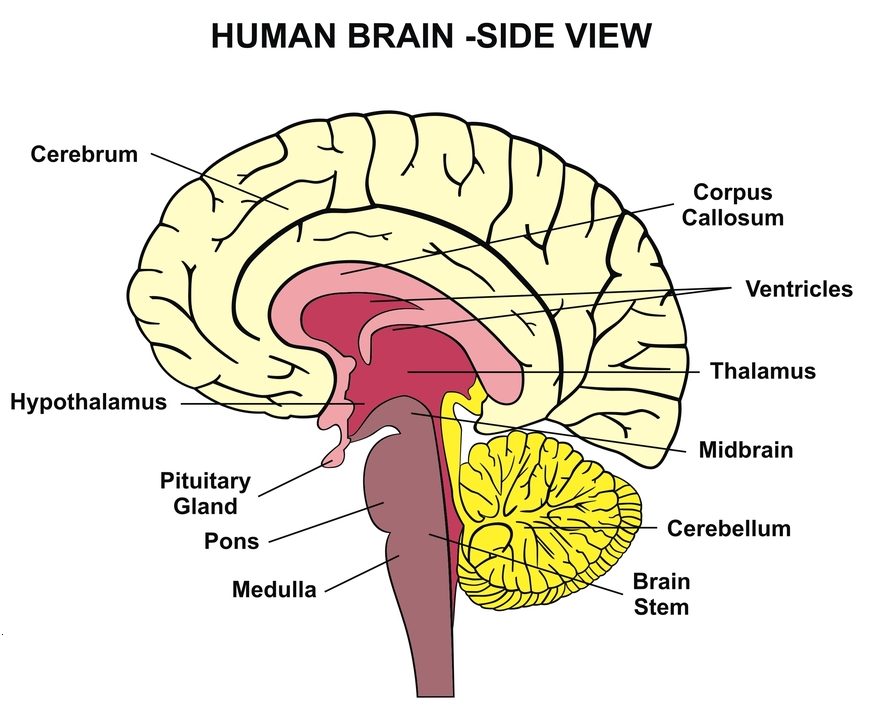
- the largest part of our brain is the cerebrum(divided into left and right hemispheres)
- these hemispheres are connected by nerve bundles called the corpus callosum
- the corpus callosum(see picture for reference) is a layer of folded nerves
- the layer is folded to increase the area for more neurons→more processing power!
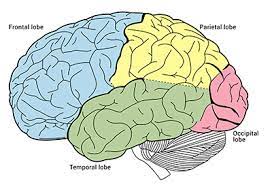
- the cerebrum is divided into 4 lobes:
| LOBE | LOCATION | FUNCTION |
|---|---|---|
| frontal lobe | above eyes | ~voluntary movements ~speech ~memory~emotions ~higher cognitive skills~higher cognitive skills ~parts of personality |
| parietal lobe | behind the frontal lobe but still at the top of the head. | ~sensory signals from the skin ~process taste~helps with visual processing |
| occipital lobe | back of brain | ~process visual info ~recognizes shapes and colors ~ |
| temporal lobe(contains the hippocampus and the amygdala) | sides on the brain, below eyes | ~visual processing ~interpet sound |
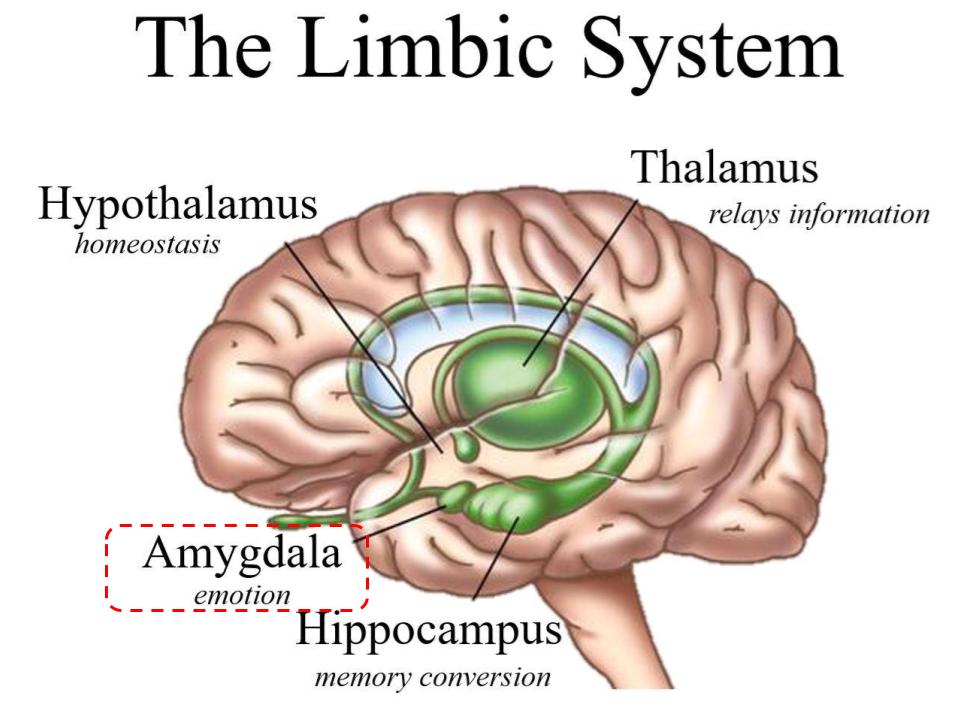
- The limbic system: regulates emotion and motivation - these structures and the cerebral cortex make up the forebrain
- Hippocampus - beneath the cerebral cortex
- curved structure
- creates new memories
- amygdala- middle of brain, adjacent to the hippocampus
- integrates memory and emotion
- thalamus
- integrates sensory information then sends it to other parts of the brain.
- hypothalamus
- sends hormonal signals though the pituitary gland
- \
- the midbrain- under the thalamus
- eye movement (blinking and focusing)
- send a reflex for certain sounds
- inhibit unwanted body movements
- manage fine motor control
- the basal ganglia is a collection of brain structures located in the forebrain and midbrain. It’s job is to regulate body movements which are complex.
- hindbrain- glucose regulation, sleep, movement control
- cerebellum
- the back of the brain, divided into two hemispheres
- the second largest section, containing over 1/2 the brain’s neurons
- voluntary movement
- new motor skills
- spatial perception
- temporal perception '
- The brain stem- brainstem, pons, medulla
- pons
- breathing and posture
- medulla-connects brian to spine
- swallowing
- heart rate
- breathing
EVOLUTION
while early brains, simply a tube, were not as complex as the ones we have today, they still had specialized sections dedicated for specific tasks. The 3 bulges for these specific tasks are now the forebrain, the midbrain, and the hindbrain. These sections developed, forming structures like the olfactory bulbs & cerebellum. As seen in all types of evolution, traits that helped the species became more pronounced, which is why the forebrain is much bigger than it was before(rapid process of visual and auditory info).
NEURAL NETWORKS
- to move from one area of the brian to the next require a chain of neurons. these bundles of nerves are called nerve tracts.
- example:
- corpus callosum: connects left and right cerebral hemispheres
- smaller anterior commissure: connects left and right temporal lobes
- A group of these nerve tracts→ NEURAL NETWORKS
- route signals allowing the brain to analyze and process information extremely quickly.
NETWORK ACTIVITY→ BRAIN WAVES
the signals pass through the thalamus and the cortex, they create electrical patterns. These patterns are called brain waves and can be monitored with an EEG(electroencephalogram). EEG is measured in microvolt range- different than Hz.
- Types of brain waves
- alpha
- produced when you are awake
- come from the occipital and partial lobes when you are relaxed and eyes are closed
- 8 to 13 Hz (frequency 1Hz= i cycle per second)
- beta
- produced when you are awake
- 14 to 30 Hz
- frontal and partial regions - sensory input or concentrates on something specific
- theta
- when you sleep
- 4 to 7 Hz
- high amplitude (stronger)than beta or theta
- Delta
- deep sleep
- frequency 3.5 Hz or less
- high amplitude(stronger) than beta or theta
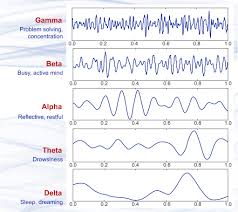
NEURAL NETWORKS ORGANIZE AND INTEGRATE INFORMATION
- Spinal tracts- pass through brain stem and spinal cord, sensory signals travel upwards to thalamus and movement signals move down the spine
- Feedback loops- signals loop back to excite or inhibit and/or influence the timing & strength of the signal
NEURAL CIRCUITS
Local neural circuits(cerebral cortex has a lot) - interconnected neurons turning entering signals→ output patterns to other parts of the brain
- [ ] Organized like shelves
While neuroscientists think that the columns are dedicated to one specific task, there is evidence leading to say that the columns have connections to other neurons in columns(more tasks)
EXCITATORY AND INHIBITORY NEURONS
- 80% of neurons are excitatory
- What does excitatory mean? Excitatory neurons send signals to other neurons, pushing them to fire. Typically sent through a circuit
- Pyramidyal- most common excitatory neuron
- Dendrites- collect signals
- Axons send signals
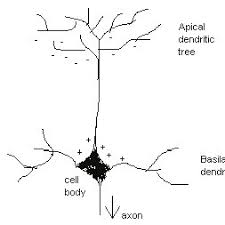
- Inhibitory- less common
- Send signals back to earlier parts of the circuit.
- Recurrent neuronal network- neurons in circuits are connected to one another
- Feed forward inhibitory circuit- excitatory and inhibitory signals are sent simultaneously
- Seizures may be caused ny inhibitory imbalance
NEURONS AND GLIA
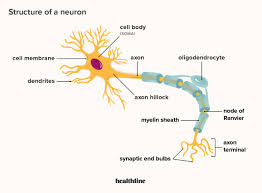
- SOMA(CELL BODY)- nucleus, most of the cytoplasm, and instructions for how to make and direct proteins essential for the cell
- Dendrites- from cell body to other neurons to collect signals
- Axon terminals- from synapse to other cell(vary in length)
- GLIA
- 1:1 ratio in humans, varies region to region
- 4 main types
- Astrocytes - regulates ion concentration, provides nutrients, regulate new connections
- Microglia- immune cells for the brain & regulate new connections
- Oligodendrocytes - wrap axon terminal with myelin
- Epedymal cells - make cerebral spinal fluid(cushions brain)
ION CHANNELS AND ACTION POTENTIALS
- Electrically charged atoms use ion channels as gates to enter other neurons→ send signals
- Ions coming or going changes the voltage of the channel (voltage= will the neuron have an electrical signal). This is called the membrane potential. In order to reach the threshold, the sum of the charges must trigger the voltage sensitive channels, triggering action potential(electrical impulse), therefore k=moving the signal down the axon
- Mammals have a voltage potential of 70 millivolts
- Less negative- depolarized(excitatory)
- More negative-hyper polarized (inhibitory)
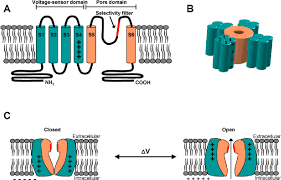
###
SYNAPSES AND NEUROTRANSMISSION
- Synapses-where signals are passed neuron to neuron
- In the synaptic cleft, chemical signals (neurotransmitters) cross. Calcium ions are triggered by ion channels, for example. These chemical transmitters are stored in vesicles until they are ready to be released, then when it is time to cross the cleft, the vesicle fuses with the cell membrane, allowing the transmitters to cross. Vesicles come from the Golgi apparatus
- Amonio acids, gases, organic chemicals, and peptides can act as transmitters. Peptide based transmitters are made in the soma
- Neurotransmitter have specific receptors on the other neurons, which allows them to pass through.
- Astrocites take care of extra transmitters that don’t get absorbed - stop from continuing activating the receptor.
- Inotropic- transmitter binds directly to ion channel.
- Metabotorpic- channel and protein are a distance away so chemical steps begin when the transmitter binds to the receptor, allowing events to happen in the postsynaptic cell
- Reuptake- transmitters are either broken down or reabsorbed via axon terminal
- GABA-most common inhibitory transmitter
- Attaches to inotropic receptors- allow chlorine to enter
- Attaches to metabotric receptors- release potassium ions
- Glutamate- most common excitatory
- Amino acid
- Binds to ionotropic receptors ex. AMPA( fast)and NMDA (slow). The se receptors play a part with learning and memory
RECEPTORS AND MOLECULAR SIGNALING
- Hormones- cues for activity and condition of body tissues
- Neuro modulators- cannabis like chemicals that prevent transmitters from being released
- Prostaglandins- lipids creating
- Molecules bind to a receptor on the surface of the cell→ changes receptors shape → chain of intracelular reactions. Shifts ion balance or changes activity of specific enzymes
- If the receptor is on on the soma, the hormone might be able to enter the nucleus therefore changing gene activity
NEURONS, GENES, AND GENE EXPRESSION
- What causes neurons to express some genes instead of others is being researched
- Depend on the changes to th e chromatin
- Expressed genes associated with unfolded chromatin
- Unexpressed associated with tightly packed area
- Changes to chromatin are reversible
- Differs between people