Unit 1
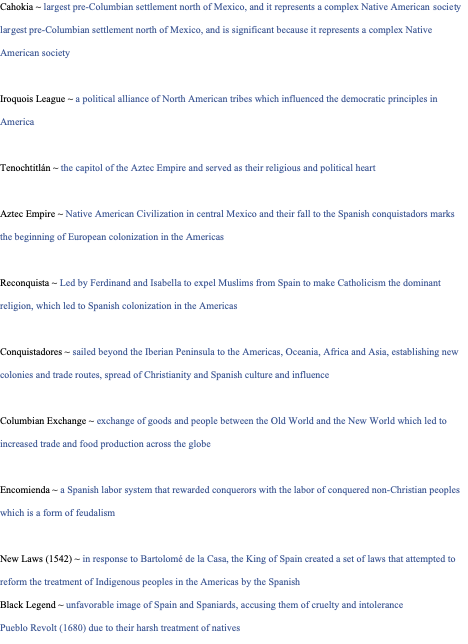
Cahokia ~ largest pre-Columbian settlement north of Mexico, and it represents a complex Native American society largest pre-Columbian settlement north of Mexico, and is significant because it represents a complex Native American society
Iroquois League ~ a political alliance of North American tribes which influenced the democratic principles in America
Tenochtitlán ~ the capitol of the Aztec Empire and served as their religious and political heart
Aztec Empire ~ Native American Civilization in central Mexico and their fall to the Spanish conquistadors marks the beginning of European colonization in the Americas
Reconquista ~ Led by Ferdinand and Isabella to expel Muslims from Spain to make Catholicism the dominant religion, which led to Spanish colonization in the Americas
Conquistadores ~ sailed beyond the Iberian Peninsula to the Americas, Oceania, Africa and Asia, establishing new colonies and trade routes, spread of Christianity and Spanish culture and influence
Columbian Exchange ~ exchange of goods and people between the Old World and the New World which led to increased trade and food production across the globe
Encomienda ~ a Spanish labor system that rewarded conquerors with the labor of conquered non-Christian peoples which is a form of feudalism
New Laws (1542) ~ in response to Bartolomé de la Casa, the King of Spain created a set of laws that attempted to reform the treatment of Indigenous peoples in the Americas by the Spanish
Black Legend ~ unfavorable image of Spain and Spaniards, accusing them of cruelty and intolerance
Pueblo Revolt (1680) due to their harsh treatment of natives
New France ~ French colony in North America that existed from 1534 to 1763 and played a part in the role n the history of Canada, the influence of its culture on the region, and the impact of its language
New Netherland ~ a Dutch colony in the 17th century that experienced dramatic growth and become a major port for trade in the North Atlantic
Virginia Company ~ joint-stock company chartered by King James I which played a crucial role in founding the first permanent English settlement in the New World, Jamestown
Roanoke colony ~ early English settlement but the entire colony mysteriously disappeared without a trace
Powhatan Confederacy ~ alliance of Native American tribes
Headright system ~ a land distribution policy used in early English colonies where settlers were granted parcels of land (usually 50 acres) for each person they brought to the colony, essentially motivating immigration and encouraging the growth of large plantations by providing land to those who could afford to pay for the passage of others, including indentured servants
Puritans ~ English protestants who sought to "purify" the Church of England by removing practices they considered too Catholic and eventually relocated to the Americas to establish Plymouth
Pilgrims ~ a group of English settlers who sailed to North America on the Mayflower in 1620 and established the Plymouth Colony in Massachusetts who were one of the first permanent European settlements in New England
Mayflower Compact ~ a document signed by the Pilgrims which established a system of self-governance for their new colony in Plymouth (first instance of creation of a government through written agreement)
Christopher Columbus ~ an Italian explorer who discovered the Americas for Spain
Hernán Cortés ~ a Spanish conquistador who overthrew the Aztec empire and won Mexico for the crown of Spain
Bartolomé de las Casas ~ a Spanish priest who advocated against the brutal treatment of indigenous people by European colonizers during the Spanish conquest
Francisco Pizarro ~ Spanish conquistador most famous for conquering the Inca Empire in Peru which contributed to Spain's wealth due to the Inca's vast gold and silver reserves
Samuel de Champlain ~ a French explorer who established New France and founded Quebec City
Henry Hudson ~ an English explorer, most famous for his voyages in search of a Northwest Passage to Asia, which led to the discovery and charting of the Hudson River and Hudson Bay
Elizabeth I ~ Queen of England who led the Golden Age and established the Church of England and created a compromise between Roman Catholicism and Protestantism
Sir Walter Raleigh ~ an explorer during Elizabeth I's reign who founded Roanoke Island
John Smith ~ English explorer who played a crucial role in establishing the Jamestown colony and had interactions with Native American tribes, which provided valuable insights into the new world for early English colonists
Pocahontas ~ a Native American woman, the daughter of Powhatan, who mediated relations between the English colonists at Jamestown and the Powhatan people
John Winthrop ~ a prominent Puritan leader and the first governor of the Massachusetts Bay Colony who had a vision on America as a "city upon a hill" based on strong religious principles