Static Electricity
To Show the Forces Between Electric Charges
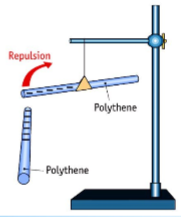
Rub two polythene rods with a woolen cloth.
Place one of them in a paper stirrup hanging from a retort stand.
Bring the second rod near the first one.
The rods will repel eachother, showing the force between charged bodies.
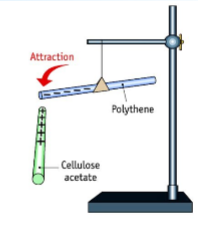
Rub a plythene rod and a cellulose acetate rod with a woollen cloth.
Place one of them in a paper stirrup hanging from a retort stand.
Bring the second rod near the first one.
The rods will attract eachother, showing the force between charged bodies.
Electric Charge
Two types of electric charge are:
Positive and Negative
Like charges repel and unlike charges attract.
Electrical Conductor
Substance through which electric charge can flow.
e.g silver, copper, aluminium, water, the human body, ground.
Electrical Insulator
Substance through which electric charge cannot flow.
e.g. glass, plastic, rubber, air.
Structure of the Atom
Electrostatic Forces
Forces of attraction and repulsion between protons and electrons.
Particles that exert electrostatic forces on eachother are said to be electrically charged.
Protons are said to be positively charged.
The amount of positive charge on a proton is the same size as the amount of negative charge on an electron.
Atomic Nature of Electric Charge
Atoms consist of:
Protons, Neutrons, Electrons
Number of Protons = Number of Electrons
=> Atoms are electrically neutral
If an object is negatively charged it has gained electrons.
If an object is positively charged it has lost electrons.
It is only the electrons that actually move when objects become charged.
SI Unit: coulomb (C)
1 coulomb = 6.25×10¹⁸
To show charging by Induction
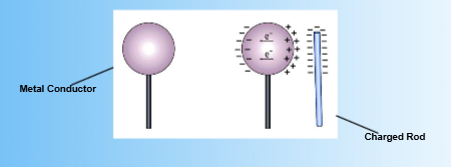
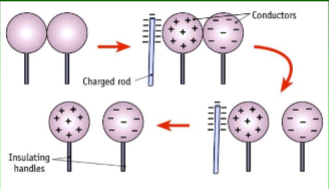
Bring a negatively charged rod near a metal conductor. Free electrons in the metal are repelled by the negative charge on the rod and head to the opposite side of the metal.
Thus a negative charge appears on one side of the metal and positive charge on the other.
Remove the charged rod and the electrons move back again.
The charges produced on the metal are called induced charges.
The induced negative charge is the same size as the induced positive charge.
Gold-Leaf Electroscope
Detects electric charge.
Indicates the approximate size of an electric charge.
Tests if a charge is positive or negative.
Tests if an object is a conductor or an insulator.
Indicates roughly the size of potential difference.
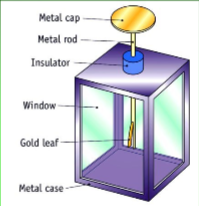
Negative charge on the object repels electrons from the cap down to the leaf and the end of the metal rod.
The negative charge on the end of the rod repels the negative charge on the leaf.
Thus the leaf diverges.
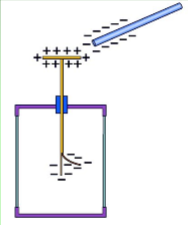
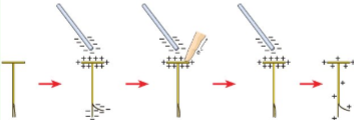
To Charge and Electroscope by Induction
Bring a charged rod near but not touching the cap.
Keeping the charged rod in place, earth the cap of the electroscope by touching it briefly with your finger.
Remove the rod.
The electroscope will now have a charge opposite to that on the rod.
All static charge resides on the outside surface of a conductor.
Distribution of Charge on Conductors
Static charge on a spherical conductor is distributed uniformly over the sphere.
Static charge on a pear-shaped conductor accumulates most at the pointed end.
Static charge on a conductor tends to accumulate where the conductor is most pointed.
Point Discharge
There is a very large charge density at the point.
This causes a very strong electric field in the redion around the point.
Ions in the air are either attracted to or repelled from the point.
Ions with opposite charge to that on the point head towards the point and neutralise the charge on it.
Ions with the same charge head away from it creating an electric wind.
It is as if the charge was removed from the point. The loss of charge from a point by this manner is called point discharge or the point effect.
Coulomb’s Law of Force
The force of attraction or repulsion between two point charges is directly proportional to the product of the charges and inversely proportional to the square of the distance between them.
Is an example of an inverse square law.
Electric Field
Any region of space where a static electric charge experiences a force other than the force of gravity.
Always caused by other static charges in the vicinity.
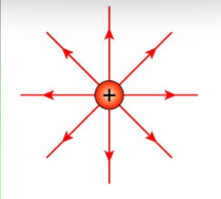
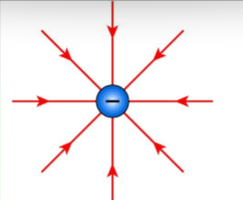
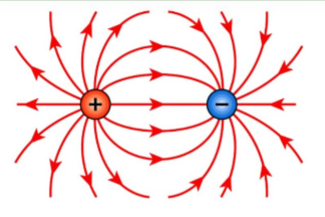
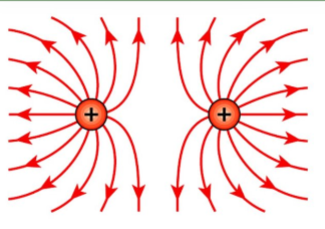
Electric Field Line (Line of Force)
Line drawn in an electric field such that the tangent to it at any point is along the direction of the force on a positive charge placed at that point.
Where the electric field is strong, lines are close together.
Where electric fiel is weak, lines are far apart.
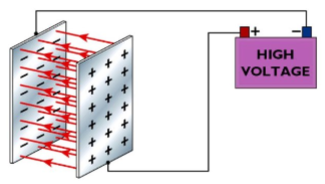
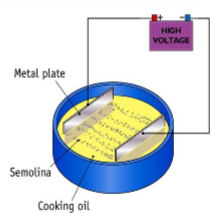
Demonstrating an Electric Field Pattern
Connect a high voltage source to the metal plates which are in the oil.
Semolina particles line up in the direction of the field, showing electric field pattern.
Electric Field Strength
Force per unit charge at that point.
Vector quantity
SI Unit: newton per coulomb (N C-1)