2.3.1 Greek Architecture
Background Information
Like the Egyptians, Greek temple architecture was designed as homes for their deities and allowed only limited access and entrances were often hidden from plain sight.
The front and back ornamentation of a temple was different
The interior houses huge statues of the Gods and only a select few were allowed to enter the sanctum
sanctum: a sacred place, especially a shrine within a temple or church
The strain and change in Greek life after the death of Alexander the Great, prompts artist to explore a wider range of emotion. What develops is a great variety of expression and sculpture with lots of motion, movement, and energy.
Hellenistic art diverged from the restrained, controlled classical model.
The classical method of columns:
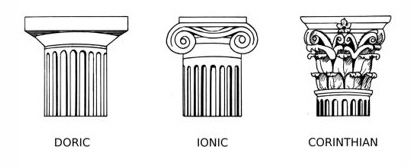
The Doric Order
The Doric order is the oldest of the three classical architectural orders and makes a turning point in Mediterranean architecture when monumental construction moved away from perishable materials such as wood and towards permanent materials like stone.
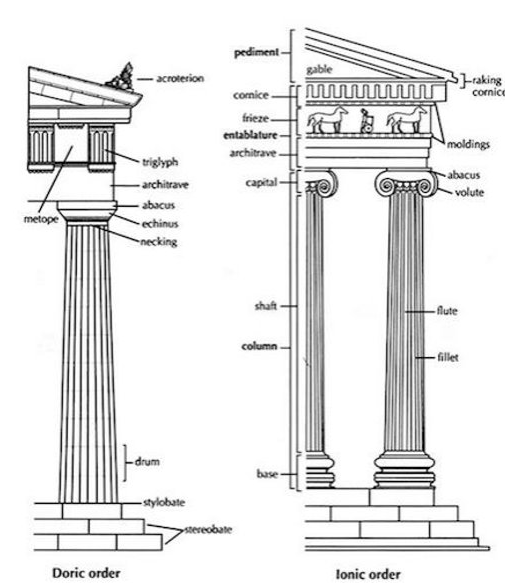
A plain, unadorned column capital and a column that rests directly on the temple's stylobate without a base distinguish the Doric order. A frieze of triglyphs and metopes adorns the Doric entablature. The fluted columns have strong and stocky, proportions.
The Ionic Order
The Ionic order originated in coastal Anatolia during the 6th century BCE where there where Ancient Greek villages. It arrived to the mainland in the 5th century. The Ionic capital has volutes or scroll-like embellishments as a base that supports the column.
The ionic capitol is considered graceful, slender, and elegant.
In contrast to the Doric frieze of triglyphs and metopes, the Ionic order includes a continuous sculptural relief running frieze.
The Corinthian Order
The most elaborate of all orders
Acanthus leaves surrounded a votive basket as depicted by Greek sculptor Callimachus, according to architectural historian Vitruvius. The order took its name from this work in antiquity.
The elaborate, carved capital of the Corinthian order distinguishes it from the Ionic, which incorporates fewer vegetal elements. Decorative acanthus leaves in the form of stylized, carved stems wrap around the capital, usually ending just below the abacus. The Corinthian order was favored by the Romans, perhaps because of the slender and refined qualities.
Important Terms to Know:
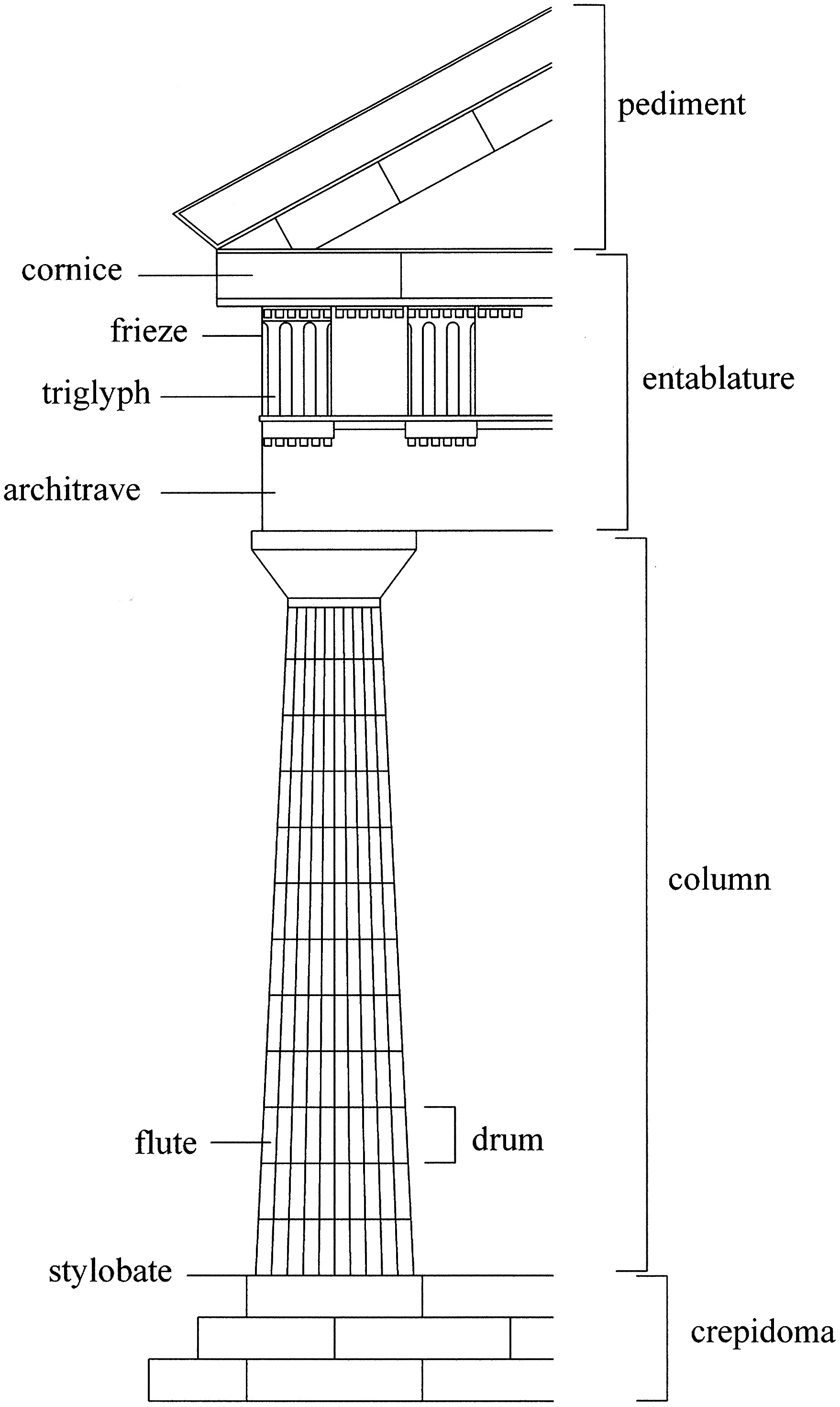
abacus - the uppermost member of a capital. Plain in the Doric order, molded in the Ionic order.
architrave - a lintel in stone or beam of timber carried from the top of one column or pier to another; the lowest member of the entablature.
base - the lowest member of a column; the Doric column has no base.
capital - the topmost member of a column and the most distinctive member of the order.
cella - the enclosed chamber or sanctuary of a temple; also known by the Greek term naos.
cornice - the upper member of the entablature.
Doric - the order evolved in the Dorian and western regions of Greece.
entablature - the superstructure carried by columns; usually divided into 3 parts: architrave (the supporting member resting on the columns), frieze (the decorative portion), cornice (crowning and projecting member).
flutes - the vertical channels in the shafts of columns.
frieze - the middle member of the entablature, usually decorated with sculpture (continuous sculpture in the Ionic order; sculptured metopes separated by triglyphs in the Doric order).
Ionic - the order evolved in the Ionian and eastern Greek world.
metope - the sunken pictorial panels between triglyphs in the Doric order.
opisthodomos - the recessed porch in the rear of a Greek temple order
pediment - 'the gable': the recessed area within the angle formed by the meeting of the cornices at the roof; usually filled with sculpture.
pronaos - the porch in front of the naos or cella.
raking cornice - upper frame of the pediment, below the roof line.
shaft - the main body of a column of pier between base and capital.
stylobate - the top step of a temple, forming the platform for the columns.
triglyph - a raised rectangular divider between the metopes.
opisthos – the porch in the back of the naos or cella.
caryatids – a stone carving of a draped female figure, used as a pillar to support the entablature of a Greek or Greek-style building.
propylaea - used as a symbolic barrier between the secular and religious parts of a city because of their size and presence at the entrances to religious buildings.
A Greek temple's cornice divides its upper and lower levels. A few columns, sometimes two, separate the doors from the façade so that little light enters these generally windowless structures. The interior becomes even more enigmatic and sacred with only a select few able to enter and the deity peacefully ruling.
periptreal: a temple whose cella is surrounded by a covered colonnade
peristyle: a row of columns surrounding a space within a building like a count, garden or edging
Acropolis: means “high city” in Greek and can refer to one of many natural strongholds constructed on rocky, elevated ground in Greece, but the Acropolis of Athens is the best known.
agora: a central public space in Ancient Greek city-states. The best representation of a city-state’s response to accomodate the social and political roder of the polis (people); a gathering place or assembly.
The Agora was used for anything from a market, elections, theatre dramas, religious processions, military drills, and athletic competitions. This centrally located Athenian Agora served as a hub for administrative, political, judicial, commercial, social, cultural, and religious activities. The agora also included government-owned buildings necessary to run the city's government.
Polis: a city in ancient Greece, especially as considered in its ideal form for philosophical purposes.
Required Works
Athenian agora. Archaic through Hellenistic Greek. 600 B.C.E.–150 C.E. Plan.
The Athenian agora is located to the northwest of the Acropolis and flanked by hills to the South and West.
~30 acres of sloped ground excavated as part of the Athenian agora excavations.
First intended for use for commercial, civic assembly, and a gathering place activity.
The open space in the heart of the town was the agora, surrounded by buildings on all sides
The council chamber (bouleuterion), the Royal Stoa, south stoa I, office buildings and the Metroon archives have all been investigated.
Athenians were directly involved in communal government because they practiced an early form of direct democracy during the classical period. The agora is credited with helping Athenian democracy take root because it served as a forum for political and philosophical debate.
Acropolis. Athens, Greece. Iktinos and Kallikrates. c. 447–410 B.C.E. Marble. (6 images)
Best known acropolis in all of Greece
Athena's temple was built on the site in the 6th century BCE, indicating that the area had long been revered as a holy place.
Pericles was the driving force behind the project, which lasted for about 50 years during Athens' golden age and the architects were Iktinos and Kallikrates with Phidias as the chief architect.
The Acropolis plan includes many temples and shrines. The temples on the North side belonged to earlier sects and gods, whereas for Athena-dedicated temples resided on the south side.
Greece's ideals of perfect proportion are expressed in the Parthenon. The number of Doric columns around the perimeter are calculated using the formula x = 2y + 1.
The relationship between all the structure's components is governed by architectural order, to emphasize symmetry and harmony.
Mainly a Doric temple; however, it does have elements of other styles.
The inner frieze was Ionic, a running frieze of continuous sculptural relief, as opposed to the outer Doric frieze composed of triglyphs and metopes.
Athena’s Impact
The Parthenon was the terrestrial home for Athena (patron goddess of Athens) and thus lavishly decorated. Instead of a religious temple, the Parthenon portrays power, prestige, and patriotism.
The cella housed the colossal statue of the Athena Parthenos, which Phidias made for the Parthenon, was completed and dedicated in 438 CE. The original work was made of gold and ivory and stood some 38 feet (12 meters) high. The goddess stood erect, wearing a tunic, aegis, and helmet and holding a Nike in her right hand and a spear and shield balanced on her left.
chryselephantine sculpture: a sculpture overlaid with gold and ivory
This building is dedicated to Athena, and the city is named after her as well. Two gods sought to be the city's patron. Poseidon and Athena. Poseidon is the sea god and Athena the goddess of war and wisdom. Athena eventually won the Athenian’s favor.
Timeline
Rebuilt in 447 BCE after the Persian destruction.
Converted to a Christian Church by the Romans c. 500 AD.
Converted to a Mosque in 1458
Holy League fight against the Ottoman Empire in 1687 and left the Parthenon in ruins.
In 1801 and through 1812, the Earl of Elgin looted the site and removed many of the sculptures to England.
The Parthenon was turned into an army barracks during the war for independence c. 1820s
The Panathenaic Way was a road that ran from the center of Athens to the main gate of the city.
Every year in June, Athenians would celebrate Athena’s birthday with a great festival.
The Panathenaic procession was celebrated every four years to compete with the Olympic games at the city-state Olympia.
Stylobate curves upward from center, as does entablature, to deflect appearance of sagging in center
Columns lean inward slightly (if lines were continued, they would all meet 1.5 miles above the temple)
Columns are not evenly spaced to prevent the look of them being clustered
Entasis: to make sure the columns look like there are straight and taper upward, they bulge out in the middle
Columns in corners are 2” thicker because they would often be surrounded by light which altered their appearance by making them look thinner – this compensates for that. Nearly every block had to be individually carved
Image 35.2: Helios, horses and Dionysus (Herakles?)
Typically, sculptors ignored the corners since the space was too small to put any full-sized figures in, however, Phidias uses the bottom line as a horizon line that figures can move effortlessly through.
Pose is life-like, and exhibit energy and the figures integrate amongst themselves making the composition complicated.
Use of Wet Drapery technique- cloth that clings to body in animated and numerous folds; reveals the contours of the body underneath. Helps in defining the musculature of the body while maintaining modesty for women.
These figures are part of the pedimental sculpture on the East pediment that depicts those gathered around the Birth of Athena on Mount Olympus
Image 35.3: Plaque of the Ergastines
Isocephalism: show all figures on the same ground line (which means the artist does not use hierarchy of scale!)
Backgrounds were painted blue, figures’ hair highlighted in gold, carved with low relief
525 feet long frieze on the inside of the Ionic part of the Parthenon
They all stand in contrapposto: right knee breaks the fall of drapery
May depict the Panathenaic Procession
Shows the social status of those who are selected to sew the peplos
It shows the procession to honor Athena. Here, six ergastines (young aristocratic women in charge of weaving the peplos) are greeted by two priests as they walk in procession toward the Parthenon.
A competing theory is that this is not the Panathenaic Procession but the story story of the legendary Athenian king, Erechtheus, who sacrificed one of his daughters to save the city of Athens – we see the funeral procession; the Oracle of Delphi told him to (Erechtheus was a king during whose reign an ancient wooden idol of Athena was said to have fallen from the heavens)
Displays of Greek humanism, rationalism and idealism
Symbol of community coming together but this is an elite political scene where only important and aristocratic Athenians are shown, not slaves or lower class
Image 35.4: Temple of Athena Nike
Located on the Acropolis of Athens dedicated to Athena Nike.
As an attribute of both Athena, the goddess of wisdom, and the chief god, Zeus, Nike was represented in art as a small figure carried in the hand by those divinities.
Athena Nike was always wingless; Nike alone was winged.
Amphiprostyle temple: has four Ionic columns on the front and back of temple
Sits oddly on the edge of the Acropolis, probably situated here so that Athenians could pay homage without crawling all the way up.
Parapet: low protective wall or barrier; 4 feet tall; acted as a guard rail; people were concerned about falling off and so the parapet was added
The single cella housed a statue of Athena Nike and is repeated dozens of times – she often holds a pomegranate, symbolizing wealth.
Built to commemorate the Greek victory over the Persians in the Battle of Marathon. The Battle of Marathon took place in 490 BC during the first Persian invasion of Greece. It was fought between the citizens of Athens, aided by Plataea, and a Persian force commanded by Datis and Artaphernes. The battle was the culmination of the first attempt by Persia, under King Darius I, to subjugate Greece
Image 35.4.1: Nike Adjusting Her Sandal
Graceful figure modeled in high relief with deeply incised drapery lines reveal body. She adjusts her sandal while her dress slips off one shoulder. No, the pose can be considered awkward Nike is rendered elegantly and gracefully. Perhaps the act of removing her sandal is an indication that she is entering sacred ground.
Wet drapery gives a sense of the weight of the cloth and the gathering around parts of the body.
Depicts an image of Nike to be a part of the decorative program of the Temple of Athena Nike,
Unusual because many of the other images show Nike adapt with Persian spoils or sacrificial bulls.
Great Altar of Zeus and Athena at Pergamon. Asia Minor (present-day Turkey). Hellenistic Greek. c. 175 B.C.E. Marble (architecture and sculpture). (3 images)
During the Hellenistic period, Greek cities and kingdoms were established in Asia and Africa. As a result, Greek culture and language spread to new lands, including modern-day India. It became a blend of Egyptian, Persian, and Indian influences.
Stairway leads to a flat colonnaded roofed-platform or hall, extends to the front and sides.
Widely-spaced columns surround the hall with Ionic capitals.
Roof was studded with numerous statues including lion griffins, a quadriga of horses, centaurs and deities, as well as gargoyles.
The Great Altar of Zeus and Athena at Pergamon commemorates a battle between the
Olympian gods and giantsThe Pergamon Altar is perhaps the most famous and well-preserved of Greek commemorative artefacts.
Created during the Attalid Dynasty that ruled from 282–133 B.C.E., the Altar once stood in a sacred precinct on the acropolis of Pergamon (on the west coast of modern-day Turkey).
The large terrace measures 36.44 x 34.20 meters or 119.5 x 115.5 feet.
At the actual site in Pergamon, only traces remain. A completely rebuilt one with the original reliefs is at Berlin’s Pergamon Museum.
An elegant Ionic colonnade flanks the staircase, its back wall adorned with a frieze depicting scenes from Telephus' life, the hero who founded Pergamon.
The altar was built between 181 and 159 BCE. By King Eumenes II and was almost finished when the plan changed to build a high podium around the portico wall, almost 100 meters long, to receive votive offerings.
Pergamon: ancient Greek city in Turkey. North side of the river Caicus and northwest of the modern city of Bergama, Turkey.
The Pergamon Acropolis would’ve stood 800 feet above the city below in about 20 miles from the coast. The panorama of nature presented a dramatic background to the altar.
The temple formed a block, with an enclosed courtyard, and two sides, extending onto the arms.
The temple was on a massive podium with a large flight of stairs, leading to the top level.
The temple had acroteria, large sculptures in the round placed on a roof.
Exhibits qualities of energy, dynamism, movement, emotion at the height of the narrative.
Animals were sacrificed inside the main temple complex on feast days or festivals.
It commemorates three major events:
The gods’ defeat over giants lead by the goddess Gaia (gigantomachy). Serves to establish the patriarchal culture of Zeus.
Alexander the Great’s defeat of the Persians in 333 BC E. Without Alexander the Great and the defeat of the Persians, there would be no Attalid Kingdom.
King Attalos I and the Attalid Kingdom of which Pergamon is the capital, enjoyed victories over the Barbarians (Gauls) in the third century BCE.
The frieze that surrounds the altar is 113 meters long and 2.3 meters high, is carved in high-relief and wraps around the base of the exterior of the building. (370.7 x 7.5 feet)
A high relief freeze with deeply carved figures that create shadows and burst of light.
The Athena freeze rejects, the rationalism of the classical era and embraces the Hellenistic style, characterized by the exaggerative forms, dynamic, poses, and emotional drama.
The figures have heroic musculature. There are over 100 figures would have been vividly painted.