Covalent Model
Overview:
Covalent bonding
VSEPR
Polarity - bond and molecular
Network structures
Intermolecular forces
Resonance structures
Benzene
Covalent bonding:
Covalent bonds refer to a sharing of electrons between two or more non-metals. The shared pair of electrons are concentrated in the region between the two nuclei and is attracted to them both. This electrostatic attraction between the shared pair of electrons and the positively charged nuclie is known as a covalent bond.
The octet rule can be used to predict stable arrangements of atoms in covalent bonding. The octed rule refers to an atom wanting to have a full valence shell of eight electrons. Electron pairs are divided into bonding pairs and non bonding pairs which play a role in the shape of molecules. There are exceptions to the octet rule which include smaller atoms such as Be and B which form molecules with less than eight molecules in its outer shell. This is known as an incomplete octet. A central atom may also have more than eight electron which is refered to as an expanded octet.
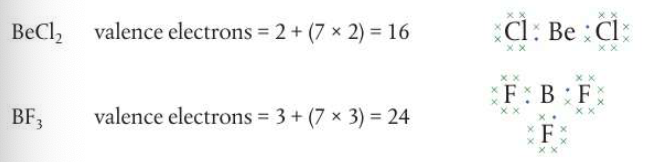
The structure of covalent molecules can be represented by a lewis structure.
Atoms can share more than one pair of electrons to form multiple bonds. They can form single, triple, or double covalent bonds. More bonds mean greater electrostatic atttraction, so they are more difficult to break and therfore result in very stable moelcules. Bond length additionally corelates with bond strength. Bond strength is described in terms of bond enthaply, being the energy required to break it. As bond length increases, enthalpy decreases meaning that shorter bonds are stronger bonds.

A coordination bond is a covalent bond in which both shared electrons come from the same atom. This can be indicated by a arrow on the head of the bond with the direction indicating the origin of the electrons.
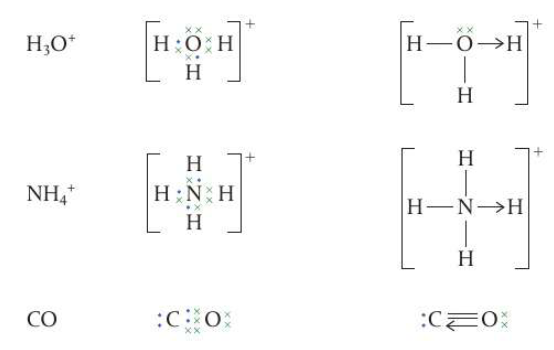
*Connection to Reactivity 3: species that can accept or donate a pair of electrons in a chemical reaction are known as Lewis acids and Lewis bases. A reaction between these two species results in a coordination bond, an example being a transition element complex, which may also be refered to as ligands.
VSEPR (Valence Shell Electron Pair Repulsion):
The shape of an electron is determined by the repulsion between electron domains around a central atom. Since electron pairs in the same shell carry the same charge, they will repel each other and spread themselves as far apart as possible. Key notes of the VSEPR model:
An electron domain includes all electron locations in the valence shell including non-bonding pairs, single, double, or triple bonded pairs.
The total number of electron domains around the central atom determines the geometrical arrangement of the electron domains
The shape of the molecule is determined by the angles between the bonded atoms
Non -boding pairs (lone pairs) and multiple bonds cause slightly more repulsion than a singular bonding pair since:
Bonding pairs have a higher concentration of charge than bonding pairs since they are not shared between atoms
Multiple bonds have a higher concentration of charhe because they contain two or three pairs of electrons
Two electron domains: Linear shape with an angle of 180
Three electron domains: Triangular planar with angle 120 or bent with angle <120
Four electron domains: Tetrahedral with angle 109.5 or trigonal pyrimidal with angle <109.5 or bent with angle <<109.5
*There may also be five or six electron domains
Polarity: