AGNG 313 Final Exam
Good Grief:
the world death rate is holding steady
at a hundred percent the onion is a
satirical journal so it's their job to
make fun of us as we try to hide from
mortality what would happen if we turn
toward loss instead of running from it
what if grief has something to teach us
in 2008 my husband and best friend died
Vic was my harbour and safety net so
what did I learn from that loss to
answer that question I have to go way
back to my first childhood memory I was
small I stood near my mother who was
lying face down on a wooden bench
her eyes were hidden in her hands but I
could tell she was crying because her
back was heaving up and down her sobs
scared me but I didn't call out to her
instead I was captivated by rays of
coloured light coming from above dancing
off the walls and filling the space soft
color covered my mother's back my little
arms everything I didn't understand the
experience then and I don't understand
it conceptually now but I felt protected
by that light and even as a child I knew
my mother couldn't feel the protection
because her face was turned away from it
I learned as an adult that I'd been
under three when that happened my father
was in a Catholic hospital and he was
expected to die my mother had taken me
with her to the hospital chapel so the
light came from stained-glass windows
and the wooden bench was a
pyew knowing the facts about the
experience didn't change its power I
trusted that support was available
during grief if I looked for it
my father didn't die at the time he
lived eleven more years always ill after
his death when I was 14 my mother felt
completely unsupported and was afraid
she would drown in grief so she
retreated she went to work came home and
went into her bedroom although she loved
my father she didn't weep for him and
she didn't speak about him and didn't
want me to speak about him either while
he was lost to death she was lost to
life when I returned to school no one
mentioned what had happened to me and
after we buried my dad the family never
returned to the cemetery of course I
felt distant from my mother and isolated
from everyone
my father's empty chair at the dining
room table left a huge hole in my heart
eight years ago after months of a
lingering flu an oncologist told my
husband Vic you likely have lymphoma I
don't know what kind Vic and I sat in
the in our car in the parking lot
stunned by this news let's not tell
anyone Vic said maybe it'll be nothing
we don't want to worry people over
nothing I took that in and I turned to
him and I said Vic I don't want to do
this alone the way my mother did I need
our sons and our friends
I need all the support I can get I think
you do too
we agreed but I saw how tempting it is
to hide our grief wounds and try to go
it alone Vic died after two tough years
a friend took this photo just a few
hours before his death after that last
exhalation
there was no inhalation the end I was
numb and exhausted but this time I faced
grief rather than running from it I knew
it could be my teacher and I turned
where humans have always turned in times
of challenging transition
I turned to ritual it's human to create
meaningful ritual anthropologists know
they've discovered civilization when
they find signs of ritual at ancient
burial sites we ritualize weddings and
baby showers baptisms and funerals we
create rites of passage to connect our
worldly and our sacred life to move us
from where we are to where we must go I
needed to move from the safety of my
marriage through a vast ocean of grief
to find the woman I am on my own
personal ritual helped me make that
journey I knew I needed to accept that
Vic soul have left his body now I'd been
there for his last breath but there's
something surreal about death for those
of us who art around it much modern
people keep a distance from death and
hand it over to hospitals and morticians
we don't wash bodies and lay them out at
home the way people did just a hundred
years ago
Vick died soon after midnight friends
and I sat with him until morning light
then I washed his body with warm water
and my tears and I helped shroud him
wrapping and tucking as though he were a
baby I helped put his body in a body bag
and I watched as a young man wheeled and
down the hallway toward the hospital
morgue I needed to let him go
I knew that wouldn't be a fast process
it would take a long time but I could at
least set the intention so the day after
his death I went with a good friend and
my oldest son to the crematorium where
Vic's body was being held and to the
funeral home until his body was being
held for cremation we lined the
cremation box with white soft blanket
and we put photographs of his students
his teachers his friends and his family
in the box we surrounded him with
flowers and written prayers because it's
important to stay awake in the after
death experience in many traditions we
put coffee beans in his cremation box
had he made us laugh and weep and we
also put bittersweet chocolate in there
and a box of his favorite shape of pasta
I didn't think he'd be hungry it was
symbolic the way ritual is I didn't even
know if it mattered to him but it
mattered to me
picture this my son put two Hawk
feathers behind his dad's ears and we
covered it with another soft blanket
close the lid of the cremation box and
wrote a prayer on top we had created a
traveling cocoon I knew it would help if
I had a sacred place to soothe my grief
they could ask to have his ashes put
near his favorite red oak tree in our
forest so I thought we'd just scatter
them there but my sons had a much better
idea they dragged large shale and
granite stones out of our creek bed to
the site and they dug a shallow hole I
walked out to the woods carrying a small
cardboard box I'd received from the
crematorium I opened it for the first
time and pulled out a plastic bag of
about a quart and a half of rough ash
the color of yellow teeth
is that all that's left my youngest son
yelled what a ripoff
and we all started laughing Vic wouldn't
love that joke we put his ashes in the
earth and we built a cairn on top and
then we sang songs and said prayers and
recited favorite poems and we told many
stories about Vic that made us weep and
even more stories that made us laugh
there had been a private memorial
service I'm sorry there'd been a
community memorial service just a few
days after his death but this small
private family ritual a few months later
gave me a sacred place surrounded by
natural beauty I still eight years sorry
six years later I still walked
the Karen under the red oak tree with
the intention of leaving a little sorrow
behind I want to leave you with three
things I've learned from loss I am NOT
in charge of course I never was but when
I stood at the threshold of death I felt
something vast and unknowable so far
beyond my ordinary sense of self opening
to that mystery was humbling it made me
a little wiser and a little more
realistic about our precarious human
situation love and grief are a package
deal think of a movie or a song or a
book that really sticks with you chances
are it's about love and also about
sorrow love ends in loss for the ones
left behind and grief is a natural
response to losing what we've cherished
when I pause to remember someone I've
lost grief is right there but so is love
ritual soothes and heals more than I
ever could have imagined when I couldn't
stand my heartache one more minute I
took my grief for a walk in nature and
visited the cairn under the red oak tree
I often left flowers there I usually
left tears
I always felt better you likely already
create personal ritual in your life even
if you don't call it that
at a recent bereavement group a woman
told me I have a photo of my husband in
my bedroom and I put flowers there and
recently I put his cell phone there and
I'm embarrassed to say it made me feel
better
you created a
personal ritual I told her cell phones
contain our net our personal history and
it turns out many people in the
bereavement group were attached to their
spouses cell phones cell phones have
voices photographs calendars contacts
there are perfect modern momento a
funeral ritual marks the beginning of
the grieving process but grief doesn't
last just a few days we can keep
creating personal rituals for ourselves
as long as we want to as long as they
help us three grieving mothers in
Atlanta created the Atlanta walk to
remember to honor their three infants
who had died ten years later hundreds of
people walk with them to remember lost
children so a small personal ritual
became a healing community ritual I
committed to writing every day after
Vick was diagnosed with cancer because I
wanted to remember what was happening to
us after his death I continued writing
because my daily practice had become a
healing personal ritual years later my
journals led to articles blogs and
eventually a book so my small personal
ritual led me to a whole new life as a
writer
humans create ritual spontaneously and
naturally our rituals can be as small as
a 30-second pause to remember someone
we've lost or as elaborate as a
Hollywood funeral in shared ritual we
dare to show our grief wounds to each
other even if it's our habit to hide
them grief opens our hearts binds us
together
and makes us grateful for each other
through ritual our grief becomes
entwined in love grief is a wound but
it's also an opportunity as the
thirteenth century poet Rilke says the
wound is the place where the light
enters you
you
Dimensions of Wellness website:
While the definition of wellness continues to expand and evolve, ICAA defines it as follows:
Wellness is derived from our ability to understand, accept and act upon our capacity to lead a purpose-filled and engaged life. In doing so, we can embrace our potential (physical, emotional, spiritual, intellectual, social, environmental, vocational) to pursue and optimize life’s possibilities.
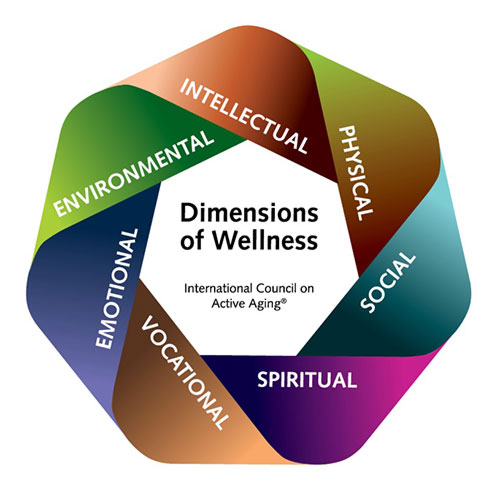
The wellness dimensions overlap and coordinate to provide rich environments for living. Wellness becomes a framework that is valuable for serving the wants and needs of a person engaged in life.
Emotional
Feelings are the lens through which people view the world, and the ability to be aware of and direct one’s feelings helps to create balance in life. Coping with challenges and behaving in trustworthy and respectful ways signal emotional wellness, attributes that can be encouraged through peer counseling, stress management, humor/laughter and personal histories.
Intellectual, cognitive
Engaging in creative pursuits and intellectually stimulating activities is a proven approach to keeping minds alert and interested. There are many ways to stay intellectually active, including taking college courses, journaling, painting or joining a theater company, and challenging oneself with games and puzzles.
Physical
The goal of living independently is one shared by many people, and physical wellness is necessary to achieve this. Lifestyle choices that can maintain or improve health and functional ability include engaging in physical activity, choosing healthy foods with adequate nutrition, getting adequate sleep, managing stress, limiting alcohol intake, not smoking, making appointments for check-ups and following medical recommendations.
Professional, vocational
Work that utilizes a person’s skills while providing personal satisfaction is valuable for society as well as the individual. Participating in the paid and unpaid workforce means maintaining or improving skills, and helping others. Older adults contribute to society as experienced professionals, caregiver, mentors, teachers and volunteers. Leisure-time vocations in the arts and through hobbies maintain vocational skills.
Social
Social interactions with family, friends, neighbors and chosen peer groups can be valuable for maintaining health. Personal contact by joining clubs, traveling, visiting friends and family, engaging in intergenerational experiences like making quilts with a elementary school children is beneficial for everyone who it touched.
Spiritual
Living with meaning and purpose in life, guided by personal values, is key to feelings of well-being and connection to the larger world. Group and individual faith-based activities, personal meditation, mindful exercise (yoga, tai chi) and experiencing nature can create the opportunity for spiritual growth.
Environmental
Surrounded by natural and man-made environments, good stewardship means respecting resources by choosing “green” processes that re-use and recycle goods. It also means looking at ways to bring people into the natural environment and encourage active living through urban and property designs emphasizing walking paths, meditation and vegetable gardens and similar options.
CHAPTER 7:
Chapter Seven,
Part One
Work,
Retirement, and
Leisure
DIVERSITY AND AGING
313
KAREN FAZIO, MSG
Gender and
Ethnic Over the next two decades, the number of older workers will grow
Differences in and make-up a significant proportion of the workforce.
the Older In 2000, 18.7 million people over age 55 were in the labor force.
Workforce In 2010, the number increased to 30 million.
It is estimated in 2020 that the number is 41.4 million workers
over age 55.
Both, men and women are remaining in the workforce longer.
In 1940, the typical retirement age was 70.
Due to wealth, social security, and defined benefit retirement
plans, that age decreased to 62 in 1985.
This trend switched in the later 1980s.
Historically, public policy encouraged people over the age
Social of 65 not to work, which made room for younger workers.
Security There were incentives for early retirement.
Benefits Incentives have now been removed,
Incentives now are to hold off collecting SS benefits.
Older workers are encouraged to delay retirement.
Full retirement age is now 67, not 65.
In addition, mandatory retirement for most occupations is
now eliminated due the Age Discrimination in Employment
Act.
Most people have health insurance coverage through their
Health place of employment.
Insurance If a person retires before they are eligible for Medicare,
they must buy health insurance on their own.
This is expensive and often not as comprehensive as a plan
through an employer.
Many people wait to retire in order to keep their health
insurance plan.
Traditional defined benefit plans are also not as common.
Concerns Only 21% of Americans are very confident they will have
about enough money to retire comfortably.
Available Investing also become riskier as one gets older.
Many older women have paid in less to social security and
Resources other retirement plans due to breaks in their careers for
childcare, caring for parents and in-laws, leaving their job
for husband’s job relocation.
Paying in less means less to collect in retirement and as a
result, single women and minorities remain in the
workforce longer.
Attitudes Baby Boomers report that they plan to work past
traditional retirement.
Toward There is a cultural shift in the way that people retire.
Work and Work provides opportunities for social interaction and
emotional support.
Leisure It allows them to pass on knowledge to younger workers
(generativity).
Among Hispanics, especially women, are more likely than
non-Hispanic men to report they enjoy their work.
Working past retirement age is not always for financial
reasons, but for engagement, passion, interest, and
satisfaction.
Health of the
Older
Population There are a number of indicators that show today’s older
adults are healthier.
There are declining disability rates.
More men and women are working in their sixties.
Those who work in physically demanding jobs are normally
the first to retire.
Educational
Between 2000 and 2010 the percentage of men and
Background women who by age 60-64 had attained their bachelor’s or
graduate degree increased from26% to 37% for men and
18% to 30% for women.
This leads to more “white collar jobs” and longer working
years.
College degrees varied by race.
Gender
Differences
Women, on average, earn less than men which reduces
social security and retirement benefits.
In 2013, women earned 78% of what a man earned. 78
cents for every dollar.
Each generation of women has done better than the last.
Ethnicity and Women age 55+ in the workforce, regardless of
race/ethnicity, is increasing.
Labor Force
Older men in every group is also increasing.
Participation
As men and women age , their numbers in the labor force
decline.
In comparison with other groups, Asian women participate
in the workforce less than Asian men.
In the 65-69 age group, each ethnic group, participation in
the workforce has been increasing, but is less than the 60-
64 age group.
Chapter
Seven, Part
Two
Work,
Retirement,
and Leisure
DIVERSITY AND AGING
313
KAREN FAZIO, MSG
Table 7.3 Educational Attainment
Educational Level of education and English
proficiency influences the type of work a
Attainment person does.
The most common occupations for these
and the
groups include physical labor: farm
Workforce workers, janitors, cleaners, gardeners,
construction work, etc.
In 2013, fatal and non-fatal work injuries were
highest among Hispanics.
Language barriers among supervisors and workers
is an issue, especially for training purposes.
Work Many immigrants who fear deportation do not
report unsafe working conditions.
Injuries The most frequent type of fatal injuries were
transportation incidents, followed by assaults and
violent acts, contact with equipment or objects,
and falls.
Among all ethnic groups, the likelihood of having a
fatal work injury increases with age.
Age prejudice (ageism) is one of the most
socially acceptable forms of prejudice in the
United States.
Older workers are discriminated against
through false poor performance evaluations,
Age refusing to hire or promote older workers,
encouraging retirement, limiting an older
Discrimination worker's access to job-related education.
Despite legislation that protects older people
from discrimination, it is the fastest growing
form of dismissal litigation.
The law requires employers to make
reasonable accommodations for
workers with physical or mental
disabilities, who are otherwise qualified
and do not pose an undue hardship on
Discrimination the operation of the business.
Accommodations include:
against those Accessibility
with Modifying work schedules, reassignment
to a different work position
Disabilities Acquiring or modifying equipment,
examinations, training material, policies,
or providing qualified readers or
interpreters.
Discrimination In recent years there have been new
developments in regard to protecting an LGBT
Based on person’s employment rights.
Sexual In 1998, President Bill Clinton signed an Executive
Order that prohibits discrimination n the federal
Orientation government based on sexual orientation.
In 2014, President Obama added gender identity.
Twenty-one states and DC have enacted laws that
prohibit discrimination for sexual orientation.
18 states and DC for gender identity.
Many large companies provide equal rights and
benefits to their LGBT workers.
FRD occurs when an employee is unfairly
penalized at work due to their family
obligations for providing care.
There are some laws that protect against
this:
Family An employer may not refuse to hire a
Responsibilities person because they have a disabled
child.
Discrimination Men and women both make take leave
for caregiving
An employer may not refuse to promote
a mother.
Diverse
Retirement Women and other minorities may have an
intermittent work history which impacts their
Patterns ability to retire.
Sources of retirement are often referred to as
the three-legged-stool: Social Security,
pensions, and savings and investments.
Many women and minorities only have social
security to live on.
Diverse
Retirement
Patterns Phased Retirement – Full-time workers moving
to part-time or retire and do something else.
Bridge Jobs - Changing jobs or restructuring
work to bridge into retirement.
Some people will start their own business or do
what they have always wanted to do.
Retirement Planning for retirement is about more than money, it is also
about preparing oneself psychologically.
Planning
Key objectives to sound retirement planning include:
Programs
General financial, psychological, and health information.
To help participants understand the value of retirement
benefits.
To motivate participants to plan.
To reduce anxiety.
To help people identity their desired lifestyle for retirement.
It is critical for retirement planning programs to be inclusive
of diverse populaitons.
Retirement is a major life transition and
includes aspects of an individual’s life,
their self-identity, self-worth, relationships,
financial status, and daily activities.
Adjustment to Planning helps people prepare and
Retirement adjust to the change in lifestyle.
The reason a person is retiring is an
important consideration, as well: natural,
for health reasons, to take care of a
family member, etc.
Leisure An older adult’s leisure activities depend
upon SES.
Activities High income older adults are more active in
leisure pursuits than low-income individuals.
Health, transportation, and cost of activities
are barriers.
Older men tend to perform household
maintenance, paid work outside the home.
Women tend to do housework, childcare,and
volunteer work.
Senior centers provide congregate
meals, home-delivered meals, exercise,
information and assistance,
socializing,and transportation.
Some have had limited success due to
poor health, seniors are busy elsewhere,
Senior Centers lack of interest, they may not want to be
with other older people, lack of
participation of men make other men
resistant.
Senior centers also need to be culturally
competent and adjust to their changing
communities.
The most popular form leisure involvement is
volunteering.
Volunteering Reasons for volunteering vary from wanting to
meet people to wanting to remain active.
The Experience Corps, an evidence-based
program in which older adults, including
minorities and low-income seniors volunteer at
high intensity.
For example, many provide 15 hours per week
helping school age children in areas of
reading and math.
Some provide tutoring.
Studies show that both, children and seniors
benefit.
Religious
Participation Many elders form of leisure activity involves
religious or spiritual practices.
This allows people to volunteer, engage with
others, uplift the community, as well as
themselves.
Lifelong Lifelong learning has been changing.
Some older adults seek formal education to change
Learning
careers in order to move into more fulfilling and
meaningful work.
Participation in education allows older learners to
attend to a deeper search for understanding,
meaning, and purpose stimulated by advancing
years.
Lifelong learning helps people transition and to face
challenges related to retirement, loss of
spouse/partner, declining health and strength.
We need to better develop these opportunities to
make them accessible to every member of the
community.
CHAPTER 8:
Chapter Eight, Part One
Religious Affiliation and Spirituality
Diversity and Aging – 313
Karen Fazio, MSG
• Religion is generally defined as a formal system of belief in God
or another being.
Defining • Refers to efforts aimed at relating the human to the divine.
• Religiousness has specific behavioral, social, doctrinal, and
Spirituality denominational characteristics because it involves a system of
worship and doctrine shared within a group.
and Religion • Spirituality pertains to one's inner resources, especially one’s
ultimate concern, basic values around which all other values are
focused and the central philosophy of life—religious,
nonreligious, or antireligious-- that guides daily life.
• May pertain to the supernatural and nonmaterial dimensions of
human nature.
• Refers to the way a person seeks, finds, creates, uses, expands
personal meaning in the context of the universe.
• Spirituality is the human’s drive for meaning and purpose.
Religion, Spirituality, and Aging
• In recent years, research on the topic of aging and religion/spirituality has expanded, due
to the its correlation with health.
• Research shows that older adults who are religious or have some sort of spiritual
framework in their lives enjoy better mental and physical health.
• Quantitative Methods – See Table 8.1 for a multidimensional approach to measure
religion/spirituality.
• Qualitative Methods – “Gives voice,” Ex. Focus groups, interviews – collect narratives about
how rl/sp is practiced or experienced.
Diversity and Religious Practice
• Among African Americans, religion is important and plays a key
role in safeguarding health and wellbeing.
• The oldest old are most likely to describe themselves as
religious.
• A survey of African American congregations found that a
variety of services are offered:
• Basic needs assistance
• Financial services, low-income housing
• Counseling and intervention
• Education and awareness – child-care, life skills, tutoring
• Health related activities – HIV/AIDS, substance abuse, counseling
• Recreation and fellowship
Diversity and Religious Practice
• Among Hispanics, religious and spiritual practice is diverse and
affected by cultural traditions and values.
• Older Hispanics are more likely to attend weekly religious services
than younger counterparts and use religious organizations as a
source of assistance.
• Fe is a concept that incorporates varying degrees of faith,
spirituality, hope, cultural values and beliefs.
• Fe represents a way of being, of living, imagining.
• It is a coping mechanism designed to help people maintain a
positive attitude.
• Native Americans have no word in their
language for religion—it is integrated into
who they are—a way of life—there is no
separation.
• Expression is diverse among tribes.
Diversity and • God is a universal force, often called Great
Spirit or Spirit.
Religious • Walk in a sacred way is encouraged as a
Practice way of life.
• Oral traditions and ceremonies are valued.
• Shamans have special ties to higher powers
for healing.
• Humor is part of the sacred way.
• The journey of life is a spiritual path.
Diversity and Religious Practice
• A common misperception is that LGBT are not religious or
spiritual—this is not true.
• While some religious organizations have rejected LGBT
participation, others are affirming. (Unitarian, Episcopalian,
and Reformed Judaism, for example).
• LGBT people report higher levels of spirituality.
• There is little research on the impact of spirituality and health
among LGBT people.
Diversity and Religious Practice
• Religious practice among rural elders is found
everywhere and plays a central role in day-to-day
life.
• Studies show that prayer, reading the Bible, and
church services are all used to manage health and
ultimately feel God is in control.
• In rural communities, there is variance across ethnic
groups.
Maslow’s Pyramid
Maslow spoke emphatically about the importance of dealing with life’s
vicissitudes from a growth mindset: that is, regarding stressful or
challenging situations as opportunities for growth rather than
retreating into passivity or pessimism. Especially in pivotal times, he
opined, people may face an important choice to make in this regard—
and discover inner wellsprings of strength that they hardly knew
existed.
The key to Maslow's writings is understanding that there
are no quick routes to self-actualization: rather it is
predicated on the individual having their lower
deficiency needs met. Once a person has moved through
feeling and believing that they are deficient, they
naturally seek to grow into who they are.
The Self-Actualizing Elder
• For those who have reached self actualization- the ability to reach
one’s full potential or to actualize, aging is much more positive.
• Those who have satisfied all the lower levels in Maslow’s hierarchy of
needs may focus solely on things like creativity, purpose and
happiness.
• These individuals are characterized by having philosophies and
positive mental health about themselves.
• The self-actualized see the process of aging as normal and therefore
have a more meaningful and positive quality of life.
The Self-Actualizing Elder
• S.A. individuals are completely satisfied and content with their past.
• They accept themselves for what they are, and those around them as
well. They do not have self-conscious problems and are able to live
their lives free of guilt.
• The self-actualized elder is realistic about their future and are not
controlled by the fear of the unknown.
• These people are not swayed by the opinions of others and are
product of their own personal beliefs and ideas.
• It is because they have such a strong foundation about who they are,
that other minor problems they face in life do not phase them.
The Self-Actualizing Elder
• Those who have aged and have self-actualized are eager to pass
down their knowledge and personal philosophies to the next
generation.
• They have lived a life of significance and full of meaning and
want to share it with their community.
• The self-actualized are proud of their accomplishments and still
want to make a difference in the world today. These are the
people that are actively involved with their community, charities
or any sort of global awareness organization.
Chapter Eight,
Part Two
Religious
Affiliation and
Spirituality
Diversity and Aging – 313
Karen Fazio, MSG
This Photo by Unknown Author is licensed under CC BY-SA
Religious Traditions and Asian Americans
• “Asian Americans” represents an
example of combining diverse groups
under one label.
• This group includes 26 Census-defined
subethnic groups.
• Religious traditions and beliefs focus on
views about birth, life, and death.
• These views influence how older people
contribute to society, how they create
personal meaning, how they are treated
by the young, and how they approach
death.
• Our text covers Muslim, Hindu, and
Buddhist traditions.
Muslims in the U.S.
• The Qur’an regards the loss of capacities in old age as
obvious evidence of universal frailty and dependence that is
an inevitable condition of human beings.
• It is the nature of all human life.
• Everything that lives has its stated term and so has human
life.
• It is assumed that old age brings wisdom and maturity.
• Regardless of condition, older adults are treated with
respect.
• Most are cared for in the home and it is considered a blessing
and an opportunity to grow spiritually.
• In the U.S. Muslims have immigrated from more than 60
nations, so it is important to remember diversity among
traditions and culture.
Stages of Life Model
• Student Stage, Householder
Stage, Retirement Stage,
Renunciation Stage.
• These stages are lived out in a
repetitive cycle of birth, death,
and rebirth.
• The belief that all beings is
determined by modes of action
over successive lifetimes
(reincarnation).
• Aging is a marker of life’s journey
• Aging as growth and maturity
• Aging as decline and loss
• Aging as an accomplice of death
Hindu Tradition (page 469)
• The term Buddha means enlightened
Buddhist Tradition or mentally awakened.
• The distinctive characteristics
include:
• All human beings suffer.
• Life is inherently unsatisfactory
and not worthy of attachment.
• Impermanence is a key principle.
• Value to personal understanding
• Meditation is the number one
reason for growth
• Nonviolence is a key principle
• The way to cease to desire is to
follow the Eightfold Path: right
belief, right intent, right speech,
right conduct/action, right
endeavor or livelihood, right
effort, right mindfulness, and
right meditation.
CHAPTER 9:
Chapter 9 Death, Dying
and Bereavement, Part
One
DIVERSITY AND AGING - 313
KAREN FAZIO, MSG
Changing the
Context of Dying
In preindustrial societies, death rates were
high in childhood and youth, and parents
could expect as many as half of their children
to die before the age of 10.
Most deaths now occur from chronic disease
over an extended time period.
This means that it is increasingly the old who
die, making death a predictable event of age
and the completion of the life cycle.
That said, in Western society, both aging and
death are often denied.
Beliefs About Life and Death
Attitudes and practices surrounding dying,
death, and bereavement vary from culture
to culture and from subculture to subculture.
Issues of loss, mortality, the meaning of life
and death are universal concerns.
Religion plays a large role in one’s beliefs
about life and death.
More insulated from death than in the past,
many Americans are uncomfortable
discussing it—especially the prospect of their
own death. This discomfort is shown even in
the euphemisms people use—sleep, pass
away, rest—instead of the word death itself.
This avoidance of death fits well into the
biomedical model of health.
Stage Model of
Grief
The stages of dying—one of the most widely known and
classic frameworks for understanding the dying
process—were advanced by Kübler-Ross (1969, 1981).
Each stage represents a form of coping with the process
of death.
Shock and denial
Anger (“why me?”), resentment, and guilt
Bargaining, such as trying to make a deal with God
Depression and withdrawal from others
Adjustment/acceptance.
David Kessler added a sixth stage: finding
meaning after loss.
Stage Model of
Grief
Although it is now generally agreed that there is no “typical,” unidirectional way to die through progressive
stages, Kübler-Ross’s controversial work was a pioneering catalyst.
It increased public and professional awareness of death and the needs of the dying and their caregivers.
Her work helped coalesce the growing awareness that both quality of care and quality of life were central to the
experience of dying and that dying individuals should have a voice in their care.
Her framework can be a helpful guideline, not a fixed sequence that determines a “good death.”
Another contribution was her emphasis on dying as a time of growth and profound spirituality.
By accepting death’s inevitability, dying persons can live meaningfully and come to terms with who they really
are. Learning how to die helps us learn how to live.
Because the dying are “our best teachers,” those who work with them can learn from them and emerge with less
anxiety about their own deaths.
End of Life Care
Numerous characteristics of a “good death” are identified, although few
deaths would meet all these criteria:
Knowledge that death is coming and an understanding of what to expect
physically and emotionally
The ability to maintain dignity, to be oneself as long as possible, and to
retain control over care decisions
Compassionate, respectful and culturally competent care
Physical comfort: control of pain and other distressing symptoms
Choice and control in decisions, including about where death occurs
Access to information, expert and trustworthy health care providers, and
palliative care/hospice in any location
Supports to minimize spiritual and emotional suffering
Ability to maintain religious, spiritual, and cultural beliefs and to affirm
significant social relationships Adequate time to say good-bye and
achieve a sense of completion; avoidance of unnecessary prolonging of
the dying process and of being an emotional or financial burden on family
Palliative and Hospice Care
Hospice care and formalized palliative care can be
differentiated, but pain management is a major component of
both types of end-of-life care.
Patients have the right to be free from pain.
Hospice became the word used (1970s) to describe programs
which provide end-of-life care.
There are key differences between hospice and palliative care
(PC)
PC is medical care provided to patients of any age with life-
limiting illnesses and is offered in tandem with life-prolonging and
curative therapies.
Palliative and Hospice Care
PC focuses on relief of pain and suffering by addressing the patient’s emotional,
social, and spiritual needs, not on any lifesaving measures.
Physicians, nurses, and social workers use both pharmacological and
psychosocial approaches to cope with symptoms and needs, especially pain
management.
Proponents of palliative care believe that it should be an integral part of
comprehensive care for patients of all ages with life-limiting illnesses.
Accordingly, palliative care is most effective when integrated into existing care
settings, such as hospitals, skilled nursing facilities, or private homes, and is not
necessarily tied to end-of-life care.
Individuals may move in and out of palliative care rather than its being viewed as
the final stage of care.
Palliative and Hospice Care
As the standard for end-of-life care, hospice provides integrated physical,
medical, emotional, and spiritual care not only to the person who is dying but
also to his or her support system.
It is dedicated to helping individuals who are beyond medicine’s curative power
to remain in familiar surroundings where pain is reduced and personal dignity
and control over the dying process maintained.
Ensuring the person’s quality of life and the assessment and coordination of the
physical, psychosocial, and spiritual needs of both the individual and family are
fundamental to the hospice approach.
In contrast to palliative care, active treatment (curative) is not permitted.
Hospice and PC among Ethnic Minorities
Ethnic minorities typically underuse
hospice and PC
African Americans, for example,
underuse these services because of
Past ethical misconduct
Religious and spiritual beliefs
Lack of knowledge
Health policy and reimbursement issues
Page 503
Advance Care Directives
A living will is an advance directive that provides guidance to those making decisions about end-of-life
care.
All 50 states have laws authorizing the use of advance directives to avoid artificially prolonged death.
These refer to patients’ oral and written instructions about end-of-life care and someone to speak on
their behalf if they become incompetent (e.g., Durable Power of Attorney for Health Care).
The most common type of advance directive is a living will.
An individual’s wishes about medical treatment are put into writing in case of irreversible terminal
illness or the prognosis of a permanent vegetative (unconscious) state.
Under such conditions, living wills can direct physicians to withhold life-sustaining procedures and can
assist family members in making decisions when they are unable to consult a comatose, or medically
incompetent, relative.
The Patient Self-Determination Act is a federal law requiring Medicare/Medicaid providers to give
patients information about advance directives.
The PSDA assumes that increased awareness of advance directives will generate discussion between
patients and their health care providers and result in higher rates of completed advance directives.
Despite this Act, the majority of the general population does not have a written document (e.g., living
will or durable power of attorney) stating their preferences about end-of-life care
Chapter 9 Death,
Dying and
Bereavement, Part
Two
DIVERSITY AND AGING - 313
KAREN FAZIO, MSG
Bereavement and Coping
The death of a spouse or partner is considered to be one of
the most difficult events for older people.
People deal with not only the loss of the person, but also a
change of status from “couple” to single or widowhood.
In a world designed for couples, this can be a tremendous
identity shift.
The loss of a spouse/partner can take a toll on a person’s
health –older widows and widowers are more likely than
younger adults to get sick and die within the first six months
following the death.
Chronic conditions may become worse.
For heterosexual women, losing a husband is almost a
normative and expected life event.
Older people are also at risk for losing lifelong friends.
Diverse Culture Approaches to Life and
Death (U.S.)
For many African Americans, beliefs about life
and death are rooted in religious beliefs.
Within the context of death, hope, supported by
prayer and belief in God, the focus is that their
loved ones are in a better place.
African Americans are more likely than other
ethnic groups to turn to friends, the church,
neighbors and other non-related people in times
of need.
Funerals are a time and place to acknowledge
the worth and importance of the person.
It is important for all family, friends and
acquaintances to attend the funeral and express
their grief.
Diverse Culture Approaches to Life and
Death (U.S.)
Hispanic Americans, unlike much of the Anglo-American
population, death is recognized as a natural and
spiritual part of the life cycle.
All Saint’s Day and All Soul’s Day celebrate the spirits of
the dead and these spirits are expected to visit.
This includes altars with offerings of favorite foods and
beverages.
Gravesites are cleaned and decorated.
After a person has died, taking photos of the deceased
is a way to honor and remember the one who has died.
Day of the Dead - The roots of the Day of the Dead,
celebrated in contemporary Mexico and among those
of Mexican heritage in the United States and around the
world, go back some 3,000 years, to the rituals honoring
the dead in pre-Columbian Mesoamerica.
Diverse Culture Approaches to Life and
Death (U.S.)
For Native Americans and Alaska Natives, each
tribe or nation has its own beliefs and beliefs
about life and death.
Most American Indians believe in life after death;
however, the Navajo do not – they are quick to
bury the dead, believing they may have a
negative impact on the living.
The Lakota gather around the dying person—this
ritual is important and there may be as many as
20 people present.
If the family member dies alone, the Lakota suffer
much grief.
The ceremony takes place at the home
reservation, even if the family of the departed
has lived away for several generations.
Diverse Culture Approaches to Life and
Death (U.S.)
For Asian Americans, it is important to acknowledge
complex factors about immigration age, ethnic
identity, their tradition and ritual practices.
In the Hindu tradition, old age is seen as a time of
preparing for death.
A time for planning, reflecting, reviewing, and
summing up.
There is a positive appreciation of the role of old age
and death is the final act of the human drama.
Many Hindus prefer to die at home – some prefer to
go back to India.
Sacred rituals are practiced for the dying person.
Cremation is a preference.
Diverse Culture Approaches to Life and
Death (U.S.)
Buddhists believe in the impermanence of
all forms, feelings, and mental constraints.
During his lifetime, Buddha instructed
followers to embrace suffering as the true
meaning of existence and to contemplate
death as a means of understanding
impermanence.
Life is the preparation for death and in the
moment of death, all is achieved.
To calm a dying person, loved ones chant
sutras (teachings of Buddha).
It is believed the dying person has the
opportunity for a favorable rebirth and
enlightenment.
Diverse Culture Approaches to Life and
Death (U.S.)
Islamic tradition – Muslims are taught much
about life after death.
God is the creator of all things and he has
ultimate authority.
Death is not perceived as the end but a
passage into an eternal existence.
Islam has rejected the concept of
reincarnation and the opportunity for an
improved life.
Thinking about death should bring calmness
to the soul.
Whether a person goes to heaven or hell
depends upon the life lived and deeds
done.
Diverse Culture Approaches to Life
and Death (U.S.)
End-of-life issues for LGBT people may be challenging.
Even though same-sex marriage is Federally recognized, there
is ongoing debate in several states, making it difficult for for
LGBT people to advocate for their loved one.
Partners may have to pretend they are “just friends” ad not
be acknowledged as a family member.
Visiting hours may be restricted to “family members,” not
allowing access to same-sex partners.
Advanced directives and other legal documents can help
but may not override a hospital or nursing home’s practice of
not recognizing a same-sex spouse or partner.
As with other minority groups, when low-income intersects with
marginalization, there may be great health disparity.
Many rural LGBT people, for example, do not have legal
documents in place because they are completely closeted
and fear discrimination, even from an attorney.
Some LGBT people face disenfranchised grief if the
relationship is not acknowledged for what it was.
They may be left to grieve alone without authentic support.