Transverse + Longitudinal Waves
L.G. To explain and compare different types of wave.
Transverse Wave | Longitudinal Waves |
|
|
Waves transfer energy from one place to another without transferring matter.
They are produced from vibration.
Oscillations and vibration - are backwards and forward movement.
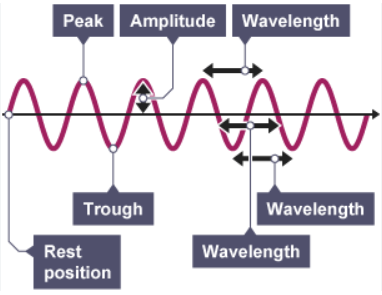
Amplitude - The largest point away from the middle line (top or bottom), measured in distance.
Peak (crests) - The highest point
Troughs - The lowest point
Wavelength - The distance between one set of troughs and peak. One complete cycle.
Frequency - This is how many waves pass by every second and is measured in Hertz (Hz)
Video Notes:
Transfer energy and not matter
Through solid, liquid, gas, vaccumes
Frequency - The number of complete waves passing a fixed point in a given amount of time, Frequency - F 4 measured in hertz
How many wave lengths in a set time
Period - how long it takes for one wave length to happen
Periodic - when it happens = repeatedly
One wavelength is from one peak to another.
Amplitude is distance from the maximum disturbance to the least disturbed (middle to top/bottom)