photosynthesis study guide
Study Questions:
Which cell(s) can carry out photosynthesis?
Plant cells (including algae) can carry out photosynthesis.
Which organelle in these cells is responsible for photosynthesis?
The chloroplast is the organelle responsible for photosynthesis.
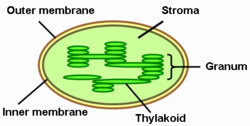
Describe the following structures that are part of a chloroplast:
Thylakoids: Disc-shaped structures containing chlorophyll are the site of light-dependent reactions.
Stroma: The fluid surrounding the thylakoids in chloroplasts, where the light-independent reactions (Calvin Cycle) take place.
Grana (Granum): Stacks of thylakoids, increasing the surface area for light absorption.
Inner and outer membrane: Double membrane surrounding the chloroplast, separating its contents from the cytoplasm.
What are photosynthetic pigments? What is their importance in photosynthesis?
Photosynthetic pigments are molecules that absorb light energy, crucial for converting light energy into chemical energy.
Describe the difference in energy between red and violet light. What causes this difference?
Violet light has higher energy than red light due to its shorter wavelength.
What happens with the light that is absorbed by chlorophyll? What happens to the light that is reflected by chlorophyll?
Absorbed light energy excites electrons in chlorophyll, initiating the photosynthetic process. Reflected light gives chlorophyll its green color and is not used in photosynthesis.
Which color(s) of light would be best for growing a plant? Explain how you know.
Blue and red light are best for plant growth as plants absorb these wavelengths effectively for photosynthesis.
What are the reactants of photosynthesis? Where/How does a plant obtain each of these reactants?
Reactants: Carbon dioxide (from air), water (from soil), and light energy (from sun).
What are the products of photosynthesis? What happens to each of these products after being made?
Products: Glucose (used for energy and growth) and oxygen (released into the atmosphere).
Complete the chart comparing the Light-Dependent Reactions and the Light-Independent Reactions of photosynthesis:
Why are the light-dependent reactions called "light-dependent"? Explain what happens with light during this part.
They are called "light-dependent" because they require light to produce energy-rich molecules (ATP and NADPH) through the absorption of light photons.
Absorbing light energy causes what to happen with some electrons from clusters of chlorophyll?
Absorbing light energy excites electrons, increasing their energy level, and leading to their movement through the electron transport chain.
Why is the movement of electrons important in the light-dependent reactions? Where do they come from? Where do they go? What are they used to do?
Electron movement powers the formation of ATP and NADPH and is essential for transferring energy; they come from water (after it is split) and move through the electron transport chain.
Why is water broken down in the light-dependent reactions?
Water is broken down to release oxygen, provide electrons to replace those lost by chlorophyll, and produce hydrogen ions (protons).
How is ATP and NADPH made in the light reactions? What is their purpose during the Calvin Cycle?
ATP is produced through chemiosmosis, and NADPH is produced via electron transfer; both are used as energy and reducing power in the Calvin Cycle.
Summarize the events of the Calvin Cycle. How is glucose made?
The Calvin Cycle fixes carbon dioxide and uses ATP and NADPH to eventually produce glucose through a series of reactions involving carbon fixation, reduction, and regeneration of ribulose bisphosphate (RuBP).
Is the Calvin Cycle endothermic or exothermic? Catabolic or anabolic? What provides the "energy" for the Calvin Cycle?
The Calvin Cycle is endothermic and anabolic. The "energy" for the cycle comes from ATP and NADPH produced in the light-dependent reactions.
The Calvin Cycle uses an inorganic material to make something organic. What are these inorganic and organic substances? How do you differentiate between organic and inorganic substances?
Inorganic: Carbon dioxide
Organic: Glucose
Organic substances contain carbon and are typically associated with living organisms, whereas inorganic substances do not typically contain carbon-hydrogen bonds.
Summarize how and why each of the following factors affects the rate of photosynthesis:
Light intensity: Higher light intensity increases the rate of photosynthesis up to a certain point, after which it levels off.
Temperature: Photosynthesis has optimal temperature ranges; too high or too low can reduce the rate.
CO2 concentration: Higher concentrations can increase the rate of photosynthesis until other factors become limiting.
Light color: Different colors affect the efficiency of photosynthesis due to varying absorption by chlorophyll.

Photosynthesis occurs in chloroplasts. Reactants include carbon dioxide, water, and light energy. Products are glucose and oxygen. Major processes are light-dependent reactions in the thylakoid membranes and light-independent reactions (Calvin Cycle) in the stroma.