Organization and Management: Nature and Concept of Management
Derived from the Italian word maneggiare, which originates from two Latin root words:
“manus” = means hand; giving instructions
“agere” = present infinitive of the verb “ago”, meaning an act of setting in motion
“ago” = to lead
Management
generally understood today as the effective “art of managing” resources to achieve organizational goals.
is "to deal with," "to handle," or "to oversee" individuals
there are people being managed within an organization.
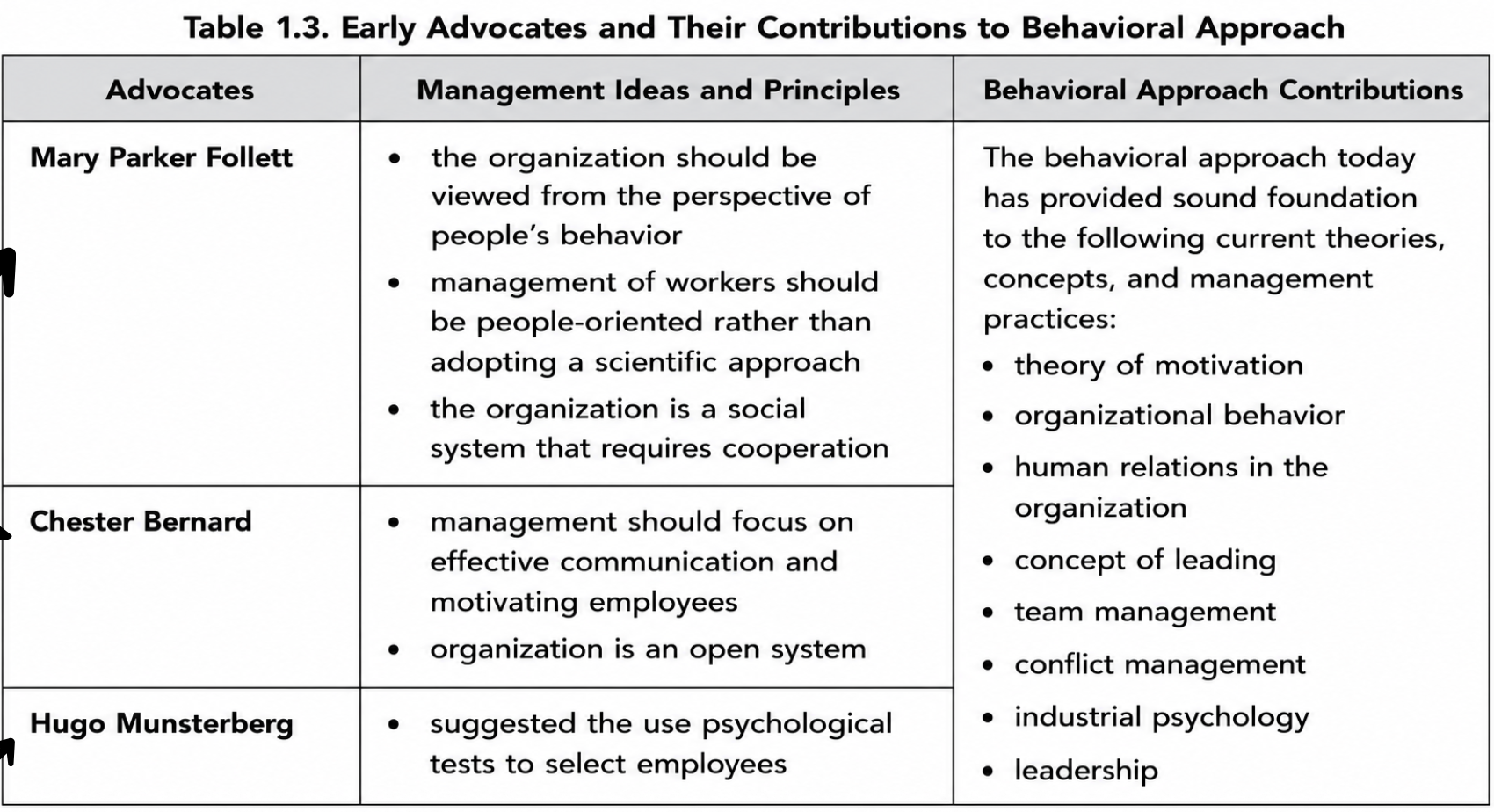
Mary Parker Follett: defines management as "getting things done through people."
the science and the art of effectively and efficiently coordinating the work activities of people working together with common direction.
Science - a systematic body of knowledge consisting of principles and tenets developed through scientific research, experimentation, and formal studies.
Art - Responds dynamically to global developments, evolving from early historical applications to today’s advanced information technology.
Core Components: Effectiveness & Efficiency
Effectiveness
attainment of business goals and objectives
“doing the right things”
Efficiency
achieving organizational goals with optimal use of resources
more output from same level of input
“doing things right”
Management Theories
The major classifications of Management Approaches
Early Management Approach
Classical Approach
Behavioral Approach
Quantitative Approach
Contemporary Approach
EARLY MANAGEMENT APPROACH
there is historical evidence that management has been practiced since the early days
from Before Common Era (BCE) until the end of the 19th century.
examples/proof:
The Great Pyramids of Giza (2580 - 2560 BCE) - Precise construction was impossible without the effective management, organization, and direction of thousands of builders and workers.
The Great Wall of China (771 - 206 BCE) - built circa as a military defense against northern invaders; workers were organized properly, yielding a continuous structure spanning more than 20,000 km.
Adam Smith
“The Wealth of the Nations” (1776)
promoted for a free trade or free-market economy
Managerial concepts: division of labor or job specification
Industrial Revolution (half of the 18th century)
James Watt
Scottish inventor
developed the steam engine in 1769
Eli Whitney
concept of interchangeable parts
CLASSICAL APPROACH
early part of the 20th century
first formal study of management
2 Managerial Principles: Rationality & Efficiency
2 Management Theories: Scientific Management Theory and General Administrative Theory
Scientific Management Theory
focuses on the efficiency of workers to improve work productivity
Frederick W. Taylor
“Father of Scientific Management”
American mechanical engineer
developed the scientific principles of management
supported by Frank Gilbreth and Lillian Gilbreth who studied the motion of the hands and body to eliminate wasteful movements
Henry Gantt
American mechanical engineer and management consultant
Gantt Chart - the scheduling system of related activities
General Administrative Theory
considers good management practices as influences to the productivity of an organization
organizational functions and structure as primary factors that enhance efficiency
Henri Fayol
managerial functions: planning, organizing, commanding, coordinating, and controlling
Max Weber
developed the theory of authority structures called bureaucracy
Historical Timeline:
Historical artifacts and relics confirm management has been practiced since early civilization, spanning the period from Before Common Era (BCE) until the end of the 19th century.
Ancient Historical Evidence:
The Great Pyramids of Giza: Constructed west of the Nile River in Egypt around without modern cranes or pulleys. Precise construction was impossible without the effective management, organization, and direction of thousands of builders and workers.
The Great Wall of China: Built circa as a military fortification against northern invaders. Workers were organized properly and activities were highly coordinated, yielding a continuous structure spanning more than .
Early Scholarly Contributions & Industrial Milestones:
Adam Smith: Published The Wealth of Nations in . A strong advocate of laissez-faire (free trade / free-market economy), Smith argued that business productivity increases significantly when workers specialize in specific tasks. He originally promoted the foundational concept of division of labor (job specialization).
The Industrial Revolution: Originating in Great Britain during the latter half of the 18th century, it transformed global manufacturing by replacing manual labor with machine automation.
James Watt: Invented the steam engine in .
Eli Whitney: Popularized the concept of interchangeable parts in manufacturing.
Scientific Management Theory:
Focuses on improving worker efficiency to maximize organizational productivity by identifying the "one best way" to perform a job.
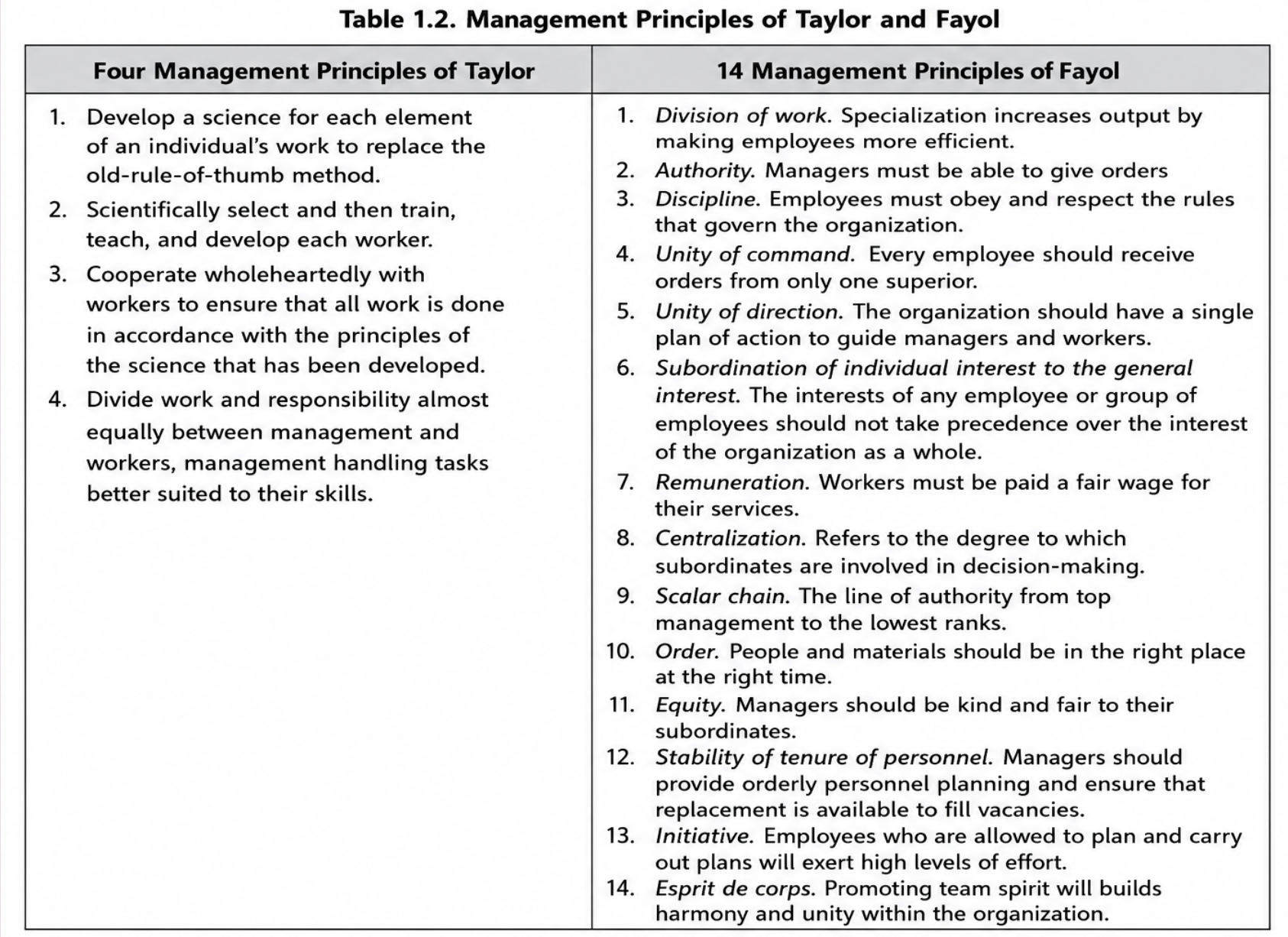
Frederick W. Taylor: Known as the "Father of Scientific Management." Published Principles of Scientific Management in . Formulated four core management principles:
Develop a science for each element of an individual's work to replace the old rule-of-thumb method.
Scientifically select and then train, teach, and develop each worker.
Cooperate wholeheartedly with workers to ensure all work is done in accordance with the principles of the science developed.
Divide work and responsibility almost equally between management and workers, with management handling tasks better suited to their skills.
Frank Gilbreth and Lillian Gilbreth: Focused on eliminating inefficient hand and body motions. Devised a classification system of basic hand motions (Therbligs).
Henry Gantt: Introduced incentive systems to improve worker productivity and developed the Gantt Chart—a scheduling system for a series of related production activities.
Present-Day Applications: Time and motion studies to eliminate wasteful movements, scientific selection of qualified applicants, output-based incentive systems, and production activity scheduling.
General Administrative Theory:
Focuses on broader organizational structure and administrative functions as primary drivers of organizational efficiency.
Henri Fayol: French mining engineer who formulated 14 Principles of Management:
Division of work: Specialization increases output by making employees more efficient.
Authority: Managers must be able to give orders.
Discipline: Employees must obey and respect organizational rules.
Unity of command: Every employee should receive orders from only one superior.
Unity of direction: The organization should have a single plan of action to guide managers and workers.
Subordination of individual interest to the general interest: Employee interests must not take precedence over the organization's overall interest.
Remuneration: Workers must be paid a fair wage for services rendered.
Centralization: Refers to the degree to which subordinates are involved in decision-making.
Scalar chain: The unbroken line of authority running from top management to the lowest ranks.
Order: People and materials must be in the right place at the right time.
Equity: Managers should be kind and fair to their subordinates.
Stability of tenure of personnel: Managers must provide orderly personnel planning and ensure replacements are available for vacancies.
Initiative: Employees permitted to formulate and execute plans exert high effort levels.
Esprit de corps: Promoting team spirit builds organizational harmony and unity.
Max Weber: German sociologist who developed principles of administrative structures and bureaucracy.
BEHAVIORAL APPROACH
people are the most important factor in an organization
“behavior” - reaction of workers to the changes in their working environment and workplace conditions
QUANTITATIVE APPROACH
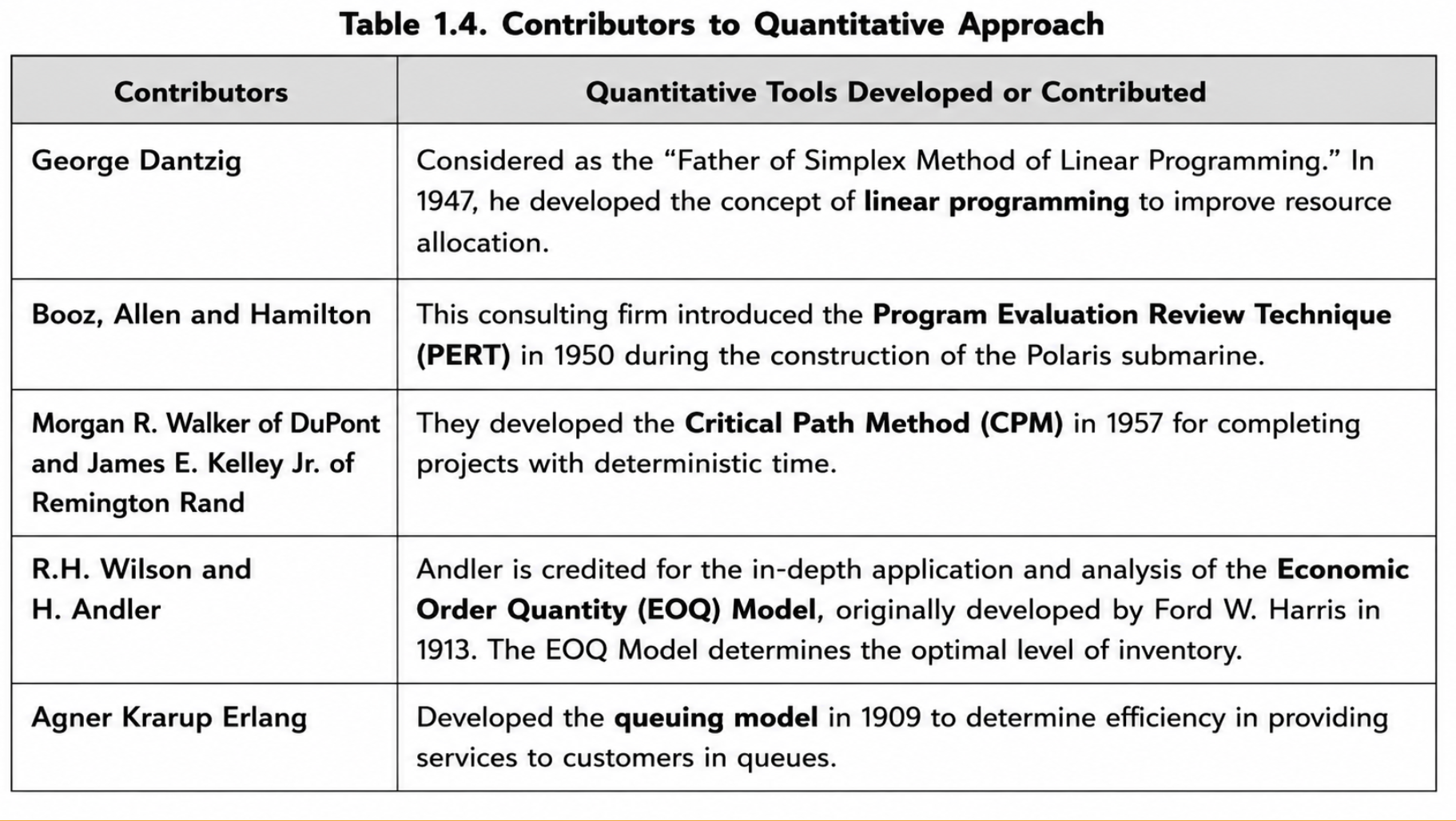
operations science or management science
some management problems (planning & controlling) can be solved using techniques, statistics, and mathematical models
CONTEMPORARY APPROACH
System Theory:
Views an organization as a unified system composed of interdependent sub-units or departments working toward a common goal.
Closed System: Does not interact with or adapt to its external environment.
Open System: Continually interacts with and is influenced by its external environment.
Contingency Approach:
there is no single universally applicable management principle or theory for all situations.
Management practices must adapt depending on environmental and situational variables.
Five Major Functions of Management:
Planning: Setting goals and establishing strategies and plans to achieve them.
Organizing: Structuring work and allocating resources to accomplish goals.
Staffing: Recruiting, selecting, training, and evaluating personnel.
Leading: Motivating, directing, and guiding employees toward goals.
Controlling: Monitoring performance, comparing with standards, and taking corrective action.
Three Levels of Management:
Low Level (First-Line Management):
First-line managers, store supervisors, plant supervisors, program heads.
Scope: Authority and duties are limited to their specific unit or operational department.
Middle Level Management:
Department manager, branch manager, area manager, dean.
Scope: Bridges top management and lower management, directly supervising first-line managers.
Top Level Management:
Chief Executive Officer (CEO), President, Executive Vice President, Vice President for Operations, Chief Financial Officer (CFO), Vice President for Marketing.
Scope: Holds overall responsibility, authority, and strategic supervision over the entire organization.
Mintzberg’s Ten Managerial Roles:
Henry Mintzberg
Interpersonal roles, Informational roles, and Decisional roles
INTERPERSONAL ROLES
managing through people
Figurehead: Performing symbolic or ceremonial legal duties.
Leader: Directing, motivating, and training employees.
Liaison: Maintaining external networks and contacts.
INFORMATIONAL ROLES
managing through information processing
Monitor: Gathering and analyzing organizational and environmental data.
Disseminator: Transmitting internal information to employees.
Spokesperson: Communicating official company information to external entities.
DECISIONAL ROLES
managing through action and decision-making
Entrepreneur: Initiating innovation, change, and improvement projects.
Disturbance Handler: Resolving unexpected operational disruptions or crises.
Resource Allocator: Distributing financial, material, and human resources.
Negotiator: Representing the organization in contract and trade negotiations.
Managerial Skills
Technical Skills: Specialized knowledge, expertise, and proficiency in specific operational processes, tools, and techniques.
Human Skills: The ability to work well with, understand, direct, and motivate individuals and groups.
Conceptual Skills: The cognitive ability to see the organization as a whole, understand complex interrelationships, and formulate long-term strategic decisions.
Relationship Between Skills and Management Levels:
Low-Level Managers: Require high technical skills to oversee daily operational tasks.
Middle-Level Managers: Require strong human skills to mediate effectively between top directives and frontline execution.
Top-Level Managers: Require exceptional conceptual skills to navigate environmental uncertainty and set strategic vision.
SWOT ANALYSIS
Strengths
Weaknesses
Opportunities
Threats
PESTLE ANALYSIS
Political
Economic
Social
Technological
Legal
Environment