Protein Synthesis
Key Terms
Translation - where a proteins is synthesised from an mRNA molecule at the ribosomes.
Proteins
Functions
Enzymatic - Catalyze biochemical reactions
Lactase enzyme breaking down lactose into glucose and galactose.
Regulatory - Involved in gene expression, such as proteins that act as repressors or activators
Structural - provides structural support
Collagen molecules forming collagen fibers
Transport - Facilitates the movement of ions and molecules across cell membranes
Channel and carrier proteins

Structure
Polypeptide chains are formed via peptide bonds, linking amino acids together.
The sequence of amino acids in a protein represents its primary structure.

Secondary Structure: Interaction with neighboring amino acids leads to folded structures such as alpha-helices and beta-pleated sheets.
Tertiary Structure: Interaction of secondary structures leads to the overall 3D conformation.
Quaternary Structure: Association of multiple polypeptide chains, potentially forming functional units called domains.

Amino Acids
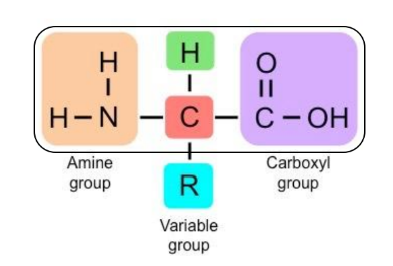
Amino acids (aa) are the monomers of proteins. The general structure consists of:
Carboxyl group: COOH.
Amine group: NH2.
Variable group (R): Determines the properties of the amino acid
Different classifications of Amino Acids Side Chains
Electrically positively charged - Arginine (Arg), Histidine (His), Lysine (Lys).
Electrically negatively charged - Aspartic acid (Asp), Glutamic acid (Glu)
Polar Uncharged - Asparagine (Asn), Serine (Ser), Threonine (Thr), Glutamine (Gln), Cysteine (Cys), Proline (Pro).
Hydrophobic - Alanine (Ala), Valine (Val), Leucine (Leu), Isoleucine (Ile), Methionine (Met), Phenylalanine (Phe), Tyrosine (Tyr), Tryptophan (Trp).
Non-essential amino acids: Can be synthesized by the body (e.g., Alanine, Serine, Proline).
Essential amino acids: Must be obtained from the diet (e.g., Isoleucine, Methionine, Phenylalanine).
Codons
Codon - A triplet of 3 nucleotides that code for 1 amino acid.
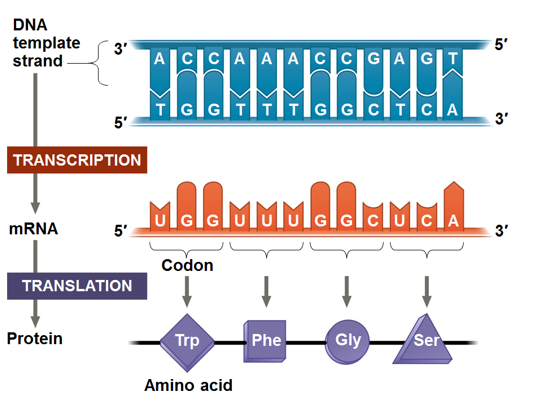
Total Codons: 64 possible codons are identified:
3 Stop Codons: UAA, UAG, UGA.
61 Sense(normal) Codons: Each coding for specific amino acids.
The genetic code is described as:
Degenerate: More than one codon may specify a particular amino acid.
Not Ambiguous: No codon specifies more than one amino acid.
Reading Frame: Codons must be read sequentially without overlap, starting from a designated initiation codon (AUG).
Universal: Genes can be transcribed and translated after being transferred from one species to another
RNA
Three main classes involved in translating genetic information:
Messenger RNA (mRNA): Carries genetic information from the nucleus to the ribosome.
Ribosomal RNA (rRNA): Component of ribosomes, facilitating protein synthesis.
Transfer RNA (tRNA): Links amino acids to codons on the mRNA during translation.
tRNA
tRNA functions as the bridge between the genetic code and the amino acids in proteins.
Each tRNA carries a specific amino acid and binds to the correct codon on the mRNA through its anticodon.
Structure
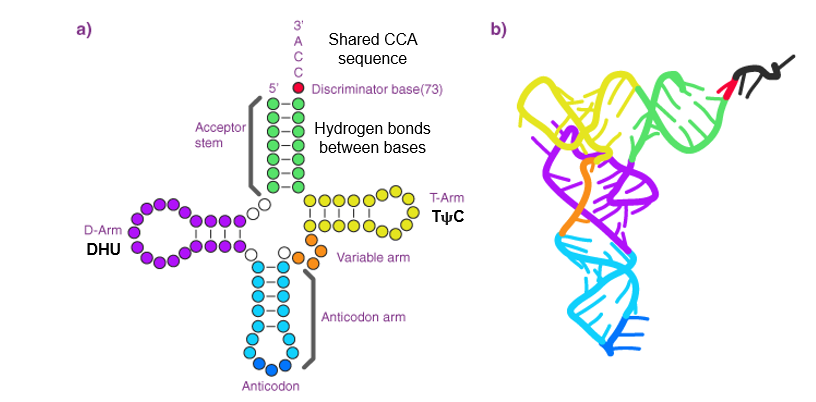
74 - 95 nucleotides long
CCA sequence at the 3’ end
Anticodon three-base sequence complementary to the mRNA codon.
D-loop and T-arm assist enzyme recognition and ribosome binding
D-loop - Contains the unusual base dihydrouridine (D).
Important for tRNA recognition by aminoacyl-tRNA synthetase, the enzyme that attaches the correct amino acid.
T-arm - Contains the sequence ribothymidine (T), pseudouridine (Ψ), and cytidine (C).
Helps the tRNA bind to the ribosome during protein synthesis.
rRNA
ribosomal RNA, a non‑coding RNA transcribed by RNA polymerases (Pol I in eukaryotes, a single RNA Pol in prokaryotes).
rRNA + ribosomal proteins = ribosome, but rRNA is the dominant component (≈60% of ribosome mass).
Structure
60S large subunit - (28S, 18S, 5.8S)
40S small subunit - (5S)
Translation
What: mRNA is translated into proteins.
When: Translation occurs after mRNA is transported from the nucleus to the cytoplasm.
Where: Ribosomes, starting near the 5' end of mRNA.
Stages
tRNA Charging: Binding of tRNAs to their corresponding amino acids.
Initiation: Assembly of all necessary components at the ribosome.
Elongation: Addition of amino acids to the growing polypeptide chain.
Termination: Completion of protein synthesis at stop codons.
tRNA charging
The CCA sequence is present in all tRNAs, with amino acids attached to the 3' end.
Specificity determined by aminoacyl-tRNA synthetases based on nucleotide sequences and properties of amino acids.
recognition of tRNA by the aminoacyl-tRNA synthesis is mediated by the nucleotide sequence
Recognition of amino acid by the aminoacyl-tRNAsynthesis is mediated by size, charge and R groups
Aminoacyl-tRNA synthesis (or aminoacylation) - attaching an amino acid to its correct tRNA.


Initiation
What is needed
mRNA
small and large subunits of the ribosome
initiation factors
initiator tRNA (met-tRNA)
GTP
Stages
Binding of Components: mRNA, ribosomal subunits, initiation factors, and initiator tRNA.
Pre-initiation Complex (43S): Recognizes the 5' cap on mRNA and scans for AUG codon.
Kozak Sequence: Surrounding sequence that aids in recognizing the initiation codon.
Basic
mRNA binds the small subunit of the ribosome
Initiator tRNA binds to the mRNA (anti-codon binding)
The large ribosomal subunit joins the complex
Detailed
the small (SSU) and large (LSU) ribosomal subunits need to be separate for the mRNA to bind the small subunit
a 43s Pre-initiation complex composed of SSU, met-tRNA a and initiation factors recognise and bind the 5’cap in the mRNA
43s pre-initiation complex scans the mRNA until the 1st AUG codon is found
AUG is surrounded by a consensus sequence which helps the recognition of the Kozak Sequence (ACCAUGG)
After recognition, codon and anticodon bind
initiation factors are released
LSU binds to the complex
CBC (cap-binding complex) promotes the nucleus to cytoplasm export and checks for errors
CBC is replaced by ELF-4E for continuation
poly-A interacts with the 5’cap via regulatory proteins and formation of a closed loop. promoting stabilisation of SSU/mRNA binding
Initiation of translation
12 IFs are needed which mediate
preventing binding of LSU via binding to SSU
recognition and binding of the 5’cap
recruitment of the initiator tRNA
binding between the initiator tRNA and the initiator codon
LSU binding
Key molecules
43s Pre-initiation complex - Group of molecules the come together before translation begins.
Includes
small ribosomal subunit (40s)
initiation factors ( eIF1 ,2 , 3 )
initiator tRNA carrying methionine
GTP -for energy
Met-tRNAiMet (methionyl initiator tRNA) - tRNA molecule that carriers the 1st amino acid methionine which starts protein synthesis.
i - initiator so only used fro starting
Met-tRNAiMet pairs with the start codon AUG
Consensus sequence - pattern of bases found in DNA / RNA that helps proteins know where to bind or start a process
EIF - eukaryotic initiation factors hep start protein synthesis
Elongation
Involves binding of charged tRNA to A site, formation of peptide bonds mediated by rRNA, and movement of ribosome (translocation).
Requires
80s initiation complex
charged tRNA
elongation factors
GTP
3 possible binding sites for tRNA
Aminoacyl (A)
Peptidyl (P) - occupied by initiator
Exit (E)
3 steps
Binding
Formation
Translocation
In Detail
Binding
a charged tRNA will bind to site A, this is helped by EIF eEF1 alpha, which is bound to GTP
anticodon on tRNA pairs with the complementary codon on mRNA
GTP is hydrolysed to GDP, and eEF1 alpha is released from the ribosome.
other eEFs then convert GPT back to GTP so eEF1 can be reused
amino acid in A site joins to the growing polypeptide chain attached to tRNA in the P site
Formation
peptide bond forms
causing the growing polypeptide chain to be transferred in the a Site
tRNA in p site loses its amino acid and become uncharged
this is in the LSU and is catalysed by 28s rRNA (ribozyme
Translocation
ribosome moves one codon along the mRNA in the 5’ to 3’ direction
it is powered by eEF2 and GTP hydrolysis
tRNA stays attached to the mRNA while ribosome moves
the tRNA carrying the growing polypeptide moves from the A site to the P site.
the empty (
uncharged) tRNA moves from the P site to the E (exit) site.
the empty tRNA leaves the ribosome and enters the cytoplasm, where it can be recharged with another amino acid.
Termination
Process
The ribosome reaches a stop codon
Translation ends when the ribosome reaches a stop codon on the mRNA (UAA, UAG or UGA).
There is no tRNA with an anticodon that matches a stop codon, so the A site remains empty.
Instead of a tRNA entering the A site, release factors (RFs) bind to the ribosome.
eRF1 recognises the stop codon
eRF1 (eukaryotic Release Factor 1) enters the A site.
eRF1 recognises and binds to the stop codon.
This signals that translation should end.
eRF3 releases the completed polypeptide
eRF3 works together with eRF1.
eRF3 uses GTP hydrolysis to provide the energy needed for termination.
This causes the bond between the tRNA and the completed polypeptide (tRNA–polypeptide bond) in the P site to be cleaved (broken).
The completed polypeptide (protein) is released from the ribosome.
The ribosome is recycled
Other release factors (RFs) help:
release the empty tRNA,
release the mRNA, and
separate (dissociate) the large and small ribosomal subunits.
The ribosomal subunits, mRNA and tRNA can now be reused in another round of protein synthesis.