Human herpes Virus
virus family | envelope present | capsid symmetry | DNA structure | medically important viruses |
Parvovirus | no | icosahedral | SS, linear | B19 virus |
Polyomavirus | no | icosahedral | DS, circular, supercoiled | JC virus BK virus |
Papillomavirus | no | Icosahedral | DS, circular, supercoiled | HPV |
Adenovirus | no | icosahedral | DS, linear | adenovirus |
Hepadnavirus | yes | icosahedral | DS, incomplete circular | Hep B virus |
Herpesvirus | yes | icosahedral | DS, linear | HSV VZV cytomegalovirus Epstein-Barr virus |
Poxvirus | yes | complex | DS, linear | smallpox virus molluscum contagiosum virus |
Pardon Papa has He Has POX
this is a mnemonic to remember which viruses are enveloped DNA viruses, which are herpes, hepdna & POX
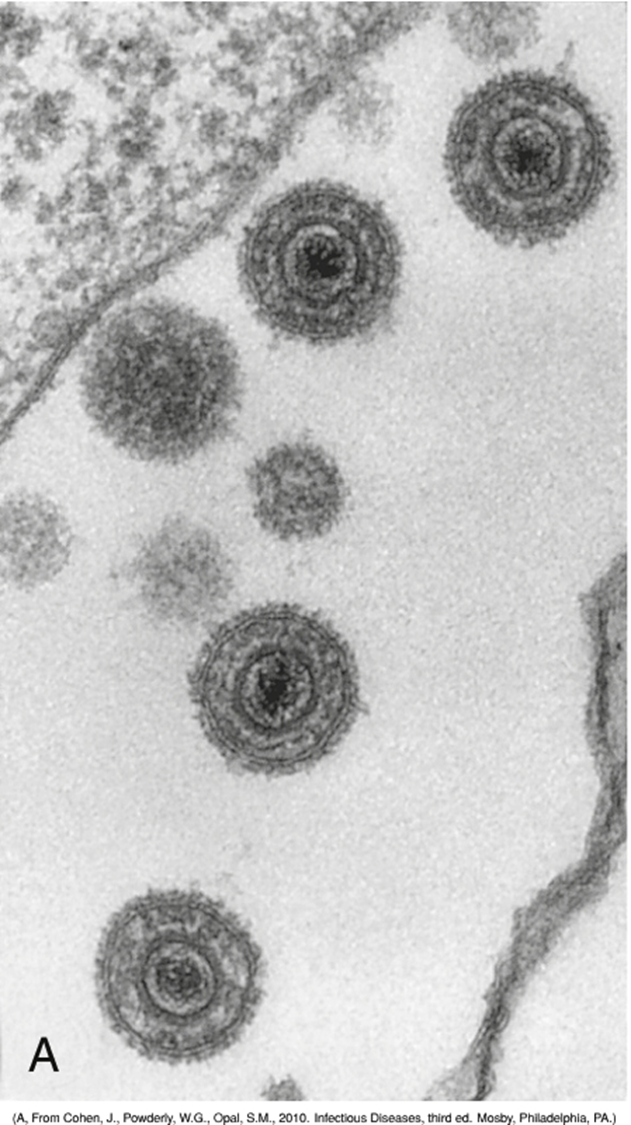
human Herpes virus family
all human herpes have a Lrg genome, linear double stranded DNA & enveloped viruses
HSV1, HSV2, painful vesicles on face & genitals, respectively
VZV, varicella (chicken pox) & zoster (shingles) when it recurs
EBV, infectious mononucleosis
CMV, congenital infections, immunocompetent adults: asymptomatic infections, mononucleosis
HHV6/7, roseola
HHV8, Kaposi sarcoma(KSHV)
hallmark of HSV is latent infection
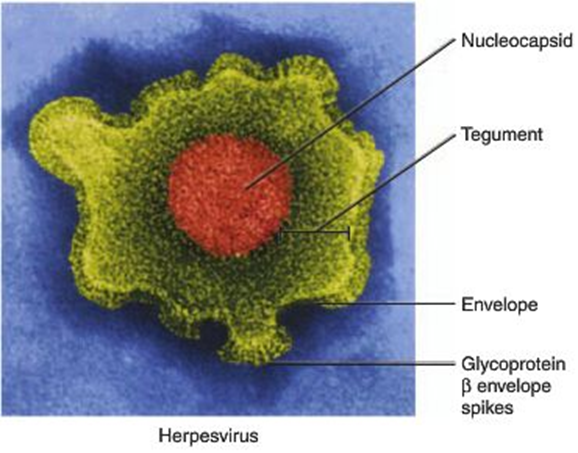
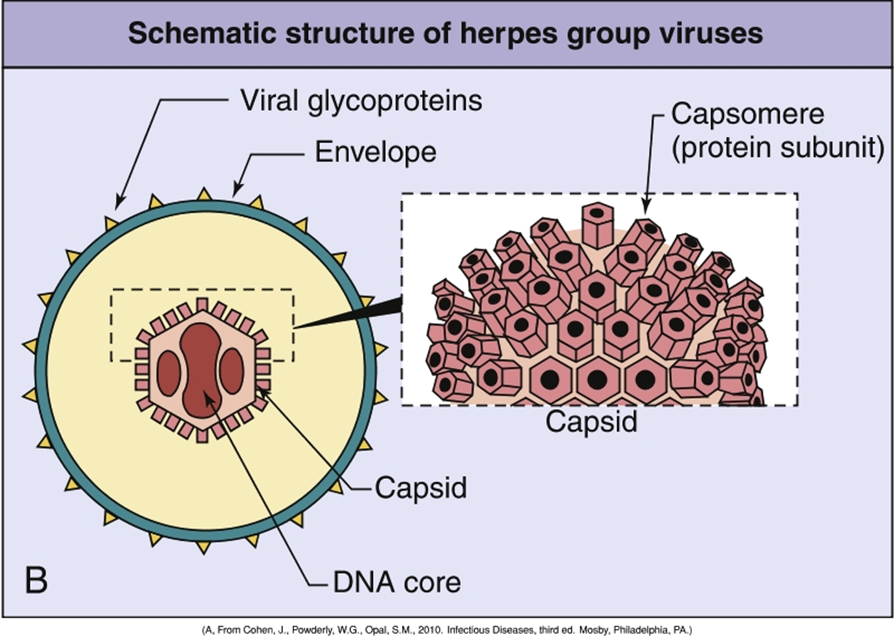
Herpes Family Structure
Linear, dsDNA
linear dbl stranded DNA
Icosahedral capsid
symmetrical, 20-sided (icosahedral) protein shell that encloses the genetic material of certain viruses.
shape is highly efficient for enclosing viral genomes using a minimal number of protein subunits, providing both structural stability & ease of assembly.
Tegument “matrix”
viral “matrix” – space btwn nucleocapsid & envelope, contains proteins & enzymes for viral DNA replication after infection
Enveloped
herpes family replication
Entry of viral DNA results in :
Active infection targets one cell type. Lysis of infected cells & CMI to infected cells are responsible for symptoms.
Latent infection targets another cell type & is associated w asymptomatic carriage.
Note that virion assembly occurs in NUCLEUS, ER, GOLGI
Virus is released by exocytosis OR cell lysis
Cell-cell release enables infections w/o virus exposure to extracellular environment – EVASION OF IMMUNE SYSTEM
steps of herpes replication simplified
attachment, penetration, uncoating, synthesis, assembly, release
The virus binds to specific receptors & fuses w the plasma membrane.
The nucleocapsid then delivers the DNA genome to the nucleus.
Transcription & translation occur in three phases: immediate early, early, & late.
Immediate early proteins promote the takeover of the cell; early proteins consist of enzymes, including the DNA-dependent DNA polymerase; & the late proteins are structural & other proteins, including the viral capsid & glycoproteins.
The genome is replicated before transcription of the late genes.
Capsid proteins migrate into the nucleus, assemble into icosadeltahedral capsids, and are filled w the DNA genome.
The capsids filled w genomes bud through the nuclear & endoplasmic reticulum (ER) membranes into the cytoplasm, acquire tegument proteins, & then acquire their envelope as they bud through the viral glycoprotein-modified membranes of the trans-Golgi network.
The virus is released by exocytosis or cell lysis.
herpes family properties
Each have a common name and an HHV# designation (HHV=human herpes virus) & are divided by Host cell targets
HHV genome encodes viral DNA polymerase*
Replication in nucleus
Virus packaging in nucleus, ER, and Golgi apparatus
virus release through exocytosis or lysis
Establish lytic, persistent, and latent infections
Some HHV are associated with cancer development (EBV, KSHV)
*Viral polymerases are frequently drug-able targets
herpes is ubiquitous everywhere all the time
HSV1/2: “Mixing and matching of mucous membranes” or via direct contact of infected fluid from vesicles
VSV: Aerosol or direct contact of infected fluid from vesicles
CMV: Aerosol (saliva), sexual, vertical or parental transmission
EBV: Saliva “Kissing disease”
HHV6/7/8: Unknown
Subfamily | Common Virus Name | Primary target cell | Site of latency | Means of spread |
Alphaherpesvirinae | ||||
Human herpesvirus 1 | Herpes simplex type 1 | Mucoepithelial cells | Neuron – trigeminal ganglia | Close contact (sexually transmitted) |
HHV 2 | HSV type 2 | Mucoepithelial cells | Neuron – lumbar or sacral ganglia | |
HHV 3 | Varicella-Zoster Virus (VZV) | Mucoepithelial & T cells | Neuron – cranial or thoracic ganglia | Respiratory & close contact |
Betaherpesvirinae | ||||
HHV 5 | Cytomegalovirus (CMV) | Monocytes, granulocytes, lymphocytes, epithelial cells | Monocyte, myeloid stem cell & probably T cells | Close contact, transfusions, tissue transplant, & CONGENITAL |
HHV 6A, 6B HHV 7 | Genus Roseolovirus | Lymphocytes & ? | T cells & ? | Saliva |
Gammaherpesvirinae | ||||
HHV 4 | Epstein-Barr Virus (EBV) | B cells & epithelial cells | B cell | Saliva (kissing disease) |
HHV 8 | Kaposi sarcoma-related virus | Lymphocytes & other cells | B cell | Close contact (sexual), saliva? |