Chapter 12
- Chromosomal Rearrangements
- Two main themes underlying the observations on chromosomal changes
- Karyotypes generally remain constant within a species
- most genetic imbalances result in a selective disadvantage
- Related species usually have different karyotypes
- closely-related species differ by only a few rearrangements on their karyotypes
- distantly-related species differ by many rearrangements on their karyotypes
- Correlation between karyotypic rearrangements and speciation
- Four types of chromosomal rearrangement: deletion, duplication, inversion, and translocation
- Fluorescent in situ hybridization can detect large chromosomal rearrangements using spectral karyotyping with probes specific for two different chromosomes showing chromosomal translocation
- Phenotypic and genetic effects of deletions
- homozygosity for deletions is often lethal or harmful depending on size of deletions and affected genes
- deletion in heterozygotes can have a mutant phenotype due to gene dosage effects (haploinsufficiency)
- deletion in heterozygotes increases risk of altered phenotype due to mutation in the other copy of the gene, may uncover recessive mutant alleles
- Transposable elements (TEs) are movable genetic elements
- TEs are any segment of DNA that has the ability to move from place to place within a genome
- Marcus Rhoades (1930s) and Barbara McClintock (1950s) inferred existence of TEs from genetic studies of corn
- TEs have now been found in all organisms with some functions beneficial to the host, can be present in hundreds of thousands of copies per genome
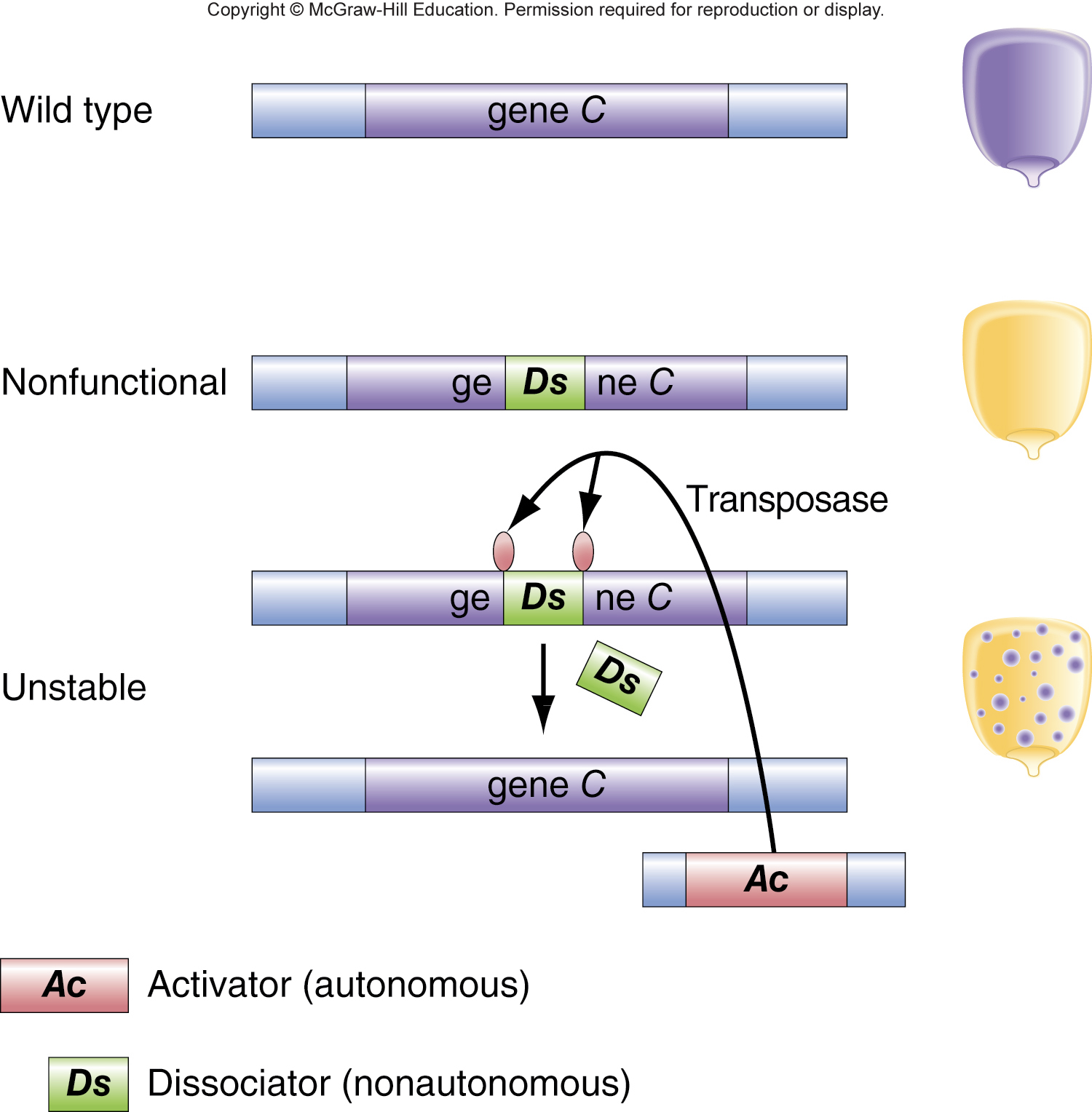
- Instability of TE assiciated alleles
- a nonautonomous TE (Ds) inserted into gene C and disrupted its function. In kernals that have autonomous TE (AC), Ds can hop out, restoring gene function
- Structure of DNA transposons
- Most DNA transposons contain inverted repeats (IRs) of 10-200 bp long at each end, gene encoding trasnposase recocgnizes IRs and cuts at border between the IR and genomic DNA
- TEs can disrupt genes and alter genomes
- TE insertion can result in altered phenotype. TE can insert within coding region of a gene or insert near a gene and affect its expression. TE-associated alleles can be unstable
- TEs can trigger spontaneous chromosomal rearragnements due to unequal crossing over between TEs
- Gene relocation due to transposition, formation of composite TE
- Aneuploidy is loss or gain of one or more chromosomes
- Aneuploids: individuals whose chromosome number is not an exact multiple of the diploid number for that species
- Euploidy: 2n
- Nullisomy: 2n-2
- Monosomy: 2n-1
- Trisomy: 2n+1
- Aneuploidy usually results in multiple abnormalities or lethality
- autosomal monosomy is usually lethal
- most trisomies are lethal; a few result in characteristic syndromes
- sex chromosome aneuploidy is tolerated due to X chromosome inactivation
- Trisomic 21: down syndrome
- Trisomic 13: Patau syndrome
- Trisomic 18: Edwards syndrome
- XO, monosomic: turner syndrome
- XYY trisomic, normal
- XXY: trisomic Klinefelter syndrome
- XXYY, XXXY: tetrasomic Klinefelter syndrome
- XXXXY: pentasomic Klinefelter syndrome
- XXXXXY: hexasomic Klinefelter syndrome
- Aneuploidy is caused by nondisjunction
- nondisjunction: failure of chromosomes to segregate normally, can occur during meiosis I or meiosis II
- Some euploid species are not diploid
- basic chromosome number (number of chromosomes in a single, complete set = x
- monoploidy and polyploidy are rarely observed in animals, except ants, bees, hermaphroditic worms, and some fish
- Formation of a triploid (3x) organism
- diploid gametes may arise from a 4x parent or from a diploid with defects in meiosis (defect in spindle or at cytokinesis)
- Meiosis in a triploid organism
- regardless of how chromosomes pair, there is no way to ensure that gametes contain a complete, balanced set of chromosomes. all polyploids with odd numbers of chromosome sets are sterile because they cannot produce balanced gametes.
- Generation of tetraploid (4x) cells
- tetraploid cells occur during mitosis in a diploid when chromosomes fail to separate into two daughter cells
- if tetraploidy occurs in gamete precursors, diploid gametes are produced
- union of two diploid gates produces a tetraploid organism
- autopolyploid: all chromosome sets are derived from the same species
- In tetraploid, pairing of chromosomes as bivalents generates balanced gametes
- four copies of each group of homologs pair two by two to form two bivalents
- successful tetraploids produce balanced 2X gametes and are fertile
- Polyploids in agriculture
- 1/3 of all known flowering plant species are polyploid
- polyploidy often results in increased size and vigor in plants
- many polyploid plants have been selected for agricultural cultivation
- tetraploids: alfalfa, coffee, peanuts, Macintosh apples, Bartlett pear
- octaploids: strawberries
- Euploid: a complete set of chromosomes (usually diploid)
- Polyploid: a euploid species that carries 3+ complete sets of chromosomes
- Autopolyploid: a kind of polyploid that derives all its chromosome sets from the same species
- Allopolyploid: hybrids in which chromosome sets come from distict, but related, species. Usually infertile ebcause different chromosome sets cannot easily pair and segregate properly
- Amphidiploid: two diploid genomes, each from a different parental species
- Raphanobrassica: sterile F1 from crossing cabbages and radishes, has 18 chromosomes (9 from each parent)
- Creation of the allopolyploid Triticale
- F1 hybrid of wheat and rye, sterile because there are no pairing partners for the rye chromosomes
- fertile Triticale can be created from infertile F1 hybrid Triticale
- some triticale hybrids combine high yield of wheat with ability of rye to grow in unfavorable environments
- some triticale hybrids combine high level of protein from wheat and high level of lysine from rye
- Colchicine treatment prevents spindle formation and results in doubling of chromosome numbers
- Duplicate genes may acquire new functions
- gene families: sets of related genes with slightly different functions
- genome in common ancestor of all cereal grasses was duplicated. The two copies are related, but have diverged in sequence and function
- Rapid chromosomal evolution in house mice on the island of Madeira
- one population of mice introduced to island in 1400s; two populations evolved different sets of Robertsonian translocations, hybrid offspring are sterile