Oxidation And Reduction
Mind Map: Oxidation and Reduction
Mind Map: Chemical Bonds and Chemical Reactions
Central Idea
Chemical Bonds and Chemical Reactions
Main Branches
1. Chemical Bonds
Definition
Forces holding atoms together
Types of Chemical Bonds
Ionic Bonds
Transfer of electrons
Formation of ions
Covalent Bonds
Sharing of electrons
Single, double, and triple bonds
Metallic Bonds
Sea of electrons
Conductivity and malleability
2. Chemical Reactions
Definition
Process where substances transform into new substances
Types of Chemical Reactions
Synthesis Reactions
Two or more reactants combine
General form: A + B → AB
Decomposition Reactions
A single compound breaks down
General form: AB → A + B
Single Replacement Reactions
One element replaces another in a compound
General form: A + BC → AC + B
Double Replacement Reactions
Exchange of ions between two compounds
General form: AB + CD → AD + CB
Combustion Reactions
Reaction with oxygen producing energy
General form: Hydrocarbon + O₂ → CO₂ + H₂O
3. Factors Affecting Reactions
Concentration
Higher concentration increases reaction rate
Temperature
Higher temperature increases kinetic energy
Catalysts
Substances that speed up reactions without being consumed
Surface Area
Increased surface area enhances reaction rate
4. Energy Changes in Reactions
Exothermic Reactions
Release energy (heat)
Endothermic Reactions
Absorb energy (heat)
Conclusion
Understanding chemical bonds and reactions is fundamental to chemistry, influencing everything from molecular formation to energy transfer in reactions.
Chemical Bonds and Chemical Bonding
Covalent Bond: Sharing of electron pairs between atomsIonic Bond: Transfer of electrons from one atom to anotherMetallic Bond: Attraction between metal ions and delocalized electronsBond Length: Distance between nuclei of bonded atomsBond Energy: Energy required to break a bondPolarity: Distribution of electrical charge across a bondElectronegativity: Ability of an atom to attract electronsLewis Structures: Diagrams showing bonding between atomsValence Electrons: Electrons in the outer shell involved in bondingOctet Rule: Atoms tend to bond to achieve a full outer shell (8 electrons)
1. Ionic bonds; an electrostatic attraction where one atom donates an electron to another atom
o follows octet rule; electrons (8) completely transferred
o atoms become ions
o electrostatic force involved
o high activation energy requires to break the ionic bonds
2. Non-polarised Covalent bonds; a type of bond that occurs when two atoms share a pair of electrons with each other
o shared electron, no electrostatic force holds these electrons together
o thus weaker than ionic bond
o no ionic charge
3. Polarised Covalent bonds; exists when atoms with different electronegativities share electrons in a covalent bond
o unequal sharing of electrons, partial + & - charges
o affinity for electrons; tendency of an atom/compound to combine by chemical reaction with atoms or compounds of unlike composition
o shared electrons spend more time circulating oxygen atom
Chemical Bonds =
- need to achieve full valence shall (8) [some exceptions – e.g. H]
- only valence electrons participate in chemical bonding
- law of conservation of mass: mass is neither created nor destroyed in chemical reactions
- in chemical equations: reactants ® products
- equal number of each atom both sides
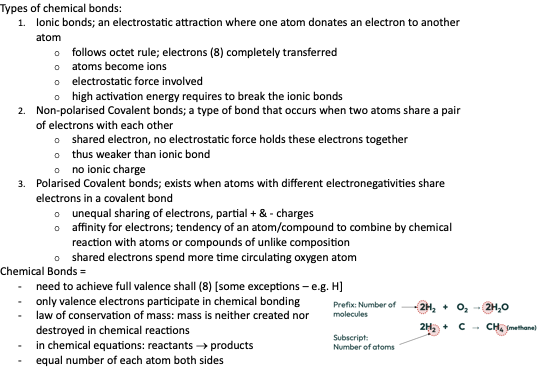
Summary of Types of Chemical Bonds
Chemical bonds are essential for the formation of compounds and can be categorized into three main types:
Ionic Bonds
Formed through electrostatic attraction.
One atom donates an electron to another, adhering to the octet rule (8 electrons).
Atoms become ions due to complete electron transfer.
Involves a strong electrostatic force.
High activation energy is required to break these bonds.
Non-polar Covalent Bonds
Occur when two atoms share a pair of electrons equally.
No electrostatic force holds the shared electrons together.
Weaker than ionic bonds.
No ionic charge is present.
Polarised Covalent Bonds
Formed when atoms with different electronegativities share electrons unequally.
Results in partial positive and negative charges due to unequal sharing.
Atoms have varying affinities for electrons, influencing their chemical reactivity.
Shared electrons tend to spend more time around the more electronegative atom (e.g., oxygen).
Key Concepts in Chemical Bonding
The goal of bonding is to achieve a full valence shell (8 electrons), with some exceptions (e.g., hydrogen).
Only valence electrons are involved in chemical bonding.
The law of conservation of mass states that mass is neither created nor destroyed in chemical reactions.
In chemical equations, reactants transform into products, maintaining an equal number of each atom on both sides.
Mind Map: Chemical Bonds and Chemical Reactions
Central Idea
Chemical Bonds and Chemical Reactions
Main Branches
1. Chemical Bonds
Definition
Forces holding atoms together
Types of Bonds
Ionic Bonds
Transfer of electrons
Formation of charged ions
Covalent Bonds
Sharing of electrons
Polar and nonpolar types
Metallic Bonds
Sea of electrons
Conductivity and malleability
2. Chemical Reactions
Definition
Process of transforming substances
Types of Reactions
Synthesis
Combining elements to form compounds
Decomposition
Breaking down compounds into simpler substances
Single Replacement
One element replaces another in a compound
Double Replacement
Exchange of ions between two compounds
3. Condensation
Definition
Reaction forming water as a byproduct
Examples
Formation of polymers
Peptide bond formation in proteins
4. Hydrolysis
Definition
Reaction involving the breaking of bonds with water
Examples
Digestion of macromolecules
Breakdown of ATP
5. Oxidation and Reduction
Definition
Oxidation: Loss of electrons
Reduction: Gain of electrons
Key Concepts
Redox reactions
Electron transport chain in cellular respiration
6. Mass Action Effect
Definition
Relationship between concentration and reaction rate
Key Points
Le Chatelier's Principle
Equilibrium shifts with concentration changes
This mind map provides an overview of the fundamental concepts of chemical bonds and reactions, including specific types and their implications in various processes.
Mind Map: Oxidation & Reduction
Central Idea
Oxidation & Reduction Reactions
Main Branches
1. Definition
Oxidation
Loss of electrons
Increase in oxidation state
Reduction
Gain of electrons
Decrease in oxidation state
2. Types of Reactions
Redox Reactions
Involves both oxidation and reduction
Electron transfer between species
Combination Reactions
Two or more reactants combine
Example: ( A + B \rightarrow AB )
Decomposition Reactions
A compound breaks down into simpler substances
Example: ( AB \rightarrow A + B )
Displacement Reactions
One element displaces another in a compound
Example: ( A + BC \rightarrow AC + B )
Combustion Reactions
Reaction with oxygen producing heat and light
Example: Hydrocarbon + O₂ → CO₂ + H₂O
3. Oxidizing and Reducing Agents
Oxidizing Agent
Accepts electrons
Causes oxidation in another substance
Example: ( O_2, KMnO_4 )
Reducing Agent
Donates electrons
Causes reduction in another substance
Example: ( H_2, NaBH_4 )
4. Applications
Biological Processes
Cellular respiration
Photosynthesis
Industrial Processes
Metal extraction
Battery technology
Environmental Impact
Oxidation of pollutants
Role in corrosion
5. Key Concepts
Half-Reactions
Separate oxidation and reduction processes
Electrochemical Cells
Devices that convert chemical energy to electrical energy
Balancing Redox Reactions
Use of oxidation states and half-reaction method
This mind map provides a structured overview of oxidation and reduction reactions, their types, agents, applications, and key concepts.