Chemistry - 6 Electrolysis - Required Practical 3: Electrolysis
Aims:
observe the products of electrolysis and compare between two different solutions
Risk Assessment:
chemicals can damage eyes
gaseous products (especially chlorine) could cause shortness of breath
chlorine is toxic
Safety:
wear safety goggles
warn asthmatics
carry out experiment in a fume cupboard
Equipment:
0.5 mol/dm³ copper (II) chloride solution
0.5 mol/dm³ sodium chloride solution
Petri dish lid with bored holes
two carbon rod electrodes with support bungs
two crocodile/4 mm plug leads
low voltage power supply
blue litmus paper
forceps
beaker
Control variables:
n/a
Independent variable:
n/a
Dependent variable:
n/a
Method:
Copper (II) chloride
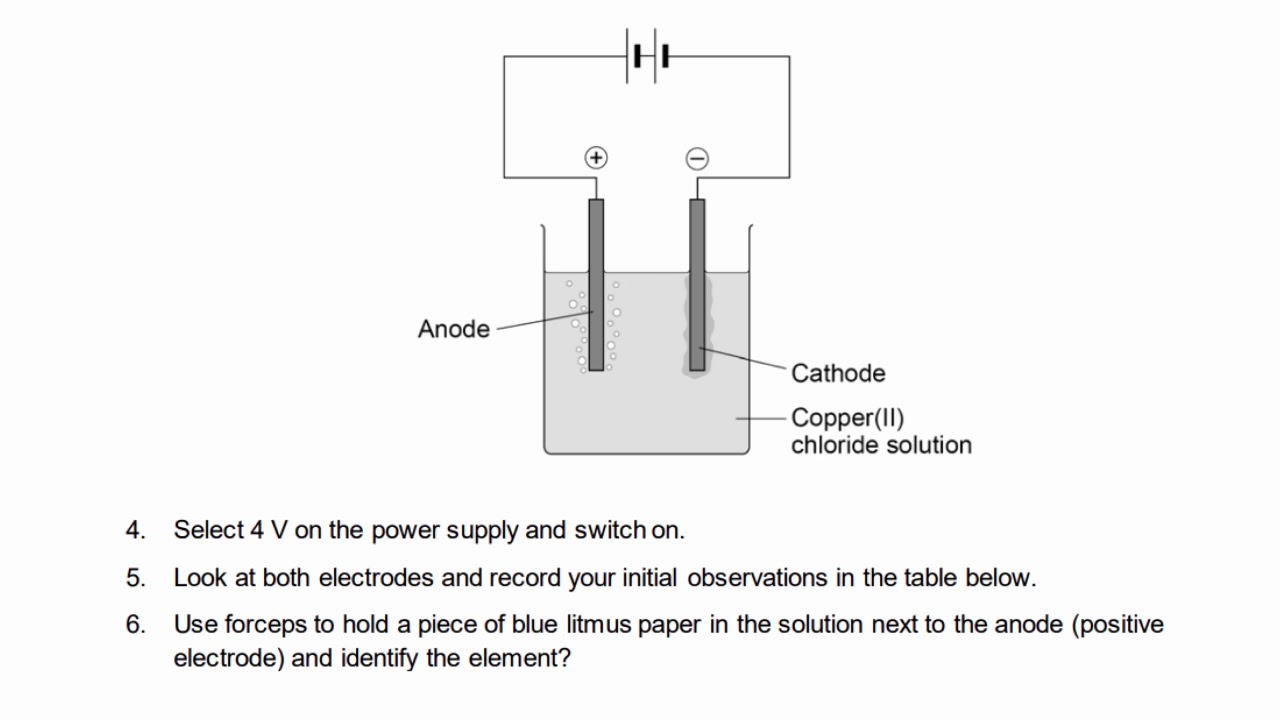
Place 50 cm³ of copper (II) chloride solution in a beaker and cover it with the Petri dish lid
Insert the carbon rods into the holes so that they are submerged in solution
Attach crocodile leads to the rods and then to the power supply. Switch the power supply on at 4 V
Closely observe the electrodes for discharged products (copper at cathode; chlorine gas at anode)
Hold damp blue litmus paper near the anode. It should bleach; this proves the gas is chlorine
Sodium chloride
Place 50 cm³ of sodium chloride solution in a beaker and cover it with the Petri dish lid
Insert the carbon rods into the holes so that they are submerged in solution
Attach crocodile leads to the rods and then to the power supply. Switch the power supply on at 4 V
Closely observe the electrodes for discharges products (hydrogen gas at cathode; chlorine gas at anode)
Hold damp blue litmus paper near the anode. It should bleach; this proves the gas is chlorine
Collect the gas from the cathode and hold a lit splint near it. It should produce a squeak/pop; this proves the gas is hydrogen
Calculations/graphing:
n/a