Part 5 - Active Cell Physiology
Diffusion
Diffusion is the movement of molecules from high to low concentration
Concentration Gradient
The glass has areas of high and low concentration of sugar
Through diffusion, the sugar will redistribute through the water to equalize concentrations
Osmosis
Osmosis is the movement of water across a membrane to equalize solute concentration
The cell membrane divides our body fluid volumes into intracellular and extracellular spaces
Water concentration is a dynamic on both sides of the membrane
Osmosis works to balance tonicity between the intracellular and extracellular spaces
Isotonic
Intracellular fluid (ICF) and extracellular fluid (ECF)
When ECF and ICF are in balance/equal concentration and no pressure needed then this is isotonic
Due to exercise water loss from ECF decreases volume and make solution hypertonic (higher concentration of molecules ) with respect to the ICF
An osmotic water shift from the ICF into the ECF restores osmotic equilibrium but decreases the ICF volume
water moves from the side with low concentration to the side of high concentration to become balanced again
Hypotonic where ECF too much and not enough ICF so ECF volume decreases to restore osmotic equilibrium
Why do we administer IV saline or Ringer’s solution to patients that need fluids instead of regular water?
By adding H2O to veins we are lowering tonicity. Therefore, A saline or Ringer’s solution is relatively isotonic compared to the intracellular fluids of blood cells, making it perfect for preserving a patient’s osmotic balance.
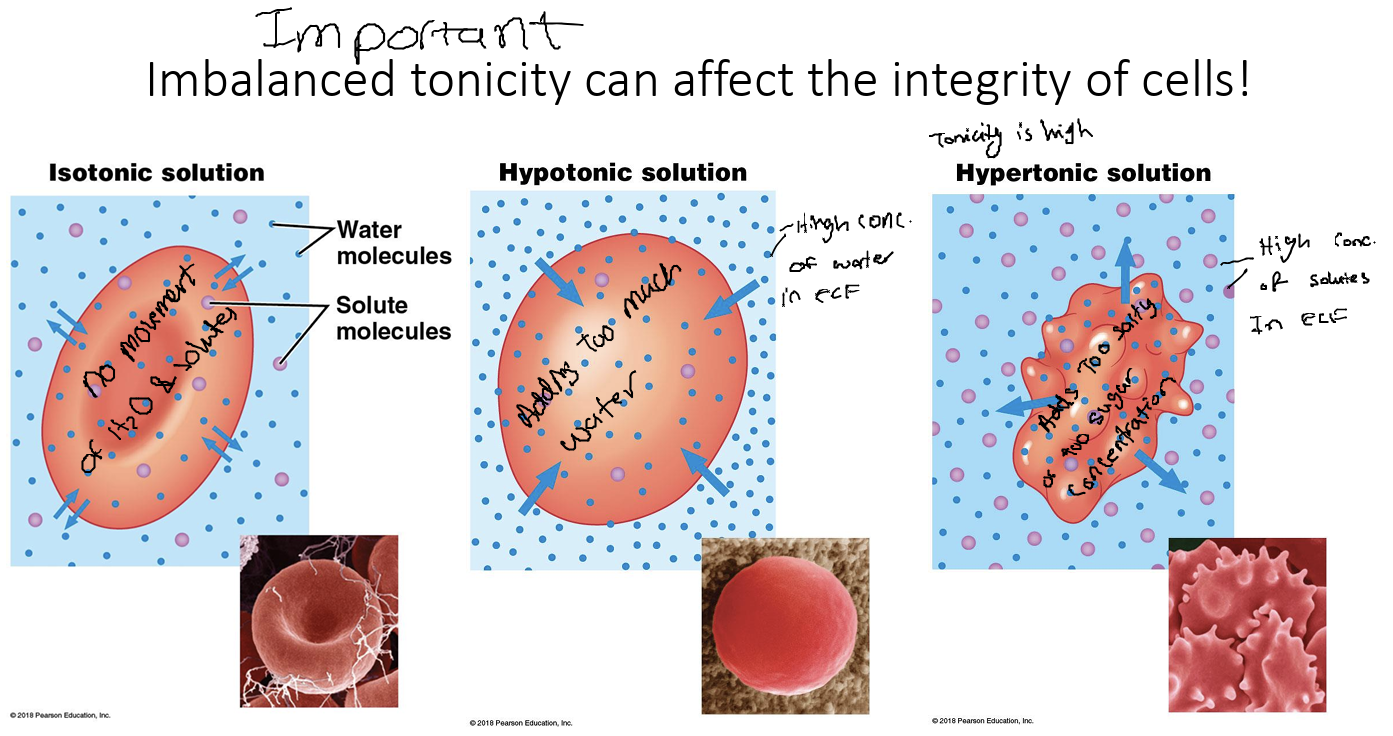
If a cell has intracellular and extracellular fluids that are equally matched in water and solute concentrations, what term describers their osmotic state?
A. Hypertonic B. Exotonic C. Isotonic D. Hypotonic
Answer is C: Isotonic
Chemical and Electrical Gradients allow rapid signalling in excitable cells
• Ions are highly driven to move down their concentration and electrical gradients…to equilibrate the inside and the outside of the cell. • But they can’t, The cell membrane is semipermeable and won’t allow the ions through. • The moment a pathway opens, the ions will rush in/out along their gradient. • The bigger the gradient, the faster and stronger the signal.
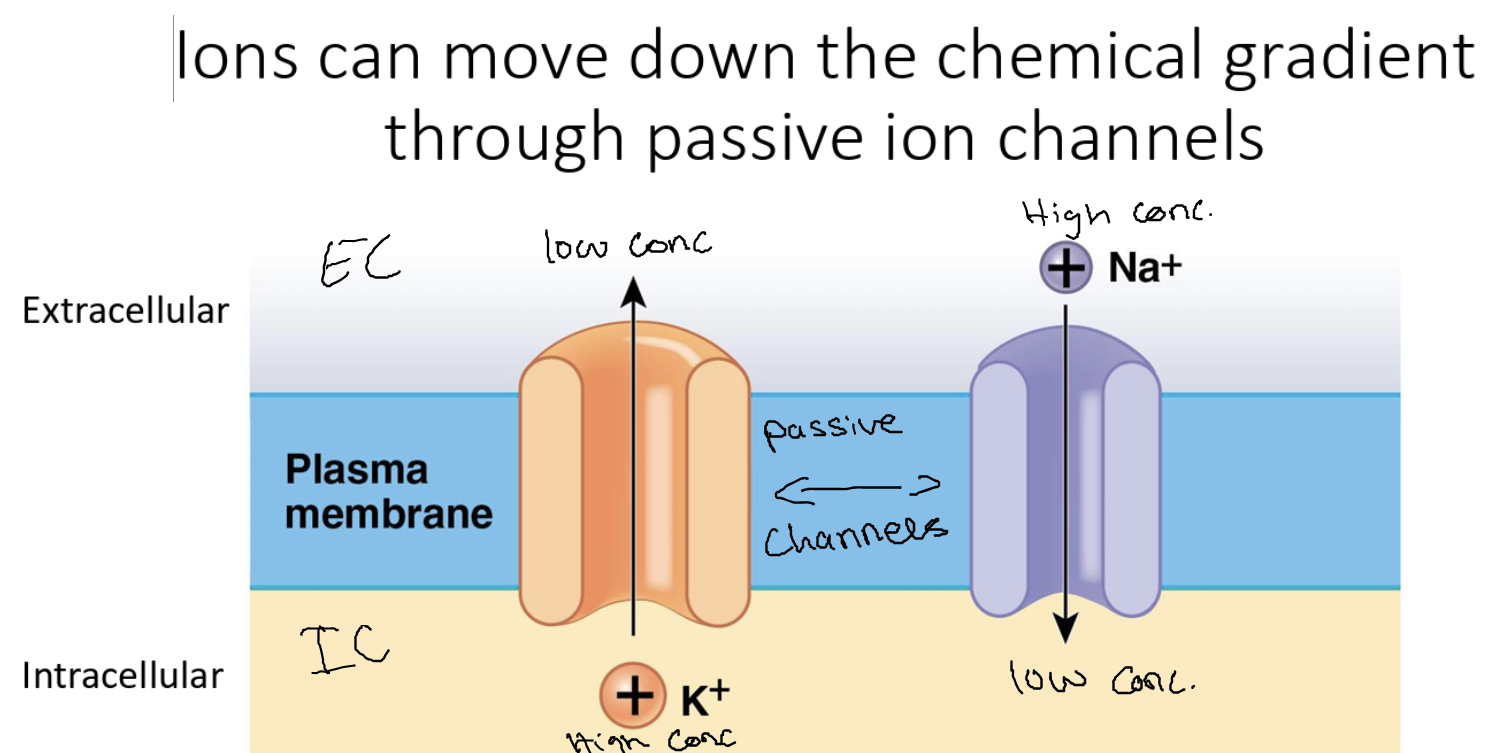
The sodium and potassium gradients are maintained by active pumps that use energy to move ions against their concentration gradient