Module 12: Oligopoly
Oligopoly
Oligopoly Characteristics
Oligopoly firms
have a small number of large firms
there may be a lot of firms, but there will be 3-4 that dominate the entire market
have barriers to entry, will not be easy in the long run
engage in interdependent decision making
Interdependence
Oligopoly firms are interdependent on each other.
firms know who their competitors are, and consider actions and reactions when making decisions, there is a lot of strategy involved in the decision making
one firm will think about what they want to do and then also consider what their competitor will do in response before making a decision
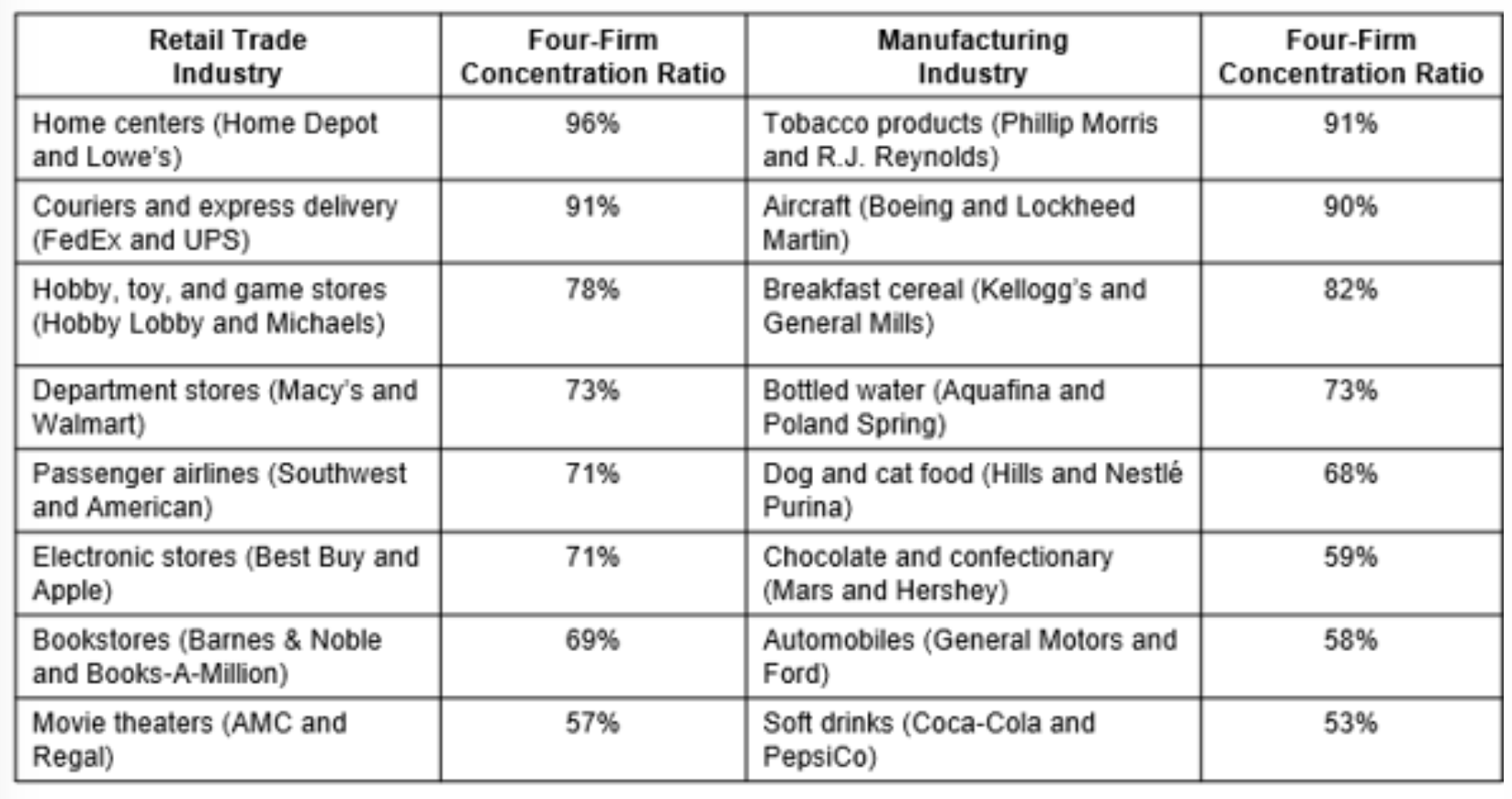
Four-firm concentration ratio: the fraction of industry sales accounted for by the largest four firms
a ratio over 40% tends to indicate oligopoly
Limitations of the Concentration Ratio
It does not include imports coming into the US, so it ignores foreign competition
They are calculated for a national market
it doesn't take into account that a market may be a local market
if it is a local market, it may have a high share of sales in an area
Market definitions are tricky
Most Important Barrier
Economies of Scale
long-run average costs fall as the quantity of output increases
makes it difficult for new firms to enter
new firms would have to start small with higher average costs than the existing firms
Other Barriers to Entry
Ownership of a Key Input
If a firm controls a key input, it is difficult for others to gain access
Limits market entry
Examples:
DeBeers - diamonds
Ocean Spray - cranberries
Government-Imposed Barriers
Government grants exclusive rights to one or a few firms
Examples
occupational licensing - medical field, such as doctors and dentists
patents - gives the right to a product for 20 years
tariffs/import quotas
Game theory
Game theory is a specialized field of economic study developed in the 1940s
General: the study of how people make decisions in situations in which attaining their goals depends on their interactions with others
Economics: the study of the decisions of firms in industries where profits depend on interactions with other firms
Basically, it is studying the interdependent decision making with oligopolies
Games share three characteristics
Rules
for a firm: production function, market demand
Strategies
for a firm: their production decisions
Payoffs
for a firm: their profits
Price Competition
Payoff matrix: shows the payoffs resulting from combinations of strategies
Business strategy: a set of actions taken to achieve a goal
Dominant strategy: the best strategy, no matter what the other firms do
Nash equilibrium: when each firm chooses the best strategy, given the other firm's strategies
this is the most likely outcome (and often the worst combined outcome)
Collusion: an agreement among firms to charge the same price or otherwise not compete
Noncooperative Equilibrium
equilibrium when players pursue their own self-interest
no cooperation between firms
it is the Nash equilibrium
Cooperative Equilibrium
equilibrium when players cooperate to increase mutual payoff
ex: collusion
Prisoner's dilemma: game where dominant strategies lead to noncooperation
generally, everyone ends up worse off
Cartel: a group of firms that collude
members agree to restrict output
the restriction increases prices and profits
The Five Competitive Forces Model
This model identifies five competitive forces that help determine the level of competition we have in an industry.
The Five Forces
Competition from existing firms
Number of competitors, intensity of the competition, product differentiation
Threat from potential entrants
How easy it is for new companies to enter a market and compete with existing firms
Competition from substitute goods or services
How available are substitutes for the product in question and how close are the substitutes
Bargaining power of buyers
How much influence do customers have to demand lower prices, higher quality, etc
Bargaining power of suppliers
How much influence do suppliers have to raise prices, reduce quality, etc