GERO CHAPTERS 4-6
OBJECTIVES
1) Differentiate normal aging from pathology
2) Importance of identifying age-related risks affecting safety and function
3) Apply nursing priorities to older adults
GROWING OLDER ADULT POPULATION
Importance of Gerontological Nursing
most % of your patients will be older adults, making it essential to understand their unique health challenges and how to best advocate for their care.
Higher risk for health complications in older adults
Nurses play a crucial role in driving patient outcomes
safety, function, and quality of life
LIFE TRANSITIONS & PSYCHOSOCIAL AGING
Key factors in psychosocial aging:
Ageism: systemic discrimination based on age
can negatively impact care when older adults are stereotyped
Changes due to parenting and grandparenting
Changes in family roles
can be positive for some but can affect many people negatively
Loss of spouse and retirement leading to a shrinking social world, increasing loneliness
affects finances and mental health
Encountering integrity vs despair during life review and tapping into inner resources
increases a risk for functional decline
AGEISM & HEALTH OUTCOMES
Impact of stereotypes on care provided to older adults
Under-treatment and misattribution of symptoms
Advocacy role of nursing to combat ageism in healthcare
MAJOR LIFE TRANSITIONS IN AGING
Retirement affecting social dynamics
can be positive, but can also lead to loss of routine, purpose, income, and social interaction
impacts patients mental health and overall wellbeing
Loss and changes in roles
loss of spouse, friends, independence, and shifts in family roles
increase vulnerability to depression, anxiety, social isolation
Reduction in the size of social networks
as mobility decreases and friends start to die off, loneliness starts to become more common.
more social elderly patients = better outcome
PSYCHOSOCIAL AGING: INTEGRITY VS DESPAIR
Life review as a process for meaning-making in aging
look back on relationships, accomplishments
they find a sense of integrity correlated to peace and pride
Development of resilience through life experiences
if they look back in regret, they find a sense of despair instead
AGING & ILLNESS
Recognition that changes in health increase vulnerability
Distinction between normal aging and pathological conditions; pathology is not inevitable
NORMAL AGING VS PATHOLOGY (CORE PHYSIOLOGIC CHANGES)
→ AGE DOES NOT MEAN DISEASE AND ILLNESS IS PROMINENT
Changes increase vulnerability
Pathology is not inevitable
NORMAL AGING:
Immune System Changes:
Immunosenescence leads to decreased immune response
older adults have a weaker immune system
Higher risk of infections due to age-related changes
Respiratory Changes:
Increase in infection risk due to decreased lung elasticity
Cardiovascular Changes:
Orthostatic hypotension due to aging physiological changes
Musculoskeletal Changes:
Sarcopenia associated with decreased muscle mass and increased fall risk
weakness, hormone imbalance, higher risk for fall and injury
Sensory Changes:
Safety and social isolation concerns due to declining sensory functions
affects social interaction and fall risk
Thermoregulation Changes:
Increased risk of hypothermia due to impaired thermoregulation
makes it hard for patients to maintain body temp. increases risk for hypothermia
PHYSICAL APPEARANCE CHANGES
Aging physical characteristics:
Graying and thinning hair, ectropion of eyelids, elongated ears, thicker hair in ears/nose
Darkening/wrinkling of skin, arcus senilis, growth of facial hair in women
Changes in physical stature: decreased height, deepening hollows of axillae, diminished muscle mass, and skinfold thickness
gait = how someone walks
men have wider gait, while women have a narrower
IMMUNE AGING (IMMUNOSENESCENCE)
Decreased immune response contributes to higher infection risk
higher risk for = pneumonia, UTI’s, sepsis
Blunted symptoms can complicate diagnosis and treatments
RESPIRATORY & CARDIOVASCULAR CHANGES
aging: decrease in lung elasticity
Effects on oxygenation and perfusion:
Reduced lung elasticity and cardiac reserve result in complications
Strategies to mitigate risks of orthostatic hypotension and resultant injuries
orthostatic hypotension: significantly increases fall risk
MUSCULOSKELETAL CHANGES: MOBILITY & FALLS
Conditions impacting mobility:
Sarcopenia leads to a risk of falls due to decreased balance
leading cause of injury = falls
loss of independence
very often preventable
prioritize safety interventions
SENSORY & NEUROLOGIC CHANGES: SAFETY & COMMUNICATION
Visually and hearing-related declines impacting communication and safety
Slower cognitive processing increases risks
COMMUNICATION!
speak clearly and confirm their understanding, especially with medications
assess carefully before making assumptions
THERMOREGULATION & SKIN CHANGES
Aging leads to less effective temperature regulation
slightest elevation can signal illness
temperature problems can lead to death because heat response is altered due to the sweat glands being diminished
Increased risk of skin integrity issues such as pressure injuries due to fragile skin
less subcutaneuos fat and reduces the cushioning and circulation
higher risk for pressure injuries, especially when mobility is limited
→ gentler handling, maintaining good room temp (75), reposition more regularly, keep them dry
skin breakdowns are not normal aging
older adults can be hypothermic without shivering
NERVOUS SYSTEM CHANGES
Changes in brain and nervous system:
Decline in weight and blood flow, affecting brain function
Slower response to balance shifts, decreased conduction velocity
higher risk for falls
hypothalamus becomes less effective at temp regulation
Altered sleep patterns and frequent awakenings
increases risk for delirium
make sure you encourage good sleep practices
ENDOCRINE SYSTEM CHANGES
Decreased activity of thyroid gland, reduced ACTH secretion
affects body’s stress response and body’s ability to maintain homeostasis
ACTH levels rise in response to stress, so stress response gets blunted in older adults
Insulin release becomes delayed, glucose metabolism is impaired
impaired glucose tolerance
Reduced gonadal hormone secretion, influencing health in older adults
CHANGES TO THE MIND: PERSONALITY
personality remains consistent
no single personality type defines an older adult
Psychological influences on aging:
Changes correlated with general health, genetics, education, activities, and physical/social changes
Consistent personality traits maintained unless influenced by diseases or major life changes
→ positive social interventions can maintain positivity
MEMORY CHANGES
Types of memory affected by aging:
Short-term, episodic, semantic, and working memory
short term: small amounts of information; declines with age
episodic memory: recalling recent experiences
semantic: general knowledge; well preserved w aging
working: ability to hold and manipulate in real time (mental math); tends to gradually decline with age
Distinction between age-related forgetfulness and memory deficits due to cognitive impairments
want to assess for reversible factors
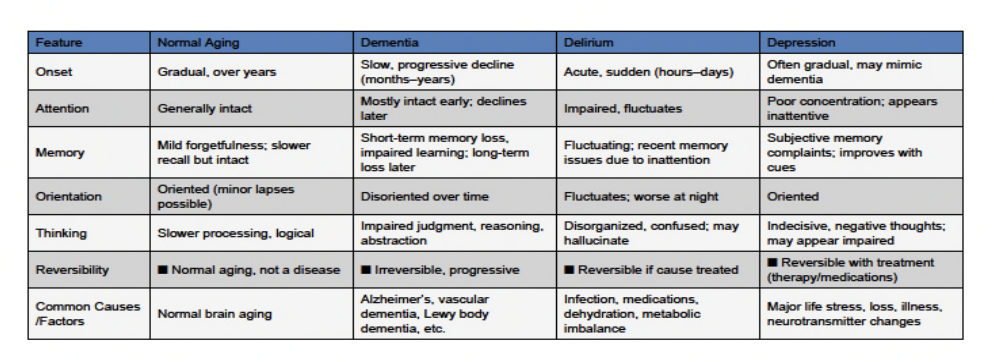
FEATURE COMPARISONS
Normal Aging vs Disease/Disorders
Normal Aging: Gradual onset, mostly intact attention, mild forgetfulness with slower recall, minor orientation lapses, logical processing
Dementia: Slow, progressive decline, mostly intact early stages but declines in later stages, greater short-term memory challenges, disorientation over time, irreversible
Delirium: Acute onset, fluctuating attention, worse at night, disorganized, caused by treatable conditions (e.g., infections, medications)
medical emergency
Depression: Gradual onset resembling dementia, treatment can reverse symptoms, influences cognitive focus and positive attitude
CHANGES TO THE MIND: INTELLIGENCE AND LEARNING
Basic intelligence generally stable with maintenance of crystallized intelligence but may decline in fluid intelligence
fluid intelligence may decline
think abstractly and adapt to new information
decisioning remains strong even though problem solving may weaken
Learning abilities remain intact with preference for relating new information to past knowledge
older adults need repeated exposure in order to retain that information
learn better when they can relate new concepts to what they already know
ATTENTION SPAN CHANGES
Diminished vigilance, increased distractibility, and difficulties in multitasking noted
older adults have difficulty sustaining attention over long periods
affect driving, tasks that require ongoing monitoring
background noises, multiple conversations can interfere with their focus
multitasking can become much more difficult as well
NURSING IMPLICATIONS OF AGE-RELATED CHANGES
Understanding age-related changes critical for nursing practice
Focus on emphasizing capabilities and assets of older adults
NURSING ACTIONS RELATED TO AGE-RELATED CHANGES
Prevent dehydration and ensuring proper temperature regulation to maintain comfort
Encourage prescribed medication adherence and establish a toileting schedule
prevents UTI’s
Promote safety measures to prevent falls and manage physical exertion and rest periods
drug metabolism
kidney or liver
KEY RISK PATTERNS
Common patterns include:
FALLS
age-related challenges, balance, any mobility change should go back to fall risk interventions
INFECTION
MEDICATION TOXICITY
metabolism, renal clearance, presents a bigger risk for adverse effects
FUNCTIONAL DECLINE
ADL’s
NURSING ASSESSMENT PRIORITIES
Evaluate functional changes and assess subtle cues that indicate risks
pay attention to changes that are often overlooked
FUNCTION BEFORE DIAGNOSIS
CLINICAL REASONING IN OLDER ADULTS
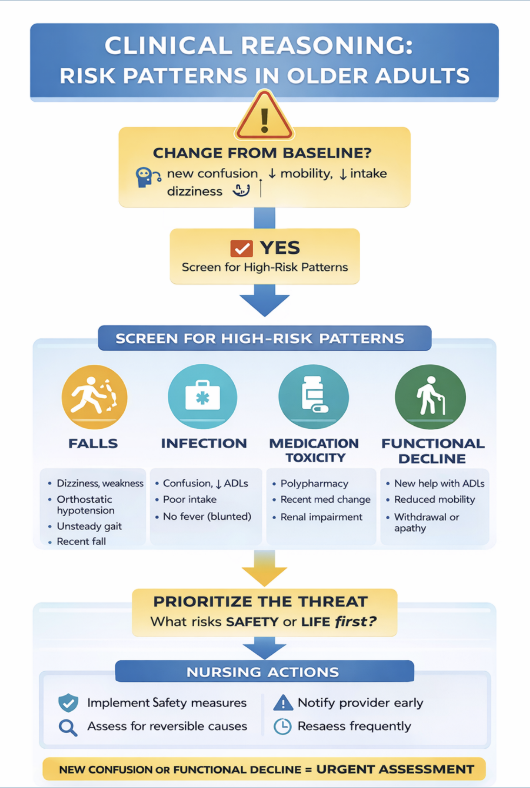
Identifying risks: Changes from baseline in mobility, cognitive status, intake and symptoms can indicate issues
Prioritize patient safety and functional capabilities over everything else
CASE EXAMPLES AND QUESTIONS
Questions based on scenarios:
Assess an 81-year-old presenting with weakness and confusion
Prioritize assessment of an older adult with new confusion and decreased mobility
Assess risks for falls, infections, and other complications
MEDICATION CONSIDERATIONS AND NURSING GOALS
Be aware of polypharmacy risks, altered drug metabolism, and potential adverse effects
Ensure nursing goals focus on safety, pain management, and preserving mobility
Even standard doses can lead to medication toxicity
PROMOTING MOBILITY
Importance of early movement and collaboration with physical therapy for optimal patient outcomes
INFECTION PREVENTION STRATEGIES
Essential measures include vaccinations, early recognition of symptoms, and patient education
confusion without fever = infection
PATIENT EMPOWERMENT
Facilitating older adults' autonomy and allowing them to partake in their care decisions promotes self-care and empowerment
GERONTOLOGICAL NURSING ROLES
Advocating, educating, and coordinating care for older adults
FINAL TAKEAWAYS
Aging process leads to increased vulnerability, not an inevitable decline in health
aging does not lead to disease
The proactive role of nurses in preventing complications and taking early action can save lives.
if unsure of an answer, choose whatever protects patient safety