Gravitational fields
Gravitational Potential and Orbital Motion
Work done is:
Positive when the displacement is in the same direction as the force
Negative when the displacement is in opposite direction to the force
Zero when the displacement is perpendicular to the force
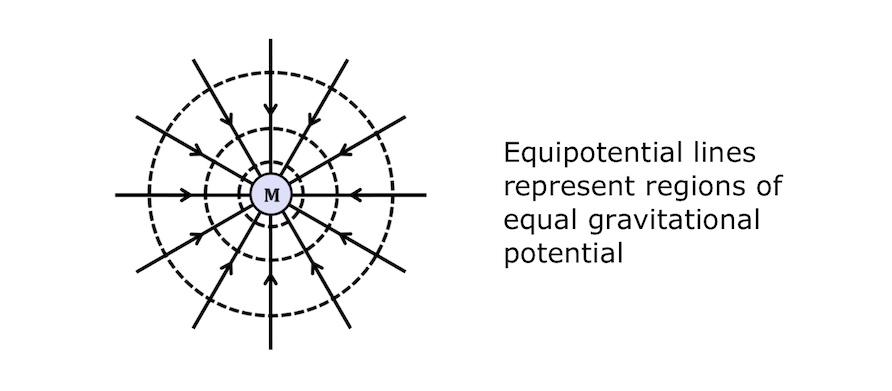
Zero work is done as we move an object along one of these equipotential lines
ΔGPE = mgΔh only in a uniform field
IN A RADIAL FIELD:
Gravitational Potential:
This is the work done to bring a unit mass from infinity to a defined point in the field
V = -GM/r
where V = Gravitational potential (Jkg∧-1)
G = gravitational constant
M = mass of object producing the field
r = distance from the centre of the object
By convention, the formula is negative because the object is moving away from the field lines
The maximum value of GPE is 0 (at infinity)
Gravitational Potential Energy (Ep)
Ep = - GMm / r
Small m is there because it's no longer a unit mass
Graphs we need to know
Gravitational Potential against Distance
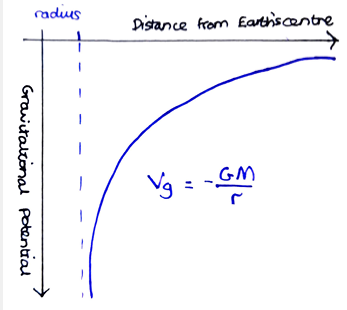
The graph is always negative
The tangent to the curve at any point is the gravitational field strength, g at that point.
Gravitational Field Strength against Distance
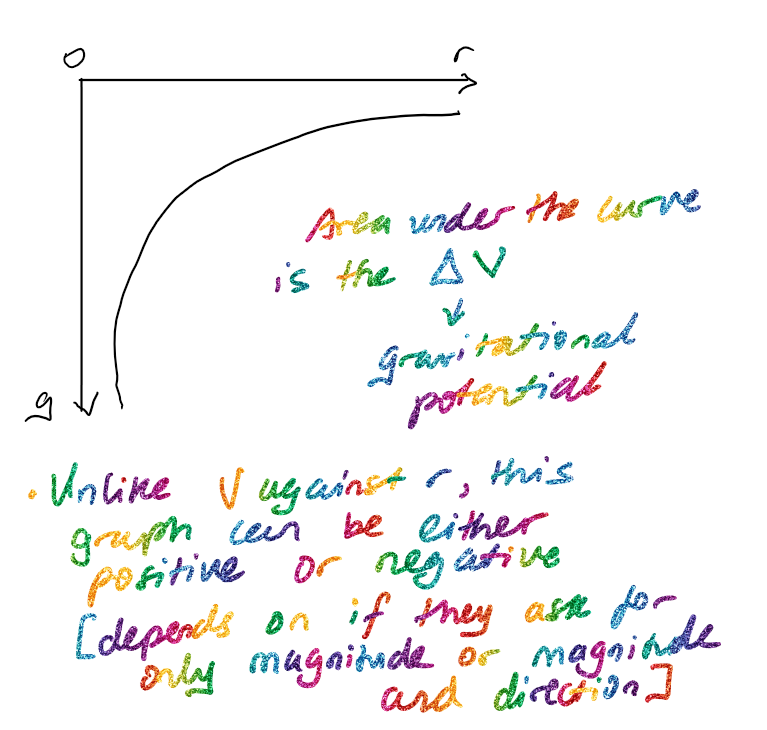
Force Distance Graph
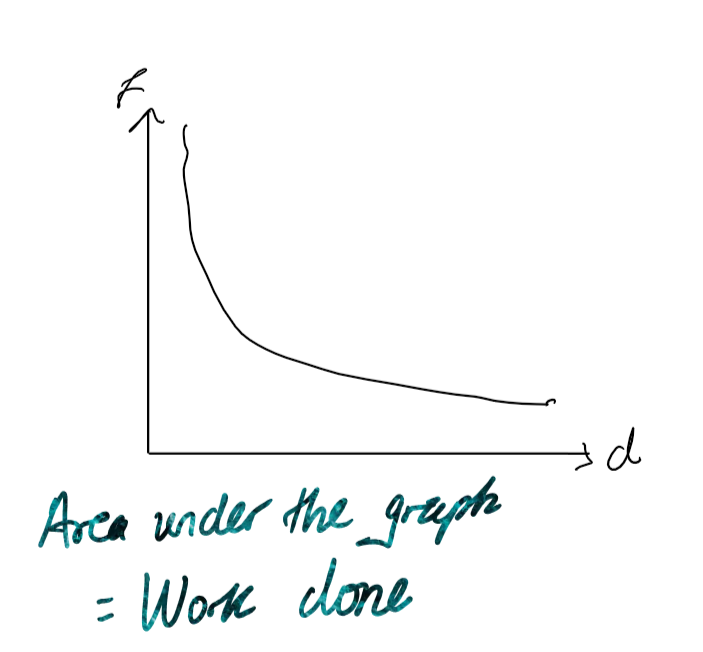
ALL THESE GRAPHS ARE INVERSE GRAPHS
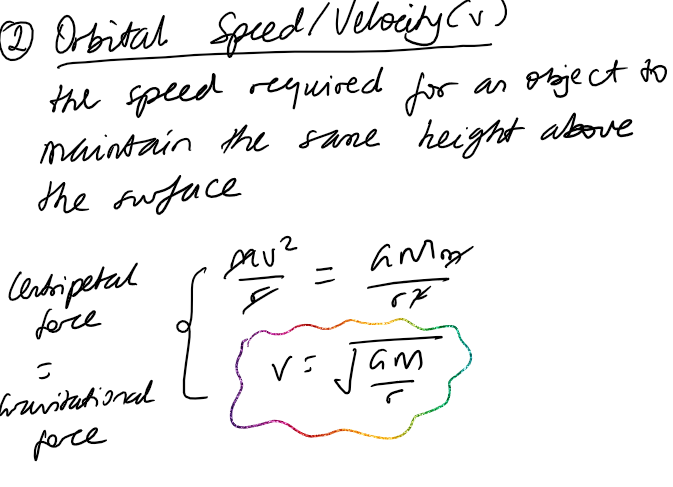
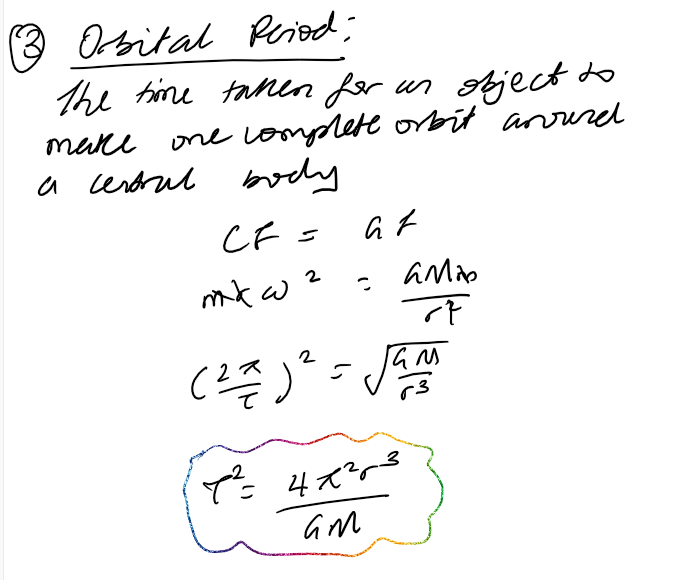
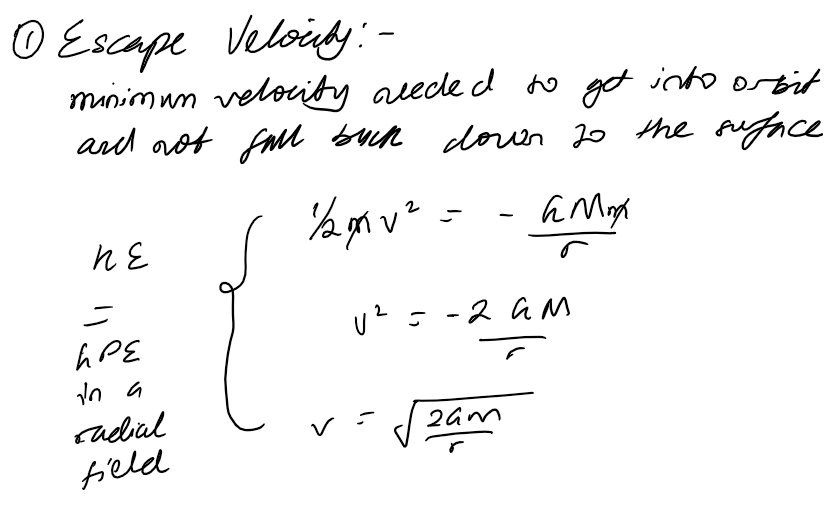
Derivations
Geosynchronous orbit
Also known as inclined orbit (at an angle to the equator)
Geosynchronous satellites orbit around the planet at the same speed at which the planet rotates around its axis.
If the satellite is orbiting Earth, the orbital period is 24 hrs
Geostationary Orbit
Positioned above the equator
Also orbits around the planet at the same speed at which the planet rotates around its axis.
If the satellite is orbiting Earth, the orbital period is 24 hrs
The satellite appears stationary from a position on Earth and will be visible all day