The decline of Feudalism
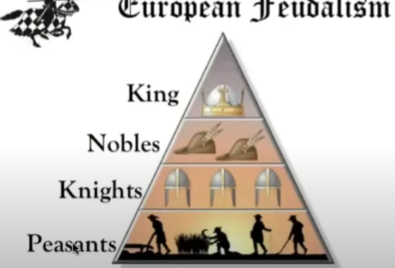
==feudal system==: a strict social system in which landowners grant people land or other rewards in exchange for military service or labor
Political changes
@@Henry II’s legal reform@@: people could no longer simply be jailed or executed for no legal reason but had to go through a court trial as well.
- strengthened English common law and the role of judges and juries.
%%Heabus corpus%%- no free man” could be jailed except by the lawful judgment of his peers or by the law of the land. an accused person cannot be jailed indefinitely without being charged with a crime.
%%Magna Carta%%- “the Great Charter” in Latin
- a written legal agreement signed in 1215 that limited the English monarch’s power
@@King John@@
- lost most of the lands the English had controlled in France.
- taxed his barons heavily and ignored their traditional rights, arresting opponents at will.
In June 1215, angry nobles forced a meeting with King John in a meadow called ==Runnymede==, beside the River Thames, outside of London.
There, they insisted that John put his seal on a document called %%Magna Carta%%
- established the idea of rights and liberties that even a monarch cannot violate.
King Edward 1st and the Model Parliament
%%Model Parliament%%- a governing body that included commoners and lower-ranking clergy, as well as high-level Church officials and nobles.
Disease outbreak
Bubonic Plague: a deadly contagious disease mostly responsible for the Black Death of the 1300s
%%the black death%%
- the term came from black-and-blue swellings that appeared on the skin of victims.
- dirty living condition
- transmitted by fleas living on infected rats
Symptoms: fever, vomiting, fierce coughing and sneezing fits, and egg-sized swellings or bumps, called buboes.
Effect of the outbreak
- powershift from nobles to common people
- peasants demanded a higher wage
- peasants abandoning feudal manors and moving to towns and cities for better opportunities, weakening the manor system and a loss of power for feudal lords.

The hundred years’ war
- a series of battles fought between France and England from 1337 to 1453
- contributed to the decline of feudalism by helping to shift power from feudal lords to monarchs and to common people.
- heavy armor causing difficulty moving when not on horseback
- weapons: sword, lances, crossbows
- lightly armored
- weapons: longbows - fired more quickly, arrows flew farther, faster, and more accurately, and could pierce the armor
- allowed the English to defeat the much larger French force
- recruited from common people that were paid
1415, the french started resistance
- using modern tactics, and also recruited an army from commoners by paying them with money collected by taxes just like how the English did.
- a new sense of national identity and unity inspired by Joan of Arc.
@@Joan of arc@@- a 17-year-old peasant girl
- claimed that she heard the voices of saints urging her to save France.
- Disguised as a boy, she put on a suit of armor and set out to fight.
- led a French army to victory in the Battle of Orléans in 1429.
- The English pushed certain Church leaders to accuse Joan of being a witch and a heretic (a person who holds beliefs that are contrary to a set of religious teachings) and to burn her at the stake.
- roman catholic church made her a saint 500 years later
impact on the hundred years’ war:
- changes in military technology reduced the need for nobles’ knights and castles.
- Castles also became less effective as armies began using gunpowder to shoot iron balls from cannons that were capable of blasting holes in castle walls.
- long bows
- The new feeling of nationalism also shifted power away from lords.
- English and French peasants felt more loyalty to their local lords than to their monarchs.
- created a new sense of national unity and patriotism on both sides.