Unemployment Unit 5
Learning Objectives for Unemployment (Unit 5)
By the end of this unit, students should possess the following competencies:
Define key terms relating to unemployment, including labor force, unemployment rate, discouraged workers, and labor force participation rate.
Identify and distinguish between workers who are classified as unemployed versus those who are considered not in the labor force.
Discuss and analyze key historical and recent trends in the unemployment rate and the labor force participation rate.
Contrast the differences between procyclical, countercyclical, and acyclical unemployment.
Explain fluctuations in the labor market using both graphical models and economic intuition.
Identify the three distinct types of unemployment (frictional, structural, and cyclical) and explain the specific reasons why each arises.
Define the concept of the natural rate of unemployment and its role in long-run economic assumptions.
The Basics of Unemployment and Formal Definitions
To determine the status of individuals in the economy, we first define the criteria for the working-age population and labor status.
The Labor Force
- a person is included in the working-age population if they meet the following specific criteria:
They are years of age or older (there is no upper age limit).
They reside within the states or the District of Columbia.
They are not an inmate of institutions, such as penal facilities, mental facilities, or homes for the aged.
They are not on active duty in the Armed Forces.
Employment Status
An individual is classified as employed if:
They have a full-time job.
They perform temporary part-time or full-time work during the survey week.
Unemployment Status
An individual is classified as unemployed only if they satisfy all three of the following conditions:
They do not have a job.
They are available to work.
They have been actively looking for a job in the last four weeks. "Actively looking" is defined as specific actions such as contacting firms, sending out resumes, and applying to job vacancies.
Measures and Mathematical Calculations of Unemployment
Fundamental Formulas
Labor Force: Calculated as the sum of all employed and unemployed individuals.
Unemployment Rate (): The number of unemployed persons divided by the total labor force.
Different Measures of Unemployment (U1 through U6)
The Bureau of Labor Statistics uses several measures to capture different nuances of labor underutilization. While these rates differ in magnitude, they tend to move together over time, implying that the specific measure used is less important than maintaining consistency across time for comparative analysis.
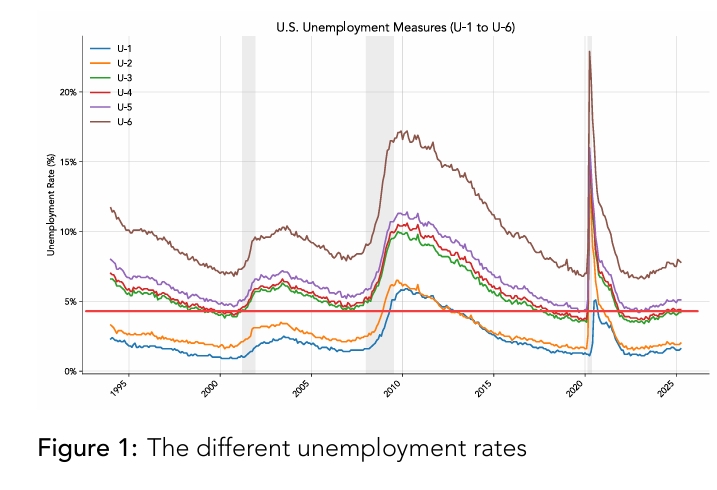
U1: The percentage of the civilian labor force that has been unemployed for weeks or more.
U2: The unemployment rate representing job losers and persons who completed temporary jobs, expressed as a percentage of the civilian labor force.
This includes U1 plus those who have finished temporary assignments.
U3: The official unemployment rate.
U4: All individuals in U3 plus discouraged workers.
Discouraged workers are a subset of marginally attached workers who have given up looking for a job specifically for a job-market related reason but would like a job if offered one.
U5: All individuals in U4 plus marginally attached workers.
Marginally attached workers are people who are currently neither working nor looking for work, but indicate they want and are available for a job and have looked for work in the recent past.
U6: All individuals in U5 plus total individuals employed part-time for economic reasons.
Part-time for economic reasons refers to persons who want and are available for full-time work but have had to settle for a part-time schedule.
We can see in figure 1 that the unemployment rates trend together.
Implication: It does not matter which unemployment rate you use, as long as you are consistent across time. Why?
Economic Significance and Labor Force Participation
Why Unemployment Matters
High or low unemployment rates serve as symptoms of broader economic health:
High or Low Unemployment: is a symptom of inefficiency
High unemployment: many resources are idle because there are fewer job opportunities available than individuals seeking work.
Low Unemployment: Can indicate labor shortages, where excessive resources are wasted trying to recruit scarce workers.
Welfare Implications: Unemployment reduces the overall welfare of the affected individuals, particularly those unemployed for long durations. Effects include low physical and mental health (anxiety, low self-esteem, low life satisfaction), which persist even after controlling for the loss of income.
Labor Force Participation Rate (LFPR)
In the Labor Force: Comprised of the Employed and the Unemployed.
Out of Labor Force: Individuals of working age who do not have a job and are not looking for one. Examples include:
Retired workers.
University students.
Stay-at-home parents.
Working-Age Population Calculation:
LFPR Formula:
Trends in Labor Force Participation
1965–2000: The overall LFPR increased significantly, primarily driven by the substantial entry of females into the labor force.
2000–2015: The overall LFPR decreased. This was due to a leveling off of female participation and a continued decline in male participation.
Causes for Recent Declines:
The aging and retirement of Baby Boomers.
Disability: of prime-age males who left the labor force are on disability.
Opioid Use: Painkiller prescriptions are estimated to explain of the decline in male participation and of the decline in female participation.
Implications: Reduced participation may create labor shortages, leading to questions about how to attract workers back into the workforce.
Analyzing the Unemployment Rate and Business Cycles
Historical Context
Unemployment rates typically increase during recessions.
Between and more recent years, unemployment has varied between approximately and .
The historical average unemployment rate sits between and , though it has been falling in recent periods.
Business Cycle Definitions
Focusing on the relationship between variables and the business cycle (GDP over time):
Procyclical: A variable that increases during economic expansions and decreases during recessions.
Countercyclical: A variable that increases during recessions and decreases during expansions (e.g., the unemployment rate).
Acyclical: A variable that does not vary with the business cycle.
Duration of Unemployment
Short-term (< 5 weeks): This is strongly procyclical.
Medium-term (5–14 weeks): This represents approximately of the unemployed population and is weakly countercyclical or acyclical.
Medium-term (14–26 weeks): This represents approximately of the unemployed population and is weakly countercyclical or acyclical.
Long-term (27+ weeks): This status is strongly countercyclical.
The Labor Market Model
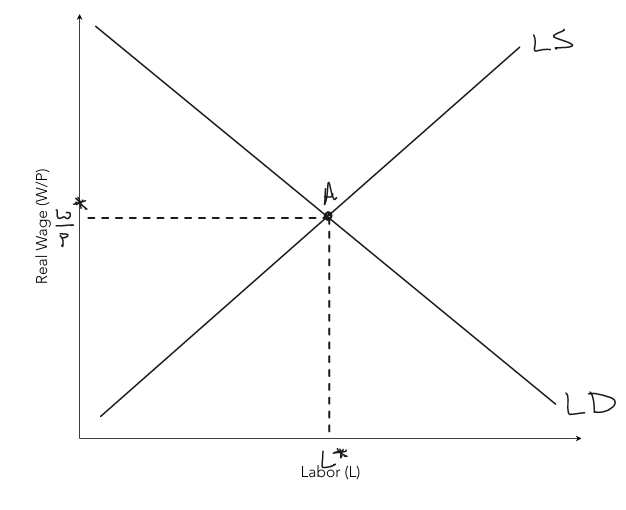
The labor market functions similarly to other markets with supply and demand.
Labor Demand ()
Represented by firms wanting to hire workers considering the number of jobs available.
Falling in the wage: as the wage increases firms want to hire few workers
W = P - MPL
Basis: This is due to the diminishing marginal product of labor (). Firms hire until the real wage equals the marginal product: .
The labor demand curve is downward sloping.
Labor Supply ()
LS: the number of workers looking for jobs.
Increasing in the wage: as the wage increases, more people want jobs.
The labor supply curve is upward sloping.
Equilibrium
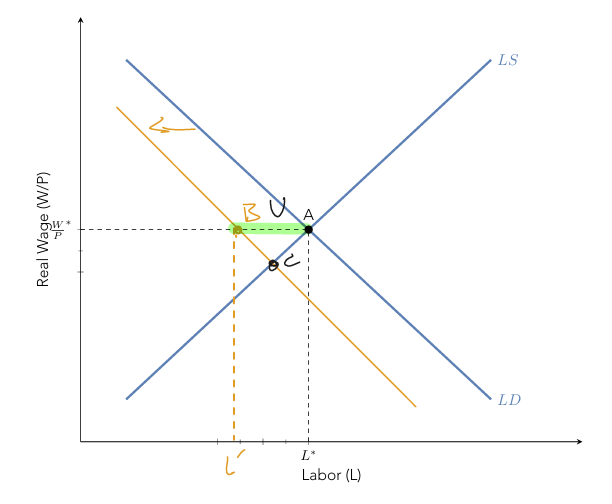
Labor Market Equilibrium: Occurs where the quantity of labor demanded (number of jobs) equals the quantity of labor supplied (number of workers seeking jobs).
This is marked as point with equilibrium labor and real wage .
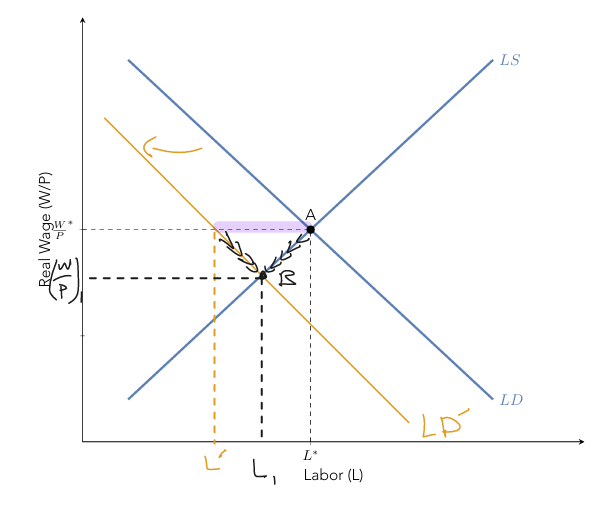
Consider a fall in labor demand.
This will cause the labor demand curve to shift left.
As the original real wage (w/p), there will be a surplus of labor (unemployment).
The number of unemployed is U = (L) - L
The unemployment rate is U = U/L
Eventually, the labor surplus will cause the real wage to fall to (W/P)
Why? The unemployed workers earnings 0 dollars, so some of them would be willing to accept a lower wage than they were making before, this will cause firms to hire more workers.
We have a problem: when the labor market is in equilibrium (either at point A or point B),how much unemployment is there?
– zero workers are unemployed: in equilibrium everyone who wants a job, has a job.
• In this model, any unemployment will be very temporary.
–In our graph above showing unemployment durations, this model might explain people who are unemployed for less than 5 weeks, but it definitely does not explain why anyone would be unemployed for 27+ weeks.
•So, why is there unemployment?
The Three Types of Unemployment
There are 3 types of unemployment:
Frictional unemployment
Structural unemployment
Cyclical unemployment
1. Frictional Unemployment
Results from people switching jobs.
Individuals are unlikely to accept any offer immediately; they seek the "right" job (correct salary, location, benefits, etc.).
Finding the "right" job takes time (friction). During this period, the worker is frictionally unemployed.
Crucially, the job and a vacancy actually exist; it just takes time to match the worker to the job.
Duration: Short-term ( weeks or weeks).
2. Structural Unemployment
Results from a fundamental change in the structure of the economy where there are not enough jobs for people with specific skill sets.
Because structural unemployment occurs due to a lack of jobs, we sometimes refer to it as rationing unemployment.
Causes to structural unemployment:
Technological change that permanently reduces demand for certain workers.
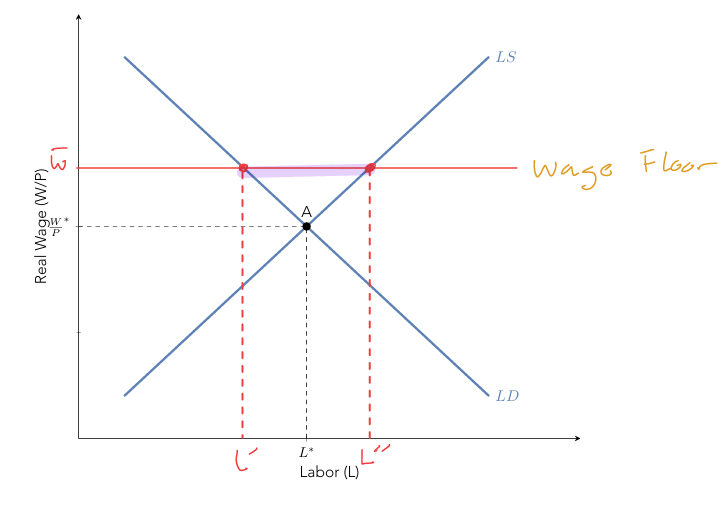
Wages kept above the equilibrium level due to minimum wage laws, labor unions, or efficiency wages.
Wage Floors: When wages are held above equilibrium, more people want to work than there are jobs available, creating persistent unemployment.
Duration: Long-term ( weeks).
What can be done about structural unemployment?
Typically, the only thing that can be done to combat structural unemployment is retraining.
3. Cyclical Unemployment
The part of unemployment that happens because the economy is in a downturn or recession.
These fluctuations occur during the business cycle and can persist for long periods.
Sticky Wages and Cyclical Unemployment
Sticky Wages: where wages are slow to adjust to changes in labor market conditions, often remaining above equilibrium and contributing to unemployment.
Reasons for Stickiness:
Social or implicit contracts.
Explicit contracts (e.g., union agreements).
Relative wages (workers resist wage cuts if they feel their pay is dropping relative to others).
The Natural Rate of Unemployment and Wage Rigidity
The Natural Rate
Frictional and structural unemployment are treated as fundamental parts of the economy that do not vary significantly over time.
Meaning, these are not things that we think of varying over time.
The sum of frictional and structural unemployment is what we call the natural rate of unemployment.
Formula:
We assume that the unemployment rate fluctuates around the natural rate of unemployment.
The actual unemployment rate fluctuates around this natural rate.
In the long-run, the economy is assumed to return to the natural rate of unemployment.
Impact of a Negative Demand Shock:
Labor demand shifts to the left.
However, if wages are not downwardly mobile, the real wage does not fall but remains (w/p)
This creates cyclical (persistent) unemployment in the short run.
Long-run Recovery: Eventually, labor demand may recover, or if individuals stay unemployed long enough, they may eventually become willing to accept lower wages, allowing the market to adjust.