Adolescence
Adolescence
Adolescence starts at the first period (menarche) for girls and first ejaculation (spermarche) for boys; biological changes happen before this, and social changes happen independently
Ending at the point of having a stable, independent role in society, but when is that?
Adolescence can be considered the process of a child becoming an adult, and many cultures mark this change in a deliberate way
Biological and physical changes
Physical changes characterize puberty. In general, sex differences become more obvious.
Puberty onset
Wide individual differences
Partly genetic
Partly environmental
Body build (short/stocky mature earlier than slimmer/leaner shapes)
Puberty happens on average 1 year younger than 100 years ago (Fisher & Eugster, 2014)
Decreasing gray matter (cells/synapses)
Increasing white matter (myelin)
Substantial growth spurt + changes in fat distribution (adiposity)
A steady increase in levels of sex hormones >> increasing variation over the menstrual cycle
Height: steady growth in school years (5-6 cm per age)
Adolescent growth spurt:
Increases early on in puberty
Falls sharply at adulthood
Growth spurt is independent of previous height
Approximately 35% of the variation in adult height is due to the growth spurt
Psychological aspects of puberty
Body image- least satisfaction during puberty
Girls tend to report less satisfaction than boys
Increased hormone levels related to emotional changes
Mood swings are common
Feelings are more intense
Increased anger and irritability, moments of low mood
Feelings of sexual attraction
Two key theories of parent-teen relationship change
Disengagement: adolescents individuate from their parents (e.g., Freud, 1946), becoming more emotionally and behaviorally independent (Steinberg & Silverberg, 1986)
Continuity and transformation: psychological independence occurs but with continued connectedness (Youniss & Smollar, 1985; Grotevant & Cooper, 1986)
Testing this…Larson et al., 1996
• 220 middle & working-class adolescents from the Chicago suburbs
• The vast majority lived with both biological parents (N = 176)
• Data from 10 - 18 yr olds
• Carried pagers and provided reports at random times 7/8 times per day when signaled (ESM Experience Sampling Methodology)
• Not in school, not sleeping!
• Reported who, what, where, emotional state, friendliness of partner, "leader" of interaction
Larson et al., 1996: Results – Time spent with family
• Oldest adolescents spent less than half the time with family than the youngest
• BUT time alone with parents did not decrease
• NO correlation between time spent with family members and quality of family relationships
Larson et al., 1996: Results – Affect during interaction
• Adolescents’ affect with family was more negative in early adolescence
• Then less so in later adolescence
• Interaction of gender
• Boys and girls both show early drop in positive affect with families
• Decrease in positive affect appeared to last longer for girls
Larson et al., 1996: Conclusions
Evidence for both theories
Disengagement:
• Total QUANTITY of time adolescents spent with family decreased
• But, due primarily to other pulls (being alone, being with friends)
• Not storm & strife within the family
Continuity & transformation:
• Continued to spend time with each parent alone (maintaining intimacy?)
• "talking time" did not decrease
• Increased view of self as leader of interactions
Affect changes, particularly for talking directly – picked up again in later adolescence
Changes are relatively small (on average)
Teenage Identity Crisis: Erik Erikson (1902-1994)
Eight stages, each with a specific "crisis" to resolve…
In adolescence – “crisis” is identity, defined as “confidence in one’s inner continuity amid change” (Erikson, 1968).
Men seen as needing to achieve a stable identity prior to intimacy, whereas women's identity defined through her intimate roles of wife and mother…
Crisis = decision
Marcia: Identity Statuses (1980; 1987;1994)
“Erikson operationalized”
Marcia categorized people across domains (social, political, religious, vocational)
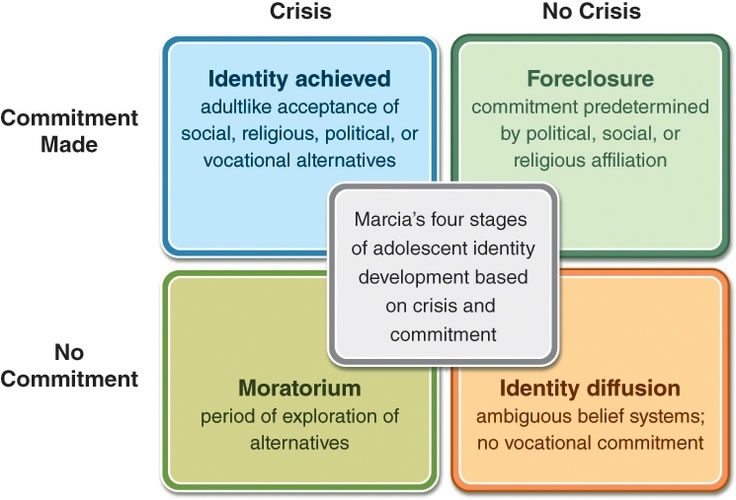
Marcia more about within domain, and about in and out of status…
e.g., going between moratorium and achievement is common ("MAMA" cycle; Archer, 1989)
Adolescence as a period of turmoil or “storm and stress” (in Berk, 2018, also Smith et al., 2015)
• Adolescents go through psychological or psychosocial “moratorium,” experiencing temporary suspension/delay from adult commitments
• They can try out different aspects of their identity without finally committing to it (e.g., temporarily adopting different religious beliefs, changing views about vocations, etc.)
• After this: a more stable/consolidated sense of identity is achieved
There are reasons why the sense of identity changes:
- physical changes/affect body image/physical self
- decision on the pattern of sexual relationships
- choices regarding vocations (society expects these)
- political preferences (18 years)
Adolescence: a period of turmoil or “storm and stress”
1) Adolescents do not experience moratorium status in different topics or domains at the same time (e.g., vocation, religion, political views)
2) Crisis can occur throughout adult life; identity development, for example, in early adult years
3) changes in identity and self-esteem: more gradual (e.g., Savin-Williams and Demo, 1984)
4) Not necessarily a “crisis”: for many, it is not traumatic (more exploration then commitment)
• In Adolescence: there are stresses that are particular to this period (in Smith et al., 2015, see also Arnett, 1999):
- conflict with parents
- mood disruptions
- risk behavior
Conflicts with parents
• Research across diverse cultures: rise in parent-child conflict in puberty, persists into mid-adolescence (e.g. Gure et al., 2006, McGue et al., 2005)
• Some conflicts: regarding readiness to take on new responsibilities; often: everyday activities
• Some evolutionary/adaptive suggestions (physically leaving the family); in modern world: psychological distancing
Overall: parents and younger adolescent children agree on many things; disagreement is possibly exaggerated, but there is huge individual differences
Other research/summary of findings: “Contemporary studies have established that conflict with parents increases in early adolescence, compared with preadolescence, and typically remains high for a couple of years before declining in late adolescence.” (Arnett, 1999, p.319)
Mood disruptions
Larson & Ham (1999):
• 10-14-year-olds: electronic pager for 1 week (signals to record mood; also: life-event questionnaire)
• Results: 10-11-year-olds reported less negative affect than 12-14-year-olds; these were related to events with family, school, and peers
Relations with peers and risk-taking behaviors
• Adolescents: become less dependent on parents and spend more time with peers (social support and identity)
• Evidence suggests: conformity with peers (in particular regarding antisocial situations): increases up to early adolescence, then declines
• Friendship is important (reciprocal relationship with parents: more “unilateral authority”)
Neurological changes and the social brain (Blakemore, 2008)
One of the most dramatic brain changes – the prefrontal cortex is proportionally bigger in humans than any other species
High-level functions:
• Planning
• Decision making
• Emotion regulation
• Inhibiting behavior
• Social interaction
• Understanding others
• Self-awareness
Dramatic Pre-frontal cortex (PFC) changes in adolescence
• Proliferation of synapses in late childhood
• Then decline in grey matter (or synaptic) density in adolescence, synaptic ‘pruning’ – elimination of weaker synaptic connections
• A little later for boys (likely pubertal timing association)
• Likely fine-tuning in adolescence such that:
• More specific regions respond to more specific stimuli while overall efficiency enhanced • Undergoing greatest reorganisation are areas associated with e.g., response inhibition, risk and reward calibration, emotion regulation
• Full maturation not complete until 20s (maybe even 30s)
Neurological changes and the social brain
• Limbic system (‘emotional brain’) develops earlier than the full maturation of the PFC (‘thinking brain’)
• Common analogy is a car: Fuel and motivation to drive fast but no brakes!
• Evolutionary reasons for adolescents to take risks, seek rewards, affiliate with peers, and crave sensations?
• Survival! Find food, shelter, a mate…and leave the parental nest
Avoiding Social Risk in adolescence (Blakemore, 2018)
• Teenagers are often portrayed as indulging in risky behaviours (drinking, smoking, risky driving & sex)
• Traditional view that teenagers impetuous & poor self control & planning.
• Neuroscience doesn’t really support this.
• Instead Blakemore proposes social risk of being rejected by peers outweighs other negative outcomes, such as threats to one’s health or the prospect of getting caught
• Peer influence can lead to prosocial as well as anti-social behaviors…
Brain Activity
• Brain regions involved in risk-taking are more activated in teenagers when they are with their friends, than alone
• This effect is not seen in adults
The new research: support for advocacy
• The importance of the language that we use (adolescents: risktakers or a time to take risks?)
• 10-19 year olds are a VERY diverse group, and age is a proxy for defining adolescence!
• Need to think along the life-course
• Interventions in the first decade will not ensure healthy transitions to adulthood at the end of the second decade: for many adolescents the second decade may be a time for second chances
• Essential to focus on individual adolescents and their environment
• The new research confirms, corrects and challenges current policies and programs
The new science confirms
• Adolescents take risks: their brains are ready to take risks, and societies want young people to take risks!
• Adolescents are influenced by their peers and want to be part of “the group”
• It’s not just about knowledge: the importance of life skills and executive functions
• Limit access to highly rewarding substances
• Support for scaffolding approaches that respond to the changes taking place (e.g. graduated drivers licences)
• Support for more integrated programming: need to focus on a range of problems that are often inter-related and in which similar pathways in the brain are activated
What does the evidence suggest?
• A need to move beyond the individual focus: epigenetics stresses the importance of also focusing on the environment
• Move beyond trying to prevent risk behaviours: the importance of harm reduction interventions - opportunities for safe risk taking
• “You will get cancer in 30 years” type messages not likely to be effective
• Questions the rationale for punishment-based interventions: adolescents more motivated by reward (and if their emotions are touched)
• Contributes to discussions about informed consent, mature minors and human rights: need to make sure that we have systems in place that really support the “best interests” of adolescents