Social Thinking & Behaviour 1 - Sep 30th
Overview of Social Psychology
Definition: The scientific study of how people's thoughts, feelings, and behaviors are influenced by the actual, imagined, or implied presence of others.
Importance: Social interactions are pervasive in daily life, often shaping our thoughts and actions.
Examples of Social Situations: Being in a lecture theatre is a social context, influenced by the ideas and structures created by collective thought.
Historical Context
Gordon Allport's Definition:
Social psychology studies how people's thoughts, feelings, and actions are affected by others around them, whether those people are actually present or just in our minds.
This is an example of Individual-focused thinking in Social Psychology ↑
Allport's view: Focused on the individual in social contexts.
Lewin's perspective:
Focuses on how relationships between people matter in social situations. He believed that the group or environment (the social context) is more important than just looking at individuals on their own.
This is an example of Relational-focused thinking in Social Psychology ↑
Understanding Social Interactions
Gestalt Illusion: Illustrates how individual perceptions can create a collective meaning or picture.
Two Types of Thinking in Social Psychology:
Individual-focused: Concentrates on the person (internal attributes).
Relational-focused: Explores the significance of interpersonal connections and context.
Lewin's Equation:
Behavior Equation: Behavior = Person + Environment
Emphasizes the interplay of individual traits and environmental factors in determining behavior.
Areas of Focus:
Personal aspects: Mood, beliefs, motivations, stereotypes, and personal health.
Environmental aspects: Social customs, crowd behavior, politics, relationships.
Application
Lewin's equation can be used to understand a variety of behaviors, including how to adopt a healthier lifestyle. For example, someone trying to adopt a healthier lifestyle will need to consider both their own factors, like motivation and knowledge, and environmental factors, like access to healthy food.
The Complexity of Social Behavior
Social psychology investigates everyday phenomena like interpersonal interactions and questions like "Why did they do that?"
Continuous question: Understanding underlying motivations and actions in social contexts.
Previous experiences, motives, personalities, people’s environments are all different
Social Cognition
What is Social Cognition?
Social cognition is the process of perceiving, interpreting, and responding to social information. It's a set of mental abilities that help people develop social skills and adapt to their environment.
Modes of Social Cognition: Two poles — Controlled processing (slow, deliberate thought) and Automatic processing (fast, intuitive reactions).
The tendency for cognitive biases favoring oneself during evaluations of social behavior.
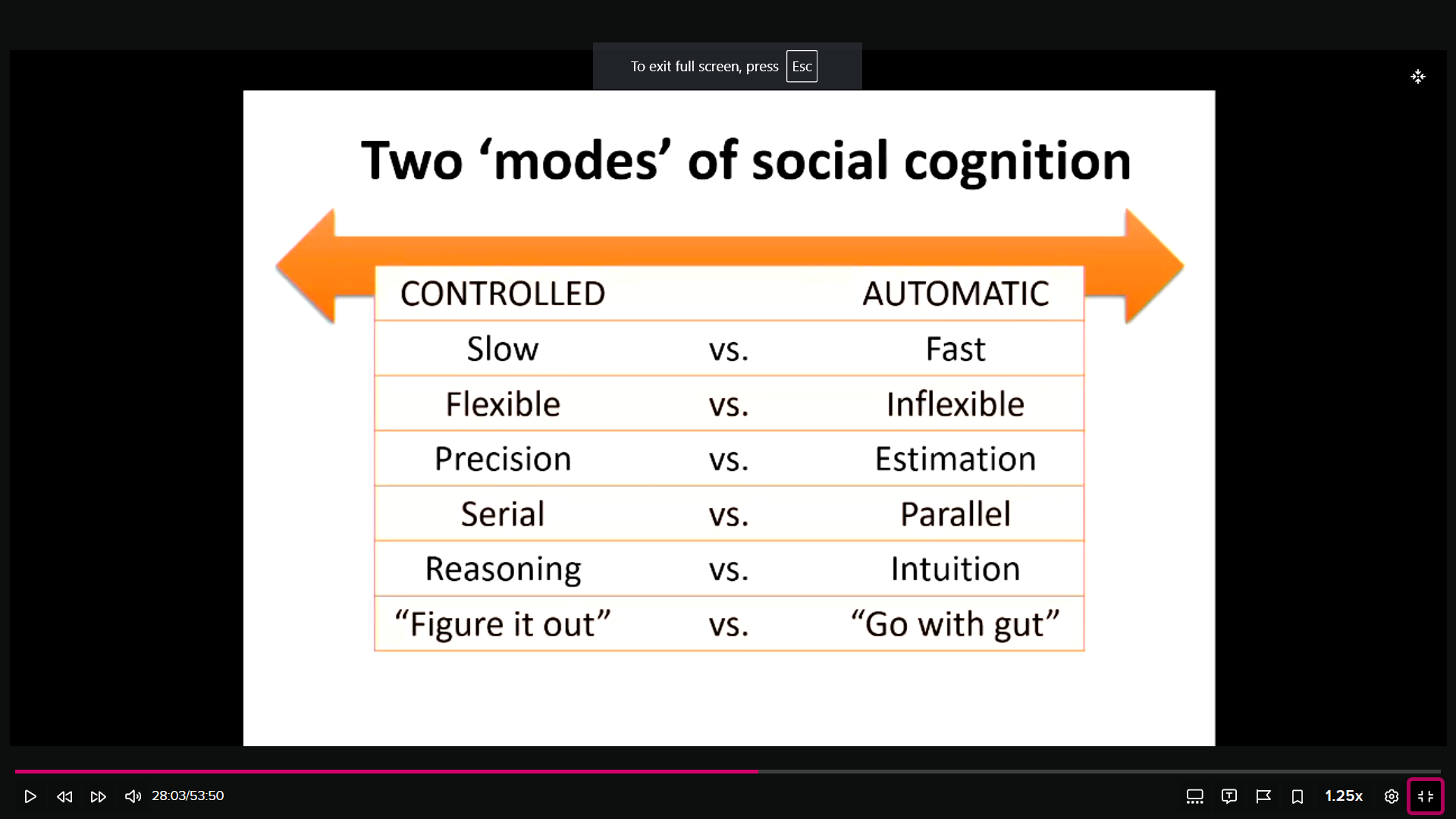
Social Cognition (harmoniously interacting with other people in society) requires both!
Attribution Theory
Explains how we attribute causes to behavior, either internal (personal) or external (situational).
Example: Feeling sleepy could be attributed to lack of sleep (internal) or a boring lecture (external).
Dimensions of Attribution: (Weiner's 2D Model)
Internal vs. External: Factors attributed to oneself vs. environment.
Real-Life Examples Based on Weiner's 2D Model
Internal Stable: The student thinks, "I'm just not good at math," attributing their performance to a consistent lack of ability.
Internal Unstable: The student believes, "I was tired and didn't prepare enough for this test," attributing it to a temporary state of fatigue and preparation.
External Stable: The student argues, "The teacher's exams are always too difficult," attributing their score to the consistently challenging nature of the assessments.
External Unstable: The student thinks, "I didn’t understand this specific topic that was only covered in the one class I missed," pinpointing a temporary external factor that affected their score.
Fundamental Attribution Error
Definition: The tendency to attribute others' actions to their character rather than situational factors.
Example: Judging someone driving fast on the freeway as reckless without considering external factors (like an emergency).
The Jones and Harris Study: Participants assumed authors of pro-Castro essays supported Castro, regardless of being assigned the topic.
Cognitive Biases and Their Impacts
Our perceptions of others' behaviors are often biased.
Successes are often attributed internally, while failures are attributed to external circumstances.
Invoking shortcuts in reasoning and descriptions often leads to internal trait attributions over situational explanations.
Closing Thoughts
Social interaction complexities require nuanced understanding beyond superficial attributions.
Understanding social psychology enhances interpersonal relationships, vital for health and well-being.
Professor Kahneman's Advice: Delve deeper into psychological concepts and avoid taking constructs at face value.