CASE STUDIES
Malaria (Protozoan)
Brief History
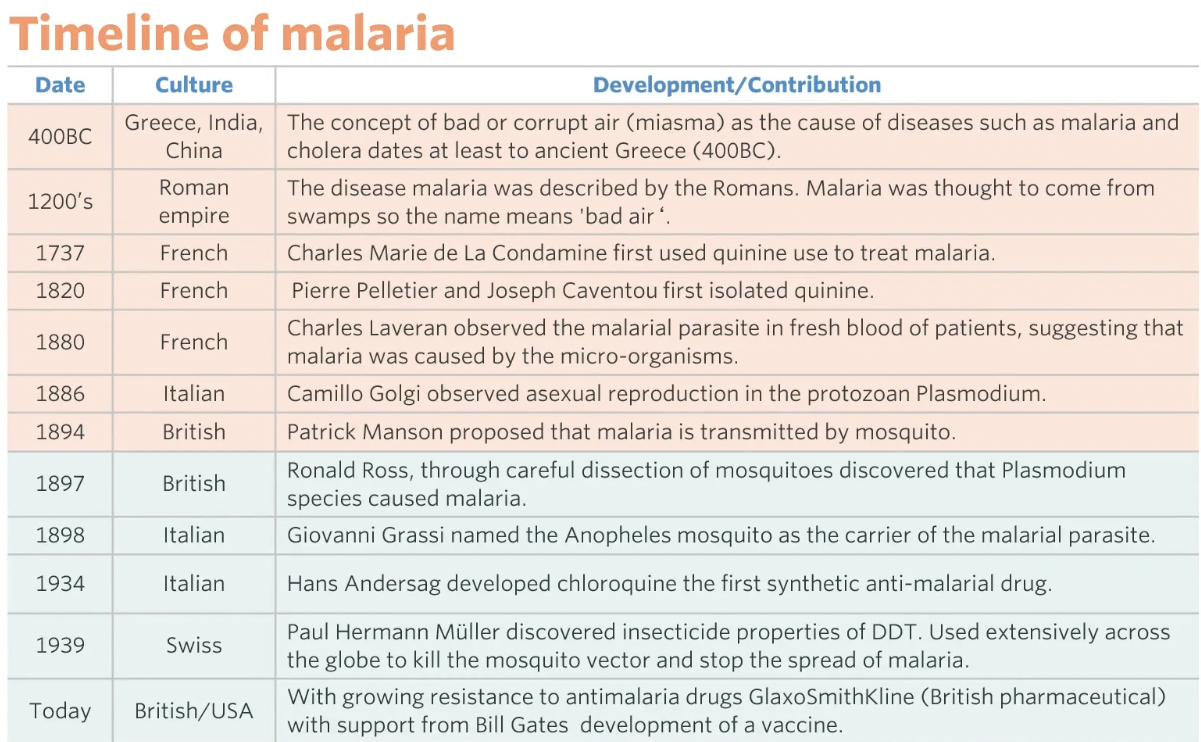
Malaria is one of the longest surviving threats to humans.
Records of the disease go back 4,000 years.
The actual word malaria has its roots in the miasma theory
In Italian the words “Mal” and “aria” means bad air- miasma
In the history there has been many attempts of curing malaria these are:
A chinese herbal remedy called Qing-hao used to treat fever episodes. The active ingredient called artemisinin are still used today is a very potent and effective antimalarial drug.
During the middle ages treatments for malaria included bloodletting limb amputation and trepanning.
Some people used nets oversleeping areas to avoid potential risks.
In 1737 a French explorer found that the bark of the Cinchona tree could be used to treat malaria and in 1820 in French researcher isolated quinine, the active ingredient from the cinchona tree.
In 1934 the first synthetic drugs used to prevent malaria was developed by the Italian scientist Hans Andersag
In 1939, Swiss scientist Paul Hermann Müller used DDT (Dichlorodiphenyltrichloroethane) to kill the Anopheles mosquito Victor. However the mosquitoes develop resistance.
Transmission
Malaria is mainly transmitted through a vector. Thus it is a vector-borne disease.
The female Anopheles mosquito transmit malaria.
Infected transfusion of blood
Contaminated needles or syringes
Transmission from an infected secondary host (human) to a mosquito that is having a blood meal.
Symptoms
Fever
Sweats
Chills
Headaches
Malaise
Muscles aches
Nausea
Vomiting
EXTREME SYMPTOMS
Swelling in the brain
Kidney failure
To clearly identify if an individual is affected by the disease they must be blood tested
Symptoms may be in cycles
Symptoms may rise as early as 7 days after infection and as late as a year after
Possible symptoms occurring periodically for years.
Stages of the infection
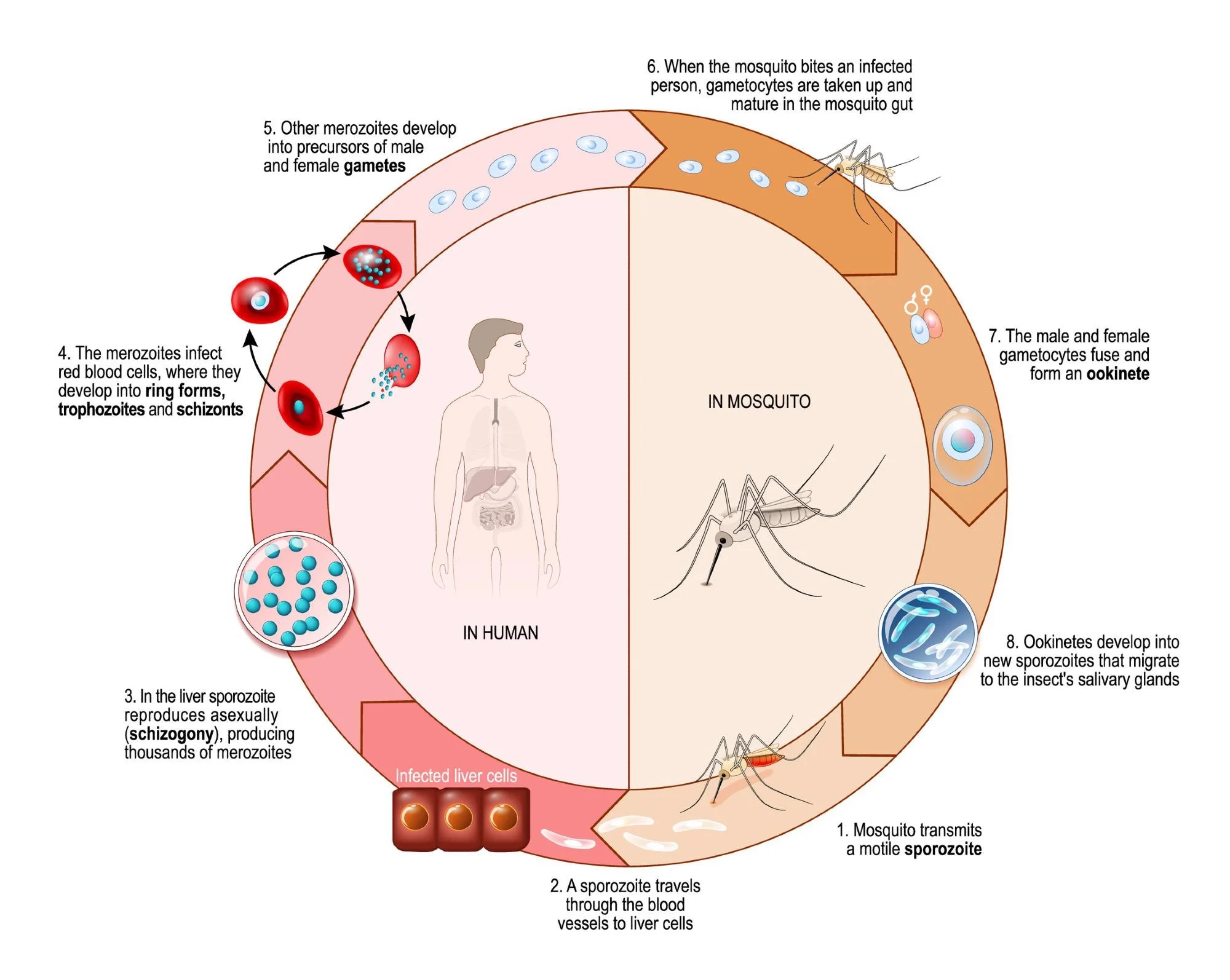
A primary host which is a mosquito bites and an infected secondary host which in this case is a human
SPOROZOITE multiplies asexually in liver and red blood cells
There plasmodium produces thousands of sexual gametes in blood called MEROZOITES
Merozoites infect the red blood cells to reproduce more
The red blood cell (erythrocyte) raptures- beginning symptoms
Some blood cells do not rapture instead they form gametocytes-female and male
The bite from a mosquito transfers gametes to a mosquito where fertilisation occurs
New asexual generation forms in mosquito salivary glands
Treatment and vaccines
Malaria can be cured with prescription drugs. Such as:
Artemisinin-based combination therapy medicines like artemether-lumefantrine (most effective)
Quinine and Chloroquine for P. vivax parasite (only in places where it is still sensitive to this medicine)
Primaquine should added to the main treatment to prevent relapses of infection with the P. vivax and P. ovale parasites
A vaccines used to prevent malaria- fSPZ Vaccine
Prevention and control
There are 12 insecticides belonging to one of four classes currently used in the control of the female anopheles mosquito (malaria vector):
organochlorines
organophosphates
carbamates
pyrethroids.
Avoid traveling countries or regions where there has been an outbreak of the case
Use sleeping nets
Use mosquito repellents
Adaptation of plasmodium species
Through the several life stages of the plasmodium different antigen molecules are produced preventing the host from launching an effective immune response
In different parts of the world the mosquito vector of malaria has become resistant to the insecticides used to kill it.
The rapid generation turnover of mos pathogens and insect resistance has led to widespread pesticide resistance.
The plasmodium hides in the red blood cells protecting themselves from immune responses
While in the red blood cells the plasmodium produces adhesion proteins thus changing the shape of the red blood cell. This change interferes with the movement of the cell through the capillaries. Consequently, facilitating the reproduction and survival of the parasite in the cell.
Before human immune system responds the plasmodium parasites alter the adhesion proteins again.
The plasmodium parasites Kill liver cells causing a gap between the healthy and dead cells. The parasites then use this gaps to infect other liver cells
The parasite accumulate calcium ions from the liver cells. They use this to block the presentation of antigens on the surface of the cell, thus avoiding the human immune system
The plasmodium has evolved to exit the infected mosquito through it’s salivary gland, once the anticoagulant protein has been injected into the host-the human.
Facts
The viruses that cause malaria are RNA viruses
Malaria is a protozoan
Malaria is caused by 4 protozoan parasitic species
Plasmodium falciparum (deadliest)
Plasmodium vivax
Plasmodium ovale
Plasmodium malariae
The 4 protozoan parasitic species belong to the plasmodium genus
All of malaria species are unicellular eukaryotic organism that cannot survive outside of their host
500k deaths occur annually from malaria. Most of these deaths are young children and pregnant women in sub-saharan Africa.
Ebola (Virus)
Brief History
Ebola was first appeared in 1976
Two simultaneous outbreaks were observed, these were in the countries:
South Sudan
Congo
Transmission
The virus was initially transmitted to a human from an infected fruit bat- Animal-to-person contact
After the introduction into the human population the virus spread through a direct human-to-human contact
Facts
Fruit bats are the natural host of the ebola virus
Ebola virus disease aka EVD is a severe, often fatal disease in humans,
The average fatality rate of ebola is from 50%- depending on circumstances.
The virus persists for more than 9 after recovery
There are 5 species within the ebola genus
Ebola virus
Sudan ebolavirus
Taï Forest ebolavirus
Bundibugyo ebolavirus
Zaire ebolavirus
Symptoms
Initial symptoms
Fever
Fatigue
Muscle pain
Headache
Sore throat
Severe symptoms
Vomiting
Diarrhoea
rash
Impaired kidney and liver function
Internal and external bleeding
Stages of the infection
Incubation period: 2 to 21 days
Ebola virus initially infects the dendritic cells of the immune system (this prevents an immune response against the virus)
The virus replicates on Mars and infect the cells of multiple organs causing cell death
The cell death leads to the release of cytokines
This cytokines initiate an immune response
The volume of cytokines released result in the thinning of blood vessel walls causing them to leak blood
Blood pressure drops, body temperature drops, ultimately causing the sufferer to go into shock and die
Treatment and vaccines
There is no cure or treatment for the Ebola virus
Individuals suffering from the virus are supported with oral and intravenous fluids combined with the treatment of specific symptoms
Prevention and control
Avoid animal to human transmission by cooking meat thoroughly
Human to human transmission by wearing personal protective equipment insure a good person hygiene and refrain from unprotected sex
Surveillance of hotspots
Contact tracing
Safe burials, mobilisation and quarantine
Fire Blight (Bacteria)
Cause
Pathogens causing blight are typically bacterium
It is a highly infectious disease caused by the bacterium Erwinia amylovora
Transmission
blossoms where the bacteria is transported by bees during pollination
surface injuries caused by insect feeding, hail or mechanical damage
bacterial exudate can be dispersed locally by wind, rain, insects and birds
Symptoms
trees appear to have been ‘scorched’ by ‘fire’ (Figure 1)
brown wilting of blossoms, shoots and leaves, with a scorched appearance (Figure 2)
leaves remain attached to stems (Figure 2)
shoots and branches bent into a 'shepherd's crook' shape (Figures 3 and 4)
bacterial ooze in warm, humid weather (Figures 5 and 6)
discoloured sunken areas or cankers on branches, limbs and trunks (Figure 7)
red-brown discolouration of the sapwood
Control and Prevention
Fire blight is successfully excluded from australia due to its strict biosecurity- quarantine
Australia has enforced a strict pest and disease surveillance at its borders to avoid exotic plants and pests cause major human, environmental and economic impacts.
DAFF (Department of Agriculture and Water Resources) has enforced inspection and import treatment requirements in place to reduce the risk of harmful pests and diseases getting into and establishing in Australia
There's no single effective treatment for fire blight.
Facts
Australia's agriculture generates a lot of money. Thus contributing to the nation’s GDP by 2.4%. For example, Australia’s pome fruit industry itself generates 475 million per year.