Cell Communication
Key terms
Ligand - any molecule that binds to a receptor to start a signalling response
Intracrine - The signal stays inside the cell, so the ligand acts inside the same cell.
AA derivative - Amino-acid derivative
Glutamate - the main excitatory neurotransmitter in the brain.
Glutamine - A storage form; remove a group and you get glutamate.
GABA - Main inhibitory neurotransmitter.
Thyroglobulin - a giant protein stored in the thyroid follicle.
Iodinated - iodine atoms added
Catecholamines - tyrosine‑derived neurotransmitters involved in stress, alertness, and movement.
Indolamines - tryptophan‑derived neurotransmitters involved in mood and sleep.
Phenylalanine - essential amino acid used to make proteins and important brain chemicals.
Arachidonic Acid - A fatty acid stored in cell membranes
Eicosanoids - inflammatory signalling molecules
Pregnenolone - steroid hormone made from cholesterol that acts as a precursor for many other hormones, including progesterone, cortisol, testosterone, and oestrogen.
Inactive precursor - a molecule that is produced in an inactive form and must be modified before it can become biologically active
Cell Signalling
Autocrine
the cell signal to itself
the cell releases ligand which binds to receptors on the same cell
helps with self-regulation, feedback loops and immune cells use this a lot
Juxtracrine
The signalling cell and target cell must be physically touching
this is done with membrane-bound ligands, gap junctions and cell-cell contact
Paracrine
The ligand diffuses through the extracellular space to local neighbouring cell
growth factors, neurotransmitters and inflammatory signals.
Endocrine Signalling
Long-distance signalling
hormones into the bloodstream, and they travel to far away target cells.
Different distances = different speeds, strengths, and purposes.
Autocrine/intracrine → fast self‑control
Juxtacrine → precise, contact‑dependent control
Paracrine → local coordination
Endocrine → whole‑body regulation
Nucleotides
Nucleotides aren’t just DNA/RNA building blocks — they also act as signalling molecules inside cells.
ATP
ATP in neurotransmission
Neurons release ATP as a neurotransmitter.
it binds to purinergic receptors (P2X, P2Y) on other neurons or glial cells.
Helps regulate pain, inflammation, and synaptic communication.
ATP in immune response
Immune cells release ATP when stressed or damaged.
ATP acts as a danger signal.
Activates immune cells (e.g., macrophages) through P2 receptors.
ADP
Regulates blood clotting
ADP is produced by platelets during injury
How it works
Platelets release ADP which binds to P2Y12 receptors on other platelets.
This causes more platelets to stick together → clot formation.
cAMP
second messenger
cAMP is made for ATP and adenylate cyclase
What it does
Acts as a second messenger inside cells
Activates PKA (protein kinase A).
Controls metabolism, gene expression, hormone responses.
GDP/GTP
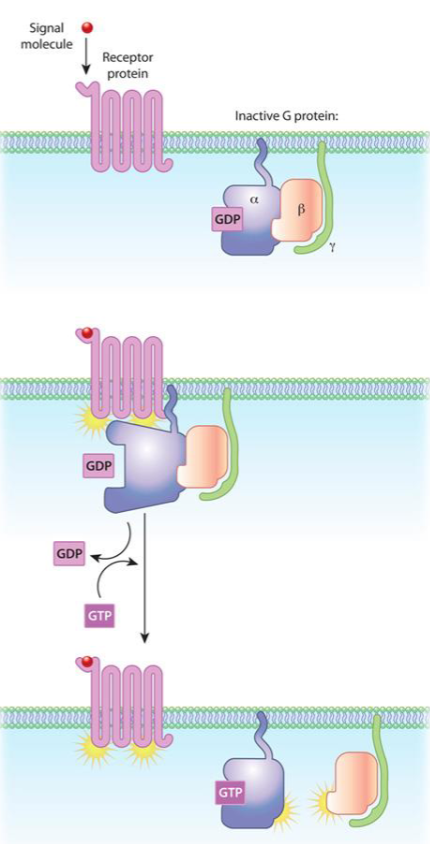
Nucleotides control G-protein activity, which is central to GPCR signalling.
How it works:
G‑protein is inactive when bound to GDP.
When a ligand binds a GPCR, GDP is swapped for GTP.
GTP activates the G‑protein → triggers downstream signalling.
GTP is then hydrolysed back to GDP → turns the signal off.
AA Derivative - Neurotransmitters
AA derivative - a molecule that starts off as an amino acid, but is then converted into something else with a different biological role.
Neurotransmitters Glutamate and GABA are made from amino acids derivatives
Transamination of 2‑oxoglutarate → Glutamate
2‑oxoglutarate is a TCA cycle intermediate.
An enzyme adds an amino group (NH₃⁺) to it.
This converts it into glutamate.
Deamination of Glutamine → Glutamate
Glutamine is basically glutamate with an extra NH₂ group.
Removing that NH₂ group (deamination)
Converts glutamine → glutamate
Making GABA from Glutamate
Decarboxylation of Glutamate → GABA
Glutamate has a carboxyl group (COOH).
Removing that group = decarboxylation.
This produces GABA.
The “GABA shunt”
This is a small metabolic pathway where:
GABA is broken down
Intermediates feed back into the TCA cycle
Why this matters:
It links neurotransmitter recycling with cellular energy metabolism.
AA Derivative - thyroid hormones
Tyrosine
Thyroid hormones are AA derivatives - as they come from the amino acid Tyrosine.
The tyrosine used here is not free tyrosine floating in the cell.
It is built into the structure of thyroglobulin, a giant protein stored in the thyroid follicle.
Iodination
inside thyroglobulin, tyrosine residues get iodinated
MIT - mono-iodotyrosine
Tyrosine + 1 iodine
DIT = Di-iodothyronine
Tyrosine + 2 iodine’s
Coupling reactions - T3 & T4
MIT and DIT combine to form the actual thyroid hormones:
T₃ (Triiodothyronine)
Made from DIT + MIT
Has 3 iodine atoms
More biologically active
T₄ (Thyroxine)
Made from DIT + DIT
Has 4 iodine atoms
More stable, acts as a reservoir
T₃ and T₄ are the active hormones
These hormones regulate:
metabolism
growth
temperature
heart rate
development
T₃ is the stronger hormone.
T₄ is the storage form that can be converted to T₃ when needed.
Mono-Amines
Amino acids can be turned into neurotransmitters through a series of chemical modifications.
There are 2 types:
Catecholamines
Indolamines
Catecholamines
Made from phenylalanine / Tyrosine
dopamine
noradrenaline
adrenaline
Process
Phenylalanine is converted into tyrosine by adding an –OH group.
Tyrosine gets another –OH group added to the ring → becomes DOPA.
This is the rate‑limiting step in catecholamine synthesis.
Remove a CO₂ group → you get dopamine.
Add an –OH group to dopamine → becomes noradrenaline.
Add a methyl group (CH₃) → becomes adrenaline.
Phenylalanine
→ Tyrosine
→ DOPA
→ Dopamine
→ Noradrenaline
→ Adrenaline
Each step is just:
oxidation
decarboxylation
oxidation
methylation
Indolamines
Made from tryptophan
serotonin
melatonin
Process
Tryptophan is modified into serotonin through hydroxylation + decarboxylation.
Serotonin is then acetylated + methylated in the pineal gland to make melatonin.

Polypeptides
Largest group of signalling molecules
• From small peptides (bradykinin: 9 AA) to large proteins
(Somatotropin /HGH:191 AA)
• Cannot cross cell membranes
Eicosanoids - Fatty acids
Arachidonic acid (AA) — a fatty acid stored in cell membranes — is converted into eicosanoids, which are powerful inflammatory signalling molecules.
There are two main pathways:
COX pathway → prostaglandins, prostacyclin, thromboxane
LOX pathway → leukotrienes
Arachidonic acid (AA)
AA sits inside membrane phospholipids.
When a cell is activated (injury, infection, inflammation)
enzymes release AA:
Phospholipase A₂
Phospholipase C
COX pathway (Cyclooxygenases) → Prostaglandins & Thromboxane
COX‑1 and COX‑2 convert AA into PGH₂, the key precursor.
PGH₂ then becomes:
Prostaglandins (PGD₂, PGE₂, PGF₂α)
Pain
Fever
Vasodilation
Uterine contraction
Prostacyclin (PGI₂)
Vasodilation
Inhibits platelet aggregation
Thromboxane (TXA₂)
Platelet activation
Vasoconstriction
Clot formation
LOX pathway (Lipoxygenases) → Leukotrienes
Lipoxygenase (especially 5‑LOX) converts AA into HPETE, which becomes leukotrienes.
Leukotrienes (LTB₄, LTC₄, LTD₄, LTE₄)
Functions:
Bronchoconstriction
Asthma
Allergy
Neutrophil recruitment
Strong inflammatory signalling
Steroid Hormones
Cleavage of cholesterol to pregnenolone
CYP enzymes to obtain other steroids
Corticosteroids: Glucocorticoids, Mineralocorticoids
Sex Steroids: Oestrogens, Androgens, progestogens
Signalling molecules - Storage & transport
Hormones/ long distance signalling: prepro or pro-hormone forms
Preprohormone
The inactive precursor produced directly by ribosomes.
Contains a signal peptide that directs it into the rough endoplasmic reticulum (RER).
The signal peptide is removed to form a prohormone.
Prohormone
Still inactive or only weakly active.
Undergoes further processing (e.g., cleavage by enzymes) in the Golgi apparatus or secretory vesicles.
Converted into the active hormone before or after secretion.
Carrier proteins: globulin and serum albumin
SIGNALLING MOLECULES - STORAGE AND TRANSPORT
Short distance signalling:
Stored in vesicles and released as active molecules
Signalling molecules - Inactivation
Essential to prevent excessive cell stimulation and allow the cell to react to new signals
• Peptides/proteins are degraded through peptidases
• Steroid hormones are degraded by CYP450 enzymes
• Eicosanoids are often degraded locally
• Neurotransmitters are recycled back into pre-synaptic vesicles or are degraded by enzymes
Signalling Receptors
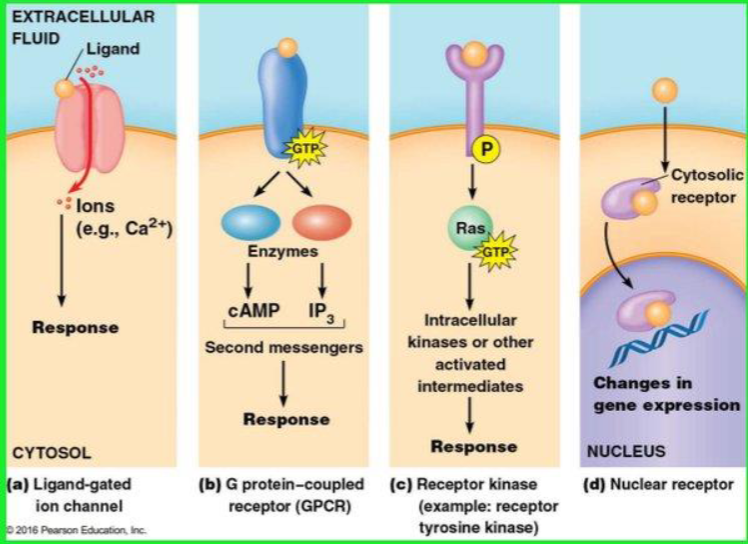
All receptors are proteins and are grouped into 4 major classes
Ion channels
GPCRs (G-Protein- Coupled Receptors)
Receptor Tyrosine
Kinases/PhosphatasesIntracellular receptors
Receptor Specificity
Agonists activate a receptor response
• endogenous (hormones)
• or exogenous (drugs)
Antagonists block a receptor response
• inhibitor/drugs
Receptors sensitivity and saturability
Affinity constant: Kd
• concentration when 50% receptors are occupied with
ligand
• When all receptor sites are occupied, the cell will be maximally simulated and the
system is saturated
• The cell can over/under-express the receptor to alter its Kd
SIGNAL TRANSDUCTION
Two-step process:
• 1: Change of shape of the receptor bound by ligand
• 2: Downstream molecular events in the cell cytoplasm
LIGAND-GATED ION CHANNELS
Structure: a ligand binding domain and an ion channel
• Leads to change of membrane polarity
• Ethanol affects many ion-gated channels in the brain!
GPCRS
Complex regulation involving multiple membrane bound proteins that migrate when the ligand is bound to the extracellular domain
• Transduction: change in cytosolic concentration of 2nd diffusible messengers: cAMP, IP3, DAG, Ca2+
RECEPTOR TYROSINE KINASES/PHOSPHATASES
RTKs
• Phosphorylation of the tyrosine residues
• Tyr-P acts as a signal to recruit and activate other cytosolic proteins, which generate metabolic changes (often through SH2/3 domains of the
target proteins)
• Receptor tyrosine phosphatases (RPTPs ) are less common
CYTOSOLIC/NUCLEAR RECEPTORS
Bind to lipid-soluble molecules like steroid hormones, thyroid hormones, vitamin D, and retinoic acid
Class I: in the cytoplasm, HSP released upon activation, translocate
to the nucleus
Glucocorticoid /Mineralocorticoid receptors,
Estrogen / Androgen / Progesterone receptors
Class II: In the nucleus, heterodimers with RXR receptors
TR receptors
vitamin D receptors
RAR receptors