CONTEMPO: UNIT 5 6
GLOBAL MEDIA CULTURE
Media
Main means of mass communication
“ a means of conveying something” or channel of communication
General circulation
Print media : Books, magazines and newspapers
broadcast media : radio, film and television
Digital media
ITS FUNCTIONS
Marshall Mcluhan
“the medium is the message’
an attempt to draw attention to how media reshape societies
Different Media
extend and amputate human senses
Television
shapes social behavior of users and reorient family behavior
Smart Phone
allow users to keep in touch instantly
Medium
allows conversations that make it sensible to its citizens
carry meanings and representations
New Media
expand the reach of communication
THE GLOBAL VILLAGE AND CULTURAL IMPERIALISM
Marshall Mcluhan
popularize the concept of a global village and to consider its social effects
to highlight his observation that an electronic nervous system
events in one part of the world could be experienced from other parts in real-time
Television
as more people sat down in front of their television sets and listened to the same stories, their perception of the world would change.
Historical Development of Media
Terhi Rantanen (2005): Added script after oral
James Lull (2000): Added digital media
Harold Innis (1950): Divided media into oral, print, and electronic periods
Terhi Rantanen (2005): Broke electronic period into wired and wireless
Oral Communication
Human speech is the oldest and most enduring form of communication. Language sets humans apart from other species, allowing them to cooperate, settle down, and engage in trade across continents.
Script
Importance of writing: Communication and knowledge sharing
Earliest writings: Symbols on clay tablets (cuneiform)
Emergence of script: 3000 BCE
Writing materials: Papyrus and parchment
Printing Press
Printing press: revolutionized knowledge dissemination
Challenged political and religious authority
Encouraged public literacy growth
Rise of inexpensive magazines and newspapers
Circulated competing views
Brought news from around the world
Electronic Media
A host of new media (telegraph, telephone, radio, film & television) revolutionize globalization.
Digital Media
Global trading facilitated 24/7
Streamlining of tasks in Economics
Reliance on digital codes
Influence on globalization
Electronic media powered by computers
in politics , it allows citizen to access information from around the world
MEDIA AND ECONOMIC GLOBALIZATION
Media's role in economic globalization
Creation of conditions for global capitalism
Promotion of conceptual foundation of the world's market economy
Economic globalization enables cross-border trade
makes it possible the buy and selling of products across borders and boundaries
Media plays a crucial role in promoting global capitalism
Media encourages consumption through various platforms
The global commercial media system is essential for economic and cultural globalization
MEDIA, ECONOMIC GLOBALIZATION AND OLIGOPOLY
Oligopoly: Small number of firms with significant influence
Media oligopoly prioritizes profit over ideology
Global media system serves corporate and commercial interests
Oligopoly limits competition and promotes market power
MEDIA AND POLITICAL GLOBALIZATION
New media enables alternative voices across borders
New media can enlarge the public sphere
New media offers opportunities for political action
New media allows more people to engage in civil society
What the New Media can do?
Dramatic political implications
Mobile, interactive, discursive, participatory
Low cost and ease of posting
Allows for multiple varied voices and views
Challenges and questions those in power
MEDIA AND CULTURAL GLOBALIZATION
Media as primary carriers of culture
Media generating interactions among cultures
Media as active economic agents
Media as aggressive political lobbyists
Media marketing brands aggressively
Media seeking new markets worldwide
Media bringing about interactions for beauty, power, and profit
GLOCALIZATION:
Definition: Combination of globalization and localization
Purpose: Develop and distribute globally, adjust for local markets
Examples: McDonald's menu variations, Google search engine results
Benefits: Increased customer satisfaction, cultural relevance
Impact: Influences marketing strategies, product design
LESSON 2 : RELIGION
ISLAM
“Salaama” :
submission to the will of God & Obedience to his Law
The Qur’an:
the basis of their actions & meaning of their existence: blueprint of their destiny
The Five Pillars
SHADA - to become Muslim : pronounce Shada without delay
SALAT: to pray 5 times daily
ZACAT: giving 2.5 % to charity.
SAUM: Ninth month of Islamic calendar: fasting during Ramadan.
HAJJ: act of worship: going to Mecca ( birthplace of Mohammed)
JIHAD : Jihad, or struggle, is an obligation for Muslims, encompassing various forms beyond warfare. It's about preserving good and combating evil, including corruption. While it includes the notion of holy war, it extends to any effort to defend against invaders threatening the country.
WOMAN’S PLACE IN ISLAM
Discouraged to nag
Expect to submit to her husband
4 wives criteria
Barren
Menopausal stage
Suffering from sickness
No longer provide sexual pleasure
Women are to cover themselves
To avoid temptation and maintain purity
Are not allowed to talk to other men
No premarital sex & no extra sex
Husbands are to provide and support
Woman’s domain
the household
if they are educated properly, the influence in the households to their sons shall be tremendous
HINDUISM
Belief in Supreme being
Dharma and karma
Vedas : sacred scriptures; source of truth
Beliefs
Truth is eternal
It is one and expressed in several ways
Brahaman ( truth and reality)
Formless and limitless
To achieve Dharma
Right conduct, righteousness, morals, or duty
Individual Souls are immortal
Reincarnation
Actions of the soul will reap the consequences in the next life
To perfect dharna
Transmigration
Moving the soul from one body
No one goes to hell
Errors of the previous life can be rectified
BUDDHISM
Gautama Buddha
Achieving enlightenment, then experiencing Nirvana
Centers on
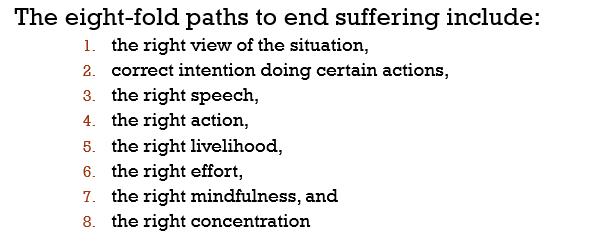
Suffering has causes, and that can end, there are paths to end suffering.
THE BOOK OF TAO
Tao Te Ching: compilation of teaching by Lao Tzu
Origin of all things: universe
Ying and Yang Principle
Yin - subtle energy
Yang- stronger energy
Living a life of integrity while maintaining goodness
BOOK OF TAO
CHAPTER 1
Nature of profound
The nature of the Profound is described as nameless and beyond speech, as it is the source of all things.
CHAPTER 2
Beauty and Inevitable presence of the opposites ( Yin and Yang)
Good only becomes good in comparison to the presence of evil
The constant Being can name outward manifestations but transcends familiar names in its essence.
The Saint understands the harmony of opposites and natural law, living without desire and effortlessly embodying the wordless teaching through action (wu-wei).
The Saint lives in harmony with the Way, without the intention to possess or claim honor.
Success, if achieved, is not pursued for recognition, ensuring its lasting presence.
CHAPTER 3
Why is there greed and chaos
We adore some people in comparison with others
Adoration of some breeds envy and chaos among those not admired.
Exorbitant pricing leads to theft, fueled by desire that confuses and destroys.
Acting without desire strengthens and leads to natural fulfillment without trouble.
4. CHAPTER 81
- Truth often hurts, and sweet words are often empty of truth.
- The wise avoid arguments and disputes, understanding the subtle truth of the Tao.
- Knowledgeable individuals may lack understanding of the Way.
- Saints prioritize helping others over accumulating wealth, following the Law of Nature where giving yields returns.
- The Saint's Way is to act naturally without contention or chaos.
CHRISTIANITY
Belief in God the Father, Jesus Christ as the son of God, and Holy Spirit
In Christianity:
Jesus is considered the Son of God and the second Person of the Holy Trinity.
His crucifixion and resurrection are believed to offer humans salvation and eternal life.
Christ's second coming heralds the Day of Judgment and salvation for the faithful.
In Catholicism:
The Rosary is a powerful prayer method to cultivate devotion to God and Mary.
Mary is often revered nearly as much as Jesus, as seen in depictions of the twin hearts of Jesus and Mary.
Among Non-Catholics:
The Rosary is not practiced because Mary is seen as a human being, while Jesus is perceived as God incarnate, tasked with saving humanity from damnation.
instructions come from the Vatican,
led by the Holy Pope, seen as the modern-day successor to Peter, the apostle chosen by Jesus.
The Holy Celebration of Mass
serves as a platform for presenting teachings and instructions.
Confession
is practiced for cleansing and seeking forgiveness.
Among Non-Catholic Christians:
Orders do not come from the Holy Father, but rather from various Bible study groups or open Bible schools.
Emphasis is placed on understanding Jesus's teachings and their relevance in contemporary life.
In the Catholic Mass:
The four parts include:
Entrance: Believers express longing for God.
Gospel Reading: God speaks to the congregation through readings of the Epistle and gospel.
Offering: Believers offer themselves and their work's fruits to God.
Communion and Peace: Believers receive communion and extend peace to one another.
The Mass symbolizes the ascent of believers' spirits and the descent of God to His congregation.
In Christianity:
- Tithing, giving a portion of income to the church, supports various church projects and endeavors, including building churches, aiding the poor, and assisting calamity victims.
- While Christian beliefs influence many countries globally, some nations have chosen to separate church and state affairs.
- Legal decisions, such as those regarding same-sex marriage and abortion, may conflict with Christian moral beliefs, even if accepted as legal in certain countries.