Genki 1 Prologue & Lesson 1: Greetings, Expressions & Basic Knowledge
There are 4 different alphabets you will learn about, 3 of which are used in Japan:
Hiragana
Katakana
Kanji
Romaji
Hiragana and Katakana represent the sounds produced within the language.
Hiragana 「ひらがな」has a round shape and is used for conjugation endings, function words, and native Japanese words not covered by kanji.
Katakana 「カタカナ」have more straight and sharp lines and are used for writing loanwords and foreign names. Unless your name is Japanese, you will write it in this alphabet.
Kanji 「漢字」 are characters which originated from the Chinese writing system. Most kanji are used for nouns and the stems of verbs and adjectives.
Romaji is used by foreigners learning the Japanese language. Romaji is where the roman alphabet [ABCD…] is used to write instead of the traditional Japanese alphabets.
Expressions & Greetings
Ohayou おはよう Good morning
Ohayou gozaimasu おはよう ございます Good morning (polite)
Konnichiwa こんにちは Good afternoon
Konbanwa こんばんは Good evening
Sayounara さようなら Good-bye
Oyasumi(nasai) おやすみ(なさい) Good night
Arigatou ありがとう Thank you
Arigatou gozaimasu ありがとう ございます Thank you (very much) (polite)
Sumimasen すみません Excuse me; I’m sorry
Iie いいえ No; Not at all
Ittekimasu いってきます I’ll go and come back
==This is used when you are leaving the house to inform family you are leaving.==
Itterasshai いってらっしゃい Please go and come back
==This is used to acknowledge the person who is leaving the house.==
Tadaima ただいま I’m home
==Used to announce your return home==
Okaeri(nasai) おかえり(なさい) Welcome home.
==Used to acknowledge the person who is returning home==
Itadakimasu いただきます Thank you for the meal ==(before eating)==.
Gochisousamadeshita ごちそうさまでした Thank you for the meal ==(after eating)==
Hajimemashite はじめまして How do you do?
Yoroshiku onegaishimasu よろしく おねがいします Nice to meet you.
Lesson 1: “New Friends”
This chapter focuses being able to describe yourself , like you do when first meeting someone and you’re getting to know them.
Useful Information
The order of words—also known as syntax—does not follow the same pattern as the English language. This is, in part, why learning Japanese is considered so difficult for someone who grew up speaking English or other languages that follow that same sentence structure.
A basic sentence can be broken into 3 categories: the subject, the verb, and the object.
Subject: The Noun performing the action.
Verb: The action.
Object: The Noun that the Verb is acting on.
English sentences follow the Subject Verb Object structure.
Japanese sentences follow the Subject Object Verb structure.
Here’s an example:
English Structure: I am Mary.
Japanese Structure: I Mary am.
In Japanese: Watashi wa Me—ri desu.
1) X は Y です
This is the most simple sentence you can make.
~です。 It is/am/are…
じゅうにじ です。 (It) is twelve o’clock.
juuni ji desu
がくせいです。 (I) am a student.
gakusei desu
As you continue learning, you will notice that, often, the Subject of a sentence is omitted once it has been established or whenever the speaker thinks it is obvious what or who is being referred to.
わたしは こうこうせいです。にねんせいです。せんこうは にほんごです。
watashi wa koukousei desu. ninensei desu. senkou wa nihongo desu.
I am a high school student. (I) am in second year/eleventh grade. (My) major is the Japanese Language.
X は Y です。 X is Y. / As for X, it is Y.
But wait, wtf is this は/wa thing?
Wa is a particle, another word category like verbs, nouns, subjects, etc. Particles are basically words that don’t fit neatly into other function word categories and have to be paired up with other function words/phrases to impart meaning.
In Japanese, there isn’t really an equivalent to English’s “a” or “the”, nor is there (typically) an “s” to indicate plurals.* So differentiating between singular and plural can be up for interpretation/context.
* technically there IS a function word that makes a noun into a plural, but it’s not all that commonly used from my experience. You will come across it in a future Genki chapter.
2) ~か
Making questions is super easy. Ka at the end of the sentence is basically the equivalent to a question mark.
Question marks are not usually used, and questions end with a period.
You might see question marks, but it’s often mostly found in very informal/casual messages like texts between friends.
Speaking of questions, the word “what” has 2 different pronunciations: nan and nani.
Nani is used before a particle AND asking nanijin “what nationality”.
Nan is used right before desu OR before a “counter” like ji (o’clock).
3) Noun1 の Noun2
No is a particle you will see often. The textbook describes it as “connecting two nouns” but that description was too vague for me to really understand how to use it and I could never remember which noun went where.
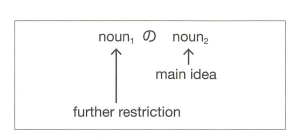
No is used to either show possession or to make a noun act like an adjective.
You’ll learn how to show possession next lesson, so we’re going to focus on the “connecting two nouns” function.
The first noun is used to describe Noun 2, so think of the no as making the Noun 1 work like an adjective: it’s a descriptor.
にほんごのがくせい A Japanese language student.
だいがくのせんせい A college professor.