Unit 6: Molecular Genetics
Slogan: Genetic Inheritance vs. Expression
Critical Unit notes
DNA is only synthesized/read/EVERYTHING in the 5’ to 3’ direction
DNA → RNA → PROTEIN
ALL LIFE FORMS USE THE SAME UNIVERSAL CODE
6.1: DNA Synthesis
#56a6fb
Facts on DNA
Rosalind Franklin and her Co-worker used X-ray diffraction to capture a photo of DNA
Watson and Crick later used this photo to determine the structure of DNA w/o her knowledge
DNA is a double helix
DNA is Antiparallel
Replication
DNA is replicated during the S phase
Chargaff’s rule:
Adenine pairs with Thymine
Cytosine pairs with Guanine
Semi-conservative replication
The original strand replicates TWO new strands of DNA
Each new strand of DNA is made up of one original and one replicated
Key players in DNA Replication
Enzyme | Function | Help memorize |
Helicase | Breaks hydrogen bonds to unwind helix | Hell Cat → Break/rip apart |
Topoisomerase | Keeps DNA from supercoiling | TOP → sTOP coiling |
Single Stranded Binding (SSB) Proteins | Keeps strands apart during replication | Maintain single strands |
RNA Primase | Synthesizing complementary RNA strand on DNA template strand | Priming |
DNA Polymerase ⅠⅠⅠ | Synthesizes new DNA during replication | Speed ⅠⅠⅠ → does more work than speed Ⅰ |
Nucleotide Triphosphates | Nucleotides and energy required to initiate and perform bonding | Three phosphates (ATP = energy) |
DNA Polymerase Ⅰ | Replaces RNA primers with DNA sequences | Speed Ⅰ → fixes mistakes slowly |
DNA Ligase | Joins segments of DNA formed during lagging strand replication | Ligase =Lagging strand |
Exonuclease | Removes extra nucleotides from the end of the DNA strand after replication | Ex → EXtra nucleotides |
Because DNA is antiparallel:
DNA polymerase 3 can only synthesize in the 5’ → 3’ direction
One strand will be leading
Will follow DNA helicase and replicate continuously
The other will be the lagging strand
Will go in the opposite direction of DNA helicase and create Okazaki fragments
* DNA ligase fixes “Glitches“ (gaps) in the lagging strand*
Proofreading and Repairing DNA
DNA Polymerase proofreads newly made DNA
Replacing incorrect nucleotides
In nucleotide excision repair, a nuclease cuts out and replaces damaged stretches of DNA
Damage caused by UV Rays, cigarette smoke, X-rays
What’s the significance of altered DNA?
Some sequence changes may become permanent and passed onto the next generation
Adds genetic variation and connects to natural selection
Chromatin mutations are NOT permanent (epigenetics)
Replicating the ends of DNA Molecules
The replication process provides no way to complete the 5’ ends, thus, after many rounds of replication it produces shorter DNA molecules with uneven ends
Not an issue for prokaryotes
Eukaryotes have a special nucleotide sequence at their ends called telomeres
Helps prevent the shortening of DNA molecules
Shortening of telomeres has possible connection to aging
DNA Packaging’
In bacteria DNA is supercoiled
In eukaryotes, DNA is combined with proteins to form chromatin
Unfloded, chromatin resembles beads on a string
Each “bead“ is a nucleosome
Histones are made of a set of 8, histone tails are like hooks which DNA can attach onto
Folding upon folding
Every time there is cell division, we have to unfold and refold the histones for the purposes of transcription and translation of DNA
6.2: DNA Transcription
#ffc481
Flow of genetic information
Central dogma: DNA → RNA → Protein
Transcription: DNA → RNA
Translation: RNA → Protein
Ribosome = site of translation
RNA
↳ Ribonucleic acid
* RNA in comparison to DNA found in Unit 1 *
RNA is a messenger between DNA and the ribosomes
RNA decodes DNA by making an RNA copy
Like keeping a copy of important documents that way the originals don’t get damaged or lost
RNA assembles amino acids into proteins = protein synthesis
Types of RNA
RNA | Role |
pre-mRNA | newly transcribed and not edited (only euk.) |
mRNA | Edited version, messenger |
tRNA | Carries specific amino acids to ribosome |
rRNA | Site of protein synthesis |
snRNA | Small Nuclear RNA; Structural and catalytic roles |
srpRNA | Binds to signal peptides |
miRNA/siRNA | Binds to R/DNA to block, regulate gene expression, or cut it up |
Ribozyme | RNA that functions as an enzyme. APE site |
the Genetic code
One DNA strand 3’ → 5’, is the template strand
Called noncoding, minus, or antisense strand
The complementary mRNA strand is read in the 5’ → 3’ direction
ALL LIFE FORMS USE THE SAME UNIVERSAL CODE
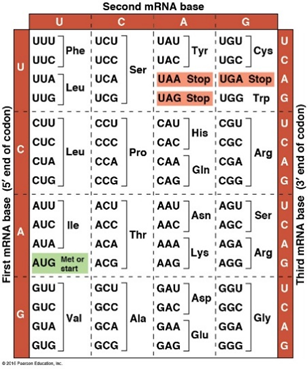
Transcription
↳ the process of making mRNA from a DNA template
transcription unit: a stretch of DNA that codes for a polypeptide or RNA
RNA polymerase and Transcription
RNA polymerase attaches to a promoter (start of gene) and stop at the terminator (end of gene).
Uracil replaces thymine when pairing with adenine
Steps to transcription
1. Initiation (Prokaryotes)
RNA Polymerase binds directly to Promoter in DNA
1. Initiation (Eukaryotes)
TATA BOX =
DNA sequence (TATAAAA) in promoter region upstream from transcription start site
Transcription factors must recognize TATA box before RNA polymerase can bind to DNA Promoter
Transcription factors + RNA Polymerase = Transcription initiation complex
2. Elongation
RNA polymerase adds RNA nucleotides to the 3’ end of the growing chain (A - U, G - C)
As RNA polymerase moves, it untwists DNA, then retwists after mRNA is made
3. Termination
RNA Polymerase transcribes a terminator sequence (prok.) or polyadenylation signal sequence (euk).
Now pre-mRNA for eukaryotes
Prokaryotes = mRNA ready for use
Flow of genetic information in Prokaryotes vs Eukaryotes
Addititions to Pre-mRNA
6.3: DNA Translation
#a5034f
6 pages
6.4: Mutations
#b1ff4e
4 pages
6.5: Regulation of Gene Expression
#d663ff
5 pages
6.6: Biotechnology
#eee871
4 pages
Kahoot/Additional notes
Who used X-ray crystallography to study the structure of DNA?
Franklin and Wilkins
What are bacteriophages?
Viruses that infect bacteria
Which enzyme is found in retroviruses that produce DNA from an RNA template?
Reverse transcription
In what process is external DNA taken up by a bacterial cell?
Transformation
Telomerase is a telomers enzyme and makes them
Exons with a mutation would be very damaging for cell
Describe the structure of plasmid DNA
It is double stranded and circular
Introns must be removed in…
Eukaryotic cells
Why are introns removed?
To produce a protein with only active genes
A growing polypeptide chain bonds together the Amino acids with ______ bonds
Covalent
What do protein kinases do?
They in/activate proteins
What does the operon model attempt to explain?
Gene expression in bacteria
Which of the following describes a post transcriptional modification?
Poly A-Tail is added
An enhancer site is…
located at a distance from the gene it affects
What is the impact of alternative RNA splicing?
It produces different polypeptides from the mRNA
The trp operon is cosidered a repressible operon because…
tryptophan stops the operon from working so trp production stops
DNA packing affects gene expression by..
controlling access to DNA
Essential Questions
Explain the central dogma.
How do transcription and translation work to produce proteins from DNA codes?
How are these processes different in prokaryotes and eukaryotes?
How do changes in DNA and RNA sequences impact an organisms' phenotype?
What are some of the impacts of point and frameshift gene mutations?
How do prokaryotes control gene expression?
How do eukaryotes control gene expression?
Gene expression is regulated at multiple levels in eukaryotes.... describe some of them.
How are cells in multicellular organisms differentiated?
What are the current biotechnologies that deal with gene editing? How do they work?
What are some of the ethical concerns associated with gene editing technology?
How is it possible for one living organisms to express genes found in other organisms?