General & Special Senses
The Senses
Sensory info
Continuously surrounds us
Gives info abt the internal and external environ
Detected by receptors and sent to the brain
Comes in multiple forms
General—touch, pressure, pain, stretch, temperature)
Special—taste, smell, sight, hearing, balance
Sensory Receptors Have Receptive Fields
Receptive field—the area of distribution of sensitive ends of the receptor
There is an inverse relationship btwn field size and the ability to ID stimulus location
Small field = precise location is easily determined
Broad field = only general region can be determined

General Sense Organs
Often exist as individ cells or receptor units
Widely distributed
Examples
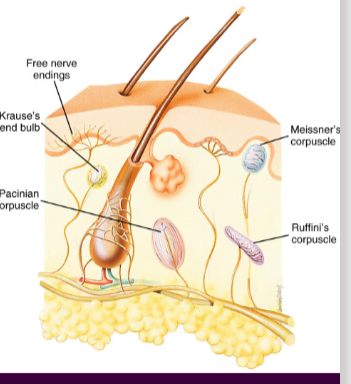
Free nerve ending—pain, temperature, and pressure
Tactile (Meissner’s) corpuscle—light touch and discriminative touch
Touch receptors closer to the surface are more sensitive to lighter touch compared to receptors deeper in the skin (which will be more sensitive to deeper sensations, like a hard press or smth)
Bulbous (Ruffini’s) corpuscle—deep pressure
Lamellated (Pacinian) corpuscle—pressure & vibration
(Krause’s) end bulb—light pressure & vibration
Tactile (Merkel) disc—light touch

Special Sense Organs
Large and complex organs
Localized grouping of specialized receptors
Five special senses
Gustation (taste)
Olfaction (smell)
Vision (sight)
Hearing (audition)
Equilibrium (balance & acceleration)
Gustation: Sense of Taste
Works w/ olfaction
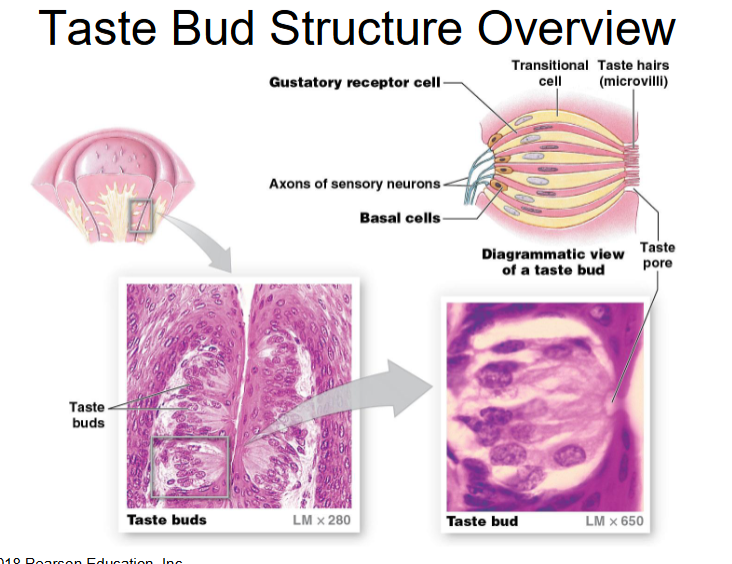
Gustatory cells
Taste receptors are located in specialized organs, the taste buds (~40 per taste bud)
Taste buds lie alongside epithelial projections called papillae (4 types)
Involves mechanoreceptors and thermoreceptors
Provide info abt texture and temp

4 Types of Papillae on Tongue
Filiform—short spikes on anterior 2/3 of tongue that lack taste buds
Detect food texture and manipulate food
Fungiform—blocklike projections on top and sides of tongue that have a few taste buds
Vallate—large papillae in a V formation on the posterior surface of tongue that contain most of the taste buds
Foliate—extend as ridges on the lateral tongue; only contain a few taste buds during childhood

5 Taste Sensations
Sweet—organic compounds, such as sugar
Salt—metal ions, such as sodium or potassium
Sour—acids, scu
Bitter—alkaloid substances, such as unsweetened chocolate, nicotine, and caffeine
Umami—savory substances w/ a meaty or cheesy flavor; related to amino acids, such as glutamate and aspartate
Olfaction: Sense of Smell
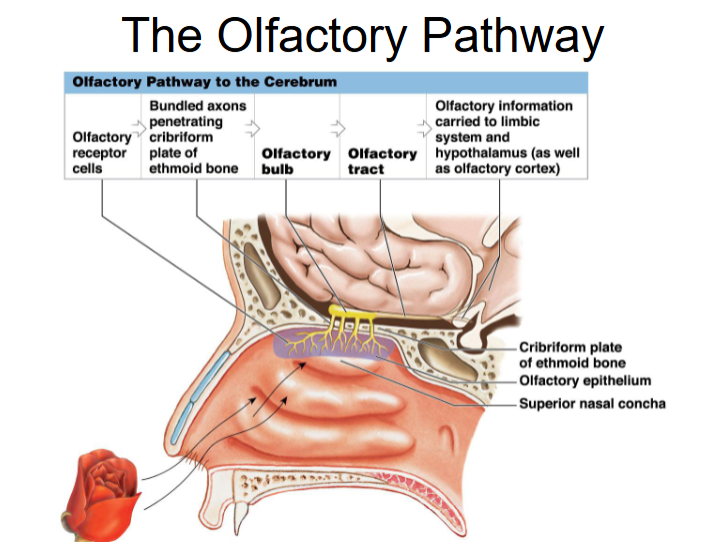
Yellowish olfactory epithelium lines the superior region of the nasal cavity
Olfactory receptor cells detect dissolved odor molecules; replaced every 40-60 days by basal cells
Humans can distinguish one odor among thousands
Olfactory receptors are extremely sensitive, but easily adapt (become fatigued)
When you start using a new shampoo, you are very aware of it but over time, you don’t smell it as much anymore. Your brain no longer deems the new scent important/dangerous, so it picks up on it less
Vision: Sense of Sight
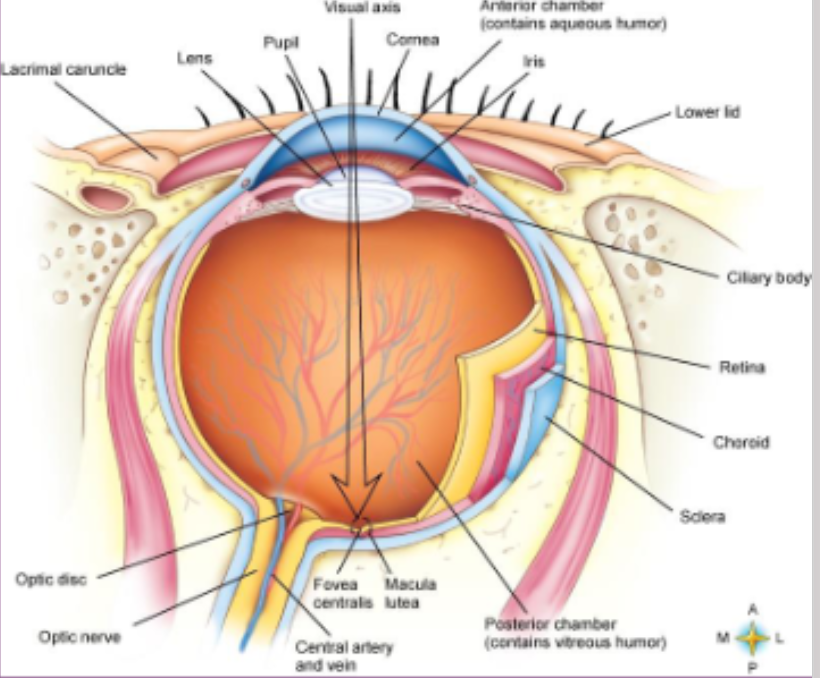
Major anterior eye structures
Sclera—”white” of the eye
Cornea—transparent covering over iris
Conjunctiva—mucous membrane covering the sclera (except cornea)
Lacrimal gland—contains tear-producing cells
Aqueous humor—chamber containing watery fluid
Iris—colored part of the eye containing the pupil
Lens—transparent body behind the pupil that focuses light on the retina

Major posterior eye structures
Vitreous humor—chamber of gel-like fluid that causes the eye to be a round shape
Retina—innermost layer of the eye containing photoreceptors that detect the light
Rods—detect greyscale lightwaves
Cones—detect color lightwaves


Optic disc—lacks photoreceptors; cannot form an image
Macula lutea—contains the fovea centralis, which forms the sharpest color images

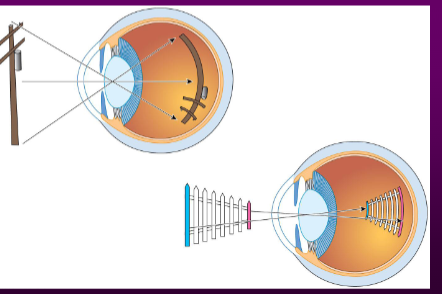
Image Formation
Images are not single point, but rather consist of large numbers of individual points (like pixels on computer screen) each focused on the retina
Image is inverted and reversed; brain compensates—learned from experience
Audition: Sense of Hearing
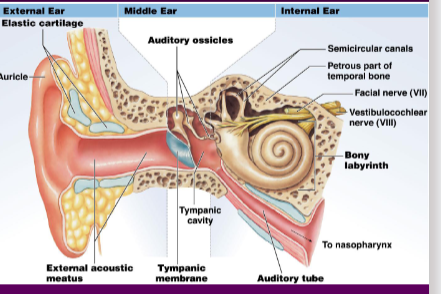
Three ear regions
External ear (air-filled)—funnels sound waves into the canal to the tympanic membrane
Middle ear (air-filled)—transmits and amplifies sound waves; connects to the nasopharynx through the auditory tube
Inner ear (fluid-filled)—cochlea creates nerve impulses in response to sound waves that move cochlear hair cells
The auditory tube allows air pressure to equalize on both sides of the tympanic membrane for optimal hearing


Senses of Equilibrium and Acceleration
Receptors in the fluid-filled semicircular canals detect rotation and acceleration
Fluid mvmt pushes on hair cells that respond by creating nerve impulses
Vision is important to maintaining equilibrium


