Federal Courts
Basic Principles of Court Organization
Dual court System
US has a Dual Court System
One national court system plus separate court systems in each of the states
State and Federal courts can have Concurrent Jurisdiction
they share some judicial powers over certain types of cases (selling drugs/bank robbing)
Litigants in state only cases can appeal to US Supreme Court (federal) if a federal law is in question
Framers of Constitution created two parallel CJ systems
Jurisdiction
Jurisdiction
Power of a court to decide on a dispute
Classified into 4 subcomponents: Geographical, subject matter, personal and hierarchal
Geographical Jurisdiction and Venue
Geographical Jurisdiction
geographical area in which courts can hear and decide disputes
In criminal cases it revolves around the ability to punish actions that violate criminal law
California cannot charge a person committing a crime in Oregon
What specific courts can hear the case in Oregon? → revolves around Venue
Venue
The particular location or area in which a court having geographical jurisdiction may hear a case
Based on statutorily defined geographical subdivisions (determined by city/county)
Defendant can waive venue by consenting to be tried in another district/county
In state cases, venue can only be transferred to another district/county in that same state
In Federal cases, venue can be changed between districts of the federal system since the offense is against the US
Changes in venue of federal court happen for two reasons
The change is more convenient for the parties and the witnesses than the original venue
Venue changes when the defendant is unlikely to get a fair and impartial trial in the federal district where the crime took place
Fair trial is guaranteed by 6th amendment
Extradition
involves the surrender by one state of an individual accused of a crime outside its own territory and within the territorial jurisdiction of the other state
“I kill someone in Alaska, but then run away to Florida, I would get extradited to Alaska to face trial”
If the fugitive had fled the country, the US secretary of state would request the return of accused through the extradition treaty they have with US
Some countries do not have an extradition treaty
Subject Matter Jurisdiction
Subject Matter Jurisdiction
Types of cases that courts have been authorized to hear and decide
Trial courts of Limited or special jurisdiction can only hear cases within a limited category.
State courts typically have traffic courts, juvenile courts (both are subject matter courts)
Trial courts of General Jurisdiction can hear all types of cases within the geographical jurisdiction of the court
Personal Jurisdiction
Personal Jurisdiction
Refers to a court’s power over an individual person or corporation
Court gains this by the defendant having done something within the place where the court is located or having had some contact with the place in which the court is located.
In criminal court, it refers to a court’s authority to try the defendant for violating the state’s criminal law
Courts obtain it when the defendant violated the law of a specific sovereign while within the state
Hierarchical Jurisdiction
Hierarchical Jurisdiction
the differences in the court’s functions and responsibilities
Original Jurisdiction
The court has the authority to try a case and decide it
Appellate Jurisdiction
The court has the power to review cases that have already been decided by another court
Differentiating Trial and Appellate Courts
All cases begin in a trial court
judicial body with primary original jurisdiction in civil or criminal cases juries are use and evidence is presented.
In criminal cases, the defendant arraigns the defendant, conducts a trial/plea bargain, imposes a sentence (if found guilty)
In civil court, it happens the same way, making sure each party knows of the complaint and conducts a trail or has an out-of-court settlement
They hear facts and listen to witnesses
Losing party can appeal to an appellate court
a court that makes sure the trial court correctly interpreted the law. Can sometimes make new laws. No witnesses, no juries, don’t conduct trials
Trial and appellate courts operate differently due to their different jobs
History of the Federal Courts
Made up of political controversies that have shaped the federal courts. Dividing power between state and federal.
The Constitutional Convention
Articles of Confederation were weak because they didn’t have a national supreme court to enforce laws/solve conflicts between different states.
At the Constitutional Convention in 1787, a big focus was on a “national Judiciary”, but there was debate on the form of the judiciary (article 3)
Should there be a federal court system separate from the state system formed two camps:
State’s rights (anti-federalists) saw federal courts as harming the power of state’s courts. Wanted federal law to be adjudicated by state courts first, and the supreme court would only hear appeals from state courts.
Nationalists (federalists) distrusted the state courts and wanted a strong gov that would govern economic and political issues for the new nation. Viewed the state courts as unable of developing a uniform body of federal law that would serve the country. Wanted the creation of federal courts.
Compromise: Article 3 - creates only an outline of a federal judiciary. the job is left to congress to create the judicial system.
The Judiciary Act of 1789
Congress quickly tried to make a federal judiciary and passed the Judiciary Act of 1789
laid the foundation for our current national judicial system.
Victory for the federalists as it created separate federal district courts
The Act also supported state’s rights in 3 ways
The boundaries of the district courts were drawn along state’s lines. This way, each federal judiciary was “self contained”. Even though they enforced national laws, they were responsible for their own work, with little oversight
Federal District Judges would be residents of their districts, even thought they are nominated by the president.
Gave lower courts only limited jurisdiction.
1789 - 1891
The Judiciary Act of 1789 was only temporary. Federalists wanted to expand the national gov powers and passed the Judiciary act of 1801 (it was quickly repealed)
Marbury v Madison - Chief Justice John Marshall declared that the US Constitution granted courts the power of Judicial Review. The authority to invalidate acts of congress as unconstitutional.
General Dissatisfaction with the federal judiciary was under 2 areas:
Circuit Riding, supreme court justices would travel around to hear cases, many of them super old dudes.
Appellate Court Workload. As the federal gov grew, so did the amount of work the judiciary had to do. The federal judiciary was severely unequipped for the high workload. The Supreme Court had to decide every case appealed to it.
Courts of Appeals Act of 1891
Due to the expanding population and increase of business following the civil war, the Court of Appeals act of 1891 created circuit courts of appeals. Most trial decisions went to a circuit court of appeals. Stopped SCOTUS from hearing petty cases, and could now focus on judging major cases.
Federal Courts Today
The Judges Bill
passed in 1925, it gave the Supreme court more control over its docket.
In 1988 congress eliminated even more mandatory appeals to the SCOTUS
Now there are four layers of federal courts: Magistrate, district, appellate, and SCOTUS
US Magistrate Judges
Created in 1968 to replace US commissioners. Used to alleviate the workload of US district courts.
Full time magistrate judges are appointed for 8 year terms
Part-time magistrate judges are appointed for 4 year terms
Can be removed for “good cause”
All must be lawyers.
A ton of cases come though them
In federal cases they are responsible for preliminary proceedings, (initial appearances, conducting preliminary hearings, appointing council for indigents, setting bail, issuing search warrants).
In Civil Cases, they are responsible for: discovery, social security disability benefits appeals, and conduct full civil trials (with consent of litigants)
They can do all tasks carried out by district court judges (but not trying and sentencing felony defendants)
US District Courts
There are 94 US district courts, at least one district court in each state, do district court area crosses state lines
Some big states have multiple district courts.
Because the districts are so large, they may be dividing into different divisions
The president nominates district judges, who are then confirmed by the senate
Serve for life
The amount of judges in each district depends on the amount of judicial work and “political clout” of each state’s congressional delegation
Idaho has 2, while Manhattan has 28
Judges have the support of clerks, secretaries, law clerks, court reporters, probation officers, pretrial services, and US marshals. Large districts have a federal public defender.
There is one US attorney in each district, nominated by POTUS and confirmed by senate.
Bankruptcy judges are appointed for 14 years by the court of appeals within the district.
Most banckrupty cases were non-business related. People who were unable to pay their bills. A small percentage was filled by businesses
Bankruptcy Abuse Prevention and Consumer Protection Act of 2005
Made it harder for consumers to lose debts that they were unable to pay. Caused bankruptcy filings to fall. The 2008 recession caused them to increase.
Caseload of US District Courts
The US District courts are the federal trial courts of Original Jurisdiction
They are the trial courts for major violations of federal criminal crime
Primarily drugs, embezzlement, and fraud.
Civil lawsuits take up much more time than criminal cases do (federal civil cases involve much more money than state civil cases do). Federal Courts can only hear civil cases involving diversity of citizenship, questions of federal law and prisoner petitions
Diversity Jurisdiction
Diversity of Citizenship
Involves lawsuits between citizens of different states or between a US citizen and a foreign country/foreign citizen.
A citizen for California is injured in a car crash in Chicago and sues the the driver (who is from Illinois) This would be a diversity of citizenship case
Federal courts apply state laws when adjudicating (deciding) state claims during diversity of citizenship
Some judges and law scholars want to abolish diversity of citizenship jurisdiction due to how how complicated it is and the fact that state law is preformed better in state courts.
Congress opposes this as state courts are biased against out-of-state defendants.
Federal Questions
Federal courts have jurisdiction over “cases, in law and equity, arising under the constitution, the laws of the United states, and treaties made, or which shall be made under this authority.” Cases regarding this are called federal questions
Deal with interpretation/application of US constitution or of a statute enacted by congress
The Constitutionalization of Criminal Procedure
The Warren SCOTUS gave defendants the right to counsel, notions of a fair trial, expanded rights to appeal, and how law enforcement get evidence/interrogates suspects. These was called the Due Process Revolution and are based in the constitution.
Violation of these rights can lead to a conviction being overturned
Discrimination laws and Civil Rights Cases
Federal laws prohibit discrimination based on race, religion, sex, age, national origin. This applies to employment, housing, welfare and voting opportunities.
People with disabilities are protected under the Americans with Disabilities Act
Yeskey v Pennsylvania Department of Corrections stated that the ADA applies to how law enforcement interact with disabled people. This means that police are civilly liable if they arrest someone who is disabled thinking they are criminally aggressive or fail to accommodate a person’s disability during investigation, interrogation, or arrest.
In United States v Georgia, states and municipalities are civilly liable for not having correctional facilities that accommodate the needs of disabled people.
Prisoner Petitions
Inmates at local, state and federal custody all have constitutional rights even though they are convicted.
prisoners are allowed to file civil lawsuits called Prisoner Petitions
Prisoner Petitions are a large part of the workload for federal cases, due to the increase in the prison population.
The Prison Litigation Reform Act made it harder to file a Prisoner Petition by requiring prisoners to use all administrative remedies before filling, by making them pay certain fees, and by barring them from filling again if the case was dismissed due to being “frivolous or malicious”
Magistrate judges help the district judges with habeas petitions and prisoner civil rights. But since Magistrate judges are not article 3 judges, they simply write to the District attorney judge to who the case is formally assigned to which tells the district attorney how to rule.
Discrimination and Civil Rights Caseload in the Federal Courts
Non-prisoner civil rights fillings had doubled due to the increase in civil rights. The specific laws are: Americans for Disabilities act, Civil Rights Act, Title VII of the Civil Rights Act, Age Discrimination in Employment Act. They account for 13.4% of civil cases
US Court of Appeals
The US Court of Appeals was created to relieve the supreme court from hearing all of the appeals. The official name for the regions are US Court of Appeals for the ___ Circuit. There are 14 circuit. 11 are numbered (geographically), one Court of appeals for Washington DC, The Court of Appeals for the Federal Circuit, and the Court of Appeals for the Armed Forces.
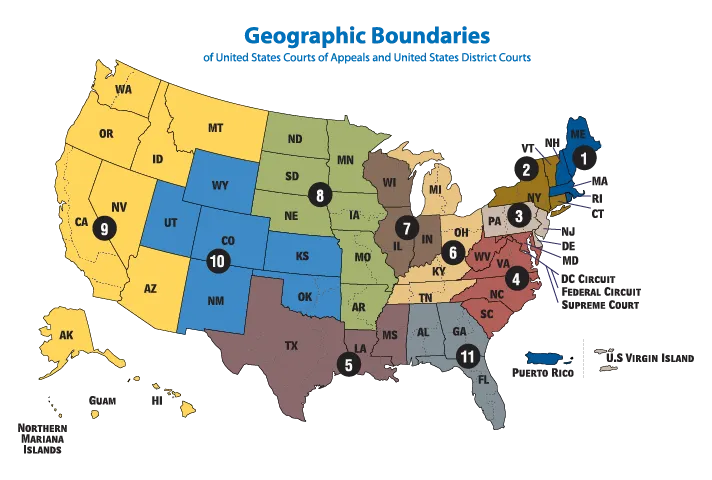
The Court of Appeals can review all final decisions of the US district courts. They also review and enforce orders of federal administrative bodies. '
The Court of appeals for the Federal Circuit’s jurisdiction is based on subject matter, not geographical boundaries. It was created by congress to deal with appeals regarding government contracts, patents, trademarks, nontort money claims against the US gov, Federal personnel and veterans benefits.
The Court of Appeals for the Armed Forces hears cases only decided in a military court or tribunals concerning members of the US military on active duty and people subject to the Uniform Code of Military Justice
The Judges on the Court of Appeals are nominated by president and confirmed by teh senate. The specific number of judges in each circuit varies on the volume/complexity of caseload. There are several staff jobs to aid the judges (clerks office, central legal staff)
The longest serving judge who is under 65 is designated at Chief Judge. They preform administrative duties as well as hearing cases.
When deciding cases, the court uses three-judge panels. The panels sometimes include visiting or senior judges.
En Banc
After a majority vote, all the judges in a circuit decide on a case or rehear a case that was already decided in appeal.
Caseload of US Courts of Appeals
Sharp increase in the Court of appeals casework.
A decision by the US Court of Appeals ends the litigant’s right to appeal, but the losing party could appeal to supreme court, but those requests rarely happen.
US Supreme Court
The “court of last resort”. Litigants cannot appeal any farther than this.
SCOTUS has one chief justice and a number of associate justices (the # is determined by Granting Cert: congress, and it is currently 8). There are currently 9 justices in total on SCOTUS.
President nominates the justices, and the senate approves them. There is no term limit, they either retire or die.
SCOTUS is mainly an appellate court, but it does have original jurisdiction in certain cases (US vs State, State vs State, or ambassador vs Foreign Minister).
The court has discretion with regard to the appeals it elects to hear and decide. It exercises this discretion through writ of certiorari - the court agrees to review a case decided upon by a circuit court or high court of a state. It tells the lower courts to send the case records to determine if the law was applied.
Granting Cert: The Rule of Four
The Rule of Four
The rule that four of the nine justices on SCOTUS must vote in favor of granting a petition for a writ of certiorari in order for the court to actually issue the writ, thereby accepting discretionary jurisdiction over an appeal.
Helps the court to control its own document following the invention of circuit courts.
“A minority (4/9 is not a majority) can impose on the majority a question that the majority does not think is appropriate to address.” This happens to about 25% of all cases that SCOTUS hears.
The court’s discretion is always guided by whether a case presents questions that have some general “importance beyond the facts and parties involved”
Caseload of the US Supreme Court
Only a small amount of cases are heard by SCOTUS
The cases must involve a “substantial federal question”
state court’s interpretation of state law can be appealed if there is a violation of federal law/constitution
SCOTUS’s term begins on the first Monday of October through late June/early July
During sittings the judges hear cases/deliver opinions
During recesses the judges study the cases, and research/write the opinions
Circuit Justices
Each SCOTUS justice is also a Circuit Justice
addressing certain requests for extension of time and rules on requests for stays in cases coming from the circuit to which the justice is assigned
Stays are court orders that temporarily suspends activity in a case. Stays are important in death-row cases as they stop executions until the court can review the case.
Specialized Federal Courts
Congress occasionally creates “specialized Federal courts” to hear a limited range of cases
Specialized courts have permanent, full time judges. Sometimes they borrow judges from federal district courts or court of appeals as needed.
Constitutional Courts
Federal courts created by congress by virtue of its power under Article 3 of the constitution to create courts inferior to the Supreme court. The supreme court, court of appeals, and District courts are constitutional courts.
Legislative Courts
Judicial bodies created by Congress under Article 1 (legislative article) and not Article 3 (judicial article). Bankruptcy judges and US magistrate judges are legislative courts
Constitutional Court Judges serve for a lifetime appointment. They are also protected against salary reductions.
Legislative court judges serve for a specific term length. Their salary can be reduced.
Most specialized courts deal with civil matters (patents and tariffs), but 3 deal with criminal matters (military court, Foreign Intelligence Surveillance act court, and immigration court)
It is not clear what court “military noncombatants” are tried in
Military Justice
Uniform Code of Military Justice- Expanded due process rights in court martial created by Congress.
US Court of Appeals for the Armed Forces - made up of 5 civilian judges who serve for 15 year terms. An attempt to “civilianize” military law
The Military Justice Act of 1968 - Covers criminal acts, but also punishes non-criminal acts for civilians but would be for military (disrespect of an officer)
Military justice/law applies not only to service members, but to civilians workers, acts committed by military on/off the base.
Military courts focus on finding guilty/innocent, but also enforce order/discipline in the military
Proceedings are open to military society, the burden of proof is less demanding, 3 or 5 person juries, jurors are military personnel, 2/3 majority is needed to convict, and all convictions are automatically appealed to a higher court
Enemy Combatants
Following 9/11 and entering Afghanistan, the military captured hundreds of suspected terrorists. Instead of calling them “prisoners of war”, they were classified as enemy combatants.
If they were prisoners of war, they would be subject to the Geneva conventions
Enemy combatants have been have been housed at the US navy in Guantanamo Bay, Cuba.
The Bush Administration says that international law did not apply to enemy combatants (no legal processes). Asserted that the president could detain them for as long as the “war on terror” was happening and that federal courts had no jurisdiction over them.
Rasul v Bush the Supreme court said that federal courts had jurisdiction over enemy combatants and could hear their habeas corpus petitions.
After the Rasul decision, the DoD created the Combatant Status Review Tribunals (CSRTs) to review evidence and see if the detainee had been officially classified as enemy combatant.
SCOTUS eventually rejected the legitimacy of the CSRTs rulings in Hamdan v Rumsfeld, since it was not created by an act of congress and violated both Uniform Code of Military Justice and the Geneva Conventions.
Congress then created the Military Commissions Act of 2006 (MCA), which allowed POTUS to identify enemies, imprison them indefinitely, try them in military commissions, and deprive them of federal court’s ability to hear habeas corpus cases
Congress approved of CSRTs past + future decisions and tried to place enemy combatants beyond the reach of federal courts.
The Courts then declared MCA unconstitutional in the case Boumediene v Bush. By Obama’s second term, there were only 55 enemy combatants remaining in Guantanamo Bay.
Foreign Intelligence Surveillance Courts
Foreign Intelligence Surveillance Courts have authority electronic surveillance of foreign intelligence agents. Created by the Foreign Intelligence Surveillance Act (FISA).
Called the FISA Court
One Chief Justice appoints 11 judges
The judges hear requests for warrants. It is held inside the Department of Justice. The warrant requests will only be granted based on “clear and convincing evidence”, which is less stringent than a normal search warrant.
Originally the only public visibility happened in the year end reports from the FISA courts. But in 2005, it was revealed that the NSA was conducting warrantless surveillance of phone calls of suspected foreign terrorist groups on domestic calls.
Bush Admin said that this was allowed as the Pres had inherent war powers under the constitution, which allowed these warrantless surveillance.
Congress passed the Protect American Act of 2007, which mandated that telecommunication providers help the gov in intercepting international phone calls/emails for national security purposes.
This law was upheld by the FISA court of review (an appellate review court over the FISA court). Said that requiring the gov to get a warrant would harm its ability to gather “time sensitive info”
As long as the federal government has several layers of protect individuals against “unwarranted harms”, it was allowed to intercept phone calls without warrants.
In 2013, Edward Snowden leaked thousands of documents which exposed government spying programs.
Immigration Courts
Researchers think that there are about 11 million undocumented immigrants in the US, the US spends 12.8 Billion each year on US Customs and boarder Protection Agency and another 5.4 billion on ICE.
There is a backlog of about half a million immigration cases.
Immigration Courts are not apart of Article 3 judiciary, but are instead of the department of Justice, an administrative agency.
Officially called in Executive Office for Immigration Review (EOIR)
Appeals are heard by the Board of Immigration Appeals
EOIR decides if a immigrant should be deported or protected from removal. There are around 250 judges for 57 immigration courts
Since there is such a high caseload, the judges decide cases in rapid succession.
One Judge only takes 7 minutes per case.
Federal Judicial Administration
Administrative Office Act of 1939
Created the current administrative structure of the federal judiciary, illuminates the tension between judiciary administration and politics.
FDR wanted to pack the courts, and there was no legal barrier to do so
Never happened, but it caused a movement in judges to clean house
The act expanded responsibilities of the judicial conference, and created the administrative office of the US courts, and established judicial courts.
Chief Justice
Presiding officer over SCOTUS
He has 5 law clerks, and an administrative assistant
Presides over all courtroom proceedings, private conferences
Speaks either first or last in these conferences
Assigns associate justices to serve as circuit justices for various federal courts
Decides who will write the opinion of the court on a case
Other administrative tasks:
regulating attorney admission to the Supreme Court Bar, opening/closing each court term, working with the court’s clerk, librarians, reporters, budgeting, advocating for the courts before congress, being a spokesperson for the courts.
Presides over impeachment trials of POTUS in the US senate
Administers the oath of office to Pres + VP
Appoints judges to special tribunals and courts
Judicial Conference of the United States
Judicial Conference of the US - administratie policy making organization of the federal judicial system.
26 members, includes chief justice, chief judges of each appeals court, district judges, chief judge for court of international trade.
has 25 committees
Most important job of the JUdicial Conference is drafting proposed amendments to teh rules that govern proceedings in the federal courts
federal rules of civil procedure, criminal rules, bankruptcy procedure
Plays a rule in disciplining federal judges
Administrative Office of the US Courts
Administrative Office - responsible for implementing the policies established by the Judicial Conference by handling the day to day administrative tasks of the federal courts.
The AO lobbies for budget requests for federal judiciary, the need for increased judges, transmitting proposed changes in court rules.
Collect statistical data on federal court operations which is then published in their annual report.
Federal Judicial Center
Research and training center of the federal judiciary
managed by a director appointed by a board
Education, training of federal judicial personnel (judges, probation officers, clerks of court, pretrial services)
Judicial Councils
A basic administrative unit of a circuit.
Consists of both district and appellate judges of the circuit.
Has authority to make “all necessary and appropreate orders for the effective and expeditious administration of justice within the circuit.”
Actual enforcement powers are limitted.
Can use persuasion, peer presssure, publicity directed at judges who are reluctant to comply with the policy.
Authorized to investigate complaints of judicial misconduct.
US Sentencing Commission
Independent agency is the Judicial branch
Original purpose was to develop federal sentencing guidelines
Now it evaluates the effects of the sentencing on the CJ system, recommends changes to congress, does research and monitors the performance of probation officers.
Caseload in the Federal Courts
The Industrial revolution and prohibition increased the caseload of the fedeal courts. this growing caseload caused teh creation of appellate courts and specialized courts
The expansion is nothing new, it is the speed of it which has increased. Today, federal judges are faced with unprecedented levels of work.
in metropolitcan jurisdictions, federal judges might postpone civil trials for months/years to accominate criminal trials in accordance with the Speedy Trials Act
How can we fix this situation
Increase the number of federal Judges?
The current increase in federal court cases does not match the amount of federal judges.
at the appellate level, there is a pathetic amount of judges
It is unlikely that the number of federal judges will increase. This is due to politics and new judgeships would give power to whatever party is in charge.
Reduce federal Jurisdiction
Most of these problems happened because congress expanded federal court jurisdiction.
Congress should now backtrack
In a 1990 report report of the federal courts study committee had some recomendations
federal diversity jurisdiction is not happening unless the case involves citizens of foreign countries, and in large complex multistate disasters
Drug trafficing would only be illegal under state law. Federal courts would only care if it was multistate or multinational
Congress should create new article 1 courts
These recommendations never happened.
Some of these reforms lie in the debate of “crime control vs due process” or politics
Consequences of Federal Involvement in the Criminal Justice System
Crime has been an issue for decades. Elected officials often campaign on their crime policies. Even the crime politics of nonelected officials is also screwtinized.
The role of the federal government in the CJ system is limmitted. Crime is teh responsibility of state and local gov.
Federal gov wants to fix crime but crime isn’t their responsibility
Forum for Symbolic Politics
The federal gov still remains the focal point of the national debate on crime.
Many intrest groups are focused on crime issues or find that crime are related to their main concerns.
Intrest groups can
Lobby for favorable government policies
Campaign for members to write to their politicians in favor of specific proposals
make campaign contributions to specific politicians
File civil lawsuits to facilitate social change
Federal Dollars
American citizens want more services but are less willing to pay the taxes for those services.
Citizens want to be “tough on crime” but do not want to pay for new prisons.
Desire for more cops does, but we don’t want to pay for their salary.
Congress has authorized spending for a variety of anti-crime programs.
Grants to reduce crime + increase public safety
60% of budget for National Institute of Justice is spent on new tech for law enforcement and criminal justice
But overall the amount of federal dollars spend is small compared to what local and state govs spend.
If fedeal govs does send money, it is often only for a short period of time, and when it runs out, state/local are supposed to take over funding, but often that does not happen.