General Chemistry Videos
1.1 Introduction to Atoms and Ions
Daltons Atomic Theory:
All matter is made of atoms which are indivisible (not true)
All atoms of a given element are identical in mass and property (not true isotopes exist)
Compounds are two or more different types of atoms combined
Chemical reactions are a rearrangement of atoms
Subatomic Particles
Nucleus: protons and neutrons (mass number)
Electron: - charged, near or on outside of atom (valence), -1.6022 × 10⁻¹⁹C, negligible mass.
Valence: on outside of atom (highest energy level) bonding
Core electrons: harder to remove, all except valence # of electrons: 2n² (n= energy level)
Proton: + charge, 1.6022 × 10⁻¹⁹ C, mass 1 amu
Atomic Number: # of protons within nucleus
Neutrons: neutral, 1 amu mass
Changing # of protons → New element
Changing # of neutrons → Isotopes (atoms of the same element with different neutrons but same protons)
Atomic Weight= weighted average
Changing # of Electrons → Ions
Cations: Positively charged ions
Anions: Negatively charged ions
1.3 Nomenclature of Ionic Compounds
Ions in the Solid State: Salts
table salt (NaCl) sodium chloride neutral
Ionic salts: metal + nonmetal
Cations: When a neutral atom loses an electron from its outermost shell
Metal: Sodium and magnesium ions
Anions: When a neutral atom gains an electron into its outermost shell
Nonmetal: chloride and oxide
Metals tend to be +, nonmetals negative
Naming Cations:
Name of element plus the word ion
Naming Anions:
Root of element name, plus suffix -ide
Fluorine: Fluoride
Naming Ionic Compounds:
Place the name of cation first
Place modified name of the anion second
Ensure that the overall charge of the salt is zero (and neutral)
Use the smallest whole number ratios for the formula of the salt
KCl (potassium chloride) LiF (lithium fluoride) Li3N (lithium nitride) NaBr (sodium bromide) BaCl2 (Barium chloride)
1.4 Nomenclature of Simple Molecules and Acids
Molecules: two or more non-metals (through covalent bonds)
Naming Binary Molecules:
Use the first element name first, use the root of second element second, then an -ide suffix
Use prefix indicating how many
Mono only for second element, not first
First element is usually less electronegative
Carbon is always first, hydrogen is always AFTER nitrogen.
Examples:
NO2: nitrogen dioxide NO: nitrogen monoxide SF6: Sulfur hexafluroide
H2O: Dihydrogen monoxide
Common Names: Memorize these!
H2O water Ammonia NH3 H2O2 hydrogen peroxide CH4 Methane
Introduction to Acids
A molecular compound that produces H+ ions when dissolved in water.
Acetic, citric, and ascorbic acids are all weak… can react with and tarnish metals (except gold which is resistant)
Naming Binary Acids
Consist of two elements, one of which is always hydrogen
Most commonly contain a halogen (F, Cl, Br, I)
Name consists of hydro + base name of nonmetal + ic + acid
HF = hydrofluoric acid
HCl = hydrochloric acid
Naming Oxy Acids
Oxy acid: consists of hydrogen, oxygen, and a non metal
When the non-metal can exist in two oxidation states:
higher oxidation state has a suffix ic
highest oxidation state prefix per
lower oxidation state has a suffix ous
lowest oxidation state prefix hypo
H3PO4 = phosphoric acid
PO43- = phosphate
H3PO3 phosphorous acid
PO33- = phosphite
1.5 Significant Figures and Error Analysis
Accuracy: The closeness of a measure experimental value to the actual literal value
Precision: The consistency of all experimental values (high precision if only variation in the last digit)
Significant Digits: used to describe uncertainty of a specific measurement
More sig figs= more precise
Rules:
Non-zero numbers
Zeroes between two non-zero numbers
404 = 3 sig figs
Trailing zeroes in a decimal
300 = 1 sig fig 300.0 = 4 sig figs 302.060 = 6 sig figs
0.0032 = 2 sig figs
Multiplication/division calculations
Express final answer in smallest number of sig figs (least precise)
840 × 0.150 = 0.126 → 0.13 (keep 2 sig figs)
Addition/subtraction calculations
Express final answer based on digit of least accuracy (fewest decimal places)
Systematic vs Random Error
Systematic: shifts in one direction of a measurement , faulty equipment or procedural error, can be fixed
Random: shifts in multiple directions, cannot be controlled, human limitations
Percent Error Calculation
Measures the discrepancy between an experimental and actual value.
|Experimental - actual value| / actual value x 100%
1.6 Mental Math, Metric Units, and Dimensional Analysis
10² = 100 → log 10² = 2 10^-2 = 0.01 → log 10^-2 = -2
→ log 100 = 2 → log 0.01 = -2
log (a x b) = log a + log b
log (a/b) = log a - log b
memorize log 2 = 0.3 log 3= 0.48
log20 = log (2 × 10)
= 0.30 + 1 = 1.3
Important Constants and Unit Conversions
T(K) = T(C) + 273.15 K
Volume (L) = 1000mL = 1000cm³
Pressure: 1 atm = 760 torr = 760mmHg = 101.3 kPa = 1.013 bar
Standard Temperature and Pressure: 1 bar and 0 degrees Celsius (273.15K)
Boiling point of H2O = 100 degrees Celsius
Freezing Point of H2O = 0 degree Celsius
Metric Units (S.I. Units)
Five we need to know:
mole mol amount of substance
kelvin K thermodynamic temperature
kilogram kg mass
meter m length
second s time
Prefixes and multiples:
kilo k 10³
centi c 10^-2
Dimensional Analysis
The process of using unit conversions to obtain a quantity in a desired unit from other known factors
concentration= number of moles / volume (mol/L)
1.7 Laboratory techniques and Equipment
Least accurate/precise to most accurate/precise
Beakers/erlenmeyer flasks
graduate cylinder
burettes/volumetric flasks
pipettes
2.1 Moles and Molar Mass
6.022 × 10^ 23 (avogadro’s number)
Moles: an SI unite to measure the amount of ANYTHING
Molar mass: the sum of the mass of all atoms found in one mole of a substance g/mol
Molar mass= atomic mass
Mole Ratio:
predicts how much product is formed
determines how much reactant is needed to make a set amount of product
2.2 Percent Composition
Percent of the compound’s mass that is made up by that element.
2.6 Limiting Reagents
Limiting reagent is the reactant that determines how much product is formed
other reagent is the excess reagent
How to Determine Limiting Reagent
Covert all given info to moles
Convert between moles
Convert from moles
2.7 Density
Density of water is roughly 1 g/mL
Density: a substance mass per unit of volume (intrinsic) g/mL
2.8 Theoretical and Percent Yield
Actual Yield: the quantity of desired product obtained from a chemical reaction
Theoretical yield” maximum amount of product you can expect from an ideal chemical reaction
Percent Yield: actual yield divided by the theoretical yield times 100%
Theoretical yield is calculated using the limited reagent.
2.9 Types of Reactions
Physical Reaction: changes to physical properties of a substance (solid → liquid)
Chemical Reaction: involves substances undergoing chemical changes to form new substances (breaking or forming of bonds)
Synthesis (forming bond)
Decomposition (compound breaks down)
Single Displacement (one element replaced)
Double Displacement (exchange of bonds)
Combustion (must involve O2 as reactant)
3.1 The Electromagnetic Spectrum and Waves
The Nature of Waves:
Red light refracted the least; violet the most
ROYGBIV
Travels as electromagnetic radiation
Electrical field and magentic field component
Wavelength: distance between two peaks
In Order of Decreasing Frequency:
gamma rays
x-rays
ultraviolet
visible light
infrared
microwaves
radio
Constructive Interference:; Waves are in phase (crests and troughs line up)
Quantum Theory:
Max Planck
energy is quantized (discontinuous)
The Photoelectric Effect:
Einstein
Emission of electrons depends on the frequency of incident light
Kinetic energy of emitted electrons depends on frequency of the light
Light travels in discrete packages (photons)
Atomic Line Spectra (atoms fingerprint)
The emission spectrum of any substance can be obtained by energizing the atoms in the sample
3.2 The Bohr Model of the Atom
see notes
3.3 Atomic Orbitals and Quantum Numbers
Heisenber’s Uncertainty Principle = it is impossible to know both the exact location and momentum of an electron at the same time
Electron cloud: areas of orbital
Quantum Numbers: set of four numbers that describes the movement and energy of an electron in an atom
Principal Quantum Number (n) energy level electron resides in n is greater than or equal to 1 (maximum number of electrons 2n²)
Angular Momentum Quantum number (l); describes orbital shape and is between 0 and n-1
Magnetic Quantum Number (ml) describes orientation in space ranges between +l and -l
Spin quantum number (ms); describes spin angular momentum ms= ½ or -1/2
Energy level diagram
The bohr model
3.4 Multielectron Atoms & Electron Configurations
Pauli Exclusion Principle: No two electrons within an atom can have the exact same set of quantum numbers
Hund’s Rule: all degenerate orbitals will be singly occupied before any are doubly occupied
Electron configuration: the description the number of electrons in each orbital and the order in which subshells are filled in an atom
3.5 Electron Configuration Exceptions and Ions
review notes and cheat sheets????
3.6 The Basics of Magnetism
Paramagnetism: must have unpaired electrons with randomly aligned spins, atoms with unpaired electrons are paramagnetic
Diamagnetism": random alignment of magnetic moments, opposite direction of applied fields, atoms with all paired electrons are diamagnetic
4.1 Introduction to the Periodic Table
Atomic Number (Z): equal to the number of protons in an atom
Group: column of elements
Group 1: Alkali Metals
Group 2: Alkaline Earth Metals
Groups 3-12: Transition Metals
Show variable valance; can have multiple oxidation states
Period 6-7 are lanthanides and actinides
Groups 13-17: Metalloids
Post Transition Metals:
Al, Ga, In, Sn, Tl, Pb, Bi
Diatomic Gases
Gas phase molecules that exist in pairs in their standard states due to unstable nature of a single atom (O2)
Have No Fear Of Ice Cold Beer (H2, N2 F2 O2 I2 Cl2 Br2)
Group 17: Halogens
Group 18: Noble Gases
Metals
Malleable, Lusterous
Good conductors of electricity/heat
Form basic oxides
Lose electrons to form cations
Solid at room temperature
High melting and boiling points
Non metals:
Brittle, dull
Poor conductors of electricity/heat
Form acidic oxides
Gain electrons to form anions
Gas/solid at room temperature
Low melting and boiling points
4.2 Periodic Table Trends Part 1
Atomic Radius
Defined as ½ of the bond length between two identical atoms
Trend:
Increases from right to left across period
Increases going down a group
Reasoning:
Across a period (Left to Right)
Number of protons increases
Increases protons → greater nuclear attraction between protons and electrons
Electron shells pulled closer to the nucleus (smaller radius)
Down a Group
Number of electrons increase significantly
Addition of new electron shell with each step down
Each new shell gets farther away from nucleus (larger radius)
Effective Nuclear Charge (Zeff)
Amount of positive charge experienced by an electron
Due to shielding effect of electrons closer to the nucleus
Prevents outer electrons from experiencing the full attractive force of the nucleus
Explains the easy removal of valence electrons (ionization)
(protons - non-valence electrons)
Trend
Increases from left to right across a period → electrons added into same shell (poor shielding)
Electrons added into same shell
Number of protons increases as you go to the right, without shielding effect
Increases slightly going down a group → electrons added into new shells going down (excellent shielding)
As you go down the group, many electrons and protons are added into new shells
We are comparing Zeff of valence electrons in the trend
The n=3 electrons shield the n=4 electrons really well
More electrons, more shielding and more protons going down means slight increase in Zeff (effects balance each other but not perfectly)
Isoelectric Series
Atoms or Ions with identical number of electrons (but different protons)
Impact on Atomic Radius
Anion (-) → more electrons than protons → additional electron-electron repulsion → larger radius
Cation (+) → more protons than electrons→ increase attraction to nucleus → smaller radius
4.3 periodic Table Trends -Part 2
Ionization Energy
The energy needed to remove an electron from a gaseous, neutral atom
X (g) → X+(g) + e-
Trend:
Increases left to right across a period
# of e- and protons increases by one across period
As atoms get smaller, the negatively charged valence electrons are held more tightly by the positively charged nucleus
Increases going up a group
Fewer e- shells going up group
Decreasing atomic radius going up group
Fewer energy levels → electrons removed are closer to positive nucleus → increasing nuclear attraction
Harder to remove electron from valence shell → requires more energy
Multiple Ionization Energies
Following removal of the 1st electron, elements can have 2nd 3rd or 4th ionization energies
These values are always LARGER → subsequent electrons are more difficult to remove as positive ionic charge increases with removal
Second Ionization Energy Trend
Second ionization energy increases with decreasing ionic size
Elements that end up isoelectric with noble gases after first ionization will have extremely large second ionization energies
Notable Exceptions
Alkaline Earth Metals have a higher first ionization energy
Alkaline Earth Metals → filled s subshell
Requires more energy to remove an electron than Group 13 with p1 configuration
Group 15 elements have greater ionization energy than Group 16 elements
Group 15 → half filled orbitals
Half-filled = greater stability
Requires more energy to remove an electron than Group 16
4.4 Periodic Table Trends Part 3
Electron Affinity
The amount of energy released or required (rare) when an electron is added to a gas-phase atom
Trend:
Magnitude increases from left to right across a period
Decreasing atomic radius
Increasing Zeff
Magnitude increases going up a group
Smaller atomic radius→ more attraction between nucleus and electron
Decrease in shielding effect
Increase in release of energy → magnitude of electron affinity is larger
Notable Exceptions
Important to understand electron configurations to rationalize exceptions to general trends
Silicon vs Phosphorus
By following the trend, phosphorous should have a higher electron affinity
However, silicon has a greater affinity for an electron
Noble gases have negligible electron affinities
Electronegativity
The ability of an atom to attract electrons to itself in a covalent bond
Trend
Increases from left to right across a period
Increasing number of protons (nuclear charge)
Increased ability to attract electron pair (in a bond)
Increases going up a group
Decrease in atomic radius
Valence electrons experience less shielding
Greater ability to attract electron pair

5.1 Bonds, Molecules, and Compounds
Chemical Bonds
Covalent bond:
negligible EN difference between two atoms
Share electrons
Ionic Bonds (Metals-Nonmetals)
Complete transfer of electrons from less electronegative atom to the more electronegative atom
Properties of Ionic Compounds
Crystalline solids: maximizes cations and anions
High melting and boiling points
Soluble in water (dissolved and dissociates)'
Conducts electricity when melted or dissolved
Covalent Bonds (nonmetal-Nonmetals)
Formed between two atoms that share their electrons (similar EN)
Properties of Covalent Compounds
Low melting and boiling points
Exist as gases or liquids usually
Insoluble in water (most)
Do not conduct electricity
Characterization of Covalent Bonds
Bond length
Distance between each atom, shortens as shared electrons increase
Bond energy
Energy needed to break bond
Polarity
Distribution of charges
Evenly = nonpolar
Unevenly = polar
Covalent Bonding
Covalent network solids
Atoms of the chemical compound are covalently bonded in a 3D structure
Extremely strong
Coordinate Covalent
Both electrons come from the same atom
Metallic Bonds
Electrostatic attractive force between delocalized electrons and positively charged metal ions
Properties of Metallic Compounds
Conduct electricity
Ductile
Malleable
Lustrous
Flowing electrons
5.2 Lewis Structures
Octet Rule
Most atoms want a filled valence shell with 8 electrons
5.3 Formal Charge, Resonance Structures & Bond Order
Formal charge:
# of valence electrons - # of nonbonding e- - # of bonds
Smaller formal charges = more stable
Bond Order
Number of bonding pairs of electrons between two atoms
Triple bonds are stronger than single bonds
Total number of bonds divided by number of bonding groups
5.4 VSEPR Theory & Molecular Geometry
Bond strength increases:
Higher bond order
Smaller radii
Higher polarity
No repulsion (lone pairs)
Electron Domains
Number of lone pairs or covalent bonds around an atom (electron groups)
Valence Shell Electron Pair Repulsion (VSEPR)
Determine geometric arrangement of covalent bonds in molecules
Electron pairs bonding and lone pairs, repel each other and will arrange themselves as far apart as possible
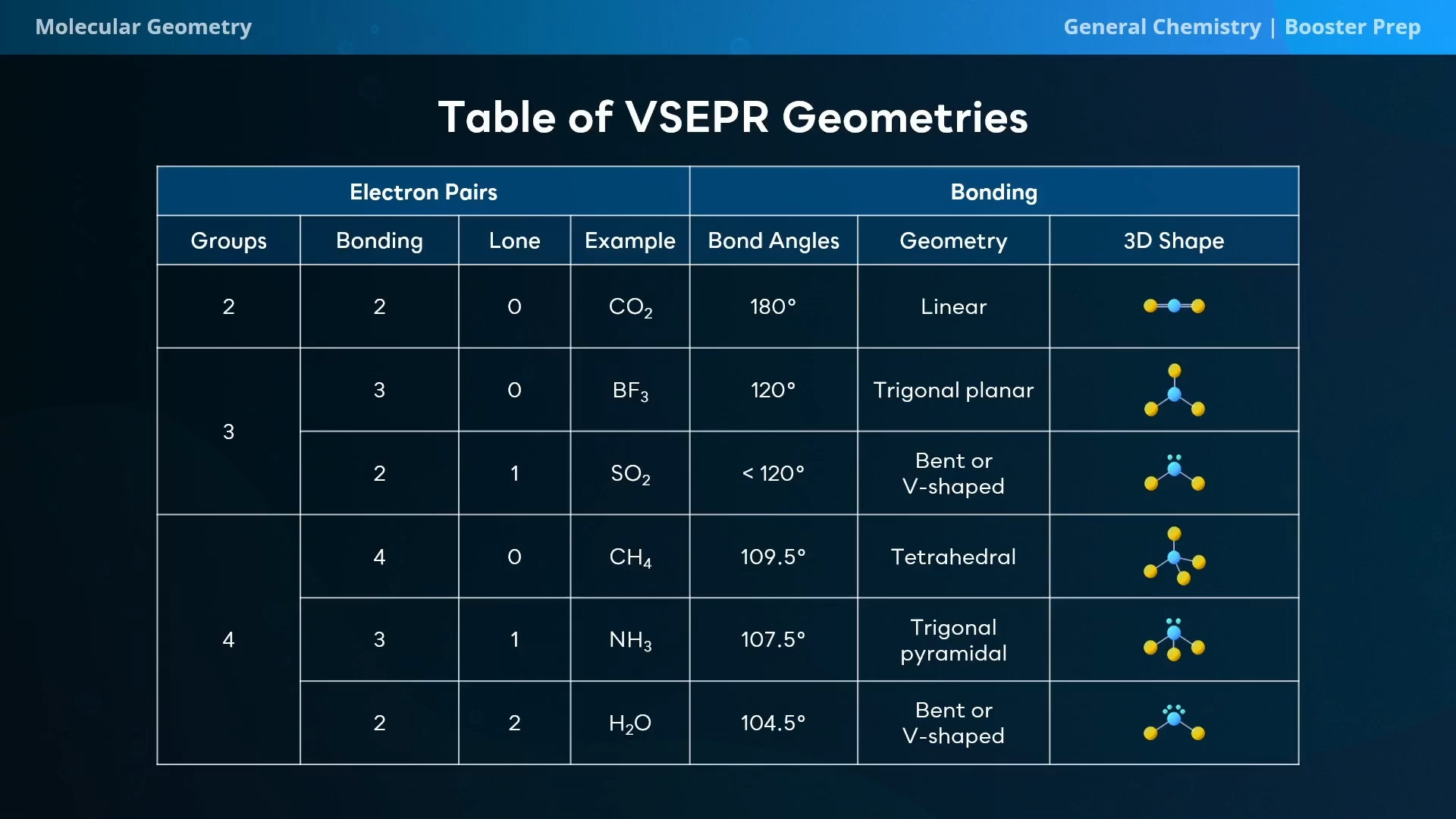
Molecular Geometry Groups
Linear
Two electron domains
180 degrees
Trigonal Planar
3 Electron domains
120 degrees
Tetrahedral
4 electron domains
109.5 degrees
Trigonal Bipyrimidal
5 electron domains
Octahedral
6 electron domains
90 degrees or 180 degrees
8 triangular faces
Trigonal Planar (3 EG)
All 3 bonds
Bent or V-shaped: 2 bonds and 1 lone pair (less than 120 degrees)
Tetrahedral (4 EG)
Trigonal Pyramidal: 3 bonds 1 lone pair (less than 109.5 degrees)
Bent or V-shaped: 2 bonds, 2 lone pairs (less than 109.5)
Trigonal Bipyramidal Group (5EG)
Seesaw: 4 bonds, 1 lone pair (less than 90 and less than 120)
T shaped: 3 bonds and 2 lone pairs (less than 90)
Linear: 2 bonds, 3 lone pairs (180 degrees)
Octahedral
Square pyramidal: 5 bonds, 1 lone pair (less than 90)
Square planar: 4 bonds, 2 lone pairs (equal to 90)
5.5 Hybridization
Orbital Overlap and the Covalent Bond
Hybridization
Atomic orbitals mix to form new hybrid orbitals
Hybrid orbitals have the correct orientation to accommodate VSEPR geometries
In above table, group 2 is 2p, group 3 is sp2 and group 4 is sp3
5.6 Polar and Non-Polar Molecules
Even Sharing of electrons:
non polar bond
no permanent dipole moment
Uneven sharing of electrons:
Polar bonds
Electronegativity difference (pull towards more electronegative)
net dipole moment
Transfer of Electrons in Ionic Bonds
High difference in EN
Full transfer, full negative and positive charge given
Non polar:
Trigonal planar and tetrahedral
Asymmetrical Shapes:
Tetrahedral (permanent dipole)


6.1 Solution Properties
Solute
The minor component in a solution ; dissolved in the solvent
Solvent
The major component in a solution; usually the liquid in which a solute is dissolved
Solution
A liquid mixture in which the solute is uniformly distributed within the solvent
Unsaturated
Less than the maximum amount of a solute is dissolved in a solvent
Saturated
The maximum amount of solute is dissolved in a solvent
Definition and Salt Solubility Rules
Solubility is the ability to be dissolved, especially in water
The solute can form a solution with the solvent

Electrolytes
Substances that have a natural positive or negative electrical charge when dissolved in water
Help your body regulate chemical reactions
Maintain balance between fluids in and outside cells
Strong electrolytes: fully dissociate in water
Soluble ionic compounds
Strong acids
Strong bases
Weak electrolytes: Partially dissociate in water
Weak acids
Weak bases
Non-electrolytes: Do not dissociate in water
Molecular compounds that aren’t acidic/basic
Important Solubility Rules of Solids vs Gases
Solids are more soluble at higher temperatures
Gases are more soluble at lower temperatures
Gases are more soluble at high pressure
Spectrophotometry
When light is passed through a solution, a spectrophotometer is used to measure how much is sent in/comes out
Beer’s Law
Light absorption is directly proportional to path length and the concentration of the solution
More concentrated solutions absorb more light than more dilute solutions
6.2 Net Ionic Equations
Molecular Equations
Equations in which all compounds are written as neutral compounds
Ionic Equations
Equations in which ionic compounds are written as separated ions (for strong electrolytes)
Spectator Ions
Ions that do not take part in the reaction and are found in solution before and after the reaction
6.3 Intermolecular Forces and Solubility
Polarity
A separation of electric charge leading to a molecule or its chemical groups having an electric dipole moment
Polar molecules contain one or more polar bonds due to a difference in electronegativity
Like Dissolves Like
Polar dissolves polar
Non polar dissolves non polar
What makes a solute soluble in some solvents but not in others
Intermolecular forces: attractive and repulsive forces between molecules
If molecules of a solute experience the same intermolecular forces as the solvent, the solute will likely dissolved the solvent
London Dispersion Forces
WEAKEST IMF
Temporary attraction btw two adjacent atoms
Increases with # of electrons (polarizability)
Dipole-Dipole Interactions
Medium IMF
Weak attractive force btw two polar molecules with permanent dipoles
Larger dipole moment = stronger attraction
Hydrogen Bonding
Strongest IMF
Btw a H atom bound to F, O, N (covalent) and lone pairs on a separate F, O, N
6.4 Stoichiometry of Solutions
Molarity
The number of moles of solute per 1 liter of solution; expressed as M (mol L-1)
Molality
The number of moles of solute per 1 kg of solvent, expressed as m (mol kg-1)
Dilution:
Process of reducing the conc of a solute in a solution
M1V1=M2V2
7.1 General properties of Gases
Gases have no definite size or shape, are widely separated, and can be easily compressed
Gas molecules are in random, constant motion
Diatomic Gases
Gas phase molecules that exist in pairs in their standard states due to unstable nature of a single atom
HAVE NO FEAR OF ICE COLD BEER
Properties That Affect Gas Behaviors
Temperature
Measure of kinetic energy, or movement, of gas particles
Higher temperature = High kinetic energy of particles = higher collisions
Volume
Solid: fixed shape and volume
Liquid: takes up shape and has fixed volumes
Gas: takes up shape and volume of container
Unlike solids and liquids, gases do NOT have distinct volumes, instead they take up the shape of the container
Pressure
Force of the gas particles colliding with the walls of its container
P=F/A (force over area)
Compression and Expansion of Gases
Compressed:
Lower volume= higher collisions = higher pressures
Expanded:
Higher volume = lower collisions = lower pressures
7.2 Introduction to Gas Laws
Kinetic Molecular Theory of Gases
Models and predicts the behavior of ideal gases through the five postulates
Particles in a gas are in constant, random motion
Combined volume of particles is negligible
Particles exert no forces on one another
Gas molecule collisions are completely elastic
All gases have the same average kinetic energy at given temp (average KE of particles is proportional to T in K)
Dalton’s Law of Partial Pressure
Total pressure of the mixture is equal to the sum of partial pressures of individual gases

Mole Fraction
Ratio of moles of one component of a mixture to total number of moles

What is Gas Density?
Mass per unit volume
Since molecular volume is negligible, density dependent on molar mass
p=PM/RT GASES ONLY
R= 0.0821 Latm/molK
Diffusion vs Effusion
Diffusion (high to low)
Effusion (escape through small hole)
A confined gas (balloon)
Graham’s Law of Effusion
The rate of effusion of a gas is inversely proportional to the square root of its molar mass
Light gases tend to diffuse and effuse much more rapidly than heavier

7.3 Simple Gas Laws

7.4 Ideal Gas Law
What is an Ideal Gas?
Behave in constant, random, straight-line motion according to KMT of Gases
Low pressures and high temperatures (far apart, lower IMF, low interaction) and (high KE, lower IMF)
PV=nRT
R= 0.0821 L(atm)/mol(K) OR 8.314 L(kPa)/mol(K)
Standard Temperature and Pressure (STP)
273 K and 1 bar
1 mol of gas = 22.4 L
8.1 Properties of Liquids and Solids
Liquids
Generally incompressible fluids with a definite volume but no fixed shape
Have a lower density than solids, since molecules are less packed
Molecules are held together by intermolecular forces (usually H bonds)
Solubility
The degree to which a solute can be dissolved by a liquid (solvent)
Miscibility
The degree to which a liquid mixes with another liquid
Viscosity
Resistance to flow (thickness)
Higher temperature, lower viscosity
Surface tension
The ability of a liquid surface to resist external forces
High temp, lower surface tension
Vapor Pressure
Equilibrium pressure exerted by a vapor above its liquid in a closed system
Higher temperature increases vapor pressure
Liquid-Solid Mixtures
Liquid particles can easily mix and diffuse with solutes to form solutions or mixtures
Heterogenous: particles mixed non-uniformly
Homogenous: particles uniformly, cant see difference
Liquid-Liquid Mixture
Heterogenous (oil and water) or homogenous (ethanol and water)
Properties of Solids
Incompressible with definite shape and volume
Strong intermolecular forces (strongest of the 3 states of matter)
Ionic, metallic, covalent network, and molecular
Ionic Solids
Hard, non-conductive, brittle, with high melting points (NaCl)
Metallic Solids
Malleable, ductile, conductive, lustrous, varianle melting and hardness
Covalent Network Solids
Hard, non-conductive, with high melting points
Molecular Solids
Soft nonconductive low melting points (ice)
Solids can be amorphous or crystaline
crystaline has higher order with a unit cell (the smallest individual repeating unit of the crystal lattice)
3 Types of Cubic Unit Cells
Simple cubic: 1 atom per cubic cell and one at every corner of the cube
Body-centered cubic: 2 atoms per unit cell, 1 atom is at the center of the cube
Face-centered cubic: 4 atoms per unit cell, 1 atom at the center of all the faces of the cube
8.2 Liquid Non-Colligative Properties
The stronger the intermolecular forces, the higher the boiling point of the liquid
H-bond > Dipole-dipole > London dispersion
Heat of Vaporization
Heat required to transform a liquid into a gas
Increases with the strength of intermolecular forces
Viscosity
Thickness of a liquid
Stronger IMF causes the liquid to appear thicker or more viscous
Surface Tension
The ability of a liquids surface to resist external forces
Stronger IMF increases surface tension
Vapor Pressure
Decreases with increasing IMF
Pressure exerted by a liquid against the atmosphere

Types of Intramolecular Forces
Polar covalent bonds: electrons shared with different electronegativities
Non-Polar covalent bonds: electrons shared equally
Ionic bonds: completely transfer electron
Metallic bonds: bonding between two metal atoms
8.3 Colligative Properties
Colligative:
Properties that depend on the concentration of solute molecules or ions, but not upon the identity of the solute
Freezing point depression and Boiling Point elevation
Vapor-Pressure depression and osmotic pressure
Non Colligative:
Properties that depend on the identity of the dissolved species and the solvent
Surface tension and color
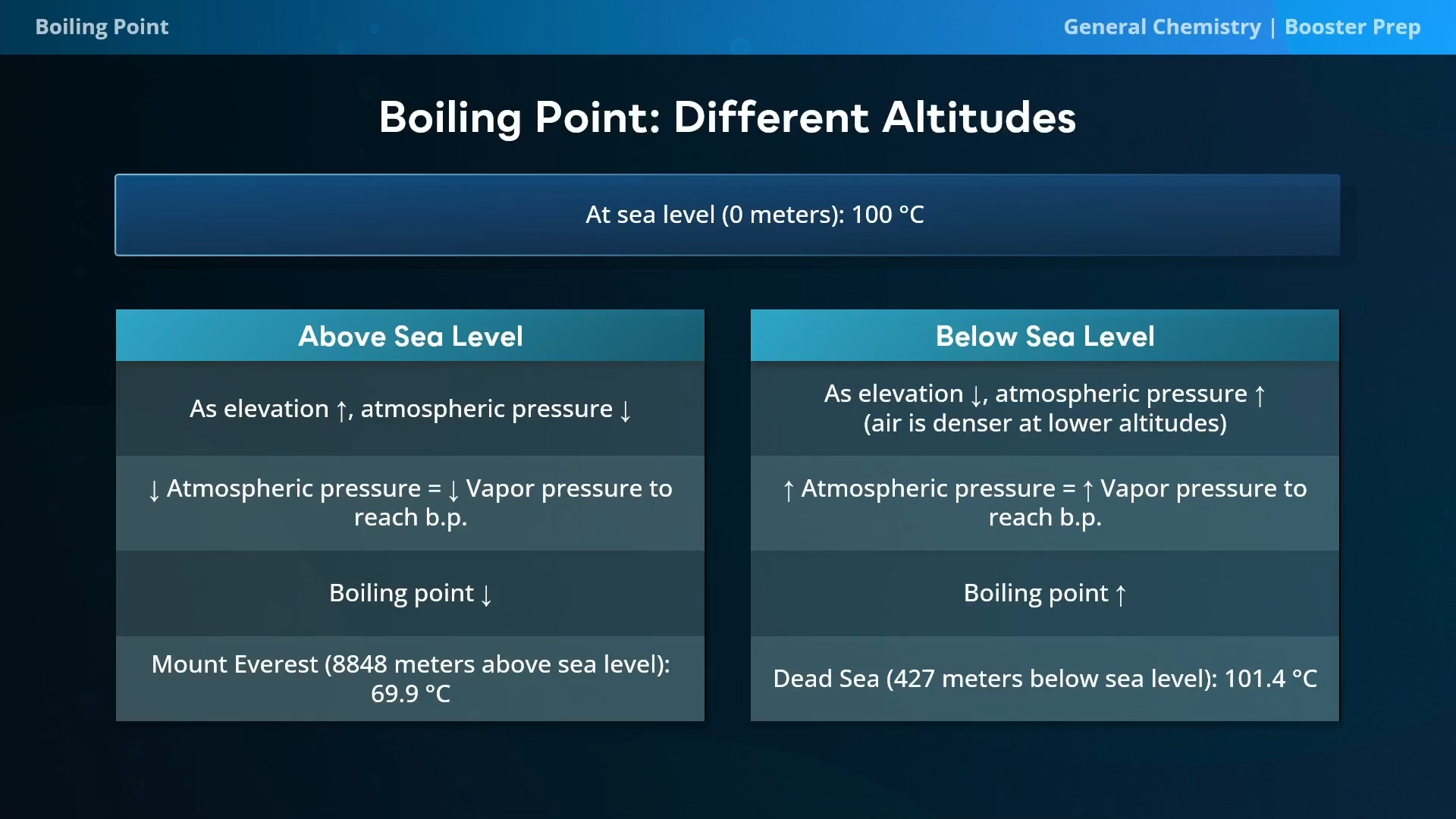
Boiling Point
Point at which molecules in liquid state are converted to the gas phase
Vapor pressure= atmospheric pressure

Vapor-Pressure Depression
The vapor pressure of a pure solvent is greater than the vapor pressure of a solution with a non-volatile solute
General rule: Higher vapor pressure = lower boiling point
Adding solute: lower vapor pressure = higher boiling point


Osmotic Pressure
Osmosis is the net movement of water across a semipermeable membrane from an area of low solute to higher solute
Solutes are unable to cross the membrane, but water can
Osmotic pressure is the pressure it would take to stop osmosis from happening

8.4 Phase Changes
Overview of Phase Changes
Each substance can change between the three phases: liquid solid gas
All are physical changes, not chemical
Requires Heat (endothermic): solid to liquid and liquid to gas
Releases Heat (exothermic): gas to liquid and liquid to solid
Solid to Liquid
Fusion (melting)
Heat is added
Liquid to Solid
Crystalization (freezing)
More disorder in liquid
Liquid to Gas
Vaporization
Heat added and vibrate until gas
Gas to Liquid
Condensation
Releases heat
Solid to Gas
Sublimation
Heat added
Gas to Solid
Deposition
Release heat
8.5 Phase Diagrams
Graphical representation of the effect of temperature and pressure on the different states of matter

Triple Point
Specific temperature and pressure where the substance is present in all three phases
All at equilibrium
Critical Point
The conditions of temperature at which the liquid and gas phases become indistinguishable
Supercritical fluid

9.1 Introduction to Enthalpy and the First Law of Thermodynamics
First Law of Thermodynamics:
Energy cannot be created nor destroyed
Energy in an isolated system remains constant but may be converted from one form to another.
System, Surroundings, and Universe
System: the chemical reaction (reactants and products)
Surroundings: the container in which the rxn happens and everything beyond it
System + Surroundings = Universe
Enthalpy (Endothermic Vs. Exothermic)
(H): amount of heat energy contained within a system
Enthalpy > 0, endothermic
Exothermic <0, exothermic (releases heat)
Hproducts - H reactants


Heat of Vaporization > Heat of Fusion
Vaporization requires sufficient energy to break almost all forces of attraction between the molecules
Fusion requires only enough energy for molecules to escape their sites in the crystal lattice
Heat of Sublimation > Heat of Vaporization
Solids have much stronger intermolecular forces than gases
Takes more energy to convert a solid to gas than a liquid to gas
11.1 Dynamic Equilibrium
When a rate forward is equal to rate reversed, the reaction is in dynamic equilibrium
No observable change in the system

If Keq < 1, there is a greater concentration of reactants than products at equilibrium
If Keq =1. then the ratio is equal
If Keq > 1, products are at a higher concentration than reactants
Gibb’s Free Energy
Products are lower in energy than reactants= more stable than reactants = exergonic
Change in Gibb’s free energy is negative = spontaneous

Reaction Quotient (Q)
Uses concentrations of the reactants/products at any point in the reaction when concentrations are still changing
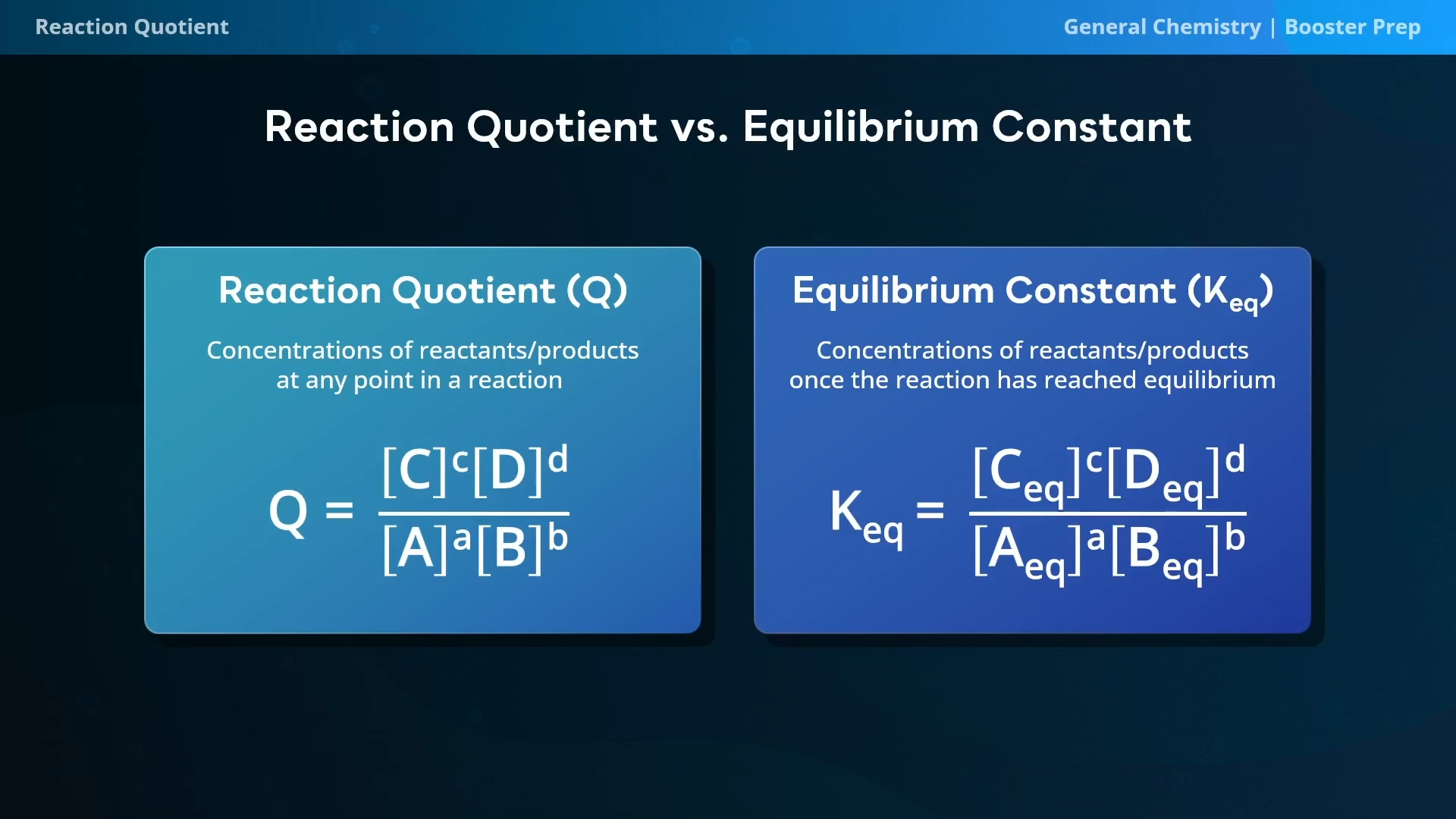
If Q < Keq, there is a higher concentration of reactants than at equilibrium, and the reaction proceeds in the forward direction
If Q = Keq, dynamic equilibrium
If Q > Keq, higher concentrations of products than at equilibrium, reaction proceeds in reverse
11.2 Le Chatelier’s Principle
Shift a system to restore the equilibrium state when its disturbed
Concentration, pressure, or temperature
Change in Concentration
Reactants are added: Q < Keq, shifts forward
Reactions are removed: Q > Keq, reverse
Products are added Q > Keq, reverse
Products are removed Q < Keq: forward
Change in Pressure & Volume
Pressure increase, volume decrease: reaction shifts towards the side with fewer moles of gas
Pressure decrease, volume increase: reaction shifts toward side with more moles of gas
Change in Temperature (Endothermic)
Lower temperature: shifts towards left
Higher temperature: shifts towards right
Change in Temperature (Exothermic)
Lower temperature: shifts towards right
Higher temperature: shifts towards left
11.3 Precipitation Reactions
Ions in solution combine to form an insoluble solid
Solubility Product Constant (Ksp)
Describes the extent to which an ionic compound dissolves in water
Qsp: describes the current state of a solution

Common-Ion Effect
Describes the decrease in solubility of an ionic precipitate when a soluble compound is added to the solution that shares an ion common to the precipitate
12.1 Introduction to Acids and Bases
Arrhenius Definition of Acids
Acid: a species that dissolves in aqueous solution to produce H ions (H3O)
Arrhenius Definition of Bases
A species that dissolves in aqueous solutions to produce OH- ions
Bronsted-Lowry Definition of Acids and Bases
Acid: a species that acts as a proton donor
Base: a species that acts as a proton acceptor
Lewis Definition of Acids and Bases
Acid: a species that accepts a pair of electrons
Base: a species that donates a pair of electrons

12.2 Acid-Base Equilibria
Acids donate H+
Bases accept H+
Autoionization of Water
Proton transferred from one water molecule to another water molecule
Weak Acids and Bases
Weak acids and bases partially ionize in solution

Effects on Equilibrium Walkthrough
Strong Acid added
Completely dissociates
Increase in H3O concentration
Equilibrium of weak acid shifts left
Strong Base Added
OH reacts with H3O
Reduces concentration of H3O ions
Equilibrium shifts right
HA increases
A- Decreased
Equilibrium shifts right
13.5 Standard Cell potential
E cell is positive in Galvanic cells and electrons flow spontaneously from anode to cathode
E cell is negative in electrolytic cells and they need an external voltage to flow (non-spontaneously)
What is E cell?
Standard cell potential is the sum of standard oxidation and reduction potenials, measured in volts
Stronger Oxidizing Agents
more positive reduction potential
reactant wants to gain electrons
Stronger Reducing Agents (products)
more negative reduction potential
reactant does not want to gain electrons
product wants to lose electrons
How to determine standard cell potential
Write the oxidation and reduction half reactions for the cell
Oxidation numbers for atoms in monatomic ions are equal to their charge
Balance the half-reactants and reverse the sign for the oxidation potential
Add the potentials of the half-cells to egt the overall standard cell potential
The half-cell with the higher reduction potential undergoes reduction
The half-cell with the lower reduction potential undergoes oxidation
The overall cell potential will be a positive value
13.6 Electrolysis Calculations
Key units and Constants
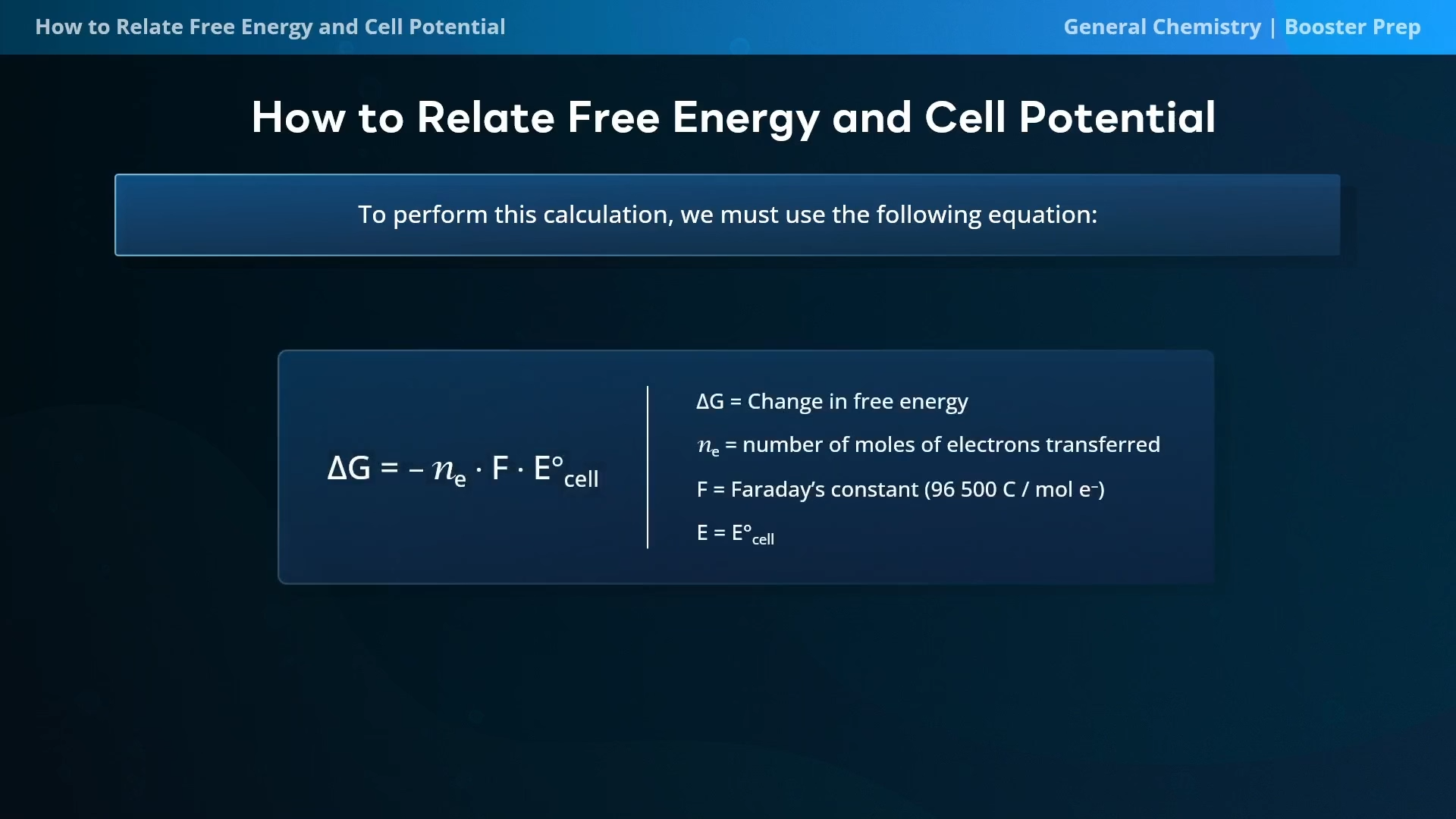
Coulomb (C) = SI unit of electric charge
Faraday’s constant= 96500 C / mol e-
Ampere = Coulomb/Second
Volt = Joule/Coulomb

14.1 Introduction to Nuclear Chemistry
Atomic Nucleus
The center of the atom is surrounded by an electron cloud
Composed of protons and neutrons
Isotopes
Same element, with different neutrons but same protons.
Binding Energy
The energy holding the protons and neutrons together at the nucleus of the atom
Calculated mass
The difference between the calculated mass of the nucleus and the actual mass of the nucleus is known as the mass defect
14.2 Types of Nuclear Rxns

14.3 Radioactive Half-Life
