tutorial 3 [week 5]
question 1
given information:
current WACC [for an all equity firm] = R0 = 12%
cost of debt = Rd = 8%
tax rate = 28%
current capital structure = all equity so debt [D] = 0
part a - calculate shadow’s cost of equity [Re]
since shadow is currently an all equity firm, its cost of equity is equal to its WACC. this is because without debt, there is no weighted average adjustment needed, and the entire cost of capital is attributed to equity.
cost of equity = Re = R0 = 12%
part b - calculate cost of equity if debt increases to 25%
if shadow converts to a capital structure with 25% debt and 75% equity, we use the M&M proposition 2 with taxes to calculate the new cost of equity. the formula is:

Re = 12% + [12% - 8%] x [25%/75%] x [1 - 28%] = 12.96%
part c - calculate cost of equity if debt increases to 50%
using the same M&M proposition 2 formula:

Re = 12% + [12% - 8%] x [50%/50%] x [1 - 28%] = 14.88%
part d - calculate the new WACC for parts b.) and c.)
WACC with 25% debt:
WACC formula is:

given values:
E/V = 75%
D/V = 25%
Re = cost of equity = 12.96% [from part b]
Rd = 8%
tax rate = 28%
substitute into formula:
WACC = [75% x 12.96%] + [25% x 8%] x [1 - 28%] = 11.16%
WACC with 50% debt:
using the same formula, our given values are all the same as before except our cost of equity [Re] is 14.88%, calculated in part c
WACC = [75% x 14.88%] + [25% x 8%] x [1 - 28%] = 10.32%
question 2
given information:
cost of debt = Rd = 11%
cost of equity [currently with no debt] = Re = 22%
tax rate = 28%
current firm value = V = 327,709
amount of new debt = D = 60,000
part a - calculate cost of equity after borrowing
after the company borrows 60,000, it used the proceeds to repurchase shares, effectively increasing its leverage. this change in capital structure will impact the cost of equity. to find the new cost of equity after recapitalisation, we use M&M proposition 2 with taxes:

NOTE: remember when a firm has no debt its WACC [R0] and cost of equity [Re] are the same!
given values:
R0 = Re = 22% [as firm initially has no debt]
Rd = 11%
D = 60,000
E = 267,709
V = D + E therefore, E = V - D
E = 327,709 - 60,000 = 267,709
Re = 22% + [22% - 11%] x [60,000/267,709] x [1 - 28%] = 23.78%
part b - calculate the new WACC after recapitalisation

using the same values as before,
WACC = [267,709/327,709] x 23.78% + [60,000/327,709] x 11% x [1 - 28%] = 20.87%
part c - implications for the firm’s capital structure
when a firm introduces debt into its capital structure in a tax environment, it benefits from the tax shield on debt, which effectively reduces the overall cost of capital [WACC] due to the tax deductibility of interest expenses. this concept is derived from M&M proposition with taxes, which states that as a firm increases its leverage, its WACC decreases because the after tax cost of debt is lower than the cost of equity.
in this case, by borrowing 60,000, the company lowers its WACC from 225 [when it was all equity financed] to 20.87%. this reduction in WACC makes it cheaper for the company to finance its operations, increasing the value of the firm and benefitting shareholders. therefore, introducing debt up to an optimal level can enhance firm value and potentially lead to higher returns for shareholders due to this tax shield effect.
question 3
given information:
debt-equity ratio [D/E] = 2.5
WACC = 15%
pre tax cost of debt = 10%
tax rate = 35%
part a - calculate Williamsen’s cost of equity capital [Re]
to find the cost of equity we can use the WACC formula with corporate taxes:

NOTE: remember, V = D + E
calculate E/V [or E/E+D] and D/V [or D/E+D] using the debt-equity ratio:
given D/E = 2.5, the firm has 2.5 euros of debt for every euro of equity
the ratios can be expressed as:
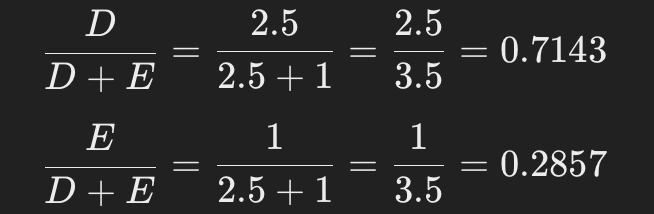
D/D+E = 71.43%, E/E+D = 28.57%
substitute values into the WACC formula:
15% = [28.57% x Re] + [71.43% x 10%] x [1 - 35%]
rearrange and solve for Re:
which gives us Williamsen’s cost of equity [Re] = 36.25%
part b - calculate williamsen’s unlevered cost of equity [R0]
to find the unlevered cost of equity [the cost of equity if the firm had no debt], we can use M&M proposition 2 with corporate taxes:

known values:
Re = 36.25%
D/E = 2.5
Rd = 10%
tax rate = 35%
substitute into the equation:
36.25% = R0 + [R0 - 10%] x 2.5 x [1 - 35%]
rearrange and solve for R0:
36.25% = R0 + [R0 - 10%] x 2.5 × 65%
36.25% = R0 + [R0 - 10%] x 1.625
36.25% = R0 + 1.625R0 - 0.1625 [or 16.25%]
36.25% + 16.25% = 2.625R0
R0 = 52.5%/2.625 = 20%
so williamsen’s unlevered cost of equity is 20%
part c - calculate WACC for new debt-equity ratios of 0.75 and 1.5
case 1: debt-equity ratio of 0.75
calculate new debt and equity proportions [D/V, E/V]:
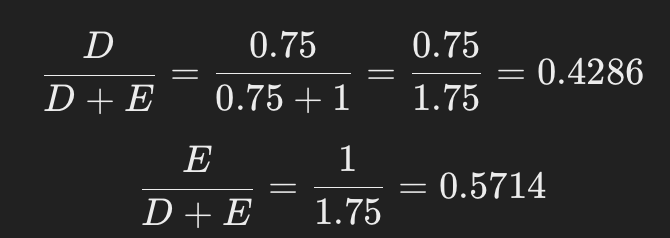
calculate the new cost of levered equity [Re]:

NOTE - in this calculation, 20% represents williamsen’s unlevered cost of equity R0. this is the cost of equity if the company had no debt in its capital structure. we use 0.2 here [as calculated in part b] because it allows to recalculate the cost of equity at different debt-equity ratios.
Re = 20% + [20% - 10%] x 0.75 x [1 - 35%] = 24.88%
calculate the new WACC:

WACC = [57.14% x 24.88%] + [42.86% x 10%] x [1 - 35%] = 17%
case 2: debt-equity ratio of 1.5
calculate new debt-equity proportions:
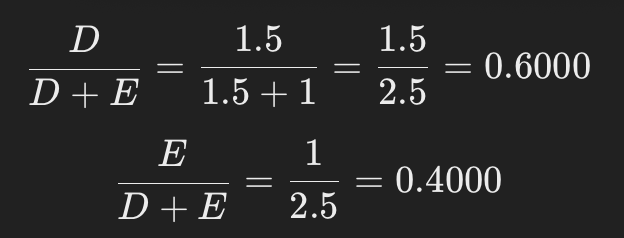
calculate new cost of levered equity [Re]:

Re = 20% + [20% - 10%] x 1.5 x [1 - 35%] = 29.75%
calculate the new WACC:

WACC = [40% x 29.75%] + [60% x 10%] x [1 - 35%] = 15.8%