A vector has magnitude and direction. and is denoted as u=<x,y>
magnitude: ∣u∣=(x2−x1)2+(y2−y1)2
direction: θ=arctan(xy)
when magnitude and direction are given and components are needed:
u=<ucos(θ),usin(θ)>
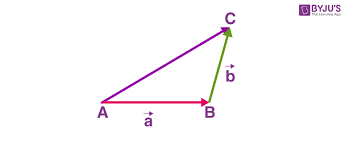
When adding 2 vectors together, use the following formula:
u+v=<ux+vx,uy+vy>
Vectors can be translated into additions of unit vectors, i, j ,k, which are unit vectors in the x, y, z axises, respectively
u=<a,b,c>=ai+bj+ck
13.2: 3d Vectors
When spreading into another dimension, where u=<x,y,z>, there is only slight differences in a few key formulas:
magnitude: u=x2+y2+z2
midpoint: (2x2+x1,2y2+y1,2z2+z1)
Sphere: points centered at (a,b,c) exactly r distance away from the point. It is empty on the inside; (x−a)2+(y−b)2+(z−c)2=r2
Ball: The volume of the sphere in included in a ball, since it is all points that satisfy the following inequality: (x−a)2+(y−b)2+(z−c)2≤r2
13.3: Dot Products and Projections
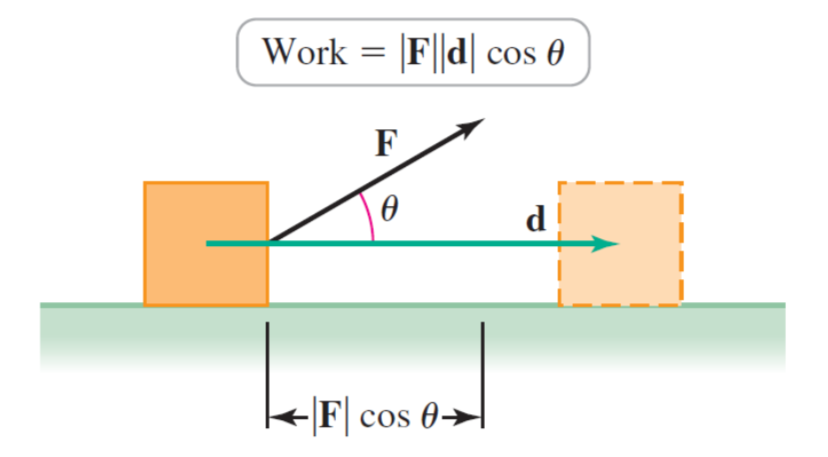
Work is the value of energy put in to move something a distance with a force
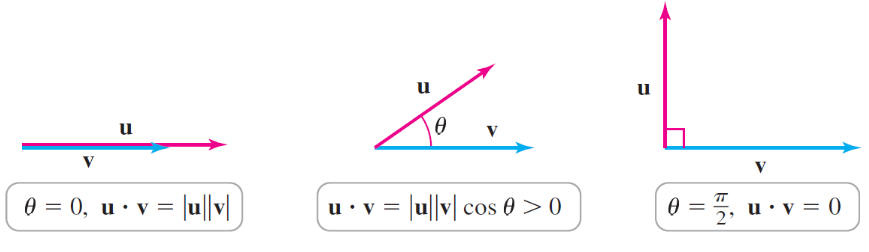
Dot Product: When 2 vectors, either 2 or 3 dimensional, when they are multiplied, you get the following theorems, which result in a scalar:
u⋅v=uvcos(θ)=u1v1+u2v2+⋯
Orthogonals: two vectors are orthogonal if and only if u⋅v=0, meaning θ=2π, meaning that the vectors are perpendicular
Projections: When you take one vector,v, and treat it as a base, a vector projection is the “shadow” of the other vector,u, on the base
projvu=∣u∣cos(θ)(∣v∣v)=(v⋅vu⋅v)v
scalvu=∣u∣cos(θ)=∣v∣u⋅v
13.4: Cross Products
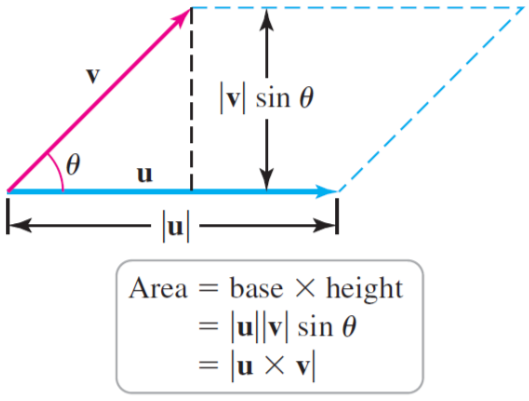
A cross product is when you multiply 2 vectors together to get another vector which is perpendicular to the other 2 vectors
magnitude: u×v=uvsin(θ)
if 2 vectors are parallel (θ=0,θ=π ), then u×v=0
Properties of Cross Products:
u×v=−(v×x)
(au)×(bv)=ab(u×v)
u×(v+w)=(u×v)+(u×w)
Cross Products of Unit Vectors:
i×j=k
j×k=i
k×i=j
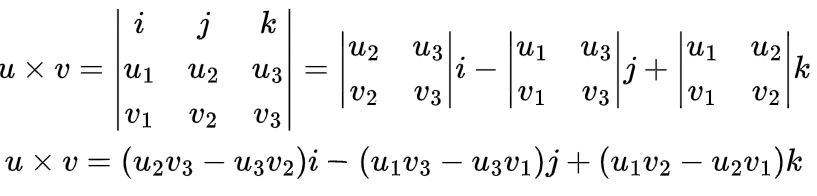
While the previous properties can be used to manipulate the cross product into finding a solution, there is always the brute force method, which involves determinants and matrices.
Torque: toque is the force at which something is rotated, and therefore it is represented by the following cross product: τ=r×F, where r is the distance from the point of rotation and F is the force applied.
τ=r×F
∣τ∣=∣r×F∣=∣F∣∣r∣sin(θ)
13.5: Lines and Planes in 3d Space
Using the basic formula for a line, y=mx+b, the formula can be expanded into the 3rd dimensions with the use of vectors. Here y will be replaced with <x,y,z>, m will be replaced with a direction vector, and b will become a point on the place.
Line: r=r0+tv→<x,y,z>=<x0,y0,z0>+t<a,b,c>
You can also then parametrize the equation to suit your needs
x=x0+at, y=y0+bt, z=z0+ct
Distance between a point and line: d=∣v∣v×PQ, where P is any point on the line, Q is the point we are finding the distance from, and v is a vector parallel to the line
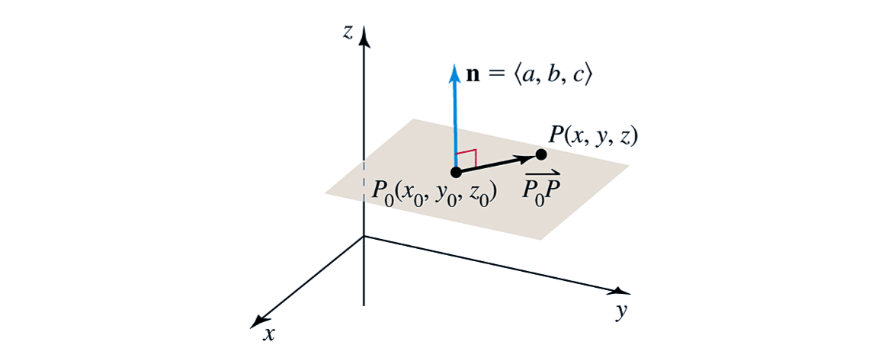
Planes are a key part of the 3d world and is defined by the set of points, P, on R³ which when made into a vector with a fixed point, P0, becoming P0P, which are orthogonal to the normal vector, n.
The general equation of a plane is:
a(x−x0)+b(y−y0)+c(z−z0)=0
ax+by+cz=d where d=ax0+by0+cz0
2 planes are orthogonal if n1⋅n2=0 and they are parallel if n1 is parallel to n2.
13.6: Cylinders and Quadric Surfaces
Cylinder: refers to a surface that is parallel to a line. Looks like a sheet
Trace: The set of points that cross one of the coordinate planes. It has 2 variables, xy, zy, or xz. The 3rd variable streches the equation to infinity
Quadric Surfaces: use the following equation: Ax2+By2+Cz2+Dxy+Exz+Fyz+Gx+Hy+Iz+J=0
Ellipses: Ovals or spheres: a2x2+b2y2+c2z2=1
Elliptic Cone: Hyperbola in 3d: a2x2+b2y2=c2z2
Elliptical Paraboloid: z=a2x2+b2y2
Hyperbolic Paraboloid: The saddle: z=a2x2−b2y2
Hyperboloid of One Sheet:a2x2+b2y2−c2z2=1
Hyperboloid of two Sheets: −a2x2−b2y2+c2z2=1
Trace Definitions:
Traces are also quite important to understanding how the function behaves. There are 3 types of traces: a hyperbola, a2x2−b2y2=1 ; a parabola, 0=x2−y; and a ellipse, x2+y2=1.