Eyewitness Testimony, Sensation, and Perception
Confounding Factors in Sensation and Perception
Defining Sensation and Perception
Let’s start by defining human sensation and perception and outlining their issues:
Sensation: the physiological reaction of a sense organ.
Examples: touch receptors coming into contact with something, light hitting the retina.
Issues: Human sensation and sensory receptors differ from individual to individual. For instance, someone who is colour blind will be less apt at distinguishing colours compared to someone with regular colour vision. Other factors like visual acuity and saturation will also influence how you interpret what you see; meaning that individual differences in our sensory systems will have an impact on eyewitness testimony.
Perception: the brain’s interpretation of the physiological input.
Examples: feeling a hot stove, seeing what’s in front of you
Issues: Human perception is not perfect. Our perception is a re-creation of the sensory input sent to the brain, and the brain can make errors during the transition from sensation to perception (e.g., hallucinations, illusions). Different sensory input leads to a different perception of the external world, and several internal (e.g., hormones, personality, motivation) and external factors (e.g., situational factors like stress or multitasking) can influence how we interpret what we sense.
Factors Affecting Sensation and Perception
Past Experience: Helmholtz’ Glasses
Our past experiences can shape how we subsequently perceive the things around us:
Helmholtz’ Glasses: Helmholtz’s glasses consist of prisms that shift everything you see by 30 degrees; so while wearing them, everything you see is actually 30 degrees to your left/right. After 20-30 minutes, your brain learns to interpret the visual information and corrects your vision. This demonstrates that perception is learned and adaptive, and that your brain uses previous experience (e.g., the time wearing the glasses) to reinterpret visual information.
“Paris in the the Springtime”: This phrase is often read without the second “the” because our past experience reading has taught us what sentences are supposed to look like, meaning that your previous experience is actively changing what you’re perceiving.
Orienting Reaction
Our orienting reaction can also influence what we focus on and what we ignore:
The orienting reaction is basically our “what-is-it” detector that interrupts ongoing activity to evaluate incoming sensory data for safety or relevance. For example, if you’re driving and you see an accident; you don’t want to look because you don’t know if it’ll be gory or not… but it is difficult to resist because the brain’s orienting reaction wants to know what happened.
An extra note: people determined that regular ads (that used to be longer) were more boring than the ‘rapid-fire’ format with constant new short advertisements that grab your attention more.
Gestalt Principles (Gestalten)
Closure: The brain tends to fill in gaps to perceive a complete object.
Illustrative Example: To demonstrate this principle, the professor drew and nearly complete circle, and proceeded to ask the class what he drew. The class said he drew a circle even if it was incomplete, demonstrating that your brain fills in the missing information.
Proximity: Objects close to each other are perceived as a group.
Similarity: Similar objects are seen as belonging together.
Example: In sports, people wearing a similar jersey are seen as belonging to the same team.
Pragnanz (Goodness of Figure): The tendency to see things as simply as possible.
Examples: The “Paris in the the Springtime” example, and a more everyday example is that when you proofread your own work you’ll often skim past mistakes
Figure-ground attention: Distinguishing a subject (figure) from its background (figure = what you’re supposed to pay attention to, ground = background).
Example: The vase/two faces illusion or the rabbit/bird illusion
When an eyewitness is traumatized, it becomes especially difficult for them to distinguish between both
Personality (Chen et al., 2012)
In Chen et al. (2012):
Subjects were made to watch video clips that created various levels of emotional arousal
During this process, subjects were exposed to three olfactory stimuli:
Pleasant Odour: lemon/orange
Unpleasant Odour: fecal odour
Neutral: rubbing alcohol
Women high in trait anxiety perceived the emotionally valanced odorants as stronger compared to the neutral one.
Men high in trait anxiety detected the emotionally valanced odorants faster compared with the neutral one.
Results on intensity and reaction time together suggest that, in the area of olfaction, anxious subject types who were emotionally aroused by the videos tended to respond more differently to emotional odours than low anxiety personality types.
Motivation
In Bruner & Goodman (1947):
Children were asked to estimate the size of various coins
Some children were from low socioeconomic backgrounds and some from upper socioeconomic backgrounds
While all children over-estimate the size of coins, those from low socioeconomic backgrounds overestimated the size much more than those from higher socioeconomic backgrounds
In Balcetis & Dunning (2006):
Subjects were told the computer would randomly select which of two liquids they would drink for an experiment on taste: either orange juice or a green foul-smelling liquid
Half the subjects (group A) were told if a letter appeared on the computer screen they would get the orange juice and if it was a number on the screen they would get the other liquid; the other half of the subjects (group B) had the simuli reversed (number= orange juice, letter= other liquid)
The ambiguous figure was flashed on the screen for 400ms and subjects were asked what they saw
72% of group A saw a “B”, the rest said they saw nothing
60.5% of group B saw a “13”, the rest said they saw nothing
Culture
Compared Japanese and Western interpretation of facial expressions of sadness and happiness Japanese culture places emphasis on the eyes as the expression of emotion USA culture places emphasis on the mouth as the expression of emotion Subjects were asked to rate pictures on a 9 point scale where 1 was extremely sad and 9 was extremely happy Two sets of pictures were used: emoticons and human face Results verified that USA subjects used mouth cues more than Japanese, and Japanese used eye cues more than USA.
Additionally, in a study regarding swear words, individuals from cultures with restrictive linguistic norms were slower to perceive swear words compared to those from liberal cultures.
Situational Factors
The Importance of Eyewitness Testimony
What is an Eyewitness?
An eyewitness is an ordinary (lay) person who reports information about an event that they personally experienced through their senses. Unlike an expert witness, whose testimony is based on professional knowledge and scientific expertise, an eyewitness can only testify about what they personally saw, heard, smelled, tasted, touched, or otherwise experienced.
The professor repeatedly emphasized that eyewitnesses are laypeople, not specialists. They are not supposed to interpret what happened. They are only supposed to report their own experiences.
The Fundamental Assumption of Eyewitness Testimony
The entire legal system assumes that people can accurately report what they witnessed.
However, this assumption is problematic. According to Prof. Hirsch, “Seeing is believing.” This simple phrase summarizes one of the biggest problems in forensic psychology. Jurors naturally assume that:
"If someone saw it with their own eyes, then it must have happened."
Why We Believe Eyewitness Testimony
One of the first points emphasized in the lecture is that eyewitness testimony is probably the single most persuasive type of evidence presented in court. Even when scientific evidence is available, jurors frequently give enormous weight to a witness who confidently says “I saw him do it.” But why?
The professor argues that humans almost need to believe eyewitnesses because questioning eyewitness perception forces us to question our own perception. The reasoning behind this is that we experience the world through our senses and generally assume that our senses accurately represent reality; so if we begin believing that people cannot accurately perceive reality, then we must also admit that our own perception may be unreliable.
According to the professor:
"We have to believe in ourselves in order to stay sane."
Therefore, when someone sincerely reports “I saw it with my own two eyes”, our natural reaction is to believe them; not necessarily because their testimony is accurate, but because believing them preserves our own confidence in reality.
Are Eyewitnesses Lying?
It is important
Why Eyewitnesses Are Often Inaccurate
The lecture builds an important chain of reasoning.
An eyewitness account depends on three psychological processes, each of which can introduce error.
Step 1: Sensation
The witness must first detect information through their senses.
Problems arise because:
people differ biologically,
visual acuity differs,
colour blindness exists,
thresholds differ,
drugs and hormones affect sensation,
environmental conditions alter sensory input.
Step 2: Perception
The brain must then interpret sensory information.
Perception is not a perfect recording device.
Instead,
the brain reconstructs reality using:
assumptions,
previous experience,
Gestalt principles,
attention,
motivation,
expectations,
culture,
stress,
personality.
Errors made during perception become part of what the witness believes they experienced.
Step 3: Memory
Finally,
the witness must remember the event.
Memory itself is highly fallible.
Information can be altered through:
forgetting,
interference,
misinformation,
suggestion,
passage of time,
retrieval errors.
By the time the witness enters the courtroom,
they are recalling something that has already been distorted during sensation, perception, and memory.
The professor summarized this progression near the end of class:
First, what you perceive is flawed.
Then, when you later remember what you perceived,
memory introduces additional errors.
The Central Message of the Lecture
One sentence from the lecture captures the entire purpose of this chapter.
Eyewitnesses are only about 30% accurate at their best—and they are rarely ever at their best.
The professor specifically said students would not be tested on the exact percentage.
Instead,
he emphasized remembering the general idea:
eyewitnesses are far less accurate than people assume,
and real-world conditions almost always make performance worse.
This idea is the foundation for the rest of the lesson.
Everything discussed later—sensation, perception, memory, suggestibility, interviews, and lineups—explains why eyewitness accuracy is so poor.
Why Is This Such a Serious Problem?
Jurors tend to treat eyewitness testimony as direct evidence.
Psychologically,
it feels much stronger than statistical or forensic evidence.
The danger is that jurors often cannot distinguish between:
an accurate eyewitness,
and an inaccurate eyewitness.
Both appear equally believable.
As a result,
incorrect eyewitness testimony has become one of the leading contributors to wrongful convictions.
This is one of the major reasons forensic psychologists study eyewitness memory.
Research on the Persuasiveness of Eyewitness Testimony
Numerous studies demonstrate that eyewitness testimony is remarkably persuasive—even when it should not be.
Loftus (1983)
Participants acting as jurors evaluated different types of evidence.
Percentage of Guilty Verdicts
Evidence | Guilty Votes |
|---|---|
Eyewitness testimony | 78% |
Fingerprints | 70% |
Polygraph | 53% |
Handwriting analysis | 34% |
Interpretation
Perhaps surprisingly,
participants convicted defendants more often when given eyewitness testimony than when given fingerprint evidence.
This illustrates the extraordinary persuasive power of eyewitness accounts.
Key Point
Eyewitness testimony was considered more convincing than objective forensic evidence.
Loftus (1974): Discredited Eyewitnesses
Loftus examined whether jurors would still believe eyewitnesses after learning that they had poor vision.
Results
Evidence Presented | Guilty Votes |
|---|---|
Normal eyewitness | 72% |
Circumstantial evidence only | 18% |
Eyewitness with 20/400 vision who was not wearing glasses | 68% |
Interpretation
Even after learning that the eyewitness was legally blind without glasses,
participants still convicted at nearly the same rate.
This finding demonstrates that jurors heavily discount information that should reduce eyewitness credibility.
Research on Accuracy vs. Confidence
Perhaps the most important finding in eyewitness psychology is that:
Confidence and accuracy are not the same thing.
People often assume:
High confidence → High accuracy
Research shows this assumption is frequently incorrect.
An eyewitness may be:
completely confident,
completely sincere,
and still be completely wrong.
Mock Jury Findings
The professor summarized several findings discussed in class.
Eyewitness testimony is believed approximately 80% of the time.
However,
jurors cannot reliably distinguish between:
Accurate eyewitnesses
Believed approximately 68% of the time.
Inaccurate eyewitnesses
Believed approximately 70% of the time.
The difference is essentially nonexistent.
Why Confidence Is Misleading
Jurors tend to use confidence as a shortcut.
If a witness appears:
calm,
certain,
detailed,
jurors assume they must also be accurate.
Unfortunately,
confidence can increase for many reasons unrelated to actual memory, including:
repeated questioning,
feedback from investigators,
rehearsal,
reconstruction of memories over time.
As later sections of this chapter will show,
memory is reconstructive rather than reproductive.
People become increasingly confident in memories that may actually be false.
Factors That Increase an Eyewitness's Persuasiveness
According to the lecture, eyewitnesses are especially convincing when they:
provide many details (even trivial ones),
appear highly confident,
are adults rather than children,
speak fluently and consistently.
Interestingly,
the professor noted that children are usually considered less persuasive—
except in sexual assault or child molestation cases, where jurors often consider child testimony especially compelling.
Similarly,
elderly witnesses are generally viewed similarly to children, although this effect also changes somewhat depending on the nature of the crime.
Eyewitness Testimony: Sensation and Perception
Confounding Factors in Sensation and Perception
lay witnesses can only report what they have experienced with their five senses.
Eyewitness testimony is the most pervasie criteria in court to find someone guilty
jurors almost always beleive what an eyewitiness says. unless the person is lying and the lawyers work out whethet they’re lying or not; most eyewtinesses don’t lie, but will be innacurate. But we still believe them… why? “i saw it with my won two eyes”… you believe it, the jury beleives it, and the judge beleives it…
if we accept that what people see and remember isn’t necessarily real, you question your sanity. we have to believe in ourselves to stay sane, so we accept that when smn says they saw something themselves, we beleive it.
Sensation: physiological reaction of the sense organ.
The retina in the eye is an example… light enters the eye and hits the retina
The pressure sensors in your skin is another example
Unfortunately, your senses and receptors are different for different people… as a result, different people will experience reality in a different way. Hirsch is completely colour blind, for instance.
Hirsch is completely colour blind, for instance
Your visual acuity will influence your vision
threshold is minimum amount of energy required to trigger your senses. maximum threshold is how much energy your senses can handle. these also influence your senses.
saturation; maximum colour saturation you can see.
Taking LSD (or other teratogens) = “something that is coming in your body that is bad”
hormones… they change sensation and perception in both women and men
environmental factors also affect sensation (like the weavers in Holland case).
COVID-19 can cause loss of sense of smell, which also interacts with tasting…
Seeing is believing?
Sensation is based on physiological parameters that differs from person to person
Color blindness, acuity, threshold, saturation, etc.
Hormones, level of electrolytes, teratogens (eg. Drugs)
Environmental factors such as background also affection sensation
Background colours and patterns
Much of the same confounding factors apply to hearing and other
senses
What is Perception?
Definition: Perception is the analysis by the brain of sensory input
It is NOT a one-to-one correlation between input and final perception
Perception is an active re-creation of what is an approximation of the input
During re-creation the brain makes assumptions and also makes errors:
E.g., Illusions (distorted sensory information = distorted perception), Hallucinations (perceiving something that isn’t there)
Factors Affecting Perception
What factors affect perception?
Past experience (Helmholtz’ glasses)
Helmholtz’ Experiment: the glasses are prisms that shift everything you see by 30 degrees… so when you have them on, and looking straight ahead, everything you see is actually 30 degrees to the left/right… the brain learns to interpret the visual information and fixes your vision (malleability of vision)
Another experiment: (refer back to lecture recording… liberals vs. conservative perception)
Orienting reaction (basis for rapid changing images on TV)
one simple rule: if the stimuli are new, the brain wants to know about it (and will perceive it). what’s even worse is that the brain will receive it and make an effort to receive it. The simplest example: you’re driving and see an accident; you don’t want to look because you don’t know if it’ll be gory or not… but god is it hard to resist.
people determined that this would be a great way to get people to pay attention to ads… they found that regular ads were more boring than the format with rapid-fire short and new ads, which grab your attention more
Gestalt Principles (Gestalten):
Closure: The brain tends to fill in gaps to perceive a complete object.
Incomplete circle… people guessed “you drew a circle” but it was incomplete, demonstrating that your brain fills in the missing information.
Proximity: Objects close to each other are perceived as a group.
Jewish Boy Phenomenon with the ancient scrolls: the ancient scrolls are written without punctuation (continuous string of letters without vowels either)
Similarity: Similar objects are seen as belonging together.
Two people dressed similarly, one is a robber, the other will be assumed to be a robber as well
Pragnanz (Goodness of Figure): The tendency to see things as simple as possible; we see what we think should be seen (e.g., reading "Paris in the the Springtime" and ignoring the second "the"). Otherwise known as the tendency for the human brain to fix mistakes.
non-straight line while painting home example
Figure-ground attention: Distinguishing a subject (figure) from its background (e.g., the vase/two faces illusion or the rabbit/bird illusion).
Figure = what you’re supposed to pay attention to, ground = background
When an eyewitness is traumatized, it becomes especially difficult for them to distinguish between both
Personality
Motivation
Culture
Situational factors such as stress or multitasking.
figure-ground illusion focusing on the passing of the ball w/gorilla! (2 vids)
the door study (simons & leven 1997) — smn passes with door and rpelaces person asking pedestrain for directions.
Situational Factors
The Yerkes-Dodson Rule
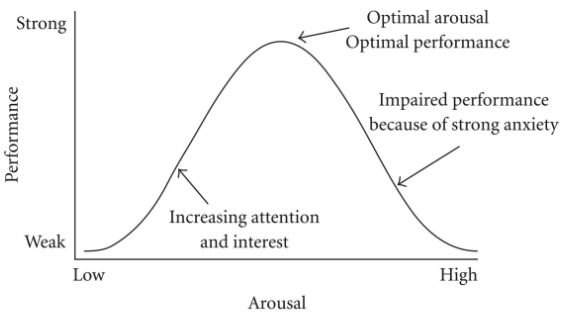
This rule has to do with how efficiently your brain will perceive information. On the x-axis is your level of arousal, and the y-axis is your ability to perceive. When you’re not aroused at all, your perception is low. As your arousal increases, your ability to pay attention and perceive increases, until the maximum threshold. Then you get to the maximum level of arousal (panic), and your perception reduces again.
Yerkes-Dodson Rule and Multitasking
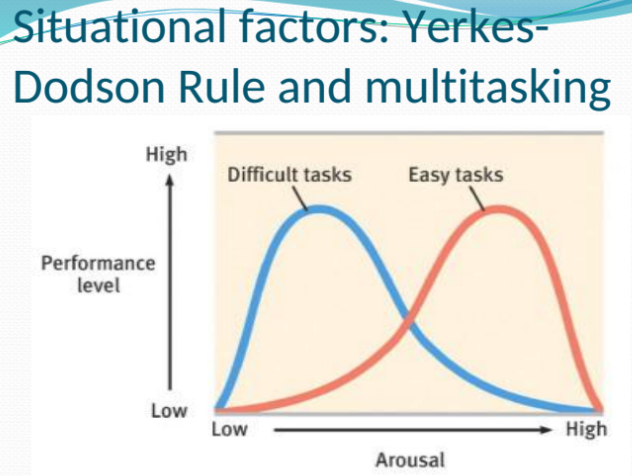
When a task is easy, a higher level of arousal is necessary for peak performance, and vice versa.
Social Influence: The Asch Experiment
The Setup:
8 subjects seated around a table (seating plan carefully constructed to prevent any suspicion)
One participant was a subject for the experiment, the rest being confederates, carefully tutored to give certain pre-selected responses.
The Experiment:
Confederates gave a variety of answers, at first correct, to avoid arousing suspicion in the subject, but then with some incorrect responses added.
The control group, those not exposed to peer pressure where everybody gave correct answers, threw up only one incorrect response out of 35
The results for the experimental group: when surrounded by people giving an incorrect answer, over one third of the non-control subjects also voiced an incorrect opinion.
Ability of social psychology to subtly affect human behaviour: Candid Camera Video
Perception is affected by conformity: a social psychological phenomenon
Motivation and Perception
Another experiment (13 or B)
Culture and Perception
Example: In Beijing mainland china he was teaching, all girls. they’re all sitting with heads down (didn’t look at him), and he tried to get excitement but failed to. He was depressed, his colleague asked “did they look at you?” Hirsch said “no” which is actually a show of tremendous respect… because there, it was considered rude to look at your professor.
Personality and Perception
Motivation and Perception
Memory and Eyewitness Testimony
Memory Factors
Sensory Memory:
Losses based on various factors (e.g., tachistoscope studies of culturally taboo words, Hernandez-Peon study on cats)
implanted electrodes in auditory nerve of cats, then put cat in bell jar with nothing in it, then rang bell,
then he put mouse in bell jar, then same thing and no reaction in auditory system… oriented reaction (e..g, i dont wanna attned to the bell cause im paying attention to the mouse)
You can have losses of memory in the sensory system
Short-Term Memory:
It is an active process — think of your computer. Your sensory memory is in your keyboard; the code for the letter you press is stored int he keyboard, then it is sent into the RAM (your short-term memory)… and RAM is also an active process…
It is also limited in humans
7± two bits of information is the room we have in our short-term memory
Proactive Interference: Some of the new information kicks out the old
Retroactive Interference: The old can prevent some of the new from getting in
Losses in information can occur due to lack of relevance and other factors
Long-Term Memory:
Following a consolidation period, the information enters into long-term memory
Some factors can impact consolidation: personality; motivation; interests; culture; state of consciousness (state-based memory), recognition memory (low confidence - low detail) vs. recall memory (high confidence - high detail)
State of consciousness; your brain remembers content and where that content is stored, but also state of consciousness/way you were feeling when you experienced the thing you’re remembering
Recognition memory (low confidence, low detail)— you’re given some clues, and you have to recognize the correct one… one example is having a lineup of suspects and being asked which one was the perpetrator
Easier (due to potential of triggering the memory), but low confidence… provides few details… for instance, most individuals will be like “I think it’s number four.” Or during exams.
Recall memory (high confidence, high detail) — you have to remember without any clues… an example if an eyewitness being asked to “describe the suspect”
Essay exams are like this.
Persuasiveness of Eyewitness
General Statistics Based on Mock Juries
Most persuasive form of evidence
Eyewitness believed 80% of the time
Juries cannot tell the difference between an accurate and an inaccurate witness
Accurate witness believed 68% of the time
Inaccurate witness believed 70% of the time
Loftus (1983)
Type of Evidence | Percentage of Guilty Votes |
Eyewitness Testimony | 78% |
Fingerprints | 70% |
Polygraph | 53% |
Handwriting | 34% |
Lindsay, Wells, & Rumpel (1981)
Witnesses viewed a staged theft
Discredited Eyewitnesses (Loftus 1974)
Type of Evidence | Percentage of Guilty Votes |
Eyewitness Testimony | 72% |
Circumstantial Evidence | 18% |
Eyewitness with 20/400 vision (legally blind) who wan’t wearing glasses | 68% |
Eyewitnesses are Most Persuasive When:
When they provide detail (trivial persuasion)
When they are confident
When they are adults
Children can be persuasive under certain circumstances (like in cases of sexual molestation… then adults aren’t necessarily perceived as more persuasive than children)
Elderly are perceived similarly to children (except in the case of sexual molestation as well…
Eyewitness Accuracy
Research on Wrongfully Convicted Defendants
Wells et al. (1998)
Rattner (1988)
Brandon and Davies (1973)
Academic Research
Buckhout (1975)
Buckhout (1974)
Correct Identifications
20% (
Extra stuff
Cromag Experiment (1996)
boeing crashed into 11-story building in amsterdam… back in those days, reporters had to come and use celluloid film to record it, then rush back to offices, then give film to processing lab, so it could be projected onto screen for the news that evening.
IMmediately reporters rushed out and filmed recovery attempts. that night it was on the news, and kept showing footage of the news. a few weeks later, cromag asked students in his classes how many student saw the news. “how many of you saw the plane crashing into the apartment?”… 66% said they “remembered” seeing the plane actually hit the building.
other epxeirment
Students asked not to touch alt key (computer would crash and would erase all data, and years of work would go down the drain)"l. we’ll be watching outsdie from one-way mirror. when all of a sudden, screen goes blank. the prof says “you hit the alt key!” guy is like “i didn’t hit the alt key”. then the prof says “we saw you. now leave.” later the prof would go see student’s friend’s, and most of the time the student would say “i messed up and hit th ealt key.
Common Errors
Overestimate the height of criminals
Overestimate the duration of a brief event (especially when traumatized)
Notice more about the action than the person
Pay more attention to the weapon (weapon focus)
Anxiety levels shoot up to panic levels, and figure of ground perception decreases… only remember colour and shape of weapons.
Figure of ground is also why rape was replaced by sexual assault (think of smart lawyer saying how do you know it wasn’t just a finger”).
Situational Factors Affecting Eyewitness Accuracy
Time Delay before Identification
Ellison and Buckhout (1981)
75% accuracy after 2-day delay
56% after 35-day delay
Typically, when there’s an investigation, it can take place months after and that drops below 30%
Suspect race
Evidence is somewhat mixed
People most accurate in
identifying own race
type of crime (victim)
seriousness of crime (witness)
arousal level
Method Used to Identify Suspect
you can never ask “which one of these is the suspect.”
Jury Composition
Selecting a Jury
most ppl don’t want to be in a jury. especially if it’s a high profile case (like murder, gang stuff). you wouldn’t want to be in a jury for a hell’s angels case when they could find out you’re in the jury. Some people can avoid jury duty (forensic psychologists, police officers, certain other professions). if it’ll create an undue burden on you and your family, then it’s a valid excuse to get out of it. inability to understand the language of the trial is also an acceptable excuse. and then you have the people who fake it. Alan gerchsewitz — jury = 12 ppl too stupid to get out of jury duty…
it’s suppsed to be representative of the community. first you select group of people… 300 people let’s say. you’ll never get an ubiased jury, because list you start out with will be biased.
then you take jury pool… one person at a time goes to trial; here’s where’s a huge difference between Canada and U.S…. in both countries lawyers are allowed peremptory challenges (e.g., I don’t want him in the jury, without cause). in the states they also have the ability to investigate the potential juror… asking them many different types of questions. in Canada, they can only ask 5 questions: name, age, occupation, education, and something else… they cant ask personal stuff, whereas in states they can.
When smn is kicked out due to preemptory challenge, you move on to next person in jury pool. when oeremptory challenges run out, you have unlimited challenges with cause. sometimes jury selection can be in trial for months, because a potential juror can be interrogated for a long time int he states.
end result: 12 people in the jury.
Juries as a social group:
jury is a social group. a group of people subject to social forces just like any other social group (such as conformity).
characteristics of a jury:
representativeness
impartiality — biggest threat to it is public knowledge
jury nullification:
in Canada, this means a jury can negate the law.
henry morganthaller was a doctor performing abortions when that was punishable by life in prison… he was asked “did you commit abortions?” and he said “yes.” and then the defense lawyer asked “why?” and he said “because I wanted to save women’s lives.” jury found him not guilty because they felt the law was wrong. he was tried two other times with the same thing.
you cant have abortion in last trimester because now youre dealing with viable, plus its dangerous for th emother… otherwise its free abortion in canada
In US it means a judge can nullify the jury’s decision (e.g., bias of judge can determine outcome of trial).
Fundamentals of Sensation and Perception
Sensation is based on physiological parameters that differ among individuals. Differences include:
Color blindness.
Acuity.
Threshold.
Saturation.
Biological factors: Hormones, levels of electrolytes, and teratogens (e.g., Drugs).
Environmental factors, such as background colors and patterns, significantly affect sensation.
These confounding factors apply to hearing and other senses.
Perception is defined as the analysis by the brain of sensory input. Key characteristics include:
It is NOT a one-to-one correlation between input and final perception.
It is an active re-creation that serves as an approximation of the input.
The brain makes assumptions during re-creation, leading to errors such as illusions and hallucinations.
Situational Factors: The Yerkes-Dodson Rule
The Yerkes-Dodson Rule describes the relationship between arousal and performance:
Performance is weak at low levels of arousal (low attention and interest).
Optimal Performance occurs at Optimal Arousal.
Performance becomes impaired at high levels of arousal due to strong anxiety.
Task Complexity and Arousal:
Difficult tasks reach optimal performance at lower levels of arousal.
Easy tasks reach optimal performance at higher levels of arousal.
Social Influence and Perception: The Asch Experiment
Experimental Setup:
8 subjects were seated around a table using a seating plan constructed to prevent suspicion.
Only one participant was a true subject; the other seven were confederates tutored to give pre-selected responses.
Confederates began with correct answers to build trust, then switched to incorrect responses.
Results:
Control Group (no peer pressure): Produced only 1 incorrect response out of 35 trials ().
Experimental Group: When surrounded by people giving incorrect answers, over one-third (> 33.33\%—specifically stated as "over one third") of non-control subjects voiced an incorrect opinion.
Conclusion: Perception is affected by conformity, a social psychological phenomenon.
Motivational Influences on Visual Perception
Study by Balcetis and Dunning (2006):
Subjects were told a computer would randomly select a drink: orange juice or a green, foul-smelling liquid.
Group A: A letter appearing on screen meant orange juice; a number meant the foul liquid.
Group B: Reversed requirements (number = orange juice; letter = foul liquid).
An ambiguous figure was flashed for .
Results: of Group A saw a "B" (the letter linked to the positive outcome), while of Group B saw a "13" (the number linked to the positive outcome).
Study by Bruner and Goodman (1947) on SES and Perception:
Children estimated the size of coins.
While all children overestimated coin size, those from low socioeconomic backgrounds overestimated the size significantly more than those from upper socioeconomic backgrounds.
Cultural and Personality Factors in Perception
Culture and Emotion (Yuki, Maddox, & Masuda, 2012):
Japanese culture emphasizes the eyes as the expression of emotion.
USA culture emphasizes the mouth as the expression of emotion.
Ratings on a 9-point scale (, ) confirmed that USA subjects prioritized mouth cues and Japanese subjects prioritized eye cues in both emoticons and human faces.
Personality and Olfaction (Chen & Dalton, 2012):
Subjects were exposed to 3 odors while watching emotionally arousing clips: Pleasant (lemon/orange), Unpleasant (fecal), and Neutral (rubbing alcohol).
Findings for high-trait-anxiety subjects:
Women: Perceived emotionally valenced odors (pleasant/unpleasant) as stronger than neutral ones.
Men: Detected emotionally valenced odors faster than neutral ones.
Memory Factors in Eyewitness Testimony
Sensory Memory: Susceptible to losses based on various factors (e.g., tachistoscope studies of culturally taboo words; Hernandez-Peon study on cats).
Short-term Memory:
Active and limited.
Affected by proactive and retroactive inhibition.
Losses occur due to lack of relevance.
Long-term Memory:
Requires a consolidation period.
Influenced by personality, motivation, interests, culture, and state of consciousness (state-based memory).
Recognition memory: Often associated with low confidence and low detail.
Recall memory: Often associated with high confidence and high detail.
Persuasiveness of Eyewitnesses
General Impact:
Eyewitnesses are the most persuasive form of evidence.
They are believed approximately of the time.
Juries typically cannot distinguish between accurate and inaccurate witnesses (accurate witnesses are believed of the time; inaccurate witnesses are believed of the time).
Evidence Ranking (Loftus, 1983) by percentage of guilty votes:
Eyewitness testimony:
Fingerprints:
Polygraph:
Handwriting:
Discredited Eyewitnesses (Loftus, 1974):
Circumstantial Evidence: guilty votes.
Eyewitness: guilty votes.
Eyewitness with vision (not wearing glasses): guilty votes.
Conclusion: Discredited witnesses are less persuasive than credible ones but more persuasive than no eyewitness.
Witness Characteristics and Persuasiveness:
Most persuasive when they provide trivial detail, are confident, and are adults.
Elderly witnesses are perceived similarly to children.
Research on Eyewitness Accuracy
Real-world Misidentifications:
Wells et al. (1998): Out of 40 people cleared by DNA, ( cases) involved false eyewitness identification.
Rattner (1988): of 205 wrongful convictions were due to inaccurate testimony.
Brandon and Davies (1973): Documented 70 cases of wrongful conviction due to inaccurate identification.
Academic Simulations:
Buckhout (1975): Simulated crime on TV newscast; only of 2,145 callers were accurate.
Buckhout (1974): Staged assault in front of 141 students; 7 weeks later, students viewed a 6-photo lineup. Result: identified the attacker, identified a bystander, and identified someone not present. Correct identification rate in similar studies: (Buckhout, 1980) to (Leippe et al., 1978).
Cutler & Penrod (1995): Unusual customer behavior; 2 hours later, correct ID, false ID, no ID.
Cromag (1996): After a Boeing 747 crash in Amsterdam, of students "remembered" seeing the plane hit the building on TV footage that did not actually exist.
Common Errors and Situational Influences
Recurring Errors: Overestimating criminal height, overestimating the duration of brief events, noticing action over person details, and focusing on weapons.
Time Delay (Ellison and Buckhout, 1981):
2-day delay: accuracy.
35-day delay: accuracy.
Suspect Race: Mixed evidence, though people are generally most accurate in identifying their own race.
Type and Seriousness of Crime:
Description completeness by crime: Robbery (—most complete), Rape (—moderate), Assault (—least complete).
Seriousness (Leippe, 1978): High seriousness (stolen calculator) resulted in accuracy; Low seriousness (stolen cigarettes) resulted in accuracy.
Weapon Focus Phenomenon: The presence of a weapon reduces accuracy due to shifted arousal levels.
Identification Methods
Formats (Live, Photo, Video): Meta-analysis shows no significant difference in accuracy.
Lineup Procedures:
Simultaneous Lineup: All suspects shown at once.
Sequential Lineup: Suspects shown one by one. This produces fewer false positives when the suspect is NOT in the lineup.
Show-up/Walk-by: Presenting a single person. Suggestive and leads to more false positives. Mainly used for "deathbed IDs" where the victim may not survive long enough for a formal lineup.
Jury Composition and Impartiality
Jury Attributes:
Representativeness: Reflects the community of the crime.
Impartiality: Jurors must be unbiased.
Threats to Impartiality:
Negative pretrial publicity: Increases guilty verdicts.
Emotional impact of publicity is remembered even when facts are forgotten.
Increasing Impartiality:
Change of venue: Moving the trial to a different community (must demonstrate reasonable likelihood of bias in the current community).
Adjournment: Delaying the trial to let bias dissipate (limitations: memory fades, witnesses move/die).
Challenge for cause: Rejecting biased jurors after questioning (potential for dishonest answers).
Peremptory challenges: Also used during jury selection.
Jury Functions and Nullification
Functions of the jury: Wisdom of 12 people (versus 1), serving as the conscience of the community, protecting against out-of-date laws, increasing justice system knowledge, and applying the law as provided by the judge.
Jury Nullification: Ignoring the law and using other criteria for a verdict. This may occur when laws are outdated and can produce both socially favorable and unfavorable verdicts.
Methods for Studying Jury Behavior
Post-Trial Interviews: Forbidden by law in Canada. In the USA, they provide data but are limited by social desirability and inaccurate recall.
Archival Records: Using trial transcripts and police interviews. Limited by inability to establish cause-and-effect and existing biases in the records.
Simulation: Using mock jurors and fictitious transcripts. Allows for manipulation of variables but lacks real-world generalizability.
Field Studies: Research during a real trial. High external validity, but court permission is difficult, and variables cannot be controlled.
Juror Comprehension and Decision-Making
Comprehension Aids:
Note-taking: Increases memory, understanding, and attention.
Asking Questions: Permitted via the judge. While they promote understanding, research suggests they do not help "get to the truth."
Inadmissible Evidence: Jurors will disregard evidence only if provided with a logical and legitimate reason for the judge's instruction to do so.
Judicial Instructions: Jurors often fail to remember, understand, or apply them. Reforms include rewriting instructions, providing written copies, and pre-exposure to instructions.
Decision-Making Models:
Mathematical Models: Mental calculations where weights are assigned to evidence. Research suggests jurors do not actually assign values this way.
Explanation Models (Story Model): Organizing evidence into a coherent story. Research indicates this is more consistent with actual juror behavior (Pennington & Hastie, 1988).
Predicting Verdicts
Key Predictive Variables:
Demographic: Effects are mostly small and inconsistent, except for the "Black Sheep Effect."
Personality Traits: Positive relationship between authoritarianism and conviction rates.
Attitudes: "Death-qualified" jurors are more likely to convict. Case-specific attitudes are better predictors than general ones.
Defendant Characteristics: Small relationship between attractiveness and verdict.
Victim Characteristics: Particularly relevant in sexual assault cases.
Expert Testimony: Interaction depends on the gender of the expert and the complexity of the testimony.