GENERAL BIOLOGY 2
Lesson 1 : DNA Replication
CHANGES
- One Gene-One Enzyme: Believed that each gene controlled the production of a single protein
- One Gene-One Protein: The first hypothesis was changed to this hypothesis because many proteins are structural proteins, not enzymes
- One Gene-One Polypeptide: The second hypothesis was once again changed, since some proteins consist of several polypeptide chains that are linked together
- Human Genome Project: The third hypothesis was changed again because we now know that a gene can produce more that one polypeptide depending upon how the information in the gene is read
CELL CYCLE
- How do prokaryotic cells divide? Through binary fission
- How do eukaryotic cells divide? Through mitosis that is necessary for development, growth, and repair of multicellular organisms
- Difference between prokaryotic and eukaryotic cells. Structure of chromosomes, the way they divide, and function of cell division
- Nerve cells/tissues are not divided or divided
- Interphase consists of G1 S and G2 (G=Growth/Gap)
- The Cell Cycle consists of 4 stages
G1 - Organelles grow and double in number
S - Replication of DNA occur
G2 - Synthesis of proteins
M - Mitosis and cytokinesis
- Cyclin-dependent kinases drives the cell cycle
- Mitosis/Karyokinesis
Prophase: Chromosomes are now visible and centrosomes start moving apart
Metaphase: Chromosomes line up forming fully formed spindle
Anaphase: Daughter chromosomes move to polar ends
Telophase: Daughter cells are formed
BASIC TERMS
- Genes: functional units of heredity, segment of DNA that specifies the structure of protein
- Heredity: transmission of traits from parents to offspring
- RNA: controls protein synthesis, it can be functional on its own or or it can produce protein, its is the flow of genetic information, an intermediary between DNA and a polypeptide chain
- Leading Strand: The leading strand as the name suggests is a complete continuous strand that is synthesized rapidly during DNA replication on the 3’→5′ polarity template of DNA. Its direction is 5’→3′ (towards replication fork)
- Lagging Strand: it lags behind and is always very slowly synthesized in the form of various small fragments on the 5’→3′ polarity template of DNA. Its direction is 3’→5′. (away from replication fork)
- DNA is read from 3’→5′
- DNA is replicated 5’→3
- Purine Bases: Adenine and Guanine (contains 2 fused carbon-nitrogen rings)
- Pyrimidine Bases: Cytosine, Thymine, Uracil (single carbon nitrogen ring)
RNA VS. DNA
| Ribonucleic Acid | Deoxyribonucleic Acid |
|---|---|
| Contains sugar ribose | Contains deoxyribose |
| Contains - A,U,G and C | Contains - A, T, G, and C |
| Single-stranded | Double-stranded |
| Short and is one gene long at most | Long and containing many genes |
THREE TYPES OF RNA
- Messenger RNA (mRNA)
- carries information that specifies a protein, each three mRNA bases forms in rows called a codon which is a code word for one amino acid
- 500-3000 nucleotides
- encodes amino acid sequence
- Ribosomal RNA (rRNA)
- combines with proteins to form a ribosome
- 100-3000 nucleotides
- Transfer RNA (tRNA)
- are connector that bind a mRNA codon at one end and a specific amino acid to the ribosome
- 75-80 nucleotides
THE CENTRAL DOGMA OF MOLECULAR BIOLOGY
Starts at DNA which replicates to form more DNA, information is then transcribed into RNA and then translated into a protein which does most of the work. Changes in proteins does not affect the DNA in a systematic manner
- DNA Replication - also called semiconservative replication and it is where two identical daughter molecules are formed \n Steps in DNA Replication:
- Unzip the DNA molecule carried out by the enzyme helicase
- The separation of two single strands creates a Y shape called replication fork and the two strands will act as a template
- The leading strand goes toward the replication fork and the lagging strand goes away from the replication fork.
Enzymes needed in DNA Replication:
- Helicase - unwinds or unzips the DNA
- Binding Proteins - prevents the strands from rejoining
- Primase - builds complementary pieces of RNA (RNA Primer) that attracts DNA polymerase
- DNA Polymerase - adds DNA nucleotides to exposed strands
- Ligase - removes each RNA primer and replaces it with correct DNA nucleotides
- RNA Transcription - the DNA message is converted into an RNA molecule
- RNA Translation - the RNA message is used to assemble amino acids
Lesson 2 : Protein Synthesis
RNA Transcription
- Produces an RNA copy of one gene
- RNA nucleotide bases bind with exposed complementary bases on template strand
- The process occurs in 3 stages:
- Initiation
- Enzymes unzip the DNA exposing the template strand
- RNA polymerase (the enzyme that builds an RNA chain) binds to the promoter (signals a gene’s start)
- Elongation
- RNA polymerase moves along the DNA template strand in a 3’ to 5’ direction, only adding nucleotides to the 3’ end
- Termination
- Upon reaching the terminator (signals the end of a gene) sequence, RNA polymerase separates from the DNA template and releases new RNA
- The RNA molecule is synthesized and it curls into a three-dimensional shape dictated by complementary bases
- The final shape determine which type of RNA it is
- Gene Expression - the production of either a functional RNA molecule or protein
mRNA Altered or Processed in the Nucleus of Eukaryotic Cells
- 5’ Cap and Poly-A Tail
- A short sequence of modified guanine nucleotides called a cap is added to 5’ end and 100-200 adenines are added to the 3’ end forming a Poly A tail to the Primary mRNA transcript (newly formed mRNA)
- The cap and poly A tail help enhance translation by helping ribosomes attach to the 5’ end of mRNA molecule
- Length of poly A tail may determine how long a mRNA last before degradation
- Intron Removal/mRNA Splicing
- Introns are junk sequences/non-coding genes that are removed ; Exons coding genes/actually expressed
- The introns are removed and the exons are spliced together to form the mature mRNA that leaves the nucleus
RNA Translation
- The actual construction of the proteins that takes place in the cytoplasm which requires the following
- A plasma cell can manufacture 2000 identical antibody proteins
- mRNA - the product of transcription
- tRNA - bilingual molecules binds to an mRNA codon to an amino acid
- Anticodon: three base loop complementary to one mRNA codon
- Ribosome - built of rRNA and proteins anchors mRNA during translation
- small and large subunit that joins at initiation
- The Genetic Code
- Same genetic code ‘unity of life”
- 64 possible triplet codes (4x4x4), but only 20 amino acids
- More than 1 triplet may code for the same amino acid
- AUG Methionine; start codon
- UAA UAG UGA; stop codon
- The Role of Ribosomes
- The decoding units of the cell
- Consists of two subunits and is an assemblage of rRNA and proteins
- They have binding sites for both tRNA and mRNA
- Peptide Synthesis
- As mRNA attaches to a ribosome, the ribosome moves along the mRNA and 3-base codons are exposed one at a time
- The tRNA anticodon temporarily bonds with mRNA
- Elongation of the peptide chain continues until a stop codon is encountered and the peptide chain is released
3 STEPS OF RNA TRANSLATION
- Initiation
- mRNA molecule at 5’end binds with small ribosomal subunit
- AUG then attracts a tRNA that carries amino acid methionine (signals start)
- A large ribosomal subunit attaches to the small subunit that completes initiation
- Occupies P Site/Peptidyl Site
- Elongation
- tRNA molecule carrying second amino acid binds to the second codon (amino acids are connected by covalent bonds called peptide bonds)
- Arriving at A / Aminoacyl Site
- Proteins called elongation factors facilitate complementary base pairing
- Translocation occurs wherein peptide bearing mRNA moves from A site to P site
- Termination
- Elongations halts a stop codon (UAA, UAG, UGA)
- Proteins called release factors bind to stop the codon prompting release
- The ribosomal subunits disassociates and can be recycled
ERRORS IN PROTEIN FOLDING
- Alzheimer's Disease
- associated with protein called amyloid that fold improperly and then forms an abnormal mass in the brain
- Mad Cow Disease
- abnormal clumps of misfolded proteins called prions in nerve cells
- Protein Alteration
- Insulin with 51 amino acids is initially translated as the 80 amino acid polypeptide proinsulin, enzymes cut it to form insulin
- Polypeptide Modification
- hemoglobin in blood cells is consist of 4 types of polypeptide chains (2 alpha 2 beta) encoded by separate genes
POISONS THAT DISRUPTS PROTEIN SYNTHESIS
- Amanatin
- death cup mushroom amanitin inhibits RNA polymerase
- Diphtheria Toxin
- bacteria called corynebacterium diphtheriae secrete toxin that causes respiratory illness
- Antibiotics
- tetracyclines, gentamicin, clindamycin and chloramphenicol are antibiotics that bind to bacterial ribosomes
- Ricin
- seed of castor bean plant with potent natural poison that binds with a cell and enters the cell then inhibits protein synthesis
- Trichothecenes
- fungi in fusarium produce toxin trichothecenes, biological weapons that interferes with ribosomes
Lesson 3 : Recombinant DNA and Biotechnology
RECOMBINANT DNA
- DNA molecules formed when segments of two different sources often different species are combined in vitro
- The ability to combine the DNA of one organism with another
- Recombinant DNA technology was first used in the 1970’s with bacteria
- Benefits
- Bacteria can make human insulin
- Bacteria can be engineered to eat oil spills
- Disease-resistant and insect-resistant crops
- Hardier fruit
- 70%-75% of food in supermarket is genetically modified
BIOTECHNOLOGY
- Manipulation of organisms and their components to make useful products
SELECTIVE BREEDING
- Breed only those plants or animals with desirable traits
- People have been using selective breeding for 1000’s of years with farm crops and domesticated animals
GENETIC ENGINEERING
- the direct manipulation of genes for practical purposes
DNA CLONING
- Yields multiple copies of a gene or other DNA segment
- Methods for preparing well-defined segments of DNA in multiple identical copies
- Steps in DNA Cloning
- Select a vector which is usually a plasmid then isolate it from the bacterial cell
- Cut/cleave the plasmid with restriction enzymes
- Combine the pieces of DNA together with DNA ligase and insert them back into the bacterial cell
- Reproduce the recombinant bacteria to form a clone of cells
- Production of multiple copies of a single gene is called gene cloning
ESCHERICHIA COLI (E. COLI)
- large circular molecule of DNA
- Has plasmids
PLASMIDS
- Small circular DNA/rings that replicate separately from bacterial chromosome
- Has small number of genes
How to Create Genetically Modified Plant
- Create recombinant bacteria with desired gene
- Allow the bacteria to infect the plants
- Desired gene is inserted into plant chromosomes
GENETICALLY MODIFIED ORGANISMS
Transgenic Animals
- Mice - used to study human immune system
- Chickens - more resistant to infections
- Cows - increase milk supply and leaner meat
- Goats, sheep and pigs - produce human proteins in their milk
POLYMERASE CHAIN REACTION
- PCR means to amplify a particular piece of DNA or make numerous copies
- It can make billions of copies of a target sequence of DNA in a few hours
- PCR was invented in 1984 a way to make DNA fragments in a lab
- A laboratory version of DNA replication in cells
- In Vitro (means in a test tube)
- In Vivo (means in a living cell)
- PCR Thermocycler : DNA, DNA polymerase, buffer, nucleoside triphosphates and primers are placed in a thin-walled tude and these tubes are placed in PCR thermal cycler
- The basis of PCR is temperature changes and the effect that these temperature changes have on DNA. The steps are repeated 20-40 times (25 cycles usually takes 2 hours and creates 100,00 folds)
- Genomes - full set of genes of an individual
- 3 Main Steps of PCR
- Step 1: Denature DNA
- At 95 Degrees Celsius, the DNA is denatured (strands separate)
- Step 2: Primer Anneal
- At 40 Degrees Celsius-65 Degrees Celsius, the primer anneal or bind to their complementary sequences
- Step 3: DNA Polymerase Extend the DNA Chain
- At 72 Degrees Celsius, DNA Polymerase extends the DNA Chain by adding nucleotides to 3’end of the primers
APPLICATIONS OF PCR
- Primers can be related that will only bind and amplify certain alleles of genes or mutations of genes
- The basis of genetic counseling and PCR is used as part of the diagnostic tests for genetic diseases
- Some diseases that can be diagnosed with the help of PCR
- Huntington’s Disease
- Cystic Fibrosis
- Human Immunodeficiency Virus
- PCR can be used to amplify highly variable regions of the human genome called variable number tandem repeat sequences
- Identifying badly decomposed bodies or when only body fragments are found
Lesson 4 : Taxonomy
TAXONOMY
- Defined as the discipline of classifying organisms and assigning each organism a universally accepted name
- Nomenclature: naming tool that only follows taxonomy
- Common names vary among languages
- Aristotle
- 2000 years ago, Aristotle was the first taxonomist
- Subdivided organisms into plants and animals
- Used common names to identify organism
- Carolus Linnaeus
- 1707-1778, classified organisms by structure
- Created the system of naming we use today
- His classification system includes 7 levels
- Taxon or Taxonomic Category is a group or level of organization
- Devised a naming system based on structure/physical structure
BINOMIAL NOMENCLATURE
- ‘Bi’ means 2 and ‘nomial’ means naming
- means the system of naming
- Each species is assigned a two-part scientific name
- Example: Polar Bear / Ursus Maritimus
- Ursus: genus (contains 5 other kinds of bears)
- Maritimus; species (refers to sea)
CATEGORIES OF CLASSIFICATION
- Kingdom: Largest taxonomic group closely related to phyla
- Phylum: Group closely related to classes
- Class: Group of similar orders
- Order: Group of similar families
- Family: Group of genera that share many characteristics
- Genus: Group of closely related species
- Species: Group that can interbreed to produce fertile offspring
- King Phillip Came Over For Green Salad
RULES
- Uniqueness: every name has to be unique
- Universality: single language, all are given common(generic) and scientific(specific) name
- Names are in Italics or underlined
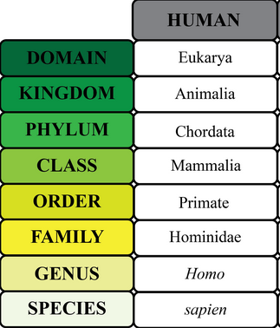
LINNAEUS VS. MODERN CLASSIFICATION
| Linnaeus | Modern Classification |
|---|---|
| 2 Kingdoms | 5 Kingdoms |
| Based on physical similarities | Based on physical and genetic similarities |
| Uses only biologists observations and knowledge of organisms | Uses observations, knowledge of organisms, molecular clocks and genetic techniques |
PROBLEM WITH TRADITIONAL CLASSIFICATION
- Relied on body structure comparison only
- Due to convergent evolution, organisms are quite different from each other and evolved
- Convergent Evolution: process where unrelated organisms independently evolve similarities due to adaptation
MODERN CLASSIFICATION
- 5 Kingdom System: Older system lumps all prokaryotic species into Monera
(Animalia, Plantae, Protista, Fungi, Monera)
VIRUSES
- Particles of nucleic acid, protein, and lipids that can only reproduce through infecting living cells
- Not considered alive
- T4 Bacteriophage- infects bacteria
EVOLUTIONARY CLASSIFICATION
- Biologist groups organisms into categories that represents line of evolutionary descent
- Evolutionary Classification: Strategy of grouping organisms together based on evolutionary history
- Cladogram: Diagram that shows evolutionary relationships
- Dichotomous Keys: used to identify organisms using a chart by excluding organism based on their observable feature
- Phylogeny: presumed evolutionary history of an organism
- Phylogenetic Tree - illustration that shows the phylogeny of related organisms
- Can be based on morphological, physiological, molecular data
- Constructed using DNA sequence data
- In molecular phylogenies, characters are nucleotide positions
WHY MITOCHONDRIAL DNA IS USED FOR IDENTIFICATION
- Copy Number
- Relatively few difference within species
- Introns (Non Coding Genes)
- Greater differences among species
Barcodes affirm the unit of Homo sapiens (Everyone differs from one another by only 1 or 2 nucleotides out of 648 while 60 from chimpanzees.