The Cortex
The Cortex
General Structure
Cerebral cortex: Unique mantle of grey matter covering the cerebral hemispheres.
Gyri: raised, ridged folds on the surface of the cortex that increase the brain's surface area, allowing for a greater number of neurons and more complex processing.
Sulci: Grooves or furrows between the gyri on the cerebral cortex, which help increase the surface area of the brain and separate different brain regions.
Functional Lobes
Frontal Lobe: Front-most part of the cerebral hemispheres, responsible for higher cognitive functions, voluntary movement, and speech production.
Location: Situated at the front of the brain, extending from the forehead to the central sulcus, which separates it from the parietal lobe.
Functions:
Motor Control: The primary motor cortex, located in the precentral gyrus, controls voluntary movements of muscles.
Executive Functions: Involved in higher-order functions such as decision-making, problem-solving, planning, and reasoning.
Language Production: Contains Broca's area (usually in the left hemisphere), which is responsible for speech production.
Behavior and Personality: Regulates emotions, social behaviour, impulse control, and personality traits.
Key Areas:
Precentral Gyrus: The primary motor cortex, controlling voluntary movements.
Prefrontal Cortex: Associated with cognitive functions, decision-making, and social behaviour.
Broca's Area: Responsible for speech production, located in the dominant hemisphere (usually the left).
Parietal Lobe: Region of the cerebral cortex that processes sensory information related to touch, temperature, and spatial awareness.
Location: Located behind the frontal lobe, separated from it by the central sulcus, and extends to the occipital lobe.
Functions:
Sensory Processing: The primary somatosensory cortex, located in the postcentral gyrus, processes sensory input from the body (e.g., touch, temperature, pain).
Spatial Awareness and Perception: Involved in spatial orientation, navigation, and integrating sensory information to form a coherent perception of the environment.
Language Comprehension: The left parietal lobe contributes to language comprehension, especially understanding written and spoken language.
Key Areas:
Postcentral Gyrus: The primary somatosensory cortex, responsible for processing tactile information.
Superior Parietal Lobule: Involved in spatial orientation and perception.
Inferior Parietal Lobule: Plays a role in integrating sensory information and language processing.
Temporal Lobe: region of the cerebral cortex located on the sides of the brain, responsible for processing auditory information, encoding memories, and facilitating language comprehension, as well as playing a role in emotion and visual recognition
Location: Situated beneath the lateral sulcus (Sylvian fissure), extending back toward the occipital lobe.
Functions:
Auditory Processing: Contains the primary auditory cortex, which processes sounds and is involved in understanding spoken language.
Memory Formation: The medial temporal lobe, including the hippocampus, is essential for memory formation and storage.
Language Comprehension: Wernicke's area (usually in the left hemisphere) is responsible for language comprehension.
Emotional Processing: The amygdala, located in the temporal lobe, is involved in processing emotions and fear responses.
Key Areas:
Primary Auditory Cortex: Processes auditory information from the ears.
Wernicke's Area: Located in the left hemisphere, associated with understanding spoken and written language.
Hippocampus: Essential for memory formation and spatial navigation.
Amygdala: Involved in emotional processing and memory.
Occipital Lobe: rearmost part of the cerebral hemispheres, primarily responsible for processing visual information.
Location: Located at the back of the brain, behind the parietal and temporal lobes separated by the parieto-occipital sulcus
Functions:
Visual Processing: The primary function is to process visual information, such as colour, shape, and motion.
Interpretation of Visual Stimuli: Plays a role in understanding what is seen, including recognizing objects, faces, and spatial relationships.
Key Areas:
Primary Visual Cortex (V1): Also known as the striate cortex, it is the main area responsible for processing visual information.
Secondary Visual Areas: Involved in higher-level visual processing, such as recognizing and interpreting complex visual stimuli.
Insular Cortex (Limbic Lobe): Hidden region of the cerebral cortex involved in processing internal bodily sensations, emotions, and certain cognitive functions.
Location: Buried deep within the lateral sulcus, separating the frontal and parietal lobes from the temporal lobe.
Functions:
Interoception: Processes internal bodily sensations such as pain, temperature, hunger, and thirst.
Emotional and Social Functions: Involved in the perception of emotions, empathy, and social experiences.
Taste Processing: Plays a role in the perception of taste and flavour.
Autonomic Control: Regulates autonomic functions, such as heart rate and visceral sensations.
Key Areas:
Anterior Insula: Involved in emotional awareness and complex cognitive tasks.
Posterior Insula: More associated with basic sensory functions, such as pain and visceral sensation.
Functional Topography of the Cortex
The cortex can be divided into primary, secondary (association), and tertiary (higher-order association) regions based on their roles in sensory processing, motor control, and cognitive functions. These regions are interconnected, forming a hierarchy in which information processing increases in complexity.
Primary Regions
Definition: Primary regions are the first cortical areas to receive sensory input from the body or to send motor output. They directly process raw sensory data or initiate voluntary movements.
Characteristics:
Each primary region corresponds to a specific sensory or motor function.
Information processing is basic and topographically organised (e.g., homunculus in the motor and somatosensory cortices).
Examples:
Primary Motor Cortex (M1):
Located in the precentral gyrus of the frontal lobe.
Responsible for initiating voluntary movements by sending motor commands to muscles on the contralateral side of the body.
Primary Somatosensory Cortex (S1):
Located in the postcentral gyrus of the parietal lobe.
Processes tactile information such as touch, pain, and temperature from the contralateral side of the body.
Primary Visual Cortex (V1):
Situated in the occipital lobe along the banks of the calcarine fissure.
Processes raw visual input, such as light intensity, contrast, and basic shapes from the contralateral visual field.
Primary Auditory Cortex (A1):
Found in the temporal lobe.
Processes basic aspects of sound, such as pitch and volume, from both ears.
Secondary Regions (Association Areas)
Definition: Secondary regions receive input from primary areas and further refine, interpret, or plan the information. These are often referred to as (unimodal) association areas.
Characteristics:
They provide more elaborate processing compared to primary regions.
Involved in specific aspects of sensory analysis or motor planning.
Functions:
Sensory Processing: Secondary areas interpret more complex aspects of sensory input, such as recognizing objects, distinguishing sounds, or understanding textures.
Motor Planning: Secondary motor areas help plan and organise movement sequences, ensuring the body is prepared for specific tasks.
Examples:
Secondary Visual Cortex (V2, V3, etc.):
Located in the occipital lobe and surrounding regions.
Processes more intricate visual features, such as colour, motion, and depth.
Secondary Auditory Cortex:
In the temporal lobe, it processes more detailed sound features, such as tone discrimination and recognizing auditory patterns.
Secondary Somatosensory Cortex (S2):
Situated in the parietal lobe.
Involved in integrating tactile information with proprioception for more detailed sensory perception.
Premotor Cortex and Supplementary Motor Area (SMA):
Located in the frontal lobe.
Involved in planning, sequencing movements, and coordinating complex motor tasks.
Tertiary Regions (Higher-Order Association Areas)
Definition: Tertiary regions are higher-order association areas that integrate information from multiple secondary areas and across different sensory or motor modalities (heteromodal). They are involved in complex cognitive tasks.
Characteristics:
Tertiary regions support the most complex forms of information processing.
They combine sensory input, motor planning, and higher cognitive functions to create a cohesive understanding of the environment or execute complex behaviours.
Functions:
Multimodal Integration: Combine inputs from various sensory systems (e.g., visual, auditory, somatosensory) to create a comprehensive perception of the environment.
Cognitive Functions: Support complex tasks, such as language comprehension, problem-solving, memory retrieval, social behaviour, and decision-making.
Examples:
Prefrontal Cortex:
Involved in executive functions, such as planning, decision-making, reasoning, and social behaviour.
Integrates information for higher-order thinking and sets goals for behaviour.
Superior Temporal Sulcus (STS):
Located along the lateral surface of the temporal lobe.
Involved in social cognition, understanding biological motion, language-related processing, and multisensory integration.
Temporoparietal Junction (TPJ):
Located at the boundary between the temporal and parietal lobes.
Plays a key role in social cognition, such as Theory of Mind, empathy, attention reorientation, and self-awareness.
Sensory and Motor Pathways in Functional Regions
Sensory Pathways:
Information processing proceeds from primary → secondary → tertiary regions, with the complexity of sensory integration increasing at each step.
Motor Pathways:
Motor planning proceeds in the opposite direction, from tertiary → secondary → primary regions:
Tertiary (prefrontal cortex): Planning and decision-making related to movement.
Secondary (premotor cortex, SMA): Sequencing and organising motor plans.
Primary (M1): Execution of movement commands via the corticospinal tract.
Additional Notes:
Topographic Organization: Sensory and motor regions are often topographically organised, such as the motor and sensory homunculus, where different body parts are represented in specific cortical areas.
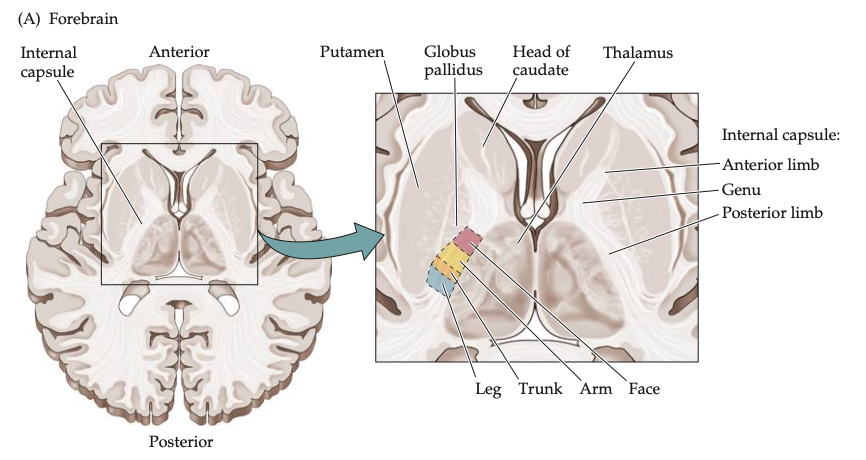
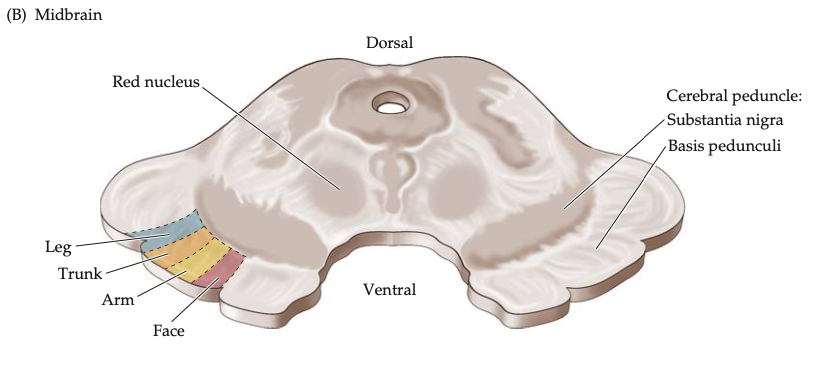
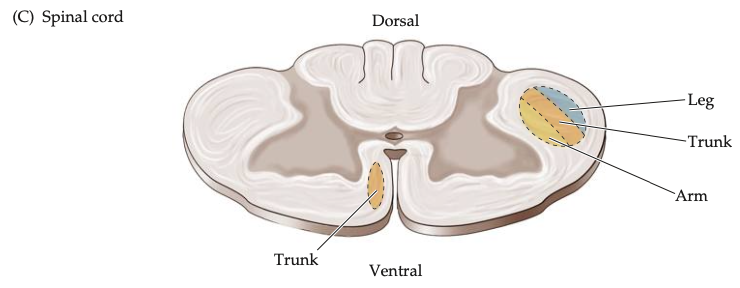
Frontal Lobe Processing Flow: After gathering information at tertiary regions (e.g., STS, TPJ), the frontal lobe processes it first in tertiary regions (planning/decision-making), then in secondary regions (motor planning), and finally in primary motor cortex for execution.