Circular Motion
Radians and Degrees
1 Radian = 57.30 degrees
One complete Radian 360θ = 2π
Conversion of Degrees to radians
(Value) x π/180 = Radians
e.g. 60θ x π/180 = 1.05 rad
Conversion of radians to Degrees
(Value) x 180/π = Degrees
e.g. 3 rad x 180/π = 171.89θ
Angular Velocity
Definition
Angular velocity is a measure of the rate of rotation of an object around a specific axis. It is defined as the angle rotated per unit time.
Unit: radians per second (rad/s).
Equations
ω = ΔΘ/Δt
ω = 2π/T
ω = 2πf
Linear Velocity
Definition
Linear velocity is the rate at which an object moves along a straight path. It is defined as the displacement of the object per unit of time.
Unit: meters per second (m/s).
Equations
v =d/t
v = 2rπ / T
T = 2π / ω
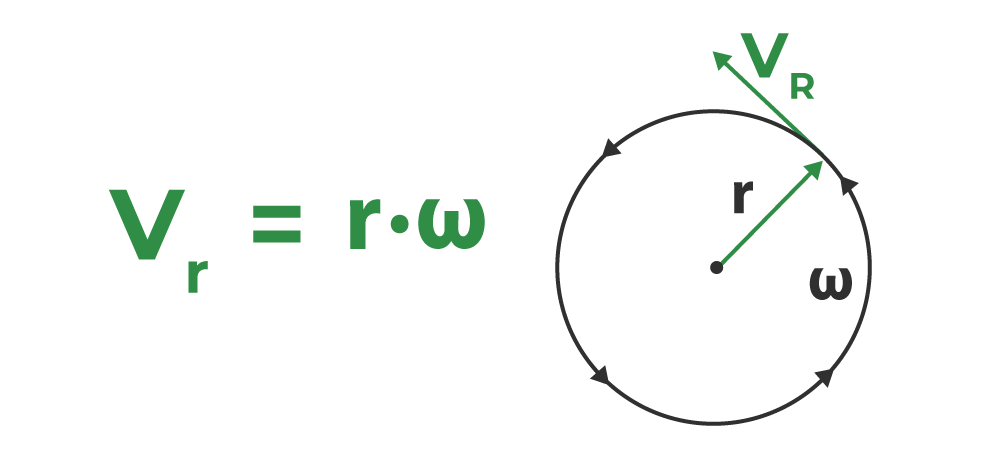
V = rω
Arc Length
Definition
Arc length is the distance along a curved line or the portion of the circumference of a circle between two points.
Equation
s = 2𝛑r x Θ / 2𝛑 = rΘ
Angular Frequency
Definition
Angular frequency, often denoted by ω (omega), is a measure of how quickly an object oscillates or rotates in radians per second.
Equation
ω = 2𝛑 / T = 2𝛑f
Centripetal Force
Definition
The centripetal force is the resultant force acting on a body moving at constant speed in a circle.
Equations
a = v2/r = ω2r
F = mv2/r = mrω2
Forces that causes Circular Motion
The forces that cause circular motion include:
Centripetal Force: The net force directed towards the center of the circular path, keeping the object in circular motion.
Frictional Force: In some cases, friction between surfaces can provide the necessary centripetal force.
Tension: In systems like a swinging pendulum or a tethered object, tension in the string or rope can act as the centripetal force.
Gravitational Force: In planetary motion, gravity acts as the centripetal force keeping planets in orbit around the sun.
Moving at a tangent
Direction is always changing, so velocity is always changing
There must be a constant acceleration
This acceleration is directed to the centre of the circle
There must also be a force to the centre of the circle - this is the centripetal force
Centripetal Force + Reaction to Centripetal Force (inertia)