4.1: Crime and Social Control
International Crime and Social Control
- Crime is ubiquitous; no countries are completely devoid of crime.
- Most countries organize justice systems by police, courts, and prisons.
- Adult males make up the largest category of crime suspects.
- Theft is the most common crime and violent crime is relatively rare.
- Crime rates are usually expressed as number/100,000 people.
- Violent and property crimes are two major types of crimes.
- Transnational crime: a crime that occurs across one or more national borders
Understanding Crime and Social Control
- Inequality in society, emphasis on material well-being, and corporate profit produce societal strains and individual frustrations
- There has been a recent decline in crime rates.
- A shift from punitive to prevention policies will reduce the human and economic costs of crime.
- Restorative justice: a philosophy concerned with reconciling conflict among the victim, the offender, and the community
- Response to the current state of criminal justice
- Focuses on repairing the relationship between the victim, offender, and community
Sources of Crime
- Crime: a violation of a federal, state, or local criminal law
- The offender must have acted voluntarily and with intent and have no legally acceptable excuse.
Uniform Crime Report (UCR)
- Sheriff and police departments voluntarily report to the FBI annually the number of reported crimes and arrests.
- Clearance rate: a percentage of cases in which arrests, charges, and referrals to courts have been made
- Large numbers of crimes go unreported.
- Police might not record reported crimes.
- Crime rates might be exaggerated due to external pressures and policing motivations.
National Incident-Based Reporting System (NIBRS) (Started in 2021)
- Phases out UCR system
- Details on every crime incident and separate offenses within incident
- Collects data on victims, known offenders, relationships between victims and offenders, arrestees, and property involved in crimes
National Crime Victimization Survey (NCVS)
- Attempts to account for unreported crimes
- Dark figure of crime: unreported crime
- Large scale annual survey interviews a representative sample of 150k people over 12 years old in 95k households to collect data about victimization, relationship to and characteristics of offender, and harm.
Self-Report Offender Surveys
- Surveys that collect data from people about their criminal behaviors.
- Attempt to bridge the gap between unreported crimes but are still subject to exaggeration and concealment.
- Reveal that almost every adult has engaged in some criminal behavior.
- Crime funnel helps us understand why only some are convicted.
- Behavior must become known to have occurred.
- Behavior must come to the attention of the police, who then file a report, investigate, and make an arrest.
- Arrestees must go through a preliminary hearing, an arraignment, and a trial, at which they may or may not be convicted.
Applying Sociological Theories
Structural-Functionalist Perspective (Merton)
- Functions of crime include group cohesion and social change (Durkheim).
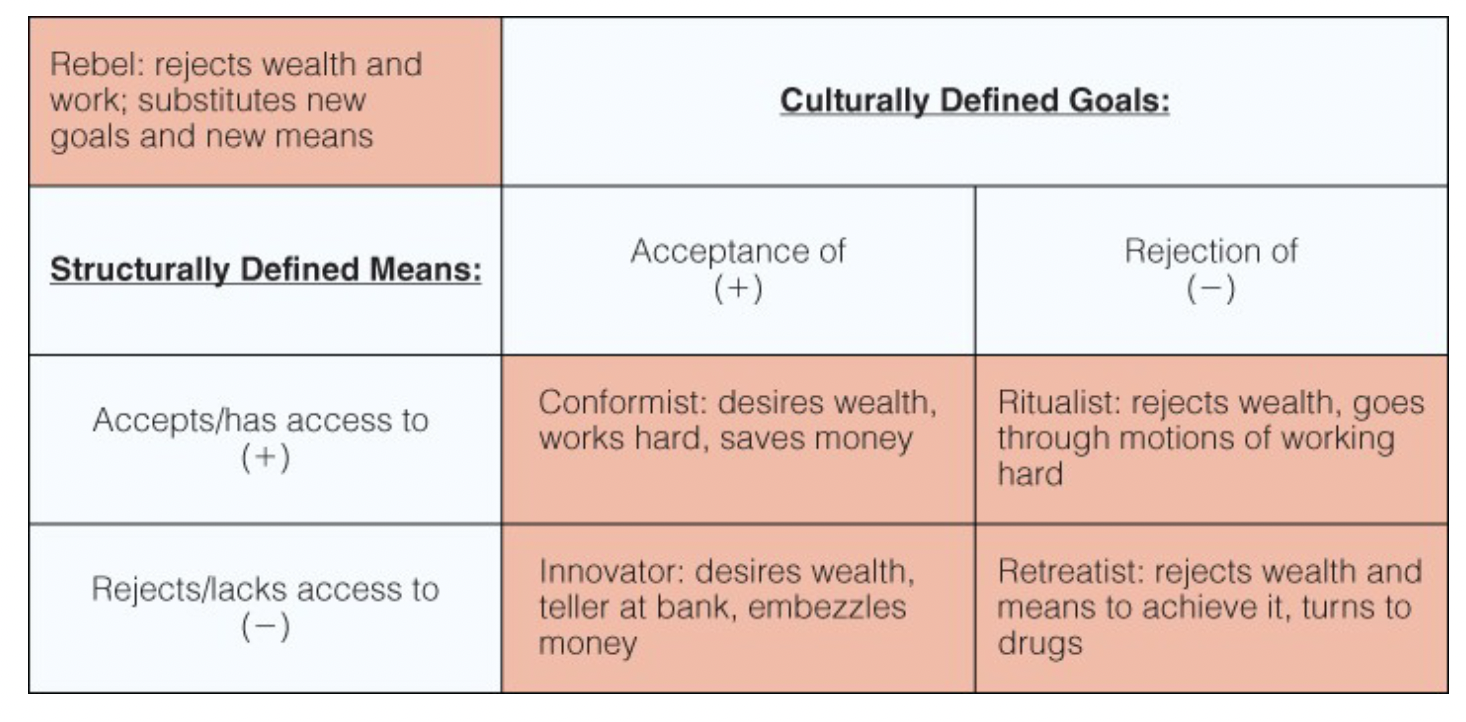
- Anomie Theory
- When society limits legitimate means to acquire cultural goals, the resulting strain leads to criminal behaviors.
- Conformity occurs when culturally defined goals are accepted and socially legitimate means to achieve them exist.
- Innovation, ritualism, retreatism, and rebellion are expressions of strain.
- \
- General Strain Theory (Agnew)
- When a person experiences strain this leads to criminal behavior.
- Subcultural Theories
- Some groups have values and attitudes conducive to violence.
- Members adopt the crime-promoting attitudes of the group.
- Control Theory (Hirschi)
- Social bond: the bond between individuals and the social order that constrains some individuals from violating social norms
- Social bonds prevent some people from criminal behaviors.
- Social bonds include attachment, commitment, involvement, and belief.
Conflict Perspective
- Focus is on how laws are created and enforced by those in power to protect the interests of the ruling class
- Connection between societal social inequality and crime rates.
- The greater the income inequality, the higher the homicide rate.
- In cities with high unemployment, unemployed defendants have a substantially higher probability of pretrial detention.
- Female prostitutes are more likely to face arrest compared to the men who seek their services.
Symbolic Interactionist Perspective
- Labeling Theory (Becker)
- Being labeled deviant leads to further deviant behavior.
- Primary deviance: deviance committed before a person is labeled an offender
- Secondary deviance: deviance which results from being caught and labeled
- Differential Association Theory
- Individuals learn the values and attitudes associated with crime as well as the techniques and motivations for criminal behavior through interactions with others