Ab Psych Chapter 12: Personality Cluster C, Causes & Treatments
Cluster C: Avoidant Personality Disorder --
- A pervasive pattern of social inhibition, feelings of inadequacy, and hypersensitivity to negative evaluation, beginning by early adulthood and present in a variety of contexts, as indicated by four (or more) of the following:
- Avoids occupational activities that involve significant interpersonal contact because of fears of criticism, disapproval, or rejection
- Is unwilling to get involved with people unless certain of being liked
- Shows restraint within intimate relationships because of the fear of being shamed or ridiculed
- Is preoccupied with being criticized or rejected in social situations
- Is inhibited in new interpersonal situations because of feelings of inadequacy
- Views self as socially inept, personally unappealing, or inferior to others
- Is usually reluctant to take personal risks or to engage in any new activities because they may prove embarrassing
Cluster C: Dependent Personality Disorder --
- A pervasive and excessive need to be taken care of that leads to submissive and clinging behavior and fears of separation, beginning by early adulthood and present in a variety if contexts, as indicated by 5 (or more) of the following:
- Has difficulty making everyday decisions without an excessive amount of advice and reassurance from others
- Needs others to assume responsibility for most major areas of his or her life
- Has difficulty expressing disagreement with others because of fear of loss of support or approval
- Has difficulty initiating projects or doing things on his or her own
- Goes to excessive lengths to obtain nurturance and support from others, to the point of volunteering to do things that are unpleasant
- Feels uncomfortable or helpless when alone because of exaggerated fears of being unable to care for him/herself
- Urgently seeks another relationship as a source of care and support when a close relationship ends
- Is unrealistically preoccupied with fears of being left to take care of him/herself
Cluster C: Obsessive-Compulsive Personality Disorder --
- A pervasive pattern of preoccupation with orderliness, perfectionism, and mental and interpersonal control, at the expense of flexibility, openness, and efficiency, beginning by early adulthood and present in a variety of contexts as indicated by 4 (or more) of the following:
- Is preoccupied with details, rules, lists, organization, or schedules to the extent that the major point of the activity is lost
- Shows perfectionism that interferes with task completion
- Is excessively devoted to work and productivity to the exclusion of leisure activities and friendships
- Is over conscientious, scrupulous, and inflexible about matters of morality, ethics, or values
- Is unable to discard worn-out or worthless objects even when they have no sentimental value
- Is reluctant to delegate tasks or to work with others unless they submit to exactly his or her way of doing things
- Adopts a miserly spending style toward both self and others, money is viewed as something to be hoarded for future catastrophes
- Shows rigidity and stubbornness
- OCD vs OCPD:
- OCD = Insight, Miscellaneous concerns. Dysfunction across domains, Significant distress
- OCPD = Lack of insight, Concerns related to daily tasks, Interpersonal dysfunction, “Less” distress
Problems with Classification of Personality Disorders:
- Appropriateness of categorical versus dimensional model
- Distinguishing personality disorders from other clinical syndromes
- Degree of overlap among personality disorders
- Difficulty in distinguishing between normal and abnormal behavior
- Confusing labels with explanations
- Sexist biases - Stereotypical feminine behaviors identified as pathological with greater frequency than stereotypical masculine behaviors
Theoretical Perspectives of Personality Disorders →
- Psychodynamic:
- Traditional Freudian theory: Focused on problems arising from the Oedipus complex as the foundation for personality disorders
- Hans Kohut: Argued that what matters most is how the self develops and whether the person is able to develop self-esteem, values, and a cohesive and realistic self
- Otto Kornberg: Borderline personality as a failure in early childhood to develop a sense of constancy and unity in one’s image of oneself and others.
- Margaret Mahler: Explained borderline personality disorder in terms of childhood separation from the mother figure.
- Sociocultural:
- Social conditions may contribute to the development of personality disorders
- Stressors encountered by disadvantaged families may contribute to antisocial behavior patterns
- Antisocial personality disorder is reported most frequently among people from lower socioeconomic classes
- Children reared in poverty more likely to be exposed to deviant role models
- Maladjustment in school may lead to alienation and frustration in larger society
- Biological:
- Genetic Factors: Evidence points to genetic factors playing a role in the development of several types of personality disorders, including antisocial, narcissistic, paranoid, and borderline types
- Personality traits may represent interactions of genetic factors and life experience
- Lack of emotional responsiveness: People with antisocial personalities had lower galvanic skin response levels when they were expecting painful stimuli than did normal controls
- Lack of anxiety in threatening situations
- The craving-for-stimulation model: People with antisocial personality disorder appear to have exaggerated cravings for stimulation
- Need more stimulation than other people to maintain interest and function normally
- Brain abnormalities – Brain imaging links borderline and antisocial personality disorder to dysfunctions in parts of the brain involved in regulating emotions and restraining impulsive behaviors
- Most directly implicated are the prefrontal cortex and deeper brain structures in the limbic system
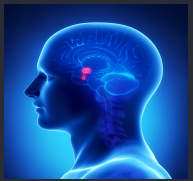
- BRAIN CIRCUITRY. Abnormalities in brain circuitry between the prefrontal cortex, the brain’s thinking center, and the limbic system may contribute to impulse control problems in people with borderline and antisocial personality disorders. The limbic system is a primitive part of the brain involved in regulating emotional processing and memory formation. The amygdala, a part of the limbic system involved in triggering fear, is highlighted here (one on each side of the brain).
- Learning:
- Learning theorists posit that childhood experiences shape the pattern of maladaptive behaviors.
- Focus on maladaptive behaviors rather than disorders of personality
- Identify learning histories and environmental factors that give rise to maladaptive behaviors and the reinforces that maintain them. For example:
- Children regularly discouraged from speaking their minds may develop dependent behavior pattern
- Excessive parental discipline may lead to obsessive-compulsive behaviors
- Multifunctional Models: Example: A multifactorial model of antisocial personality disorder
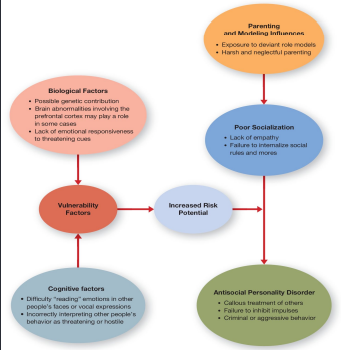
What makes Treating PDs Difficult: People with PDs often fail to see need for change. They see traits as “ego syntonic” – part of themselves
- People with anxiety and mood disorders see their abnormal behaviors as “ego dystonic” – not a part of their identity
- Blame others, despite self-defeating consequences of behavior
Treatment of Personality Disorders →
- Psychodynamic:
- Psychodynamic approaches used to help people diagnosed with personality disorders through (1) Becoming aware of the roots of their self-defeating behavior patterns, and (2) Learning more adaptive ways of relating to others
- People with borderline personality disorder tend to have turbulent relationships with therapists, sometimes idealizing them, sometimes denouncing them as uncaring
- Cognitive-Behavioral:
- Cognitive behavior therapists focus on changing clients’ maladaptive behaviors and dysfunctional thought patterns.
- Modeling and reinforcement used to help clients develop more adaptive behaviors
- Successful in treating personality disorders characterized by anxiety
- Two successful approaches in treating borderline personality:
- Cognitive-behavioral approach focusing on identifying and correcting distorted thinking
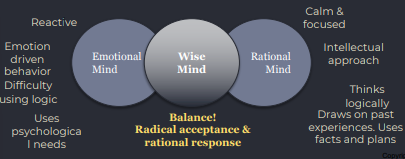
- Cognitive-behavioral approach combined with mindfulness meditation (called DBT)
- Dialectical Behavior Therapy, DBT:
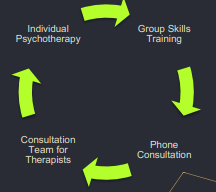
- Multimodal Treatment Approach: Manualized therapy, 1 year
- Individual therapy, X1 per week (1 hour)
- Group therapy, X1 per week (2.5 hours)
- Medication: Drug therapy does not directly treat personality disorders, However:
- Antidepressants or antianxiety drugs are sometimes used to treat associated depression or anxiety in people with personality disorders
- Atypical antipsychotics may have benefits in controlling aggressive and self-destructive behavior in people with borderline personality disorder -- The effects are modest + The drugs carry serious potential side effects
Beth wasn't invited to the party. No one really knows her very well because she rarely talks. Beth did not mind not being invited – she never really liked being around people anyway, and much preferred spending her Saturday night alone at home reading. Now if only her family would leave her alone too.
- Schizoid
No one wanted to invite Dave to the party because he has a tendency to lie and be irresponsible, but they felt compelled to because he also tends to be incredibly charming. During the party, Dave got into a fight and grabbed a cake knife and threatened to attack someone with it. When he realized he had just freaked everyone out, Dave showed no remorse; instead, he laughed and made everyone feel uncomfortable
- Antisocial
Ed walked into the party elated to see his friends. He was chatty, engaging, thinking the world of those around him. But then, a girl he was talking to glanced at her watch as he talked … and a drunk friend made a comment that seemed dismissive. Ed felt rejected. Ed suddenly burned with rage … hurled insults at these people and locked himself in the bathroom, where he broke down in tears, drowning in shame about “not being good enough.” He then rummaged through the cabinet and found a bottle of pills. As his friends knocked on the door, he thought about how much he hated them and the fact that he would always be alone and maybe he should just take the pills now and end this unbearable, never-ending pain.
- Borderline (hard time regulating their affective emotions)
Frannie danced into the party wearing a bright red lipstick and an over the-top frilly, form-fitting dress that accentuated her curves. She immediately became the center of attention. With sweeping gestures of her arms and dramatic displays of emotion, she boasted about her career as an actress in and the things she “had to put up with” in the field. At the first sign of the conversation dying down, she began to exaggerate elements of her stories and describing things in even more overly theatrical terms. Noticing that one of the men in the room seemed to be engaged in her story, she soon started acting in excessively provocative ways. She was convinced they had a deep connection, although he never talked to her again.
- Histrionic (don’t feel good about themselves, rather just seeking attention to feel good. Vs narcissistic where they actually feel good about themselves)
Before entering the party, Alex watched the party for several minutes from outside through the window, wondering if it really was a party or just a gathering of people with ulterior motives. Once she went in, she seemed very uncomfortable. When people tried to be nice to her, she responded minimally, staying guarded and suspicious. “Why are they asking me questions?” “What do they want from me?” “Will they use whatever I tell them against me?” she wondered. Soon, Alex distanced herself from the crowd and hung out alone in the corner, staying hypervigilant. She didn't stay very long at the party.
- Paranoid (paranoid thoughts but not to the degree of schizotypal, not delusions)