BISC316 - Midterm Exam
Examinable Material:
lectures 1 - 14
worksheets
background reading + conceptual parts of aquarium assignment
phylogenies → be comfortable reading trees, drawing trees and mapping traits
Lecture 1: Introduction
phylogenic tree worksheet
Lecture 2: Chordates
Phylum Chordata
are multicellular
bilateral symmetry
deuterostome development
deuterostome development - mode of animal embryonic development where the first opening in the embryo → anus
second opening forms the mouth later on
sister phylum to echinoderms (sister phylum → closest evolutionary relative of a phylum that share a common ancestral lineage)

5 defining features of chordates
Notochord
Dorsal Neural tube
pharyngeal slits
endostyle
post-anal tail
other features:
segmentation
myomeres - blocks of muscle separated by connective tissue
sub phylum: Cephalochordata (amphioxus / lancelet)
free swimming but usually buried in sediment

Notochord
flexible rod that can be bent laterally but not compressed
contains cells and fluid
tough external collagen sheath protects the notochord
is below the dorsal nerve cord
formed from mesoderm
skeleton + locomotion
myomeres are v shaped
crucial for even force distribution + swimming mechanics
notochord and muscles work together to allow locomotion
coordinated contraction of muscles allows for side-to-side motion → swimming
Dorsal neural tube
formed during development of the embryo → folding of the ectoderm tissue layer
forms the central nervous system

Nervous system
neural tube is dorsal to the notochord
do not have a brain or well developed sensory organs
neural tube is protected by the notochord
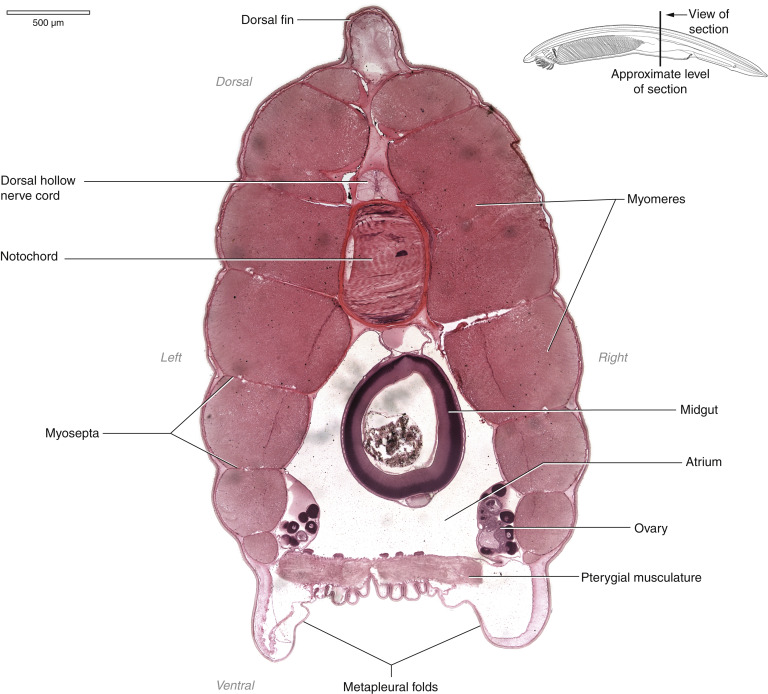
Feeding & Digestive system
suspension feeders - feed on organic matter + small organisms that are suspended in the water
has a one way digestive system → food moves in one direction
draws food in by using cilia to create a water current
food (+ water) → pharynx (food is trapped by mucus from the endostyle) → moves through gut → anus
water (+ food) → pharynx → through the pharyngeal slits → atrium → atriopore
pharyngeal slits
openings in pharynx - leads water to another exit (atriopore)
pharyngeal slits + gill slits → homologous structures
(pharyngeal slits develop into a role of respiration in later groups)
pharyngeal - feeding function
gill - respiratory function
slits are supported by pharyngeal arches - made up of collagen like material (provides strength and flexibility)
endostyle
runs along the ventral wall of the pharynx
tissue has specialized gland cells → secretes mucus
lined with cilia - used in a beating motion to propel stuck particles of food toward the esophagus for digestion
homologous to the thyroid gland - develops from the floor of the pharynx
both structures involved in iodine metabolism
circulatory & respiratory system
has a closed circulatory system with blood vessels
blood has no pigments or blood cells → plasma like
no heart - has contractile blood vessels
blood flows ventrally → posterior dorsally
respires through body surface ( gill slits have not developed yet )
post anal tail
anus does not sit at the very tip / end of the body
body continues past the anus to form a tail
Sub phylum: urochordata
3 groups:
tunicates (sea squirts)
larvaceae
thaliaceae
(groups may look different from each other but all contain the same structures and systems as the chordates)
Lecture 3: phylogeny
Purpose of phylogenetic: organizes life into nested taxa that describes the evolutionary relationships between them
(phylogenetic trees are hypothesis about the relationship among taxa)
traditional classification (hierarchical system):
domain
kingdom
phylum
class
order
family
genus
species
Rules of Binomial nomenclature
species name: genus + specific epithet
can refer to a genus itself - but cannot use a specific epithet by itself → always has to be with the genus as well
both genus + specific epithet should be italicized / underlined
once the genus is mentioned in full it can be abbreviated when in subsequent usage
defining taxonomic groups
monophyletic group (clade) - an ancestor and all of its descendants
paraphyletic group - an ancestor and some but not all of its descendants
polyphyletic group - two or more groups but not their common ancestor
terminology
homology - a trait found in more than one taxon that comes from a common ancestor
synapomorphy - trait that is shared and derived due to common ancestry - is unique to a group of
defines a monophyletic group
convergent evolution - when two or more taxa evolve the same trait independently
homoplasy - a shared derived trait that is not due to common ancestry
evidence used to form phylogenetic trees
fossil records
comparative anatomy
embryology
molecular data
fossil records
only source of information for extinct lineages
provides evidence of the morphological (shape, structure, form) characteristics of ancestral species + extinct lineages provides evidence
independent of molecular data - fossil records can be used to validate molecular phylogenies
fossils can preserve external (2D) or internal (3D)
Biases in the fossil records
some species are more likely to be fossilized than others
preservation is biased by varying factors:
environment → species/bones in the aquatic are more likely to be fossilized than on terrestrial
anatomy → hard parts, bones, shells, teeth
quantitative size → species larger in mass
population size → common species
species age duration → long lived
( first chordates and first vertebrates appear during the Cambrian period - 490 mya )
Comparative anatomy
useful traits reflect common ancestry and show variation → doesn’t evolve too slow/fast
Comparative embryology
comparisons of embryos + early developmental stages
highly conserved ( more conserved than adult stages ) → can provide information on relationship of taxa
identifying embryological origin of adult tissues can help distinguish homologies vs homoplasies
molecular data
typically include single genes, mitochondrial genes, gene arrangements
is not perfect - doesn’t tell us anything about extinct species (DNA is not recoverable)
Lecture 4: Vertebrates
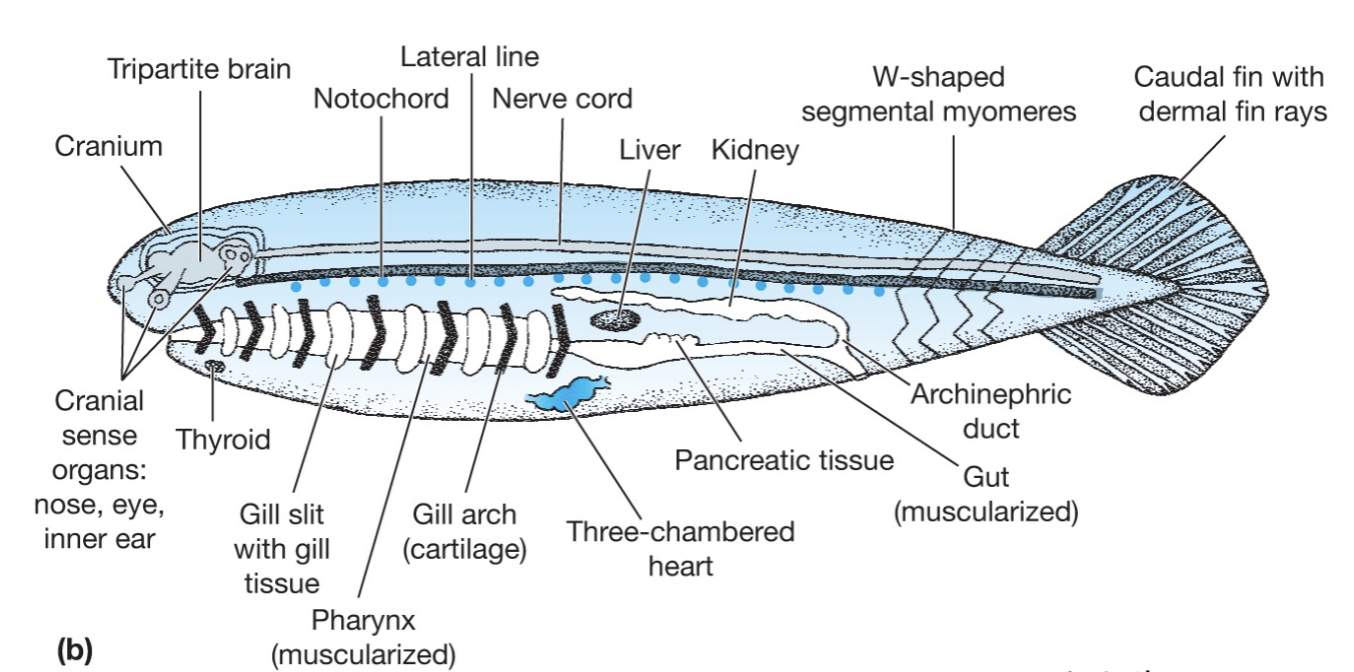
has the 5 chordate features + new shared derived features
derived features
vertebrae
cranium
tripartite brain
pituitary (+endocrine organs)
multichambered heart
mineralized tissues
+ also characterized by developmental features → hox duplication
Vertebrae
are formed of cartilage/bone
protects neural tube + notochord
can also anchor other structures → i.e. ribs
earliest vertebrates had simple vertebrae → arcualia (cartilage that protected the bone)
cranium (skull) → formed of cartilage / bone protects neural
tripartite brain
anterior of the dorsal neural tube swells to form tripartite brain
capable of processing sensory information - olfactory, visual, auditory
pituitary gland ( + other glands) - produce + regular hormones
Question: why are brains always at the anterior end of a bilateral animal?
due to cephalization - driven by forward locomotion
bilateral animals move through their environment head first
front end encounters new stimuli (i.e. food, predators, obstacles) before the rest of the body
having sensory organs allow them to detect changes immediately
results in shorter neural pathways → quicker pathways
Hox gene duplication
hox gene - genes that help regulate development
non-vertebrate animals - one cluster of hox genes
vertebrate animals - two or more cluster of hox genes
→ likely that a duplication of hox genes allows for more complex development + phenotype
feeding & digestion
still a suspension feeder + one-way digestive system
food (+water) → pharynx → digestive system (by muscular peristalsis) → anus
water (+food) → pharynx → gill slits
Question:A pair of structures related to feeding in the cephalochordate that has been lost. What is it?
structure: pharyngeal slits → used for suspension and filter feeding
repurposed and evolved into gill supports in early vertebrates
pharynx
gill slits (modified pharyngeal slits) have gill filaments for respiration (acquiring oxygen / waste excretion)
gill arches made up cartilage
water is moved through the pharynx by muscular pumping
circulatory & respiratory systems
closed circulatory system + 3 chambered heart
has RBCS + hemoglobin → transports carbon dioxide and oxygen
gill slits now play a role in respiration
gas exchange occurs in the gills
question:What direction does blood flow?
single unidirectional loop
dorsal (leaving the gills) → blood flows backwards
ventral (towards the gills) → blood flows forward
→ blood flows forward toward the gills to perform countercurrent exchange to efficiently pickup oxygen ions from the water
(blood flows in the opposite direction of the current → to maximize the amount of oxygen that is picked up by blood)
excretory system
kidneys empty through the archinephric duct
archinephric duct + anus → forms the cloaca
cloaca → common opening of reproductive + excretory tracts
Lecture 5: Agnathans
are paraphyletic group - contains vertebrates without jaws
life during Cambrian
no life on land
prokaryotes / protists (eukaryotic organisms + algae) / animals → lived in the ocean
animals are diversified
thrive in lare numbers in shallow ocean waters near the edge of continents
Metaspiggina
cambrian fossil
508 mya
possibly had a cranium and arcualia (forms backbone / vertebral column)
likely had eyes and nasal sacs
no evidence of bone / mineralized tissue
Hypothetical vertebrae ancestor
body - soft/slender body that lacks a rigid mineralized skeleton
notochord / nerve cord - features a stiffening rod along its back + nerve cord for a developing brain + spinal cord
pharyngeal slits - gill slits initially used for filter feeding → evolved to respiratory gills (fish) → jaw/skull structures (jawed vertebrates)
sensory systems - actively free swimming + rudimentary brain (basic + simple nervous system - lacked complex processing)
development of sensory organs → eyes, chemical receptors. regulating organs were evolving for more advanced processes
Question:how does Metaspriggina compare with the hypothetical vertebrate ancestor?
Metaspriggina closely matches the hypothetical vertebrae ancestor
hypothetical: a series of simple identical gill bars
metaspriggina contain seven pairs of distinct separate gill bars
hypothetical: front-most gill arch modifies → jaws
first pair of gill arches are thicker + more robust → offers a starting point for jaw evolution
hypothetical: well defined head + sensory structures
contains a large, forward facing eyes + nasal structure
hypothetical: assumed active swimming capability
contains W-shaped myomeres → identical to modern fish (i.e. trout/salmon)
myomeres contract to move the body side to side for swimming → w shaped myomeres indicates capability of swimming
cyclostomata
contains: hagfishes / lampreys
have most characteristics of hypothetical vertebrate ancestor:
gills, gill chambers, gill arches
notochord + arcualia
nerve cord + brain
heart with 3 chambers + RBC’s w/ hemoglobin
like hypothetical vertebrate ancestors - they lack:
bones
jaws
myxiniformes (hagfish) - do not have to memorize the scientific name
found in the deep sea
scavengers of carcasses
secretes large amounts of mucus - encases food in a mucus bag
tie themselves in a knot to feed / escape predators
hagfishes vs hypothetical vertebrate ancestor
are scavengers not suspension feeders
have poorly developed eyes
lack a lateral line system
specialized feeding structures + teeth-like structures
petromyzontiformes (lampreys)
are parasitic as adults
adults live in the ocean/lakes → return to freshwater for reproducing
larvae resemble a cephalochordate / simple vertebrae
lampreys vs hypothetical vertebrate ancestor (how they differ from the hypothetical ancestor)
have well developed eyes
ventilate their gills by tidal ventilation → water enters/exit through gill slits
attaches to a host by suction + keratinous teeth
Life in the Ordovician & Silurian
first appearance of land plants, vascular plants & fungi
arthropods start to colonize land
diversification of jawless fishes w/ mineralized tissue → origin of jawed fish
Ostracoderms
“shell-skinned”
approx. 480-360 mya
examples: cephalaspis / pteraspis / pharyngolepis
have diverse morphology and ecology - have bony head shield / small bony scales → through mineralization
various adaptation for swimming - open water / along the bottom / stirring sedimentation / avoiding predation
respire through gill arches
has no jaw → pulls food into the mouth by using a muscular pharyngeal pump
mineralized tissues
combination of organic (proteins) + inorganic (mineralized) components
potential advantages of mineralized tissues
interacts with muscles - allows for more complex locomotion
strength - allows them to absorb high impact without breaking
supports the body against gravity
storage banks for essential minerals → i.e. calcium, phosphate, magnesium
regulates concentration of those ions - body can reabsorb bone tissue to release the minerals back into the bloodstream
percentage mineralization - a higher mineralization percentage indicates increased structural hardness / stiffness / load-bearing capacity
bones that endure high / predictable mechanical forces or require extreme rigidity → typically feature higher mineralization
higher mineralization - good for stiffness + compression resistance → not good for shock absorption ( requires less energy to maintain but cracks easily)
lower mineralization - good for flexibility and toughness → bone can bend / absorb energy without breaking
hydroxyapatite
mineral that contains calcium and phosphate
major component of bone, dentin, enamel and mineralized cartilage
stores phosphate
more stable than calcium carbonate → especially in acidic environments
Question: Why might vertebrates have higher metabolic activities?
vertebrates may have higher metabolic activities due to high energy demand for moving, hunting, survival + maintaining internal body temperature
Odontodes
first mineralized vertebrate structure
tooth like elements that formed within skin
evolved into teeth / armour shields (gives rise to dermal bone and scales)
Lecture 6: Breathing water
oxygen content
water has 30 times less oxygen than air
temperature increases = oxygen decreases
increase of temperature results in more kinetic movement → kinetic energy breaks and reduces the forces between water and oxygen
salinity decreases = oxygen decrease
salt ions bind to water molecules - leaves less space + attraction for oxygen molecules
3 things needed for efficient water breathing
gills
where oxygen diffuses from water → blood through counter current exchange
flowing water
ventilates by moving water over their gills
flowing blood
heart pumps blood through the gills to pick up oxygen
flowing water (gill ventilation):
sharks
water enters mouth / spiracles → flows over gills → exits through gill slits
fish
water enters mouth → flows over gills → exits through the operculum
(water flow is unidirectional in both sharks and fishes)
ram ventilation:
fish/shark swims with mouth open - forces water over the gills
buccal pump ventilation:
buccal chamber expands → creates negative pressure that draws water into mouth
operculum / gill slits prevents water from flowing backwards
mouth closes → creates positive pressure that forces water out through the gills from operculum/gill slits
flowing blood
single circuit system
blood flows from heart → gills (becomes oxygenated) → body (through arteries)
veins carry deoxygenated blood
heart generates blood pressure
organization of gills
gill arches have a septa that helps support the gills
holobranch - interbranchial septum that has gills on each both sides
hemibranch - interbranchial septum that has gills on one side only
water flows through the gill chambers/pouches and out the gill slits
each gill has many primary lamellae → each primary lamellae contains many secondary lamellae
→ creates a lot of surface area for efficient gas exchange
gill efficiency - are efficient due to certain features
large surface area
induced by many stacked lamellae in each gill filament
interbranchial septa provides support → ensures gill filaments are separated and exposed to flowing water
short diffusion distance
gas exchange occurs in capillary beds (single cell layer thick) - minimizes the diffusion distance
Lecture 7: Gnathostomes
a monophyletic group - jawed fish and their descendants
gnath = jaw | stome - mouth
retained vertebrate features + chordate features
have new shared derived features
second hox gene duplication
jointed gill arches
jaws ( + teeth )
paired fins (pectoral + pelvic )
more developed vertebrae
origin of jaws
splanchnocranium consists of:
jaw (palatoquadrate + mandible)
hyoid arch
gill arches (3-7)
( all components of the splanchnocranium are considered visceral arches → 7 visceral arches in total )
→ later evolve real teeth made of enamel + dentine
how:
ancestral condition:
visceral arches → unjointed
all arches have functional gill tissue
evolutionary changes:
visceral arches became jointed
1st gill slit → spiracle
slit was reduced in size + only in dorsal position
loss of hemibranch on anterior side of the slit
hemibranch on the posterior side becomes non-functional
1st visceral arch → jaws
thickens and develops true teeth (made of enamel + dentine)
2nd visceral arch → hyoid arch
hyoid arch helps the mandible by suspending and stabilizing the brain case + neurocranium
evidence - jaws evolved from gill arches
jaws, hyoid and gill arches share a similar developmental origin
nerves + blood vessels that support gill arches and jaws are similar
nerves + blood vessels that support spiracle (in sharks) are similar
muscles that support jaws related to muscles that support gill arches
ventilation hypothesis
breath before you eat hypothesis - taking intentional deep breaths before meals optimizes digestion → shifts the body out of a sympathetic (fight or flight) to a parasympathetic (rest and digest state)
reduction of pre-mandibular oral cavity + re-organization of the mandibular arch + changes in hypobranchial musculature → changes increases gill ventilation
further development of the jaws allowed for prey capturing through suction feeding → allowed for more forceful opening and closing of mouth
origin of paired fins
ancestral:
no paired fins / caudal fins
gnathostomes:
paired pectoral + pelvic fins → supported by pectoral + pelvic girdles
paired fins → i.e. pelvic fin - supported by pelvic girdle
→ as fish move faster through the water = higher chance of instability among the 3 axes
fins help increase stability
axis of movement:
tilt/pitch - vertical
yaw - left and right
roll - rotational
fin fold theory;
early fish had unpaired continuous dorsal fins along their midline
genetic instructions for making the dorsal fins were duplicated
genes are turned on/off in specific regions → breaks the continuous side fold into separate pectoral (front) and pelvic (back) fins
evidence:
similarities in hox gene expression in the dorsal and paired fins
similarities in hox gene expression in the pelvic and pectoral fins
Gill arch theory
fins are homologous with gill rays
girdles are homologous with gill arches
evidence:
suggests similar developmental origin between arches/rays + girdle/fins
placoderms
→ stem group gnathostomes (stem group - extinct, primitive relatives that branched off before the common ancestor of all living members of the group)
placo = plate | derm = skin
called armoured jawed fishes → also has bony teeth
has a head shield that is fused with plates of dermal bone
includes bottom dwellers and predators
first vertebrates to show evidence of internal fertiization → claspers + fossils with embryos
dunkleosteus:
large predator (can be larger than 8 m in length)
strong bite force → can bite through dermal armour with their bony plates → tooth like
Lecture 8: Chondrichthyes
a monophyletic group
chondro = cartilage | ichthys = fish
life in the Devonian
land - seedless vascular plants (i.e. ferns) → diversified
first presence of insects
water
all 4 lineages of Gnathostomes are present
Placoderms / Acanthodians / Chondrichthyes / Osteichthyes
first radiation of Chondrichthyes - first major explosion of different types of shark-like fish
Chondrichthyes
characteristics that define Chondrichthyes:
cartilaginous skeleton
claspers (males) for reproduction
additional characteristics:
placoid scales
teeth replacement
variation in jaw suspension
sensory systems
spiracle
series of gill openings
spiracle
series of gill openings
lipid (fat) filled liver → does not have an air bladder
skeleton:
are secondarily cartilaginous - ancestors were bony → lost the development of bones
replacement of teeth:
visible teeth are apart of a system of developing teeth
outer teeth are the oldest → are more likely to be shed soon
rapid replacement as teeth can be rapidly broken or become dull
jaw suspension:
→ describes how the mandibular arch articulates with the chondrocranium + role of the hyoid arch
ancestral Chondrichthyan had autodiastylic jaw suspension:
upper jaw is firmly attached to the cranium at 2 different points
hyoid arch is not involved in jaw suspension
Holocephali
holo = whole | cephali = head
i.e. chimaerans / ratfishes
a bottom feeder that feeds on molluscs + other invertebrates
has a single gill opening with 4 gills insides → covered by an operculum + has no spiracle
has a holostylic jaw suspension → upper jaw is fused with the chondrocranium
provides high strength - low flexibility
chimaeras - have short blunt teeth + holostylic jaw suspension that allows them to crush hard prey
Helicoprion
Helico = spiral | prion = saw
fossils exclusively had individual tooth whorls

early elasmobranchs (early sharks)
i.e. cladoselache
early sharks had:
terminal positioned mouth - mouth was located at the very front of the snout instead of tucked underneath the head
fins - had 2 dorsal unpaired fins
pectoral fins that were broadly attached to the body
caudal fin’s upper and lower lobe were large
had an amphistylic jaw suspension
upper jaw is attached to the chondrocranium anteriorly by ligaments + posterior supported by hyoid arch
connection is looser compared to autodiastylic jaw suspension
extant Selachi (living sharks)
subterminal positioning of mouth - mouth is located on the ventral or underside of the head
uses a hyostylic jaw suspension (upper jaw fused with the chondocranium)
oviparous (lays eggs outside their body - external reproduction) / ovivviparous (eggs develop inside the females uterus - internal reproduction)
paired fins have a narrower base → allows greater movement + control
complete pectoral + pelvic girdles → stronger anchor
buoyancy:
2 adaptations that help to reduce their overall density:
cartilage skeleton - less dense than bone and keeps them light weight
large fatty liver - lipids / fat are less dense in water → prevents them from sinking in the water
→ most sharks are still negatively buoyant (a higher density than the fluid - causing it to sink)
theoretically when swimming their tail creates lift → causing them to tip their nose down
pectoral fins + broad flat underside of the head counter this lift
as predators:
uses sensory system to find prey
detection → olfactory (smell)
approach → lateral line/vision
attack → electroreception
biting prey - protrusible jaw + sharp backward pointed teeth → allows sharks to grasp their prey
sensory system:
olfaction (chemoreception)
highly sensitive to smell
differences in left and right nares tells them the direction of source of smell
vision
have good vision even at low lights
electroreception
ampullae of lorenzini - detect electrical fields (even from muscle activity of prey)
lateral line system (mechanoreception)
specialized cells that help detect vibrations and pressure gradients → help detect movement
extant batoidea (skates and rays)
has enlarged pectoral fins → batoidea wings (modified pectoral fins)
eyes + spiracles on the top
multiple gill slits on the underside
has a modified hyostylic jaw suspension → allows greater suction feeding
allows downward protrusion of the jaw → used to inhale food from the ocean floor
teeth are modified for crushing shell invertebrates
oviparous
Lecture 9: Osteichthyes
fish vs fishes (in a scientific context)
fishes is used when referring to more than one taxonomic group
Osteo = bone | ichthy = fish
shared features:
ossified endoskeleton - made of endochondral bone
skull includes dermal bones
original tooth bearing jaw bones
operculum & changes to gills
ossified vertebrae
air filled organ
→ some have reduced ossification - have secondarily derived cartilaginous skeletons
dermal bone - formed in the skin - not dependent on cartilage
endochondral bone - bone that replaces cartilage + forms specialized cells deep within the body
bony skull
Chondrocranium:
evolutionary origin - surrounds and protects the brain + sensory organs
developmental origin - endochondral bone
splanchnocranium
evolutionary origin - mandible, hyomandible, gill arches
developmental origin - endochondral bone
dermatocranium
evolutionary origin - dermal plates / armour leg placoderms
developmental origins - dermal brain
jaw & teeth
jaws of bony fish consist of a combination of splanchnocranium + dermal bones
operculum & gills
no more interbranchial septum - gill arches still support a pair of gills
gills open through a single opening - protected by an operculum made up of dermal bone
question: how does the operculum help with the ventilation of the gills in bony fishes
operculum acts as a bony gill cover + functional valve → works with the mouth in a coordinated system that drives a continuous one way flow of water across the gills
evolution of vertebrae
in early gnathostomes notochord is prominent
vertebral elements made of cartilage protect the neural tube + blood vessels
vertebral elements increase and replace the notochord as the primary supportive structure → notochord is reduced but still present
cartilage ossified (turned into bone) → forms endochondral bone
vertebrae is specialized further → trunk / caudal vertebra
trunk vertebra - spans the main body section
supports body weight, anchors pectoral and pelvic girdles, protects internal organs
has ribs
caudal vertebra - found in the tail
propels the animal and houses the major caudal blood vessels
no ribs attached to caudal vertebrae
Air filled organs
all / most osteichthyes have air filled organs → lungs / gas bladder
contribute to respiration and or buoyancy
gas bladder + pneumatic duct
gas bladder is connected to the duct
fish gulps / burps air to control the volume of air in the swim bladder
contributes to buoyancy and gas exchange
allows for oxygen uptake from the air
can be an accessory respiratory organ
carbon dioxide and waste elimination can be eliminated into the gut from the pneumatic duct
gas bladder without pneumatic duct
no connection between the gas bladder + gut
volume of gas in the gas bladder is controlled by the fish → by releasing gas from the blood into the swim bladder
only contributes to buoyancy
evolution of lungs
respiration - lungs evolved in fish that inhabited warm shallow waters with poor oxygen
fish gulped well oxygenated surface water → later leads to air
adaptive significance: fish were able to store air in primitive lungs
fossil record isn’t consistent with the idea that early Osteichthyes were constrained to shallow waters
cardiac - main advantage of early lungs is that they provided oxygen to the heart
coronary arteries evolved independently and are not an ancestral condition
doesn’t provide information on the early stages of lung evolution
Actinopterygii (ray finned fishes)
monophyletic group
actin = ray | pter = fin / wing
has a reduction in skeletal elements that supported the fin → fins are more maneuverable / collapsible
polypterids:
poly = many | pteron = fin / wing
i.e. bichirs
acipenseriformes
i.e. sturgeons / paddlefish
holostei
i.e. gar (garpike) / bowfin
sarcopterygii (lobed-finned fishes)
sarca = flesh
includes 3 lineages → one lineage gave rise to tetrapods
monobasic - contains a single basal bone that articulates with the girdle
increase in the robustness of skeletal elements that support the fin
actinistia - coaelacanths
dipnoi - lungfish
Lecture 11: Fish to tetrapod
fish → tetrapod - tetrapod characteristics were adaptive for animals living in shallow water
water → land - tetrapods increasingly took advantages of new niches in terrestrial habitats (abundant food, predator avoidance, availability of habitat)
eusthenopteron
eustheno = strength | pteron = fin/wing
has lobed fins and fin ray
acanthostega
tetrapods with digits
tiktaalik roseae
a transitional tetrapod → fish/tetrapod
origin of first appearance of necks
comparative anatomy
pectoral fins:
from fins + unjointed fin rays → limbs + jointed digits
tetrapod limbs typically have:
single bone → humerus
pair of bones → ulna & radius
many bones → wrist & digits
skulls:
head becomes flatter and wider
loss of opercular dermal bones that connect the skull to the pectoral girdle → evolution of a neck
allows the animal to turn its head independently from its body
pectoral girdle:
shift in support from external dermal bones → internal endochondral bones
glenoid cavity of the pectoral girdle articulates with the humerus bone of the limb
eusthenopteron - glenoid cavity is ventral and posterior → fins are under the body and are angled back
tiktaalik / acanthostega - glenoid cavity is more lateral → fins / limbs angle out from the body
→ adaptation of pectoral girdle + finds allow tiktaalik and acanthostega to bear weight on their front fins and legs
pelvic girdle:
tiktaalik:
pelvis has increased in size + has distinct acetabulum → articulates with the femur
left and right bones of the pelvis do not articulate (connect) with each other / vertebral column
pelvis is not yet weight bearing
acanthostega:
has an acetabulum
pelvis increases in size → left and right side of the pelvis articulate with each other and with the vertebral column
pelvis is weight bearing
comparative vision:
aquatic tetrapods
eyes shift from lateral → dorsal position
eyes (relative to the species body size) increased 3 times in size
light travels better through air than water
bigger eyes → advantage in air (but disadvantage in water)
buena vista hypothesis
shift in position + increase in the size of eyes allowed aquatic tetrapods to see better in air → leads to the transition to land
additional trends:
ossification of vertebral column + development of short ribs
loss of dorsal & anal fins
acanthostega - loss of scales while the other two retained their scales
all groups retained the ability to breathe water (with gills) and air (with spiracles) → mechanisms for ventilating gills/lungs changed
Lecture 12 - From water to land
life in the Carboniferous
mass extinction event at the end of Devonian
age of “coal swamps”
oxygen levels increased
tetrapods adapt to land
diversification of insects
why move onto land? (hypothesis)
push factors - what pushes them to be out of the water:
competition for food sources (habitat, food, resources)
predator avoidance
moving between water resources
response to drought/tides
egg laying to reduce interaction with predators
pull factors - what “attracts” them to be out of the water:
feeding - new prey (i.e. insects + other arthropods)
sun basking
→ oxygen/air quality are not valid factors in potential reasoning for moving to land - organisms have spiracles / lungs / respiration structures that allow them to breath above the water surface
living in water vs air
water is 800 times more dense than air
more resistance moving through water
density of vertebrae tissue is similar to water → gravity has little effect on vertebrates in water
density of vertebrae tissue is much greater than air → gravity has a great effect on vertebrates on land
aquatic vertebrates are shaped by resistance and compression → to compensate the resistance experienced in water + reduce drag
terrestrial vertebrates are shaped by gravity to minimize gravity’s effect
some structures can be negligible as it doesn’t induce the effects of gravity
Pederpes
a terrestrial tetrapod
earliest tetrapod to show definitive terrestrial locomotion
is amphibian like but taxonomy is not known
transition to land: walking
tetrapod swimming → fins/limbs are used for propulsion (forward thrust) - body is supported by the water
i.e. tiktaalik/acanthostega
belly dragging sprawling locomotion
limbs are used for movement - body is dragged on the ground
Perderpes most likely used this movement
walking
limbs help bear weight during walking - body is lifted off the ground
less pressure on crucial organs found by the belly
transition to land: breathing air
air is easier to breathe than water
small volume of air will have the same oxygen content as a large volume of water ( a lot more oxygen in the air compared to the water )
air is less dense and viscous than water
lung ventilation with buccal pump
negative pressure pulls air into buccal cavity
positive pressure pushes air into lungs
negative pressure pulls air out of lungs
positive pressure pushes air out of buccal cavity
hypothesis of evolutionary sequence of buccal pumping → aspirational breathing
aspirational breathing → air is pulled into the lungs
buccal pumping → air is pushed into the lungs
→ breathing on land requires that the body is lifted on the ground - to minimize the crushing weight of gravity on the lungs
transition to land: feeding
terrestrial cannot perform suction feeding → instead they feed by biting
skulls of tetrapods show evidence of biting mechanics
decrease in skull kinesis - provide structural stability / improving chewing / maximizing bite force
increase in skull strength - induce a stronger bite
transition to land: sensing
some sensory systems were lost → lateral line system, electroreception
new sensory system emerged → hearing
middle ear and hearing
spiracular cavity evolved → middle ear cavity
hyomandibula is homologous with the stapes (bone in the middle ear)
in ancestral amphibian + later tetrapods - tympanum receives sound waves and transmit → stapes
stapes amplifies the waves transmit → inner ear
skeleton of terrestrial tetrapod
tetrapod skeleton needs to be able to support the body’s weight on land + provide flexibility
gravity can stress the vertebral column through:
buckling - compressive force that pushes down so hard it bends sideways
torsion - twisting / rotational stress when pressure is distributed asymmetrically
vertebrae of terrestrial tetrapod
zygapophyses - projections on the front/back of neural arches that articulate with each other
allows some movement + provide support against torsion and buckling
ribs - supports the organs
provides a surface for muscle attachment + assists with breathing
Lecture 13: Amphibians
defining amphibian: includes only the extant Lissamphibians
Liss = smooth , amphi = both , bia/bio = life
retains general tetrapod characteristics
tetrapod skeleton + walking
senses (+ hearing with stapes)
eggs laid in water
unspecialized carnivores
amphibian metamorphosis
allows them to start life as an aquatic egg → aquatic larva → aquatic / terrestrial adult
details of metamorphosis vary by group
salamanders → lose their external gills & become terrestrial / retain them and live aquatically as adults
respiration: gills
internal gills - ventilated by pumping a one way stream of water over them
external gills - can be exposed to a current / waved about in the water
respiration: lungs
most species develop lungs as adults
switches from breathing water through gills → breathing air through lungs
amphibian lungs have internal folds → increases surface area + heavily vascularized
ventilation of lungs
inhalation - all amphibians push air into the lungs → buccal pump
exhalation
some amphibians pull air out of lungs through buccal pump
some amphibians push air out of the lungs using abdominal muscles
→ amphibians represent an intermediate stage between full buccal pump - full aspirational breathing
respiration: skin
many amphibians can use cutaneous respiration
they have relatively thin epidermis + well vascularized dermis → can regulate blood flow through the capillaries in the dermis and perform gas exchange through the skin
permeable skin
amphibians have moist permeable skins without scales
mucous glands help to keep the skin moist
granular glands secrete toxins (varies by species)
chromatophores - contain colour pigments
skin has capillaries that help with cutaneous respiration
amphibian skin: moulting
stratum corneum → outer most layer of skin is molted regularly
moulting renews the outer layer - may help get rid of pathogens and parasites in the skin
amphibians frequently eat their molted skin → reclaiming nutrients
amphibian heart
has 2 atria
right atrium - receives deoxygenated blood from the body
left atrium - receives oxygenated blood from the lungs
tidal ventilation helps reduce the mixing of oxygenated / deoxygenated in the single ventricle
spiral valve in conus arteriosus maintains the seperation of oxygenated/deoxygenated currents + directs each current into the appropriate arteries
when lungs are in use: limited mixing of oxygenated / deoxygenated blood
gas exchange happens through a closed capillary network wrapped around alveoli (air sacs) → blood picks up oxygen at the lungs as it flows past
when lungs are not in use: blood flow is restricted through the pulmonary circuit and left atrium
i.e. when lungs are inactive or are submerged in water → cutaneous respiration takes over
urodeles
uro = tail
i.e. salamanders
larvae are aquatic → has tails and gills
during metamorphosis - loses their gills + tail fins → adults are terrestrial
salamander paedomorphosis
paedo = child, morph = form
Paedomorphosis - the retention of juvenile characteristics in a sexually mature adult
some species of salamander retain gills as adults (instead of losing them)
allows them to continue living in and breathing water
anurans
an = without, uro = tail
body is highly modified for jumping and swimming
short vertebral column + posterior vertebrae fused into a urostyle (long still rod like bone at the very end of frogs backbone)
vertebral column is incapable of lateral bending (sideways flexing / rotation)
Caecilians
legless - have a burrowing or aquatic lifestyle → eyes are reduced or absent
feed on small prey → earthworms, termites, other insects
Lecture 14 - Amniotes
Amniotes mark the transition of a fully terrestrial life → can reproduce + lay their eggs on land
characteristics of amniotes
amniotic egg
amniotic skin
aspirational breathing
atas-axis complex
tempoal fenestration
amniotic egg
fish and amphibians produce eggs that have a single membrane
typically develop in freshwater → restricts amphibians to aquatic / moist habitats
amniotic egg allows development independent of water → helps amniotes become fully terrestrial
eggs on land face 2 problems:
desiccation (drying out)
air constantly evaporates moisture through the eggshell removing the fluid environment needed for the embryo to grow → cellular processes stop
gravity
lack of buoyancy in air results in the yolk and embryo to sit at the bottom → squishing blood vessels that are needed for breathing through the shell
can collapse under their own weight
membrane
amniotic egg → air breathing egg
contains 3 inner membranes
amnion - surround the embryo + holds the protective amniotic fluid
allantois - stores embryonic waste and helps with gas exchange
yolk sac - encloses the yolk + has blood vessels (vascularization) to transport nutrients to the developing embryo
other parts of the amniotic egg:
chorion - outer membrane encloses 3 inner membrane → allows for gas exchange
albumen - protein rich solution that provides water + nutrients
shell
has pores that allow for gas exchange between the egg + environment
shell of turtles / lizards / snakes / monotremes → leathery & flexible
shell of crocodilians / birds → mineralized (with calcium) - hard
marsupials / eutherian mammals → develop internally and do not produce shelled eggs
evolutionary significance
embryo is suspended in fluid to prevent desiccation → allowing it to develop in a terrestrial environment
minimizes the effects of gravity on the embryo
evolutionary constraints:
all amniotes have internal fertilization
shelled amniotic eggs must develop on land → to have sufficient oxygen for gas exchange
evolutionary advantages:
ecological hypothesis - amniotes were no longer constrained to aquatic environments and became more terrestrial → access to new niches
developmental hypothesis - amniotic membranes have a greater surface area for gas exchange → allows eggs to become larger
amniote skin
amphibian & amniote skin have the same basic layer
amniotes have (compared to amphibians)
fewer glands
thicker epidermis - thicker stratum corneum
more keratin
scales:
amniote skin is less permeable - more resistant to mechanical abrasions
can form epidermal scales - by folding and thickening of the epidermis
exposed sections → have a thickened keratinized layer
hinges → thinner layers with less keratin (for more movement)
molting:
amniotes molt less frequently than amphibians → molt a thicker layer compared to amphibians
may shed the whole skin at once or in flakes
outer layer of epidermis separates at the separation zone → newly exposed layer dies and become the new stratum corneum
keratin & derivatives:
→ keratin gives rise to a variation of skin derivatives
nails/claws/hooves - form on the tip of digits of amniotes
turtles - scutes on their shells → made of keratin
whales - have baleen made of keratin
horns - bone covered in a thin sheath of keratin
beaks - bone covered in a thin sheath of keratin
hair
feathers
aspirational breathing
amniotes went from ventilating their lungs through buccal pumping → aspirational breathing
inhalation - muscles contract to expand the ribs → pull air in (negative pressure)
exhalation - abdominal muscles contract to push air out (positive pressure)
shift in muscles used for breathing → instead of using muscles in mouth / pharynx - muscles in the abdomen are being used
running & breathing:
problem: early amniotes had problems running & breathing at the same time → used the same abdominal muscles to run / move and to ventilate the lungs
→ legs move in sync with body bending when moving
atlas-axis complex
atlas - first cervical vertebra (C1) that articulates with the skull
in amniotes - have a specialized second cervical vertebra (C2) → axis
skull + atlas-axis complex includes 2 joints → combining allows specialized head and neck movements
temporal fenestration
temporal holes
anapsids - no hole
synapsids - 1 pair of temporal holes
diapsids - 2 pair of temporal holes
evolutionary significance:
form at joints where bones fail to fuse during development → do to slow ossification
switch of buccal pumping / aspirational breathing allowed evolution in the musculature of the jaws
change in musculature allows amniotes to close their jaw and apply pressure (instead of snapping)
why is it advantageous:
temporal holes allow muscles to attach + expand outside of the skull
allows muscle to become larger and longer → without required a larger skull or a greater surface area
contributed to diversity in modes of feeding
allowed for more complex jaw movements / eating
longer muscles = stronger muscles