Human Factors - 1
Human Factors - 1
Objective: Flight Safety
80% of aviation accidents (91% of fatal accidents) are caused by pilot error
not major aircraft malfunction.
Equipment and advances in technology have become so reliable we need to now focus on the human elements that cause accidents and those elements that create safe flying environments.
Hypoxia
Results when our body cells do not receive enough oxygen (02) to function properly. Hypoxia is not often experienced below 8000 feet but may occur under certain conditions.
The onset is insidious and can:
interfere with reasoning
give rise to unusual fatigue
result in loss of consciousness
To get oxygen to cells that need them
The lungs must be able to transfer sufficient oxygen to the blood stream
The blood must be able to absorb sufficient oxygen
The bloodstream must be able to transport the oxygen to body cells
The body cells must be able to take the oxygen from the blood
Types of Hypoxia
Hypoxic I Anemia I Stagnant I Histotoxic
Hypoxic Hypoxia
There is not enough oxygen in the lungs, or the lungs cannot transfer the oxygen to the bloodstream.
Near the ground there is a higher concentration of air molecules due to higher pressure, this decreases as we increase in altitude.
Common cause: high altitudes.
Time of Useful Consciousness (TUC)
Aircraft that fly at high altitudes are pressurized to allow us to breath oxygen at an adequate pressure.
If the aircraft suddenly depressurizes there is a limited amount of time for humans
to think properly as seen in the table above. This is known as Time of Useful
Consciousness.
Anemic Hypoxia
When there is sufficient 02 in the lungs, but the blood cannot carry it.
Oxygen is carried by hemoglobin, a protein found in the red blood cells. When the red blood cell count decreases, less oxygen can be carried by the blood.
Common causes:
Carbon monoxide poisoning
Blood loss (blood donation or injury)
Anemia
Ischemic/Stagnant Hypoxia
When there is sufficient 02 in the bloodstream, but the blood cannot transport it.
Common causes:
Exposure to G forces
Diseases that affect arteries
Histotoxic Hypoxia
When the cells are unable to extract and use the 02 from the bloodstream.
Common causes:
Drugs and alcohol
Chemical poisoning
Symptoms of Hypoxia
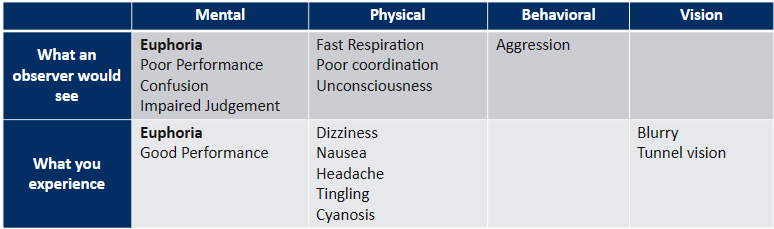
The symptoms of hypoxia will be the same regardless of the type.
In the table below, the symptoms are broken down into what you expect to see in another
person who is hypoxic and what you experience if you are hypoxic.
Euphoria: a feeling of well-being or happiness
Last look at some causes
Anemic
Carbon monoxide poisoning
Blood donation
Stagnant
G forces
Histotoxic
Drugs and Alcohol
Carbon monoxide (CO) is a colorless, odorless, and tasteless gas that is a product of Combustion.
For example: engine exhaust and cigarettes.
Hemoglobin in red blood cells is responsible for carrying O;
Hemoglobin bonds with carbon monoxide with an affinity 210 times greater than oxygen.
When carbon monoxide is in the air, your body replaces the oxygen in your red blood cells
with carbon monoxide.
This can lead to serious tissue damage, or even death.
Carbon monoxide detectors are installed in aircraft to alert us of a carbon monoxide exposure.
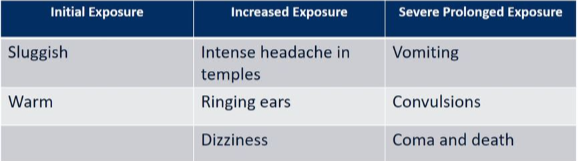
Symptoms of carbon monoxide poisoning will be similar to hypoxia but with several key differences depending on how long you have been exposed to the poison. The progression of symptoms are detailed in the table below.
Blood donation
When we donate blood, we will not have enough red blood cells to carry oxygen throughout our bodies and can experience anemic hypoxia.
In a completely healthy individual, the amount of blood taken when donating can be replaced within several hours. However; the loss of blood causes disturbances to blood circulation that may last for several days and cause stagnant hypoxia.
Generally, active pilots should not donate blood. If they do, they should wait at least 48 hours before flying.
Stagnant Hypoxia = exposure to G Forces
G Forces
G is the symbol for the rate of change of velocity which represents both a force and a direction.
Sudden changes in direction can cause disturbances to blood flow.
This force affects pilots in all aircraft—from the smallest ultralight to the biggest jet. G Tolerance
Tolerance varies greatly with the individual and if affected by diet and good physical conditioning.
Good muscle tone achieved from weightlifting is more beneficial than intensive aerobic training.
Moderate aerobic training (20-30 minutes daily) or running less than 5km is helpful, but long-distance training decreases G tolerance by lowering your resting heart rate.
Positive G
The most serious effect of positive G is the draining of blood away from the head toward the feet, causing stagnant hypoxia of the brain. The first symptom is vision deterioration.
Gray-out begins at +2G. Your vision, starting with peripheral vision, becomes dim and colorless.
Black-out ls complete at +4G. The blood flow to the eyes is completely interrupted and temporary loss of vision occurs even though the pilot is still conscious.
As the G increases, hypoxia of the brain develops, and consciousness is usually lost in unprotected pilots at more than +6G. This is known as 6~Loss of Consciousness or GLOC.
Negative G
Negative G is considered worse and is poorly tolerated because the acceleration is from feet to head forcing too much blood into the head.
Blood pressure in the eyes and brain is increased and may cause red-out(vision is red and hazy).
Negative G more than -5G may cause rupture of small blood vessels in the eyes and prolonged negative G may cause brain damage.
Alcohol
The Canadian Aviation Regulations require pilots to allow at least 12 hours between consuming alcohol and exercising the privileges of their license.
It is recommended to allow 24 hours between the last drink and take off time and at least 48 hours after excessive drinking.
On average it takes about 3 hours to metabolize a standard alcoholic drink.
Drugs
Any condition for which medicine is required may impair a pilot's ability to perform well and should not be taken before or while flying.
Over-the-counter and herbal remedies, such as antihistamines, cough medicines, sleeping pills, and appetite suppressants (to name just a few) may cause drowsiness, decrease mental alertness, and seriously impair the judgment and coordination needed by the pilot.
Unless cleared by a Civil Aviation Medical Examiner (CAME) do not fly under the influence of prescription, over-the-counter drugs or herbal remedies.
Recreational drug use has no place in aviation and illicit drug use can result in the suspension of your medical certificate.
Hyperventilation
Causes
Hyperventilation is caused by having too much oxygen and not enough carbon dioxide in the blood.
This results in the constriction of blood vessels and reduced blood supply to the brain.
Hyperventilation is a common response to stress and is made worse by anxiety or during times of intense concentration.
Symptoms
Symptoms
Dizziness
Cold sensations
A sensation of a tight band around the head
Pins and needles in the hands and feet
Cramping and spasms of the hands and feet
Breathing too deep and too fast
Remedy for Hyperventilation
Some symptoms of hyperv and hypoxia are similar, if unsure if a situation is either follow procedure
Breathe oxygen at 100% (if available) If hypoxia, is the cause, the symptoms will improve after 3 - 4 breaths
If the symptoms persist. consciously slow the rate of breathing to 10-12 breaths per minute and do not breathe deeply. Breathing slowly and deeply into a paper
bag is helpful, although obviously not always practical during flight Keep the
respiratory rate slow until the symptoms disappear.
If below 8000 ft ASL (2 44- m), hypoxia is unlikely to be the cause of the problem.
Gas expansion
- As we ascend through the atmosphere, pressure will decrease allowing air to expand.
- There are areas within our bodies containing gas that may cause problems when they expand.
- EX. Sinuses, intestines, ears, teeth
- Any conditions that develop due to a decrease in pressure are known as dysbarisms.
- Physical damage to our body due to a decrease in pressure is known as barotrauma.
- One of the more serious conditions that can occur while flying is decompression sickness.
Decompression sickness
On the ground, our body tissues are saturated with nitrogen, which makes up 78% of our atmosphere.
As pressure decreases with ascent, the nitrogen will form small bubbles in and around blood vessels, joints, and muscles causing disruption of blood flow and discomfort. Nitrogen is the most common gas that bubbles out of solution, but other gases may also cause decompression sickness.
Decompression sickness is rare below 2-,--- feet and is mostly prevented by having a pressurized cabin.
People who fly after scuba diving can experience decompression sickness at much lower altitudes.
Scuba diving
Breathing air at a pressure higher than standard atmospheric pressure, such as when scuba diving, can supersaturate your body with gases.
At a depth of 33 feet underwater, the body will absorb twice as much nitrogen as it would on the surface. Your body becomes supersaturated with nitrogen.
When you return to the surface after your body becomes supersaturated with gases. the extra gas can form bubbles and you can experience decompression sickness at altitudes of 8000ft and below.
Depending on the depth of the dive, decompression stops may be required during ascent to allow the body to adjust to the decreasing pressure. If decompression stops are not required, flights up to 8000 feet should be avoided for 12 hours.
If decompression stops are required, flights up to 8000 feet
Symptoms of decomp sickness
The gases that bubble out of your tissues can block circulation, cause pain. and damage body tissues.
Depending on where the bubbles form you could experience the following symptoms:
The Bends
The Creeps
The Chokes
Anesthetics
General: patient becomes unconscious
Regional: blocks nerves to a certain body part
Local: injected to the area to be operated on
After general or regional anesthetics, you should not fly until your doctor says it is safe to do so.
After local anesthetics, such as dental procedures, wait at least 24hours before flying.
Pilots may continue to fly up to 30 weeks into their pregnancy, provided the pregnancy is normal and without complications.
However, there are certain physiological changes that may affect flight safety, and the fetus may be exposed to potentially hazardous conditions.
After giving birth, pilots may not exercise the privileges of a medical certificate for a minimum of 6 weeks.