Response to Infection
Communicable diseases: are usually caused by micro-organisms, can be transmitted from one person to another
Pathogens
disease causing organisms
defence against pathogens can be specific or non-specific
non-specific a generalised response against all pathogens, infections or injuries
specific work against selected pathogens
Bacteria: are microscopic living organisms, usually one-celled, that can be found everywhere
they can be dangerous, such as when they cause infection, or beneficial, as in the process of fermentation (such as in wine) and that of decomposition.
pathogenic bacteria may enter the body in many ways, such as through the mouth or through cuts in the skin
they invade the body and are able to multiply. if they multiply sufficiently they can cause an infection
the infection may be caused by the microbes themselves, or by poisons called toxins that they produce
Cell Structure | Function |
Capsule | Protect the cell |
Cell wall | Protect the cell and gives the cell its shape |
Plasma membrane | Controls movement in and out of cell |
Cytoplasm (cell content between nuclear and cell membrane) | Includes organelles and cytosol. Where life activities occur. |
DNA | Genetic instructions |
Plasmid | Circular DNA capable of self - replication |
Flagellum (tail like structure) | Allows movement |
Viruses
are 10-100 times smaller than bacteria
are able to multiply only within the living cells of a host and therefore tend to target specific tissues (cells) in the host
the ‘flu’ virus will lock onto a target cell in the respiratory system and dock onto the cell surface. they then enter the cell
once they’re in the cell they use it like a factory; they take it over and make it produce thousands, or millions, of new copies of the virus, which come streaming out of the cell
they infect other cells to make more viruses, or they escape from the body and infect a new victim
taking over a cell can kill the host cell which has a consequence for us because it might damage the mucosa (the lining of your airway). this means you get inflammation.
Cell Structure | Function |
Spike proteins | For attachment to specific cell receptors |
Envelop | Protective outer layer |
Protein coat | Surrounds the genetic material |
DNA | Genetic instructions |
Transmission of Pathogens
Transmission by contact through direct or indirect means
Ingestion of contaminated food or drink
Transfer of bodily fluids
Airborne transmission
Infection by droplets
Transmission by vectors
Three lines of defence
Keep microbes out of the body
Non-specific attack on microbes
Specific attack on microbes
Skin
Barrier; prevents entry of micro-organisms. Large amounts of bacteria live on skin → occupying bacteria makes it difficult for new (pathogenic) establishments
Sebum (oily secretion) → substances which kill some pathogenic bacteria
Sweat → salts and fatty acids prevent growth of many micro-organisms, lysozyme kills bacteria
Mucous Membranes
Hair
Cilia
found in the respiratory tract
Acids
found in stomach, vagina and sweat
Lysozyme
found in tears, saliva, sweat, nasal secretions, tissue fluid.
enzyme → kills bacteria
Cerumen
Flushing action
occurs in urine flowing through urethra; tears, sweat, saliva
cleansing action → prevents bacterial growth/travel through ducts/tracts
Protective reflexes
Sneezing
Stimulus of irritation of walls of nasal cavity
Forceful expulsion of air from lungs
Coughing
Vomiting
Stimulus of psychological; excessive stretching of stomach; bacterial toxins
Muscles of abdomen and diaphragm contract
Stomach contents expelled
Diarrhoea
Stimulus of irritation of small/large intestines by bacteria/virus/protozoans
Increased peristalsis to quickly remove irritant
Material spends less time in intestine → faeces watery
2nd Line of Defense
Fever (elevation of body temperature). Increases production of killer T cells, increases metabolic rate which speeds up tissue repair, increases heart rate/blood flow which enables lymphocytes to reach sites of infection faster, creates a non-optimum temperature that kills pathogens
Specific Defences: Recognises foreign molecules and acts to inactivate or destroy them. If it fails, diseases may occur. Three important aspects: acts against specific pathogens or foreign substances, not restricted to initial infection site, recognises and launches stronger attack on previous encountered pathogen
Antigens: Any substance capable of causing a specific immune response e.g. proteins, carbohydrates, lipids, whole microbes, flagellae, cell walls, virus, cell structures from other individuals, pollen grain, egg white
Self-Antigens: Human cells have many surface proteins, our immune cells do not attack our own proteins. Our cells in another person’s body can trigger an immune response.
Non-Self-Antigens: Materials recognised by the immune system as not belonging to the organism. Stimulate an immune response.
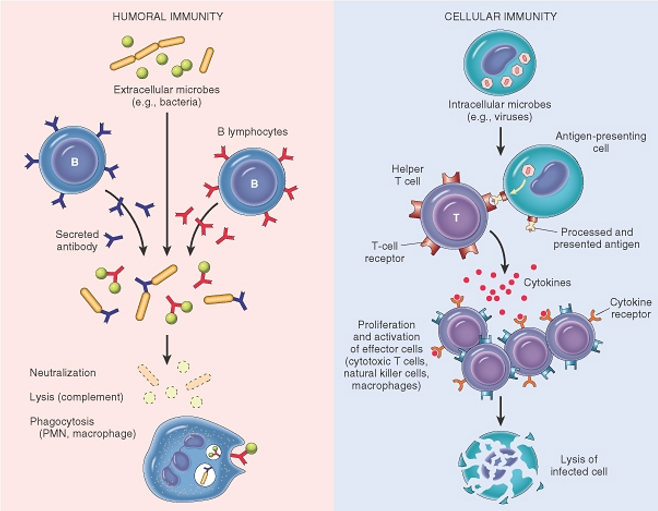
Two types of specific immunity
→ Humoral or antibody mediated (B cells): Involves B-cell production of antibodies that bind antigens resulting in either neutralization, lysis or phagocytosis
Antibodies: Specialised protein produced in response to a non-self-antigen. Protein group called immunoglobulins (Ig)
Antigen-Antibody Complex: Specific antibody attaches to specific antigen. Result in destruction/inactivation of the antigen
Agglutination: The clumping together of microorganisms or of blood cells due to a reaction between substances on the surfaces of the cells and antibodies in the surroundings.
Humoral response: A macrophage engulfs a pathogen. Macrophages presents the pathogen to a helper T call and B-cell. Helper T cell secretes cytokines which activates the specific B cell to enlarge and divide through mitosis producing clones of themselves. B cell proliferates and differentiate into plasma cells which makes specific antibody for invading antigen/pathogen. Some clones of B cells become memory cells. Memory cells remain to increase immune response when reinfection occurs. Memory cells respond faster to re-exposure to the antigen.
First exposure to antigen is the primary response. It takes time for B cells to differentiate into plasma cells and then build up antibody levels. Re-exposure response is the secondary response. Memory cells respond much faster.
All antibodies combine with the antigen for which they are specific. Antibodies may:
Combine with bacterial/viral/toxins/enzymes and inhibit them
Bind to viruses to prevent cell entry
Coat bacteria for easier phagocytosis
Cause agglutination of foreign particles
Make substances insoluble and hence easier to phagocytose
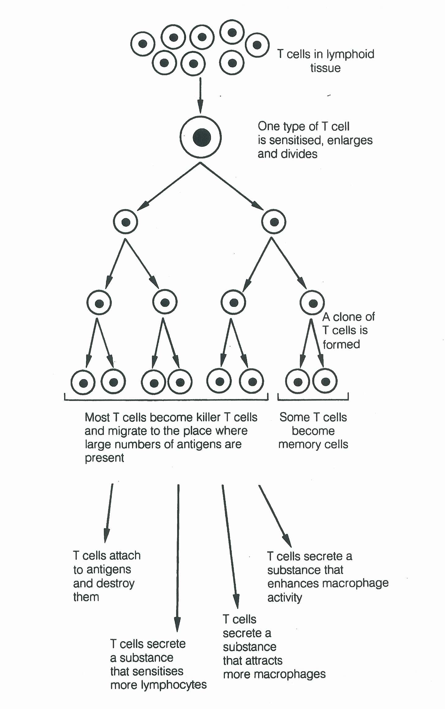
→ Cell mediated (T cells): Involves T-cell recognition of abnormal antigens on the surface of host cells (indicating viral infection or tumorigenic change) and the killing of infected cells.
B and T cells are both produced by bone marrow. B cells mature in the bones. T cells mature in the thymus gland
T cells
One T cell is specific to one antigen
May be stimulated by cytokines during Humoral immunity
Intercellular infection of non-self antigen stimulates T cells
Killer T cell, Helper T cell, Suppressor T cell, Memory T cell
Cell Mediated Response