4 - encoding + early memory formation
MISC.
mnemonics: ex. songlines.
NMDA receptors are coincidence detectors (need glutamate and voltage change to open!!)
increasing AMPA receptor expression in PostSyn membrane strengthens neuron
WHAT IS MEMORY ENCODING?
how do we define encoding vs perception vs sensation?
CONCEPT OF ENCODING: HISTORY
Deese: integrating or unitizing (chunking) nonsense syllables
Melton: perceptual traces and memory traces are the same thing
1980s: Shift to cognitive neuroscience
priming, implicit memory, multiple memory systems
neuroimaging
What is LOP?
Levels of processing (LOP): framework for study of memory with levels of perceptual processing depth
Craik and Lockhard
memory trace as byproduct of perceptual analysis, influenced by depth of analysis
stronger experience (depth, amt of attention, compatibility of info, time spent) → greater retention
compatibility: does it fit existing structures (of what you already know)?
What is GAPS?
General Abstract Processing System (GAPS): framework for studying episodic memory
Tulving (important boi)
memory starts with encoding, ends with retrieval.
encoding: converting event into an engram (memory trace)
ecphory: process of combining information in engram and retrieval cue into ecphoric information
ecphoric information: end product of act of cognitive memory
encoding is not the same as perception. perception necessary but not enough for memory trace formation
Why have a separate process (encoding and perception)?
interruption of encoding
can perceive but not recall perception (encoding failure)
ex. expt involving high priority item. poor recall of preceding items.
remembering events that never happened
confabulation. not perceived at all!
anterograde amnesia
perception intact BUT no memory trace!
psychopharmacology of encoding
benzodiazepines (depressant) don’t reduce perception of stimuli but have poorer recall
How do we measure encoding in the brain?
Sanquist et al.
EEG study showed ERPs for words on a list
differences between words that were recalled vs not recalled
differences reflect encoding!
Wagner et al.
fMRI study, localized encoding of remembered words vs not remembered words
in left prefrontal and temporal cortices
damage to prefrontal regions associated with memory deficits but not perceptual!!
Encoding vs consolidation?
Defining encoding:
encoding is NOT transduction (environmental energy into neural code)
encoding is NOT always sensory encoding (neural sensory code into perceptual code)
encoding IS turning perception or experience into memory trace!!
How do neurobiologists understand memory traces? (review)
formation of memory trace:
starts with behavioural experience → activates weakly connected neurons
cellular molecular processes strengthen these neuron connections (LTP, etc)
form neural representation of experience → memory trace
can reestablish state via retrieval cues
neurons that fire together wire together!
Are NMDA receptors critical to memory formation? (Richard Morris)
pharmacological approach
Setup:
cannula implanted into rat brain ventricles, time release pellet
pellet contained NMDA receptor antagonist APV
rats trained on place-learning version of water escape task
Manipulated:
infused w APV
not infused w APV
Results:
APV rats impaired learning of hidden platform location
during probe trial, control rats selectively* searched platform’s quadrant but APV rats didn’t
Takeaway:
antagonist inhibits NMDA receptors which impaired memory
NMDA RECEPTOR SUBTYPES
NMDA subunits
all NMDA receptors have GluN1
multiple types of GluN2 subunits
NMDA receptor complexes made up of GluN1-GluN2A and GluN1-GluN2B subunits
What occurs with GluN1 deletion in CA1 (hippocampus area)? (Tonegawa)
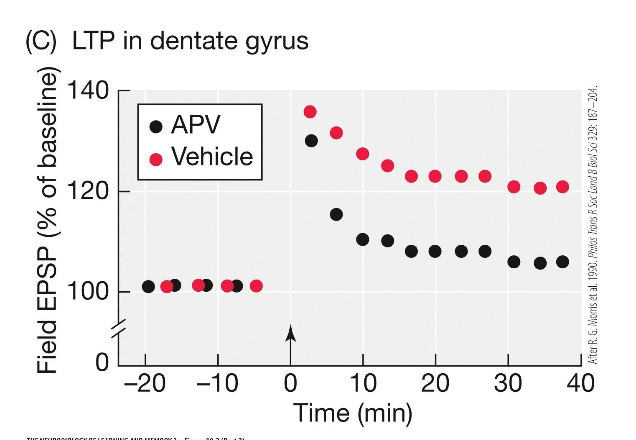
LTP could be induced in dentate gyrus but not CA1
impairment performance in hidden platform water escape task
developmental shift in receptor ratios (of GluN2A and GluN2B receptors)
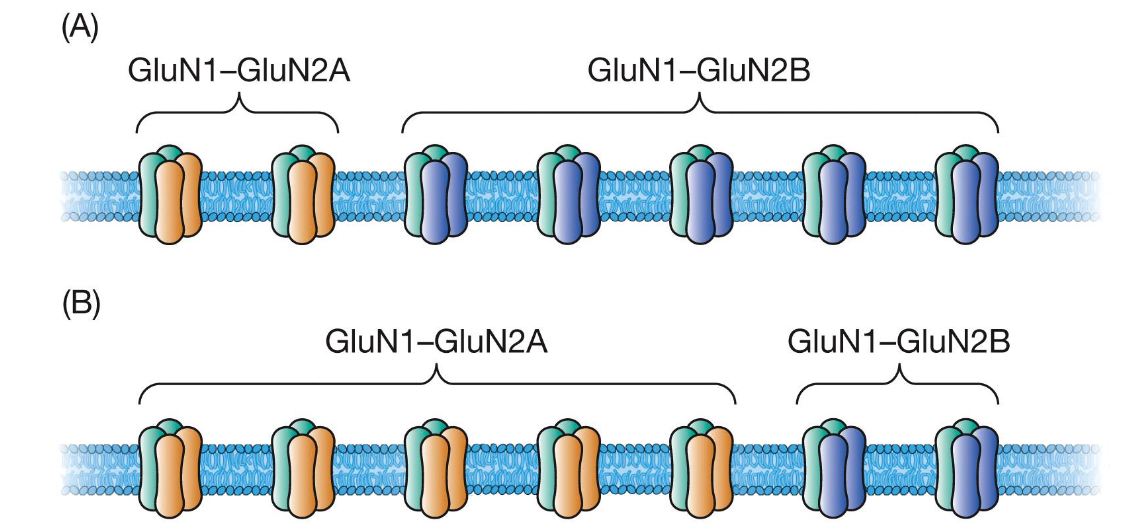
(explore vs exploit!!!!)
What occurs with GluN2B overexpression? (Tsien)
“Doogie mouse”
GluN1-GluN2B NMDA overexpressed in cortex, hippocampus, amygdala
Result:
showed enhanced LTP in in-vitro brain slices
stable+enhanced memory for contextual fear-conditioning experience
increasing expression of GluN2B resulted in improvement of learning and memory!!
Does AMPA receptor trafficking improve memory? (Roberto Malinow)
Setup:
made GluA1 subunits with distinct electrical conductance from endogenous (in-body) GluA1s
labelled receptors w fluorescent protein
viral vector system, delivered receptors into neurons of basolateral amygdala
Manipulation:
tested for fear of tone w shock
tested for fear of tone without shock
Results:
paired condition showed fear to tone
brain slices showed fear conditioning increased GluA1 AMPA receptors into dendritic spines
Can dummy AMPA receptors impair memory? (Robert Malinow)
follow up experiment
Setup:
modified nonfunctional GluA1 receptors, injected into lateral amygdala
those receptors compete w endogenous functional GluA1 receptors going to spines
Manipulated:
injected
not injected
Results:
injected rats had impaired fear conditioning to tone + shock
slices from animals with modified receptor couldn’t sustain LTP in lateral amygdala
Can we enhance learning?
ampakines: class of drugs designed to improve cognition (neurotropics)
Glutamate binds to AMPA receptor. conductance channel opens (short time)
+ ions enter, depolarization
Ampakine only. nothing happens
Ampakines and glutamate binds to AMPA receptor. conductance channel opens (longer time)
more + ions enter, stronger synaptic response.
POSITIVE ALLOSTERIC MODULATION. ampakines enhance rate of auditory fear conditioning (learning)
NMDA and AMPA: role in acquisition and retrieval?
Setup:
can rats learn and remember location of flavoured food pellets?
Manipulated:
2 antagonists used
APV (blocked NMDA)
CNQX (blocks AMPA)
Results:
BOTH antagonists: interference w establishing memory
ONLY CNQX, affecting AMPA: interfered with retrieval of memory
ONLY APV, affecting NMDA: could retrieve the memory
Implications:
NMDA are needed for acquisition (learning) but Not retrieval (memory)
AMPA are needed for BOTH acquisition and retrieval
What is the role of CaMKII in memory?
Setup:
use CaMKII-deficient mice (CaMKII KO)
control group
Results:
CAMKII KO mice learned to swim to visible platform but couldn’t learn hidden platform
Probe trial: control group selectively searched target quadrant, CAMKII KO mice didn’t
How to use the radial maze to study working and reference memory?
Setup:
rat in middle of maze
trial starts at centre of maze, ends when rat gets all 4 rewards.
same 4 arms have the rewards each time
two types of errors
working memory (enters previously sampled arm)
reference memory (enters arm never baited)
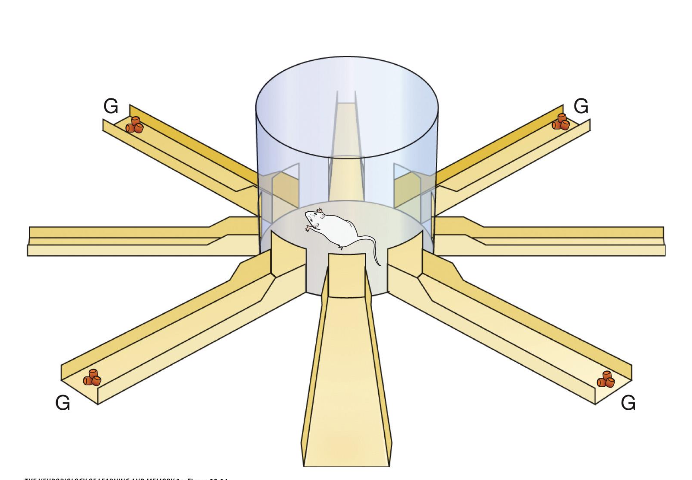
Results:
GluA1 KO mice learn + remember Reference memory part, BUT working memory impaired.
Implications:
reference memory: learning which arms are never baited
working memory: remembering which arms you’ve already visited
GluA1 receptors are essential for working memory
DUE before the midterm (friday before)
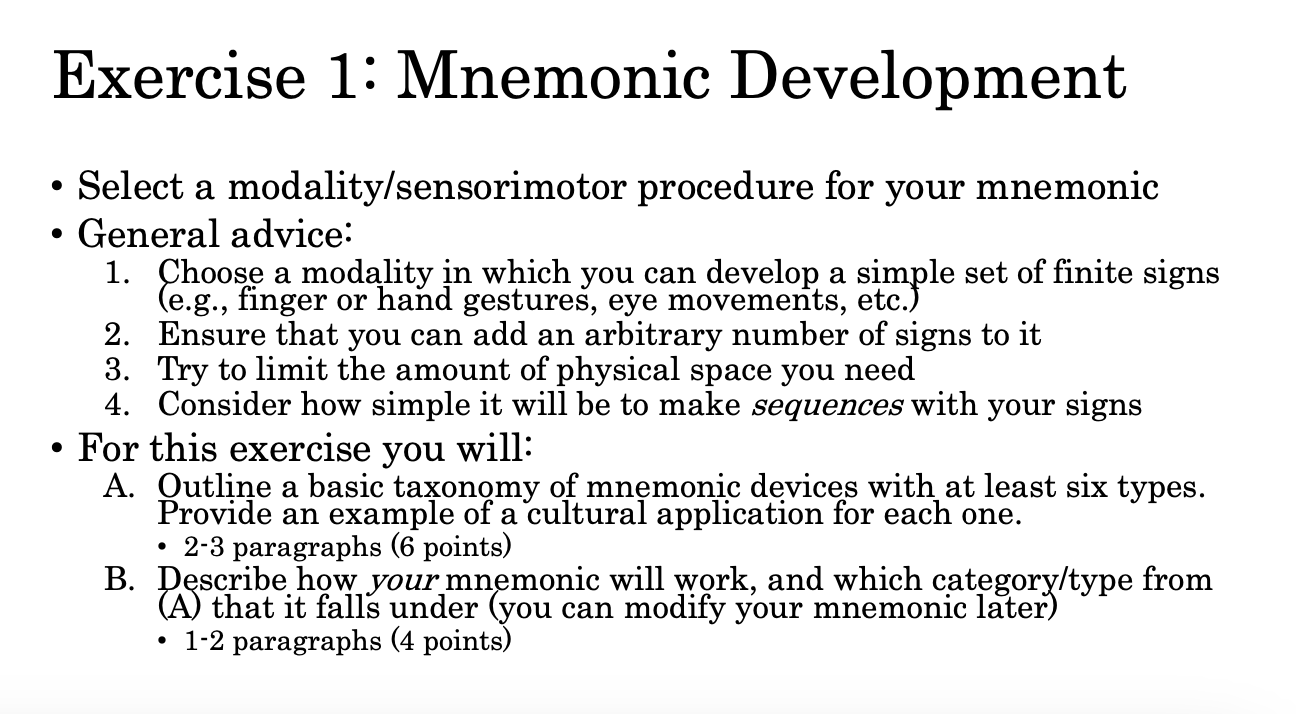
outline taxonomy of mnemonic devices (6 types)
(different modalities??)
cultural application?
describe my mnemonic!! what category it falls under