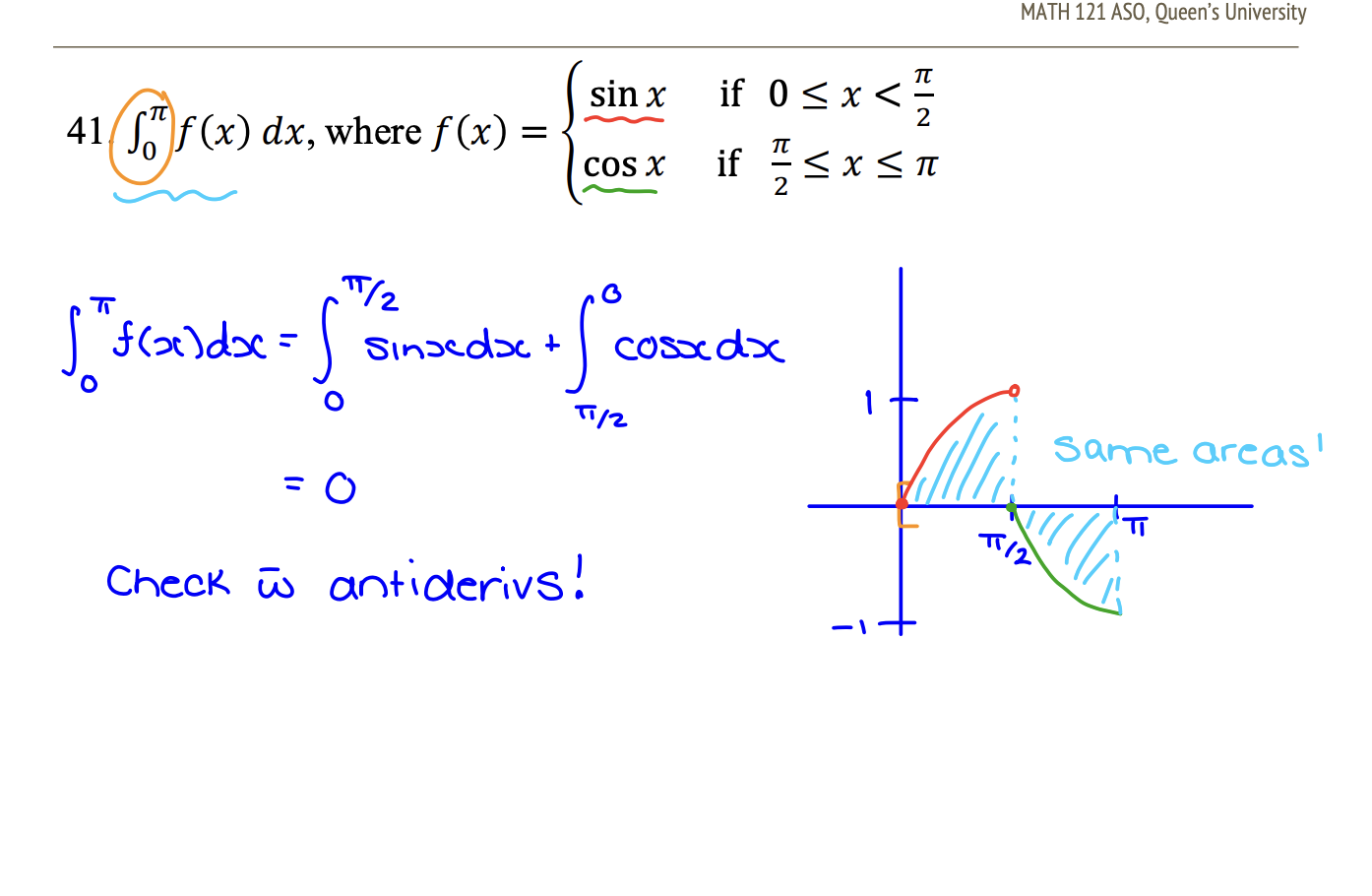
Problem solving
Okay? Okay. So the first problem we're going to do today is we're just going to do a little bit of a combination of what we learned last week.
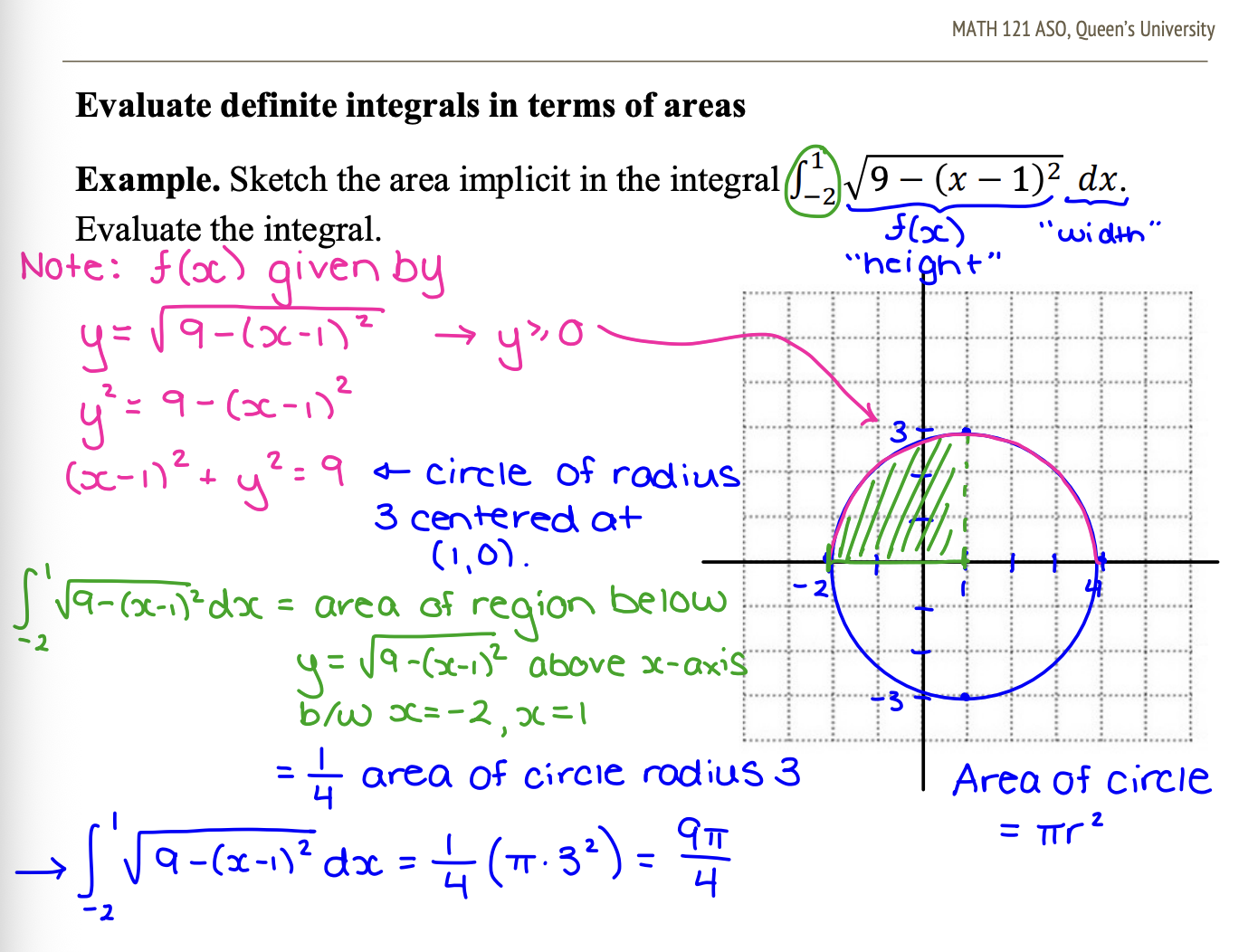
So we've got this function and we're taking the integral from negative 1 or negative 2 to 1 of this expression with respect to the variable X.
That's what that DX was telling us. Right. And so I'm just going to want to evaluate the integral at the end of this.
So the first part of this question asks us to sketch the area or quote, unquote, area that we're talking about, because remember, sometimes it might be a negative.
So you can't really say that an area is negative, but it's talking about what is the space.
I'm trying to say how big is it? Okay. And so I always have the wrong size pen, but let's draw some axes first, so that we kind of have some place to start.
Okay, so remember when I draw graphs, and so you might have seen this on the first midterm, you might see it again on the second when you're drawing graphs, remember, everything should be labeled so that we know that you know what you're talking about.
Okay? So we want you to show us that you know that this is the X axis.
This is the Y axis. You're talking about time. You should maybe label it with a T rather than an X.
And then we want you to show what your scale is, make sure it's consistent.
And so for us, I'm going to choose. Each box is one unit, okay? And it wants us to sketch the area that is given by this kind of complicated integral.
And so what I want to think about first and foremost maybe is that function under or the function that I'm taking the integral of.
And I'm going to call this F of X. And remember, these were. We kind of thought of them as the heights. Okay? And I want to just notice that's maybe not upon first glance, something that I know how to draw, but I'm telling you now, it is something that you know how to draw.
And that's because. Let's just think about this for a second. F of X is given by. Okay, well, the Y values are equal to the square root of 9 minus X minus 1 squared.
So that's kind of. Remember, sometimes we write Y is equal to something in terms of X. F of X is equal to something in terms of X.
That's what we're talking about. Okay? Notice that if I square both sides. So I'm just going to do some algebraic manipulation.
So I'm going to square both sides and I'm going to get Y squared is equal to 9 minus X minus 1 squared.
So I'm maintaining the equality and still getting that this equation is satisfied.
And then if I take things and I put them in a way that's going to look a little bit more clear to you, I'm going to write this as X minus 1 squared.
I'm going to bring it over to the other side. I'm going to keep that Y squared on that side, and then it'll be equal to nine.
And so now this should be a little bit more clear what this is.
This is the equation of a circle of radius 3, because 3 squared is 9, but it's centered at.
And if I just remember how I figured out the center of my circle, I have to see if my X And my Y are shifted.
And so my X is shifted to the right by one, and my Y is not shifted at all.
So if I want to draw that curve in particular, let me just draw this circle.
So it's going to be centered at 1. It's going to intersect at 1 3, at 0 4, at. Sorry, at 4 0, at negative 2 0, and at 1, negative 3.
So if I really wanted to be very clear about these things, I would write this.
Okay? And then this would be my circle. And now I hope that my tool will give me a nice circle over here.
Okay, let's imagine that that circle intersects the proper points.
Okay? Okay. But it's still not exactly clear what area I'm trying to figure out.
So the next thing I might draw your attention to is this first line.
This first line here. Remember, if I go back up this chain of equalities, if I wanted to go from the second line to the first line.
So if I wanted to take the square root of both sides, I know I have to take plus or minus, right?
And so taking plus means that I'm taking the top of this circle.
And so what I'm telling you is F of X is giving you the top of this circle with that equation.
So it's giving you the hemisphere of the circle of radius 3 that is centered at 1 0.
Okay? Okay. So that's what our function is. So we figured out how to draw our function, but now we need to figure out what the area is that we're talking about.
And so that's where this, this part of our integral comes in.
The bottom, you know, is the starting point. So that's negative two here. The top is our end point. And so that's one here. And so we know that we're talking about the area above the x axis below my curve, which happens to be that area there in orange.
And so if I want to explicitly write out what this integral is asking me for.
Now, I've completed the first part. I sketched the area implicitly asked for in this integral, and I'm going to write it in words.
It's asking me for the area of the region because it's a positive function.
So because my function lies above the x axis, I know I want the area below my function.
So below Y is equal to the square root of 9 minus X minus 1 squared.
I want it above the X axis, and I want it for X in the interval negative 2 to 1.
Right? That's exactly what that integral is asking me for.
And now to evaluate this integral I don't have any tools with me yet.
I don't want to use a Riemann sum because it says to evaluate the integral, not approximate it.
But the nice thing about this is if I look at that orange region that I've shaded, it's actually going to be equal to a quarter the area of the circle of radius three.
Right. So that should be clear from that sketch. And that's why we usually start with a sketch, so that we can make the problem a little bit easier on ourselves.
Okay. Okay. Now this is something that you should remember. A lot of this course is not about memorization, but certain things you should know.
And one of them is the area of a circle is PI r squared.
Similarly, areas of other shapes, volumes of other shapes, you should know these things.
So if I know that, then I can actually explicitly compute this integral.
Okay? So it's going to be the integral of my function dx, which is equal to a quarter times PI.
The radius is 33 squared, which will give me 9 PI over 4.
So that's how to evaluate a definite integral. Just using areas. Yes. So that's because my function that has to do with this part right here.
Because if I was really going to talk about the circle as a whole, that representation would be plus or minus the square root.
That's the equation that would give me the equation of that circle.
Or it would be related to the equation of the circle.
But it only taking the positive version means that you're only taking the top.
If it was negative, the square root, that would mean you're taking the area under the bottom.
Does that make sense? Okay. Any other questions? It's a good one. Okay, Sit with this for a bit. If you do have questions at the end, let me know. If you have questions later, let me know next week during tutorial, office hours, whatever.
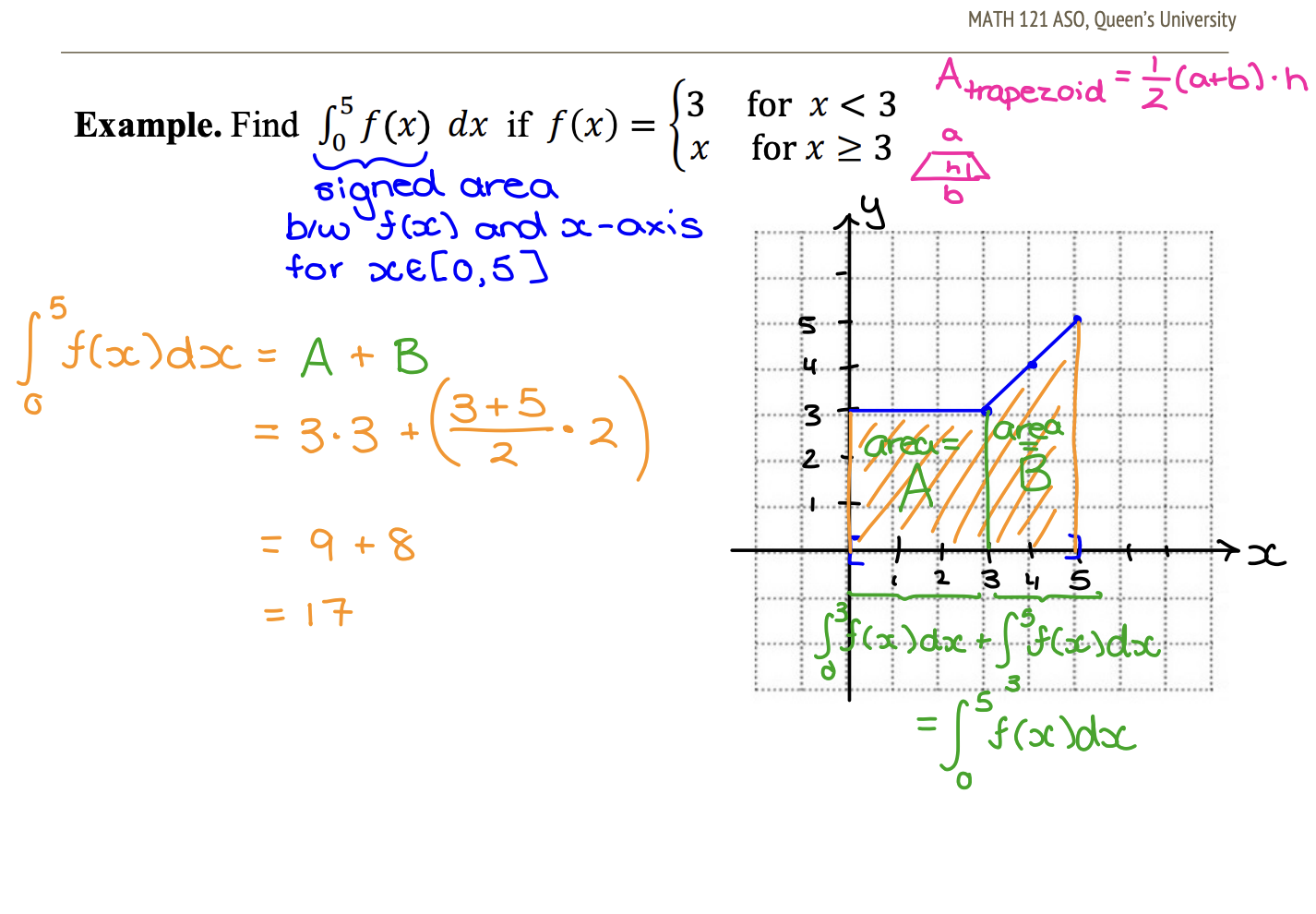
But let's look at maybe another example. It might go a little bit quicker. We want to find the integral from 0 to 5 of a function F of X that's defined piecewise in this manner.
And so we just have to remember what that F of X, that integral from 0 to 5 means.
I'll write it in my notes, but I might not write it down enough for the sake of time.
Just means the signed area between F of x between.
Between F of X, sorry, and the x axis. And I want it for 0 to 5, the integral 0 to 5. So I need to sketch this if I want to try and figure out how to find this integral without knowing any antiderivatives or anything.
Yet. And so I'm going to say this is my x axis, this is my Y axis.
I'm going to split it up in the same scale as I had before, and I'm only going to include up to five.
I mean, I, I could keep going, obviously, but because I only want 0 to 5, I'm just going to draw it like that.
And then I'm splitting it up the same way here. And so to draw this, I'm just going to look at for x less than 3, I'm a constant function, 3.
Okay? And so since we only care about anything 0 and above, I don't need to draw this entire function because this entire function extends past zero.
But I'm just going to draw it. It starts at 03. And then that straight line extends all the way to x being less than 3.
For x greater than or equal to 3, I'm taking the line of slope 1.
And so I know that that has a point 3, 3, 4, 4, 5, 5. And so this is what my function looks like on the interval that I care about.
And that interval that I care about is this 0 to 5. So that's the interval that I care about. And so when I say I want the signed area between F of X and the x axis is this area, are we going to take the positive or the negative?
I heard it here, we take the positive. Yeah, because this function as well as the last one, it lies above the x axis.
So this is the area that we want. Okay? If some portion of this went below and some was above, remember you would then need to split that up and you would need to take the positive of the area that's above minus whatever area is below.
So just remember that we're going to keep going. So if I were to take the integral from 0 to 5 of F of X dx, I need to take the area of that shape.
And now that is not a shape that I know. I don't know overall what that shape is. But I know this fun thing that I can do. I can split it up into two shapes that I do know. So if I split it up as this area here being equal to A and this area here being equal to B, then I can say that my integral is asking me for the area A plus the area B.
Okay? And so I can evaluate that and I can say that that's equal to, okay?
A is just a Square, square has base 3 height 3. And then let's maybe, since last time I skipped it, we can review the area of a trapezoid so let's say I've got a trapezoid here.
You again, can always break up the trapezoid in terms of other things, in terms of triangles and squares or rectangles.
But if that's a trapezoid, if that's some arbitrary trapezoid, the smaller side I label with A, the bigger side I label with B, it's not going to matter.
You'll see that area of the trapezoid is going to be equal to A plus B over two times whatever the height is.
Okay? So for us, Our A is 3. It's the shorter side of my trapezoid. Again, it doesn't matter because you're adding them.
So it doesn't matter which order you take it in, but it's going to be three plus the other side of the trapezoid, which is five over two times the height of my trapezoid, which is two.
Again, this trapezoid is on its side. So if you're having trouble seeing what A, B and H are, just remember that it's on its side.
Our height has to do with how to go between your parallel lines.
What's the distance between your two parallel lines?
Okay. Okay. So if you do that, you should get 17. And the one thing I really want to draw your attention to is the strategy we use to compute this area.
The strategy was, okay, I didn't give up when I didn't see what overall that shape.
I didn't know I didn't have an area formula for it.
My strategy became to break this up into, well, if I think about what I'm doing by breaking it up into the slope and the trapezoid, I'm breaking it up into the integral from zero to three because that's where my rectangle or square goes of F of x, because that's still the function whose area I'm looking at being under.
Okay? And then the second portion that I added to it was the integral from 3 to 5 of F of X dx.
And I said that that was equal to the integral from 0 to 5 of F of X dx.
So this is kind of a motivation or introduction to some properties of integrals.
And this one's actually a really, really useful one.
It is that you can break up your integral into these sections.
So if it's an integral from 0 to 5, you could break that up into as many intervals as you want, as long as your intervals are small, staying between zero and five.
So you could break it up into the integral from 0 to 1.
The integral from 1 to 2 plus the integral from 23 to.
We're going to apply a couple of rules. I'm not going to have you do this by yourself. I'm going to go through this one and then the next one.
I think I'll get a little bit more input.
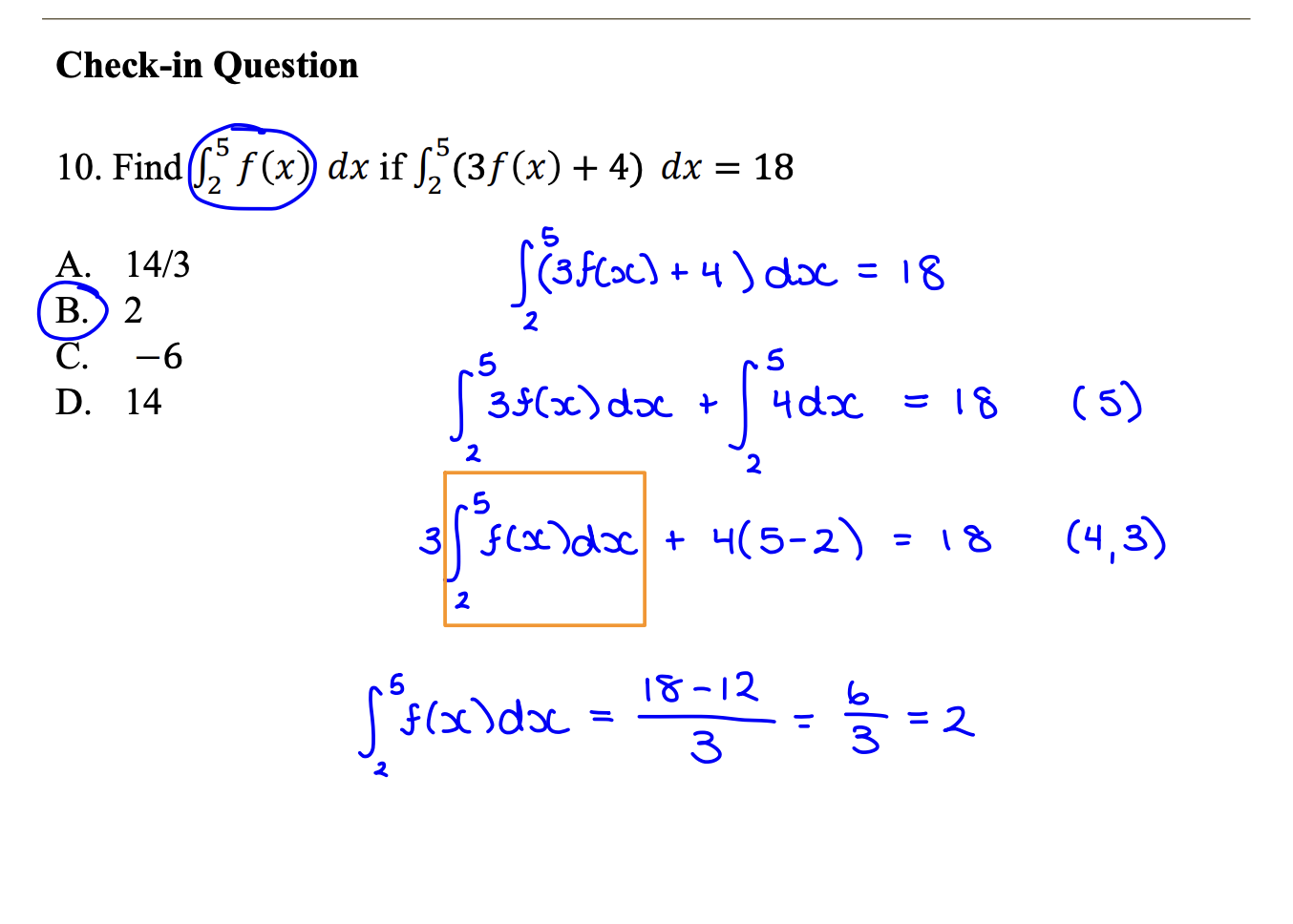
Because this one's a little bit involved. So we want to find the integral from two to five of just some function F of x.
If I know something about this combination of F of x with some other things, I know the value of that integral.
And so I'm going to use my integral properties. So in particular what I'm going to do is I'm going to write 2 to 5, 3F of X. I'm just going to rewrite exactly that expression is equal to 18.
And then I'm just going to do some manipulation. I'm going to rewrite the left hand side and I'm not going to do anything that I'm not allowed to do.
And so I should be able to maintain this equality the whole time.
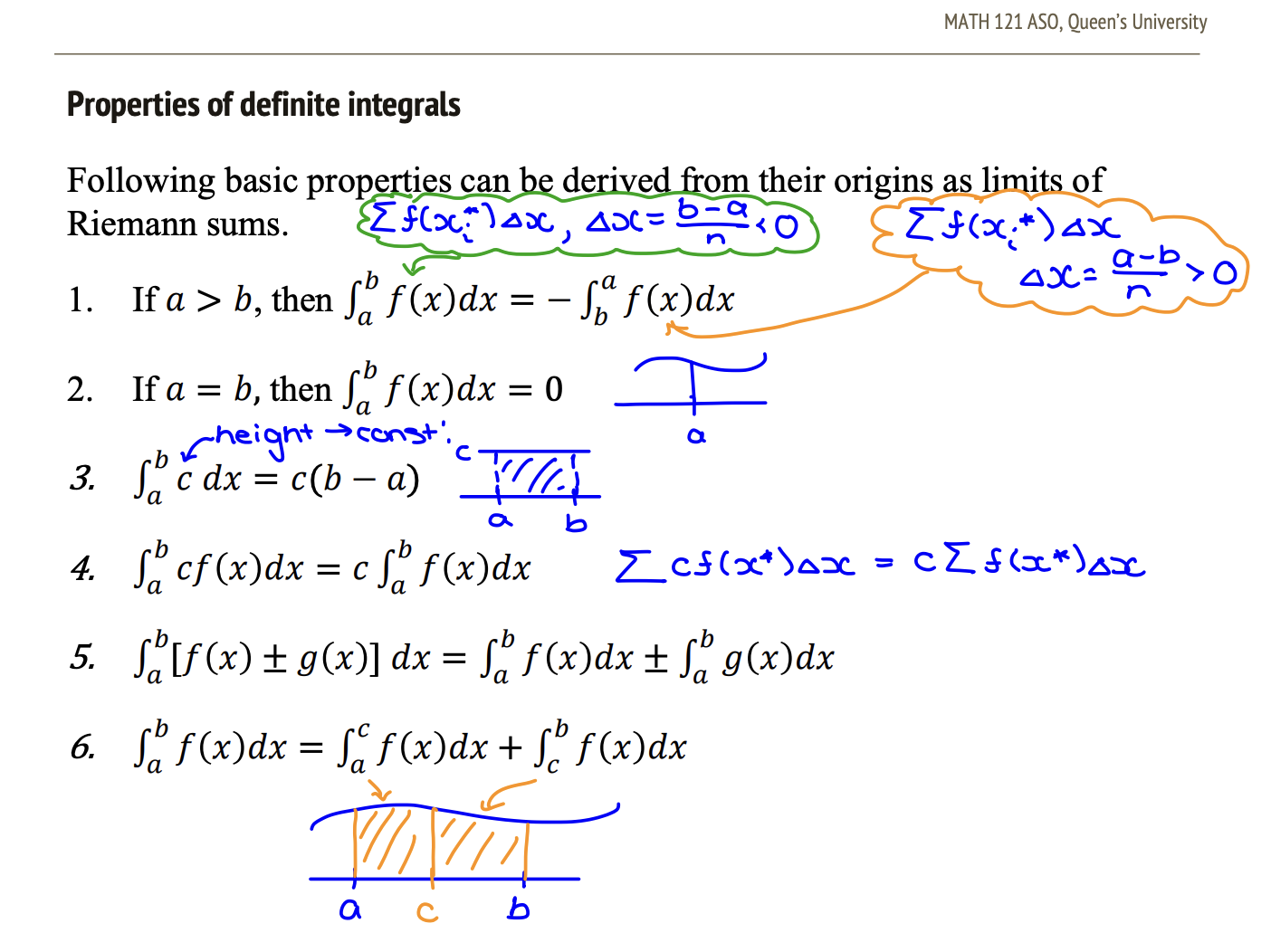
If I do things that I'm allowed to do based on my rules, the first thing that I'm going to be allowed to do is I'm going to write my left side as the integral of the function 3 times f of x dx plus the integral from the same bounds of 4 dx.
And that's still equal to 18. Because all I've applied is rule 5 here I've applied that.
That first function that I'm taking, the integral of is the sum of two functions.
So I've just split it up into two integrals, same bounds.
This is really important not to get mixed up which rules you're taking.
I'm taking the same bounds and splitting up the function.
Okay, the next step I'm going to use two rules and so I'm going to use one for my first integral and that's going to be that I'm pulling out the constant 3.
And so then it just becomes three times the integral from 2 to 5 of F of X dx.
And then I'm going to notice that my second integral is just the integral of a constant function.
So the area is just the area of the box. The box has height 4, it has width 5 minus 2 and that's still equal to 18.
And that was using. I'm going to write them in order. The first rule I used was Rule 4. The second rule I used was Rule 3. I think I could be wrong about these labels, but yeah, okay, this, to be honest, you don't need to tell me which rules you're Using I have always done this, and I used to do this all the time for the sake of myself going back and studying.
That's how I would study. I would go back and I would say, okay, what rule did I use?
Like, how am I supposed to know how I got from this step to that step so that I don't get lost?
Okay, and something really nice has popped out now, right here is what the question is asking me for, right?
And so just treating this like anything else that I can solve for, because a definite integral is just going to give me a quantity so I can solve for that quantity.
And so if I do that, if I solve for the integral from 2 to 5 of F of X dx, I'm just going to tell you that it will give you two.
I encourage you to fill in those steps. Maybe I'll Write delta equal to 2. So all you need to realize here is that you can apply a bunch of rules.
You can pull out the quantity that you want and solve for it if you've got an equality already.
Okay, does this make sense? Severity of things?
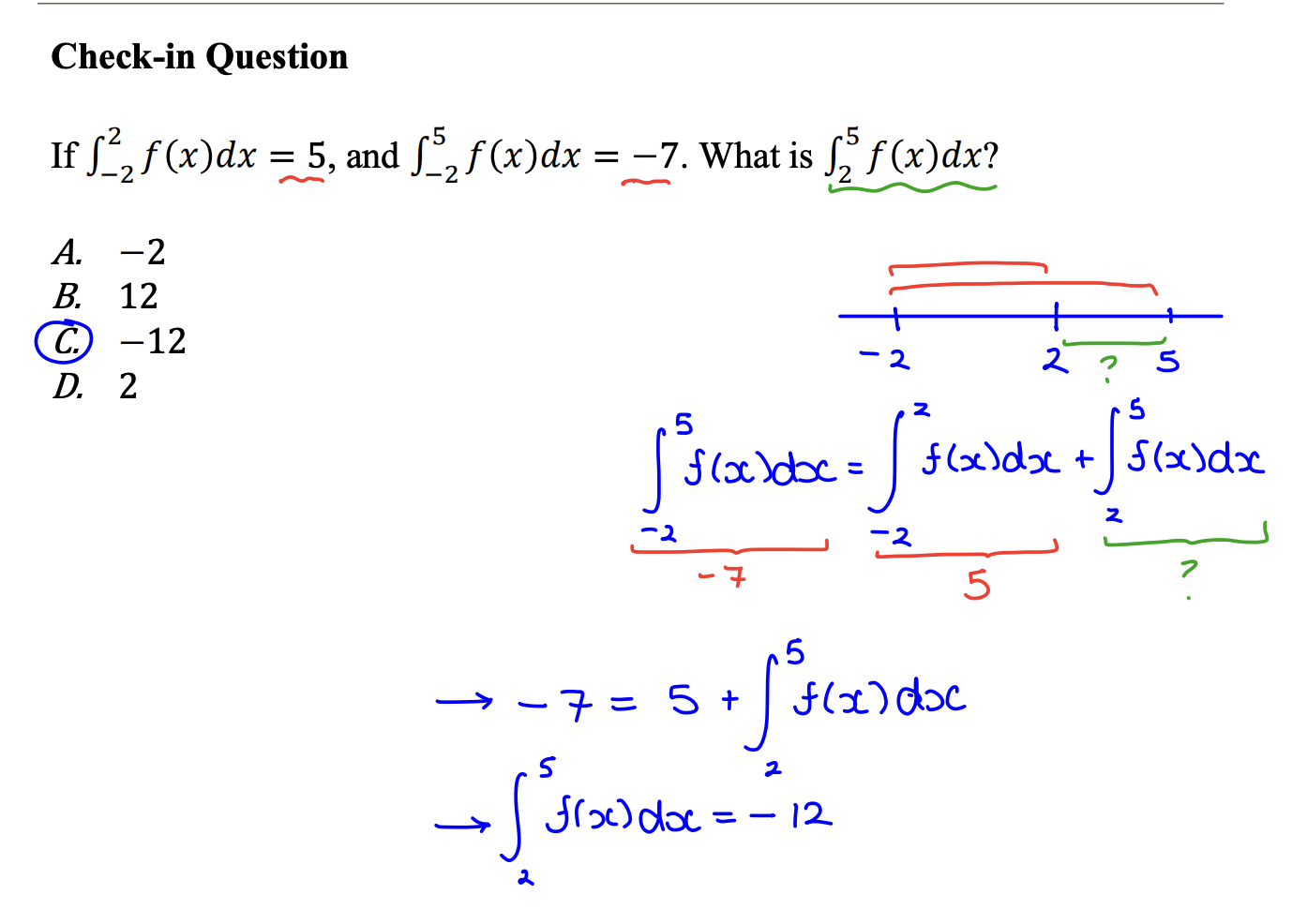
This next question is using a different rule. I know what the integral from negative 2 to 2 of f of x dx is.
I know the integral from negative 2 to 5 of f of x dx.
I want the integral from 2 to 5 of f of x DX. And so what I would really like you to realize here, and this is where I'm going to get you to try and do a quick calculation for me.
Once I set this up, I have the integral between negative 2 and 2.
So let's pretend F of x is somewhere over here. Doesn't matter what F of x is. I know what the area is. It's five. It's actually going to look different than that.
So I'm not even going to draw that. I'm just going to draw. I also know the value. If I take this all the way up to five and I'm asking what the value is if I just consider this interval.
And so what I'm going to want to realize is that the integral from negative 2 to 5, so the integral on the whole interval could be split up into those sub intervals.
So it could be split up into the integral from negative 2 to 2 of F of X dx.
And then I need the remaining portion of my interval from 2 to 5.
And so if I know that this value is, what is it? Negative 7. If I know that this value is 5, A, B or C, what is the value that I'm looking For if you know the answer, you can either yell it or you can put your hand up.
Yeah. See, it's negative 12. Yeah. If you didn't see that, I encourage you to try it. Otherwise I'm going to move on because I do have quite a bit that I need to get done.
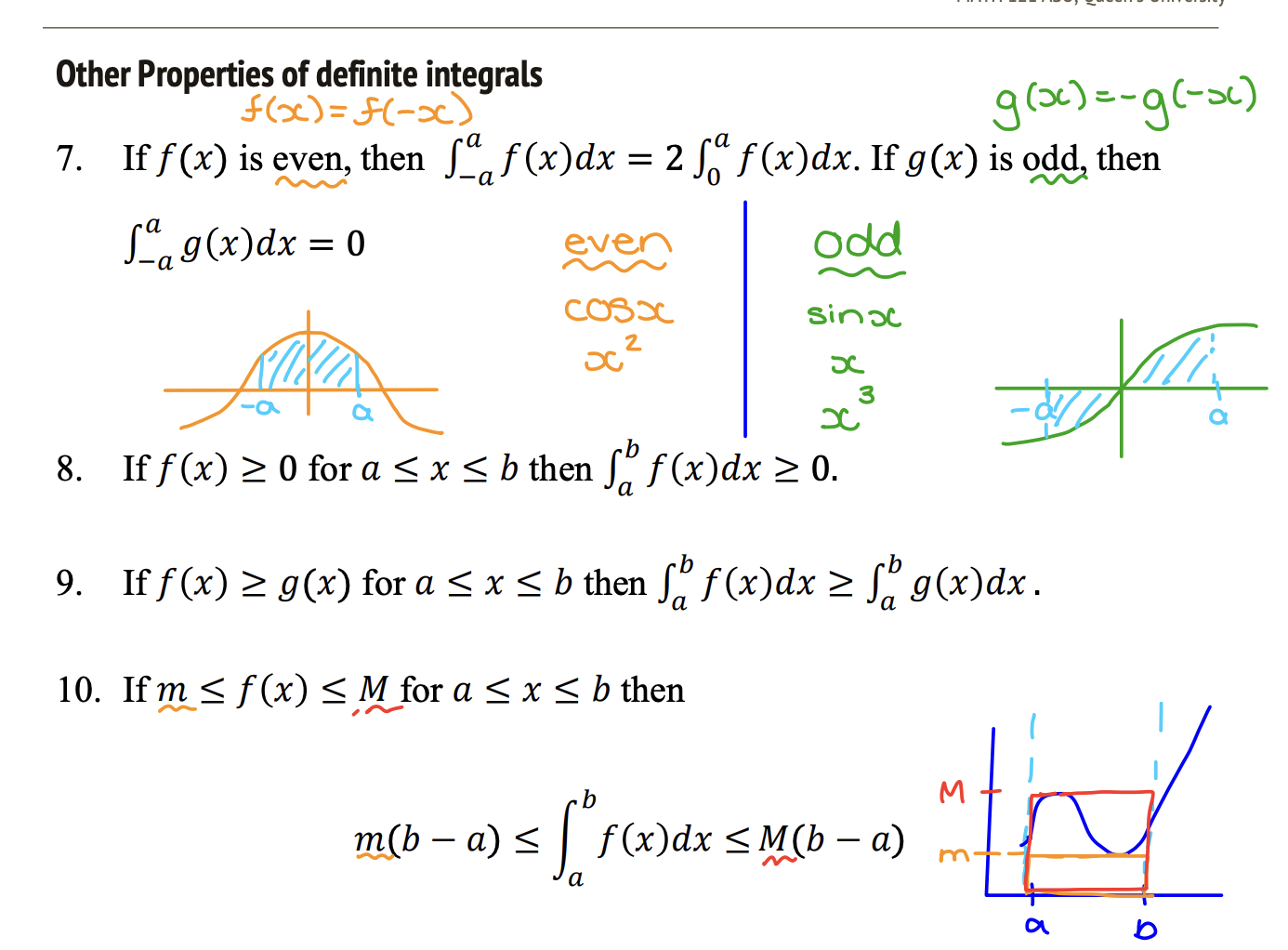
Okay. Lots more properties of definite integrals. Okay? And so while the last ones kind of relied more on constants and certain things that we've seen from derivatives, these ones rely on properties of the functions themselves.
Okay? So if you haven't seen it before, we talk about even functions and odd functions.
And so an even function is characterized by if I take some input X and I evaluate the function there, if I go to the exact same distance in the negative direction, then it gives me the same output.
Okay? And so that would look something like Cos X is an example.
X squared is an example. And so if you look at. Would look something like maybe let's look at cos X just it looks something like this.
And so you can see if I went to any X value. So let's say I took X over here. And then if I go to the same negative X, you can see that.
I mean, my bad sketch. But you can see that they would have the same Y values on either side.
So basically it means that they're symmetric over the Y axis.
That's kind of one way you can think about it. What that says in terms of the integral which we see described right here is if I take the area between negative A and A, it's just two of the same areas.
So it's two of those areas between A and 0 are equivalently negative A and 0.
Okay? For an odd function. An odd function is. It's almost the opposite of that, I guess, is one way of thinking about it.
But an odd function is given to you by the fact that if you take an X value and then you go to the negative X value in the opposite direction, it'll be the negative of that previous Y value.
Okay? And so basically what that means is that you've got some symmetry almost over the origin in a sense.
And so this is some examples or sine X. Just the line X cubed is one of those examples. And so what that means in terms of the integral, so this looks like an odd function because if I go over here to X and if I go over here to negative X, I go as far away above the X axis in the positive direction as I go below in the negative direction could be the opposite.
But again, I'm just giving an example and what that says in terms of the integral is something actually really, really nice and really, really useful is if I take the integral between negative A and A.
If you think about that areas wise, those are the same areas.
So similar to in the case of the even function, they're the same area, but one of them you have to take as a negative, right, because it's below the x axis.
So one of them is always a negative, one of them is always a positive because they have the same quantity, they cancel out.
Okay, the next few of these properties are fairly intuitive, except for, I mean, the last one is fairly intuitive as well.
But the eighth property just means that if you've got a function, it lies always above the x axis.
When I say signed areas, you know, that means you're taking positive areas.
So your integral is going to be positive if you have a function that's always bigger than another one, that means that the area under the above function is clearly going to be bigger than the area above or the area below.
Function, I guess, is what I would say. This last property here is actually pretty interesting.
It says that you can get a very, very, very, very, very crude estimate of a lower bound and an upper bound on your integral.
And that comes from the fact that on closed intervals you have a maximum and you have a minimum of all your functions as long as they are continuous.
Okay? And so when we think about this graphically, what that means is let's say I've got this function here and I want to look at the interval.
Let's say A is here, and let's say B is here. So I want the area under that curve, right? But I know that because this is a closed interval, I've got some minimum F of my function.
And maybe I've drawn this very. But it does look like this is going to be the lowest point of my function.
So this here is going to be little M. My function is always above little M on this interval.
And so to get a lower estimate of my area underneath my curve, I use M times B minus A, the area of that rectangle for an overestimate.
Well, I know again that I've probably not probably.
I've definitely got a global max because this is a continuous function and it's on a closed interval.
And so, for example, for us, that's our maximum. I would take the area of this box and that would give me an overestimate of my area here.
Any questions about these properties? Again, these are always here for reference. You can always Come back to them.
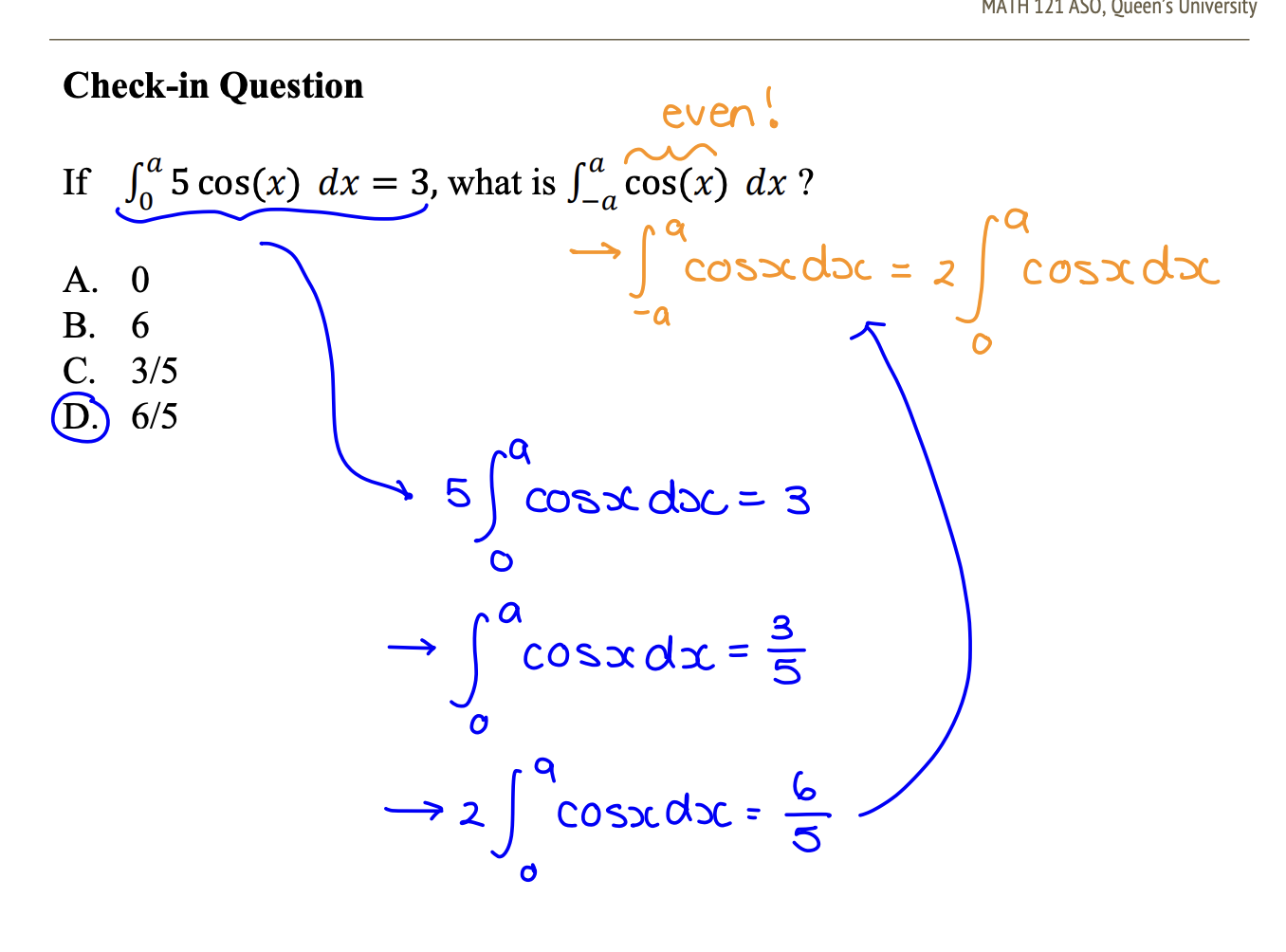
Now, this question I'm not going to go through completely because it's a little bit just algebraic manipulation after a bit.
But what I want you to notice is we've got an even function here.
You've got an even function which is cos, and you've got bounds that are going from negative to positive of the same value.
And so what that tells you negative A to A of cos x dx, you know that that's equal to two times the integral from zero to A of your even function.
And that's because it's an even function. Using that and this piece of information, you can solve for that negative A to a cos x dx.
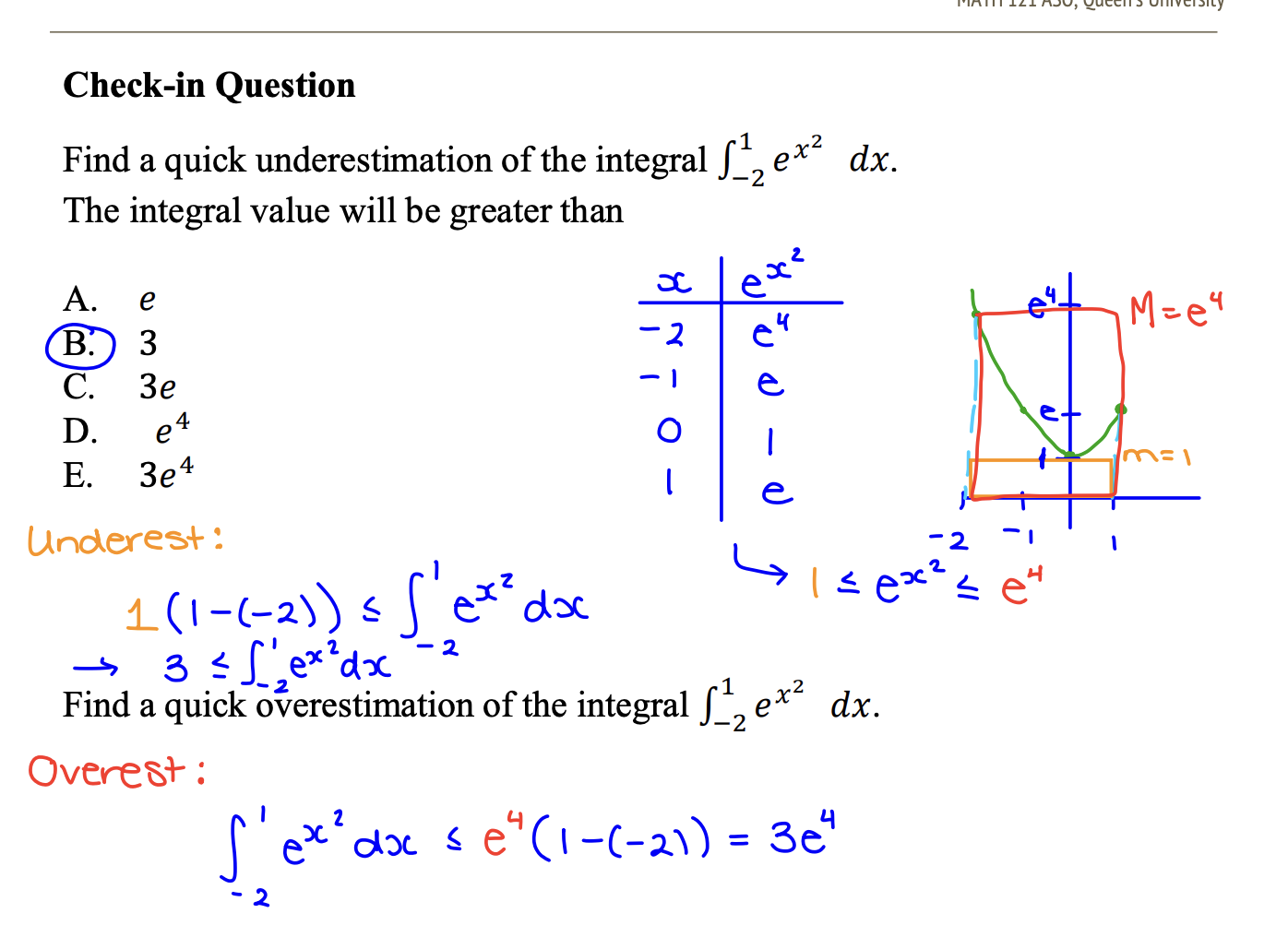
Okay, this question is going to be using those minimum and maximum areas.
So what you're going to want to do here is you're going to want to potentially.
So you want to find a quick underestimation, a quick overestimation.
And so basically what you're going to want to do is I just took a table of values and so I said, because it's on the interval negative 2 to 1, I just went in increments of 1 just to see what was happening.
So negative 2, negative 1 0, 1. At each of those values, I figured out what my output would be.
And so you get something that kind of looks like the following.
So you got negative two, negative one. One you've got here is E to the four. We'll put E here and we'll put one here. And so you kind of get something that looks like a parabola a little bit.
And you are looking at negative 2 to 1. So we're only looking here. So you want the area under that curve to get the underestimate, you're going to use Rule 10.
And so you're going to use the area of the box with height minimum of your function on that interval.
To get the maximum or the overestimate, you're going to use the box with height the maximum on that interval.
Okay. Does that make sense how we would get a quick underestimate and overestimate?
Okay. And the reason that this is why we are like, the reason we are using these to be our underestimates and our overestimates is that keyword quick.
I know that I could use left or right or whatever those are.
I can use Riemann sums to estimate this area. That's not very quick. These are much, much quicker. Okay. They're worse, but they're quicker. Okay. Any questions about that? I know I'm going through these a little bit quick, but they are checking questions, so they should be manageable on your own time.
The next question is something that I want to talk about.
Okay. And I want to try and give some intuition. I want to try and talk through it. If you do have questions, please just, please stop me.
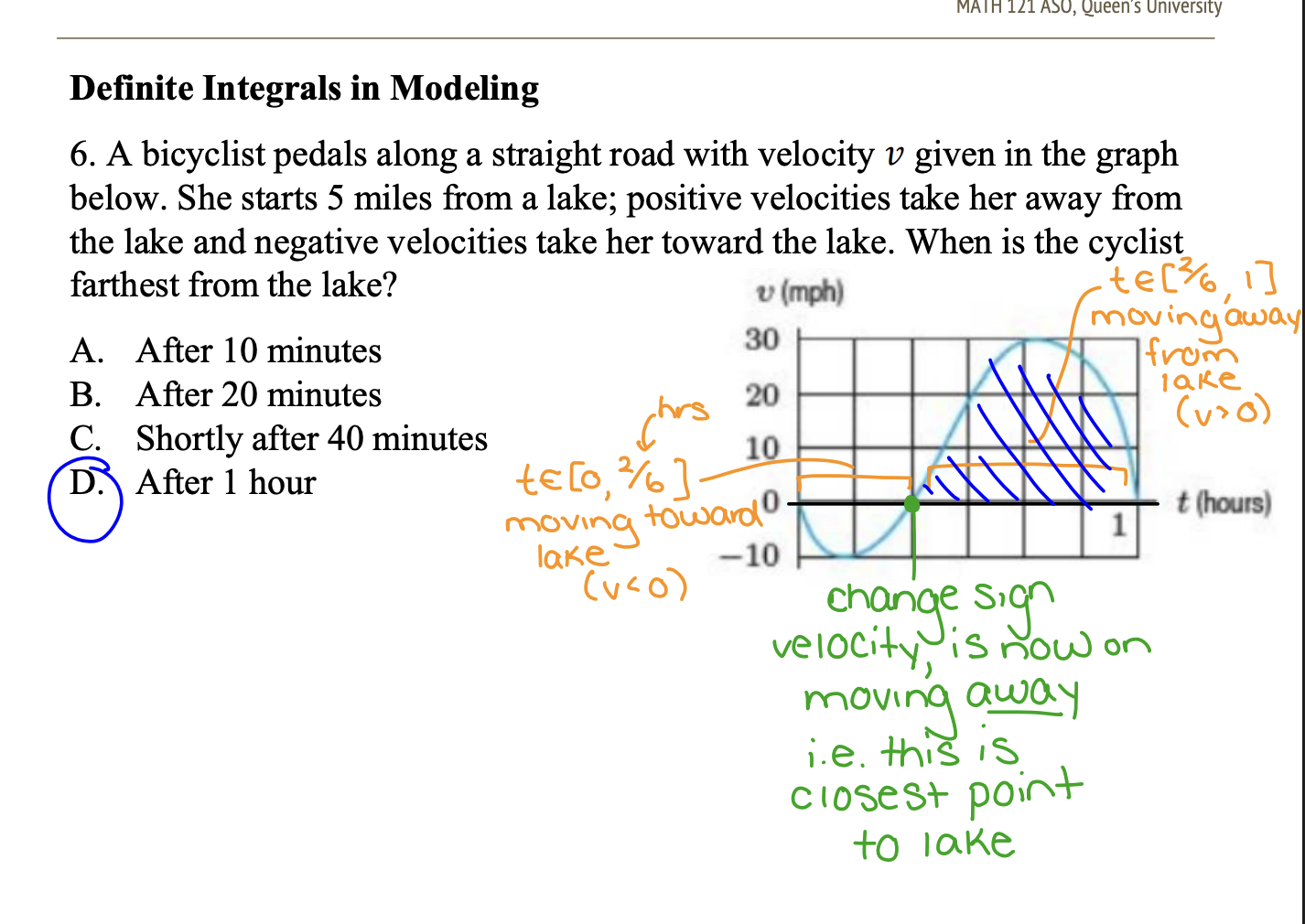
Ask. Okay, so we've got this cyclist. They're pedaling along a straight road. They've got velocity. V it's given in this graph. So we know when we're talking about intervals, we're usually talking about rates of change graphs.
And so that's perfect. We're talking about, in miles per hour, how fast this person is biking on the step.
They start at five miles away from the lake. Positive velocities take them farther away and negative velocities take them towards the lake.
Okay. When is this cyclist farthest from the lake? Okay. It doesn't ask you to compute any specific quantities, but we do still have to kind of think about what we can gain from this graph, what we can gain from the information that we've been given.
Okay. What I want to draw your attention to is just a simple interpretation of what's going on in this graph.
So in this graph, let me maybe emphasize this line here.
And I found it a little bit hard to see, and maybe that's even still hard to see.
But I want you to notice where the velocities are negative and where they're positive.
And so in particular, on this interval here, I'm going to call it t in 0 to 2 6, because I want my units to be in hours.
V is less than zero. It's negative. Occasionally it's zero, but we're not. That needs to be. Just not in the middle. And we were told that negative velocities take her toward the lake.
So that means that in time 0 to 2 or 6 hours or in those first couple minutes or whatever, however you want to think about it, she's moving toward the lake.
So she's starting five miles away. And in that interval of time, she's moving towards the lake.
And this is how far she moves towards the lake. The area under that curve or between that curve and the x axis is the distance she's traveled towards the lake because our negative velocity gave us that we were going towards the lake.
Okay, cool. Now, if I look on the right hand side, or actually maybe let me draw your attention to this point here.
Now, this point is where we've got a change of sign in our velocity.
So changing sign of velocity and that means that now they're moving away.
Now on, maybe I should say away from the lake. And so if you think about what this means, let's say that that's my lake.
Okay, let's say that that table is my lake. From time zero to two over six, I'm moving towards it.
At that green point. Maybe I'm here, maybe I'm all the way up. I don't know, I'm turning around. So this point here, from now on, I'm moving away. That point represents the closest I want to pull.
Okay, so that place where I turned around was the closest point to the lake.
That's not what we were asked for, but it's still a good observation to make.
Okay, and now if you look at the right hand side here, because our velocities are positive, we say on the interval T is from 2 over 6 to 1, again, we're thinking about hours.
We are moving away from the lake, from the loop. Okay, that's great. Now we have an interpretation of what this graph is.
Now I can say that the area under that positive curve is how far?
Okay, so I walked towards it. I'm at my closest point. And now I think about how far I'm moving in this direction.
I can gain that from the area under that curve. It won't tell me the distance away from the lake that I am.
It'll tell me the distance away from this exact point, the closest point.
Okay, and now let's think about what's farther five miles from the lake or the distance I get to at the very end of my journey.
How on earth would I figure that out? Yeah, wouldn't it be the distance you got the very end.
At the very end. Why? Because the area is greater. Perfect. So exactly. You might have this question come up. Well, how do I know that they did without computing anything?
How do I know that they didn't just walk back? I don't know. And they were ended up being four miles away from the.
You don't need to compute anything to get back to the point at which they started.
You only need to cover the same amount of area. Right. Because the area would then cancel out. That would mean that your net change was. I started five miles away. I walked here. I walked here. If that integral was zero, that meant my net change is zero.
It started and ended at the same point. But because that area is so much bigger. So if we look at this, that area is so much bigger than that area that we started at.
So we started at five. I walked a little bit towards the lake. I turned around and I walked pretty far away. I covered that. I passed five miles. And so your answer is that after one hour, you are as far away as you can ever be.
Okay. Does that make sense? Does anybody still. A little bit. If you have questions you might have wanted to ask.
Okay. Okay. The next thing that we're going to do, we're going to start this on Friday, and hopefully we'll be able to do it quickly to motivate our fundamental theorem of calculus.
But we're actually going to compute how far this person got away from the leg.
So you're going to compute the net change. I want you to remember this word, net change from the beginning to the end.
Okay. Perfect.
Speaker 3
So Wednesday we left off on this problem and kind of talked about it, and we didn't do a whole lot of calculation yet, but we kind of just started with an interpretation of what was going on.
So if you remember, there was a cyclist, they're settling on a straight road.
Their velocity is given in this graph. They start at five miles from a lake, and we want to know their position relative to this leg.
And we know that positive velocities take them away from the lake, Negative velocities take them towards the lake.
Okay, we already discussed the first part of this question.
So the first part of this question asks, like, when the cyclist is farthest from the lake.
We already talked about this. We talked about how it's not that starting point of five miles away because they don't force it.
And then the area under the curve of the positive velocities, which you know is taking them away from the lake is a lot bigger than how far they moved from that five miles.
So they passed those five miles and they got as far away as they could after an hour.
Okay, now the second part of this question is asking us how far away they are.
And so this is where it's going to take a little bit more of some thinking of what the areas represent.
How do I figure out what that distance is? I need to now introduce another function because I didn't have any really, like, functions.
I didn't have any numbers or anything really playing with yet.
But we're going to introduce a P of T, and that will be the distance in miles from the lake at T hours.
And so exactly what we're asking for is to find P of one.
Another thing you might start with, if you don't really know exactly where to go, you just gather some information that you have.
Okay? And so the first piece of information that I'm going to pull out of this problem is that the starting point is five miles from the lake.
And so since that P of T represents the distance from the lake, I know that p of 0.
So no time has passed, which means this is my starting point.
The cyclist is five miles away. The other thing I know is velocity is miles per hour.
So it's the rate of change of the position of the cyclist.
And so what that's saying, what that's translating to in our symbols or in our location is that the function V of T, which I can see on my graph there is the change of position with respect to the change in time.
So I have my velocity graph is the derivative of my Position.
Okay. And now some other tools I might try to look at. I'm going to try and incorporate this P of 1. Well, I need to figure out something that involves P of 1.
I need some expression, some information that involves p of 1.
I've also got p of 0, which is pretty interesting.
And what I can infer from these things is something about a net position.
So the net position, if P at a time represents how far this person is away from the lake, then if you take a later time and you subtract the initial time or you subtract the position from the later time in the initial time, you get a net change in position.
So I didn't write that correctly, but the net change in position is exactly what you think it would be between 0 and 1.
Well, one version of that would be p of 1 minus p of 0.
That would be my net change in my position between an hour and where I started.
Right. This makes sense. That's kind of what we would guess. But we've also discussed net change in position being the definite integral on our time or on our whatever interval we're talking about, whether it's time, whether it's something else.
So we've also discussed that the net change in position for 0 times 0 to time 1 in this scenario would be the integral from 0 to 1 of the velocity.
So the rate of change. We talked about this. If that's not looking familiar, go back in the videos, go back in the notes.
We definitely discuss this. Okay, so we've got two notions of a net change in position, and one of them involves the quantity that we're trying to figure out.
That's really awesome. So the first thing that I'm going to do is I'm just going to write how these are related.
Well, if the net change in position is P1 minus P0, but it's also this integral, then I can set them equal to each other.
That means that these two things are equal. They both represent the same thing. They're equal. And so this is actually going to be a really important expression here.
So I'll just circle it or I'll make a note of it. Okay, now it's still not clear to me. I can still solve for P of 1, but I still have some things to figure out.
So the first thing that I should probably figure out is, is, well, I've got P of zero.
So that's awesome. I've already got this quantity. But if I want to figure out What P of 1 is, I still need one more piece of information.
I still need that integral portion. The nice thing about that is that I know how to find that because that's what we've been working on this entire time.
If I let this area here between the curve and the x axis be A, and if I let this area here ab, then I know that this interval is the signed area of those.
So the, the signed sum, I guess I could say of those areas.
And so the ones that are above the x axis, I take them to be positive.
So I take the area B, it's positive, and then I need to subtract the area A because it's below the edge.
Okay. Again, these kind of shapes that we've been given, we don't have the tool of an antiderivative yet.
We got in there. We don't have that tool yet. And so the shape of these areas is a little bit obscure right now.
So if you look at these, they're kind of, they're not rectangles, they're not triangles, they're not trapezoids.
I don't have like a good formula for these. So I'm really just going to give an estimation here.
I'm going to do my best estimation of these areas.
And I'm going to do that by figuring out what the area of just one single box is.
Because I can kind of approximate these areas to be a certain number of boxes.
It's not going to be exactly correct, but if I look at what one box represents, well, I can see that Its height is 10 miles per hour.
So the area will be 10 miles per hour multiplied by the width, which is.
Okay, I have to be careful here. I want to keep it in hours. And so what I'm going to do is I'm going to notice that there's six boxes in the one hour interval.
And so this is going to cover 16 of an hour. And then you would get. I'm not going to reduce for now. I'm just going to leave them as is. One box represents a distance of 10 over six miles.
And so if we kind of look at these shapes, I'm going to give you rough estimates.
You can maybe have different ones, so you might get a different answer.
But roughly A looks like it's one square. So I know that the area a will be 10 over 6 miles. And if I, I don't know, there's a couple different ways you could go about looking at B and how many boxes are in B.
It roughly turns out to be a little bit under eight boxes.
You might get seven. I don't know. It's a rough approximation, right? So you get that this is 80 over six miles. And so that what that says about the interpretation of our problem is you start 5 miles away, you bike 10 over 6 miles towards the lake, and then you bike 80 over 6 miles away from the lake.
That doesn't mean your total distance away from the lake is 80 over 6 miles.
It means that once you made it to that stopping point where you turned around, then you went 80 over six miles.
So overall, I have that. That B minus a Quantity will be 70 over 6. And this is actually really good news because now in my equation, I only have one unknown, and it's exactly the unknown that I want.
So I can finally solve that. And I can say that P of 1 is equal to the integral of 0 to 1 of V of T plus P of 0.
And so that'll be equal to 70 over 6 plus 5, which will work out to be roughly 16.7 miles.
So the distance away from the lake is 16.7 miles. And like I said, that equation that I put a box around is going to be really important.
Okay. Might look familiar if you're remembering the videos.
But before I switch to the next problem, are there any questions about this?
Okay, perfect. So this is a bit of motivation for the fundamental theorem of calculus.
We're gonna do one more little discussion here about something that applies to the fundamental theorem practice, and then we're gonna state it.
And so this scenario that we've got here now is we've got a volume of water in a tank that's represented by V of T. I know we were just talking about velocities, and maybe it's a little bit.
I know it's Friday. Going between different V's might be confusing.
Just stay with me. This one is a volume of water in a tank at time T. Now, we're supposing we start initially with 10 gallons.
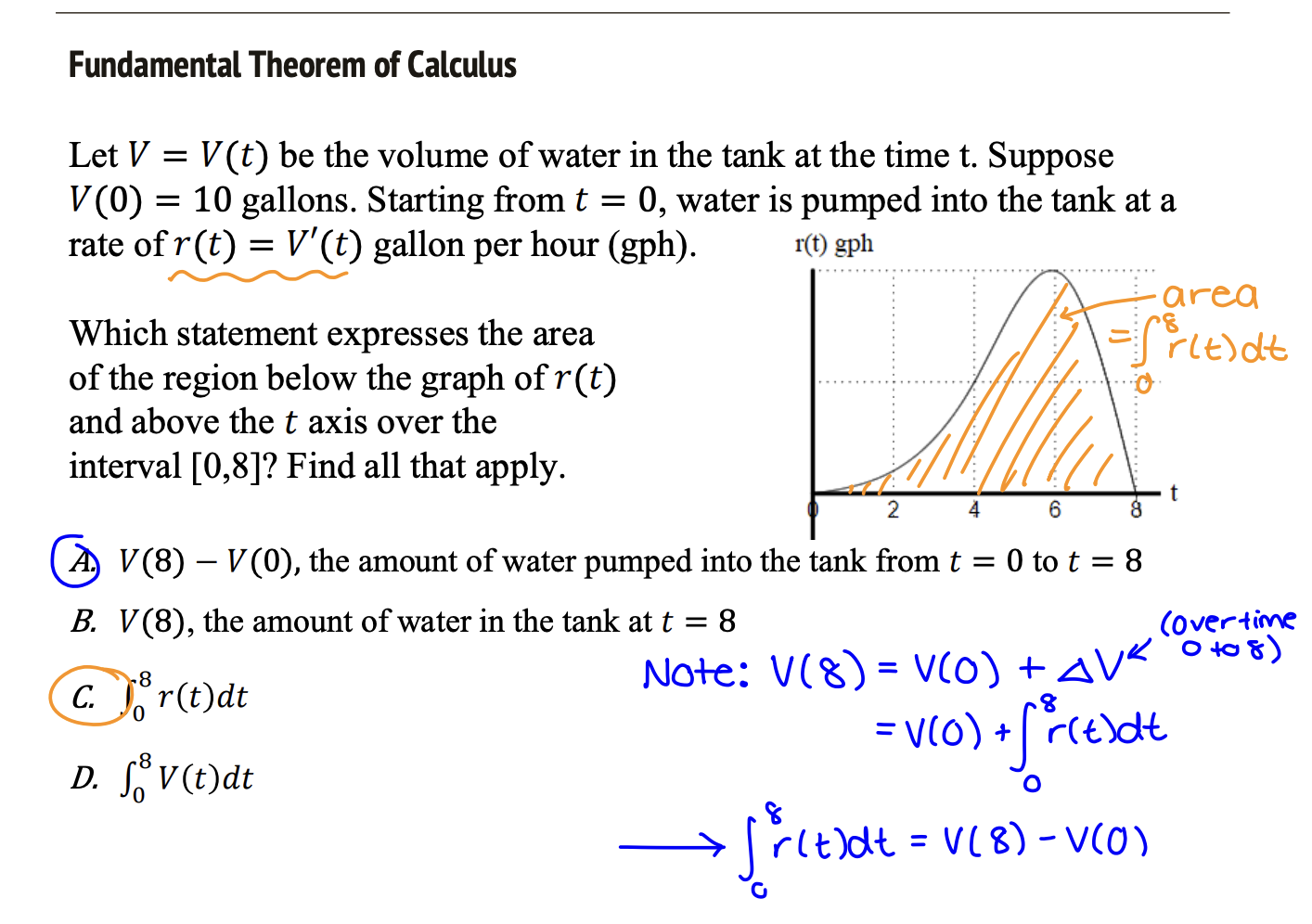
That's what it means for V of zero to be 10. And if we start from time zero, we pump water into the tank of a rate at a rate of R of T, which is also the derivative or the rate of change of our volume.
Right? So that graph is showing. We're analyzing graphs and rates of change now. And so now I want to discuss what statement expresses the area of a region below the graph and above the t axis over an interval 0 to 8.
So we've got a graph here. We've got the interval 0 to 8. I want to know what my interpretation of this area should be in terms of this problem.
There might be multiple. Okay, the first one that we might go to is the one that we've been talking about a lot, which is that it's the definite integral from 0 to 8 of R of T DT, right?
So we would automatically get this C as our answer.
Notice it is not the integral of the volume. We're not integrating the volume function. We're integrating a rate of change function. So just be careful of those things, okay? Okay. There is one other possibility here, I'll tell you that.
And it's motivated. It comes out of the fundamental theorem, Kava. So maybe it motivates fundamental theorem of calculus, whatever way you want to think about it.
But the way that you can think about the volume of water in the tank at time 8.
This is how I kind of like to get this out. Rather than thinking of both of them as net changes, I kind of like to think about.
Okay, if I want to figure out what the volume at my end time is, I have to start with my initial volume.
And then I know that the volume is changing because I have some non zero rate of change function.
And so I need to add whatever the change in volume is.
And that's going to be. Just note that this is from 0 to 8. Okay, maybe this is bad notation. I'm just giving intuition. This isn't like a formal equation or anything. I know we use that delta for other things. I'm just trying to get at. You start from the initial volume and you add the change of volume over your interval you're looking for.
And so what this would give us is that I know that that change is represented by the integral from 0 to 8 of my rate with respect to time, right?
And so then if I solve for that integral, because I know that that is already an interpretation of the area under my curve that's equal to V8 minus V0.
So it's equal to that net change of the volume, which I already kind of knew.
I already knew that from intuition. This is another way that you can kind of think about it.
Okay? And so we also get that A as an answer. It's also important to realize that B is not an answer.
It is not the correct answer. It does not apply in this scenario. It might apply in some scenarios, for instance, when your initial volume is zero.
So then we get to the fundamental theorem of calculus, which is basically exactly what I just wrote down.
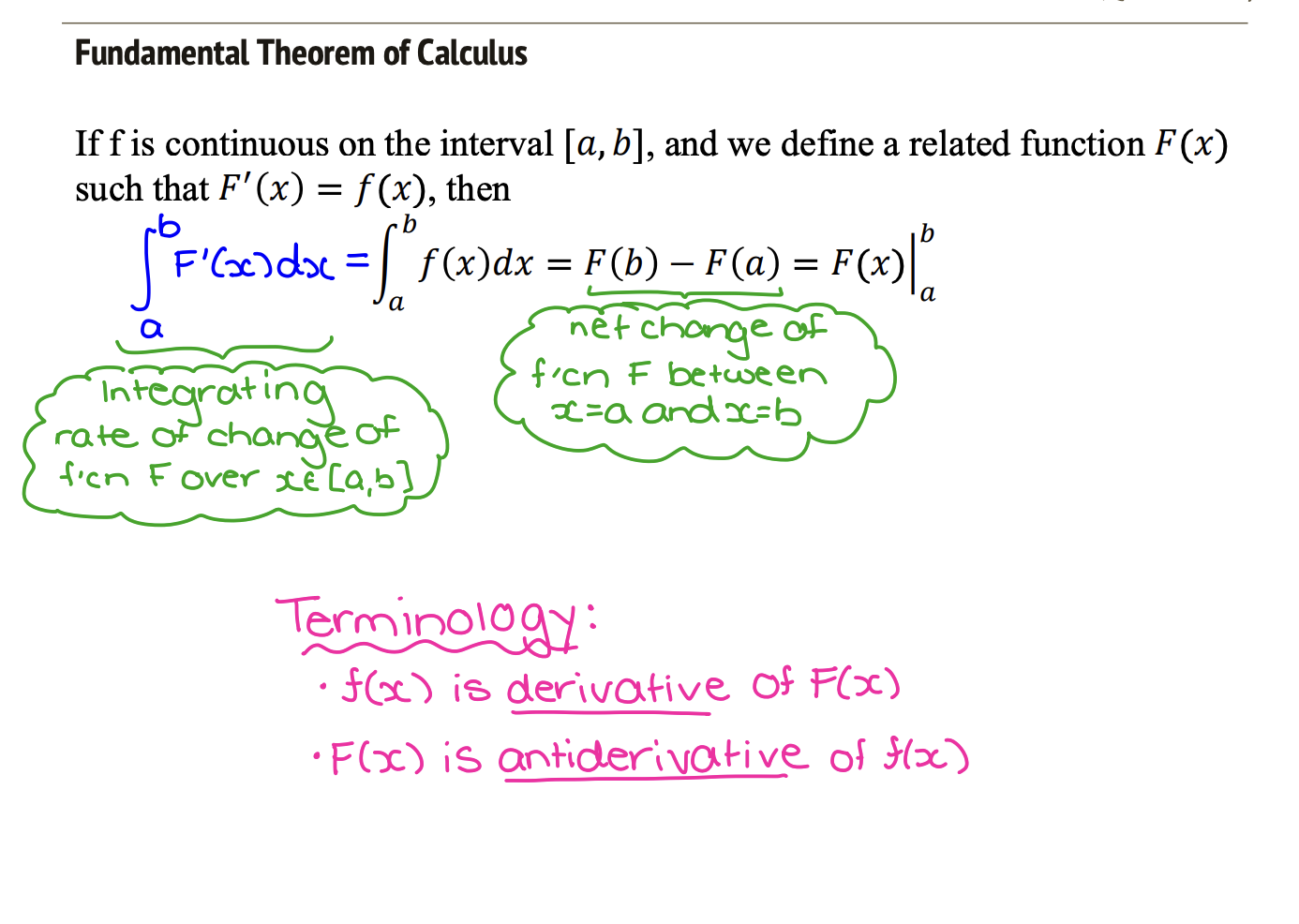
I just wrote down that if you've got a continuous function on an interval, that word continuous is very important as well.
So don't forget about it. If you have a continuous function on an interval from A to B and we define a related function big F of X.
So it's a lot of the time we take big F of X. Again, don't get stuck on notation. I want you to get focused on the concept of it. That property here, such that its derivative is your function that you're integrating.
That's the important piece, not that it's a big F and a little F. The important piece is that one of your functions, its derivative is the one that you are taking the integral of.
If you have that, then the definite integral of F of X DX is equal to big F of B minus big F of A.
So it's equal to the net change of your big F function.
And then this right hand side piece is just a little extra notation.
It's a shorthand so that we don't have to write the F of B minus F of A all the time.
Okay. And so what we could also write here is rather than having little S, big F, all those things, if you just have that big F function, this translates exactly to integrating my rate of change.
Right? Okay. And so, yeah, so the left hand side, we interpret that as integrating a rate of change function over an interval.
And the right hand side, we kind of talk about it as a net change.
I mean, the same thing, but notationally we kind of read them a little bit, a little bit of terminology while we said so we already know that F of X.
If I've got that property that I've underlined above, F of X is the derivative of big F of X.
So we've already seen that. We already know what that means. Okay, again, the letters are not relevant here. It's specifically that property that is giving me these words.
But I can talk about the function big F of x and you can kind of imagine it as going backwards from the derivative.
So if I take a function and take its derivative and then I want to go backwards to get the original function I started with.
This is called an antiderivative. So if you have a function little F and you have some other function whose derivative is little F, that function is called the antiderivative.
So now we have names for both of these notions. All right, any questions about the fundamental theorem?
Amazing. We're almost getting to those antiderivatives that you might be really excited about.
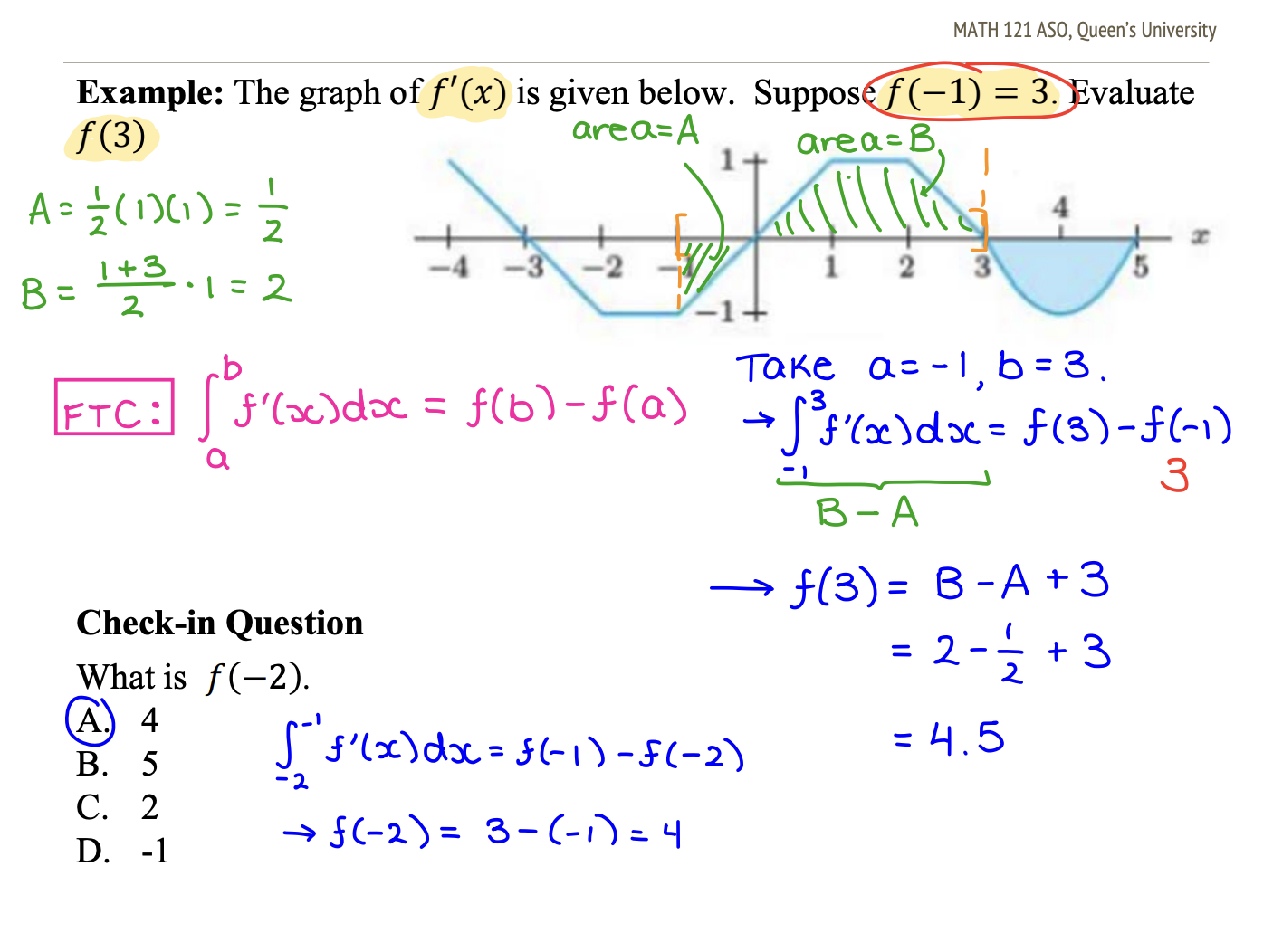
Okay, so we're going to use the fundamental theorem of calculus here.
This graph might look familiar. We Talked about it before. We've got a rate of change graph. This is F prime. Yeah. Question. The antiderivative is the basically opposite of the derivative.
You have a function and you want to know what other function, if you take that thing's derivative, will give you your original thing.
That's called an antiderivative. It's going backwards. So if I have this function F of X and I'm asking what possible functions have F of X as their derivative?
They're called antiderivatives. It's going backwards. So rather than taking the derivative, you're going backwards to the antiderivative.
Okay. Yeah. The thing that you started wanting. Yeah. Okay. Yeah. And we're going to get there. It's a really good point. When you're taking antiderivatives, the easiest way to check if you've done it right is to take the derivative and see if you got back.
But then you start with it. Right? Yeah. So is the antiderivative kind of like the same thing as the integral almost?
Well, it is in a sense, but that's where the distinction between a definite integral and an indefinite integral comes in.
Because a definite integral, we've been getting numbers out, but an antiderivative is a function, and so an antiderivative isn't the same thing as a definite integral.
It's the same thing as an indefinite integral. So I'm going to get there. But basically what the question comes down to is when we have these tools of taking antiderivatives, that's what we find before we can do the definite integral rather than computing errors.
Does that make sense? Did I answer the question? Yeah. Okay, good questions. Anything else? Okay, yeah. So that's why this integral thing is kind of. I mean, you try to get some intuition beforehand so that you don't just, you know, strategically go back and forth.
But this is the idea. We figured out how to take derivatives. Now we're going to try and figure out how do we undo them.
That's kind of the idea. Okay. Again, this is a rate of change graph. Okay. But now I'm given a bit of a different piece of information than I've maybe been given before.
I've been given that the value of my function at negative one is equal to three.
So, I mean, I don't know what to do with that yet, but maybe it'll be important.
So these couple pieces of information I've been given that I have a rate of change graph.
I've been given that the function itself so not the rate of change function value at negative one.
The function value at negative one is three. And I want to figure out what F of three is. And now for me, maybe, or maybe the first thing you would think of, I don't know, you might be super stumped on what to do here, but you kind of have to look at what the pieces of information you've been given are and what you know that involves those pieces of information.
And so what I mean is, and this is really convenient because we've just talked about it, but maybe if you hadn't just talked about the fundamental theorem of calculus, that this might not be the first thing to think of.
But for me, the first thing I think of here is, okay, well, I've got the fundamental theorem of calculus.
Okay? I know that it tells me that this definite integral from A to B of a rate of change function.
So because I have a rate of change function, I'm going to write it in my integral.
I know that that is equal to just the original function minus F of A.
So I know that it's equal to the antiderivative evaluated at B minus the antiderivative derivative evaluated at A.
And now this is kind of nice because if I look back at the problem, I've got three pieces of information in the problem, and I've also got three pieces of information in this equality.
It's similar to what I did a couple problems ago where I was looking for P of 1.
Well, here I'm looking for F of 3, right? I'm looking for this F of 3 that I have been asked for.
I've got these, I don't know, F of some things. I haven't told you what they are yet, necessarily.
And I've also been given an F prime. And so I've got three pieces of information in my problem, three pieces of information in this equation.
So let's see if I can make this equation make a little bit more sense.
So for me, when I take intervals, when I'm integrating, if I have control over it, I always take A to be the one on the left, B to be the one on the right.
Basically means you're taking an interval that makes sense.
You're saying, go from a smaller number to a bigger number.
So for me here, I'm going to take A to be negative one, and I'm going to take B to be three.
And that fully has to do with the fact that on the right hand side of that fundamental theorem of calculus equation, I've got a B and an A evaluated at F or F evaluated at B and A.
And those are the two pieces of information in my problem.
I've got F of negative 1 and F of 3 in my problem, okay?
So I'm gonna be concerned with this interval here, okay?
And if I do that, then what the fundamental theorem of calculus tells me is that the integral from negative 1 to 33 of F prime of X, I don't have a function for F prime of X. I have its graph, which is really nice.
I know. I work with those. And that's going to be equal to F of 3 minus F of negative 1.
And now we're getting somewhere, because this F of 3 is what I want.
I know F of negative 1 is 3, and I know how to compute this because that's what we've been doing all week and even a little bit last week.
We've been talking about how this definite integral is the area of the sine area between the x axis and my curve.
So if I let this area ba this area bb, what is my integral in terms of big A and big B?
What is the value of negative 1 to 3 just of f prime of x dx just in terms of A and B?
You don't have to evaluate it yet. I've done this like four times now. Yeah, B minus a perfect. B minus A negative. Okay? And if you compute that, so now I've got a bunch of pieces of information.
I can take those areas. Those are shapes that I know. And if I do that, I get that the area a will be 1/2. I'll get that the area of B will be 2. You can check that if you want. And so now that's great. I've only got one unknown in my equation like I did before.
And so I can solve for F of three, it'll be equal to B minus A plus F of negative one.
And so I get that. That'll be 4.5. And now I'm going to leave this other checking question.
As an exercise, you should be able to use the exact same structure as I used above to figure that one out.
So, yeah, now we get to this conversation about. Okay, is the integral just the answer? Well, if you're talking about an indefinite integral, yes, that's exactly what it is, because the definite integral.
So when I say I want to take an integral from A to B, remember we talked about that?
This sine area. And so it's going to give me a number. But if I'm talking about antiderivatives those are functions, they're not just numbers.
And so I need a bit of different terminology to differentiate between what an indefinite integral is and what a definite integral is.
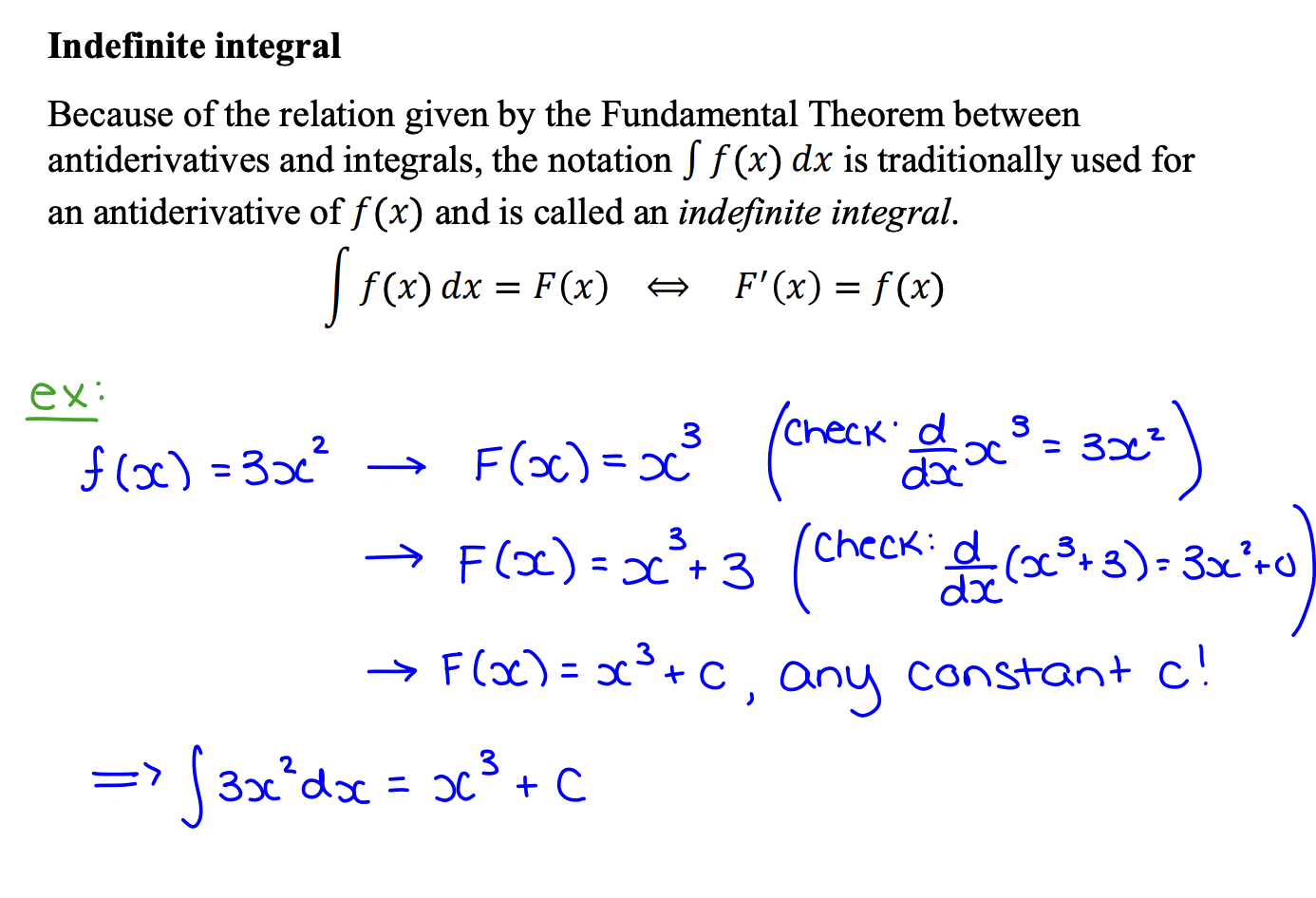
So if you ever see this symbol of your integral sign and it doesn't have any bounds, that means it's an indefinite integral.
And that means you are effectively taking the antiderivative of the function that you're integrating.
That's what we want. Okay, and now something interesting about these, maybe.
Let's look at an example to see this in practice. So let's say that my function I'm integrating is F of x, which is 3x squared.
So that means that what I'm looking at is the indefinite integral of 3x squared dx.
And so what I'm asking for is some function such that when I take its derivative, I get back 3x squared.
So the first one that comes to my mind is just X cubed.
Because if I take the power, I bring it down, I subtract by one in my power, I get exactly back.
So if I take D by dx of x cubed, I get back 3x squared, which is F of x.
Okay, but what if I said F of x is equal to. Okay, well, I can't really multiply this X cubed by anything because that'll change the three out front.
So I really have to keep this X cubed because I can't.
I can't really change anything about that. I can't multiply by anything. I can't add anything in the power. I have to really keep it with this X cubed. But what if I added three? Let's say, okay, well, if I take the derivative of x cubed plus 3, that's just 3x squared plus 0.
So again, I get back F of x little F of X. So the important thing to notice here is when we are asking for the antiderivative or we are asking for the indefinite integral, it's not a unique thing.
You always need to say I'm going to add any constant possible.
So any constant C, I need to include that. When I'm being asked for an indefinite integral like this, I need to write that this is equal to X cubed plus C. If I leave up the C, it's wrong.
If you leave up the C, you will get marks taken off.
If you forget the constant when you're asked for an indefinite integral, it is wrong.
Okay? This is something to like really ingrain in your brain.
It's an understanding thing. It's not just a simple oops I forgot a letter. It is. You need to understand that X cubed is not the only possible function whose derivative is 3x squared.
There are infinitely many functions that will give you that.
Okay, does this make sense? Any questions? I'm not saying that to like is carry or anything. I'm saying it because it's like a really important concept to wrap your head around.
It's kind of tricky. Okay. And it might seem like just some silly thing that you have to remember, but it's really.
It's really a conceptual thing.
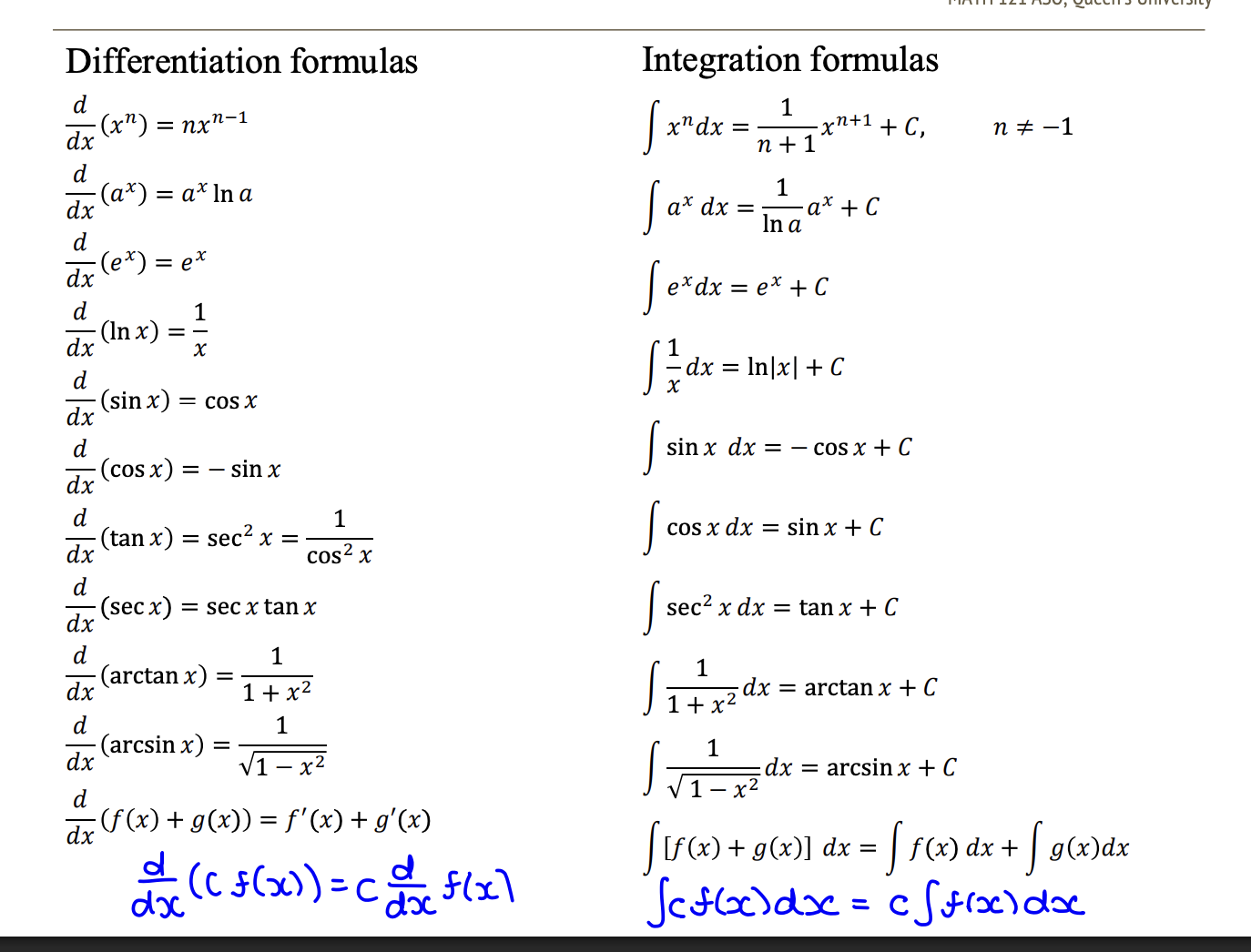
Okay. This. I'm not going to go through this. Really not. It's not worth it to just read this all in class right now.
The idea is that we established a bunch of derivatives that are common, that we see a lot that we know we've derived them.
You can do the exact same thing for integration. Notice that all of those indefinite integrals have that C on the right hand side.
That's why I say it's really important. It actually is super, super important. The ways that we've derived these are. I mean, they're basically from the fact that we know all those derivatives, the one that I would draw your attention to and definitely slow down the videos, pause them, whatever you need to do to understand why the antiderivative of one over X is not just one of X, it's one of the absolute value of X.
Okay, that's a really good one. It's very interesting. I think the last rule. So the last thing on this page is basically that you've got that sum rule.
So when we were taking definite integrals, remember if you had the sum of two functions, you could split that up into two different definite integrals.
And you did the same thing for indefinite integrals.
The last thing was this constant rule. Remember for derivatives, it worked like exactly how you think.
You just pulled the constant out and then you took the derivative and then it works the same thing for definite integrals.
We already saw that. And so it does work the same way for indefinite integrals as well.
So it works in that I can take that right out of the indefinite integral.
Okay, Any questions? We're going to start doing some antiderivatives.
I won't have a chance to get through all of them. Of course, I will always put up my notes. It will be there. But really, really well and truly, these things just take practice.
You just need to try. You just need to work through a bunch of them. Okay. Because you will see things come up that maybe I haven't done in class.
But you still can do it. There's still functions that I'm not going to get to because look at that.
Look. Look at that list. There's so many things there. I can't possibly go through an example that has every single thing in there in class.
Okay, so let's start by actually just revisiting something that we've already seen.
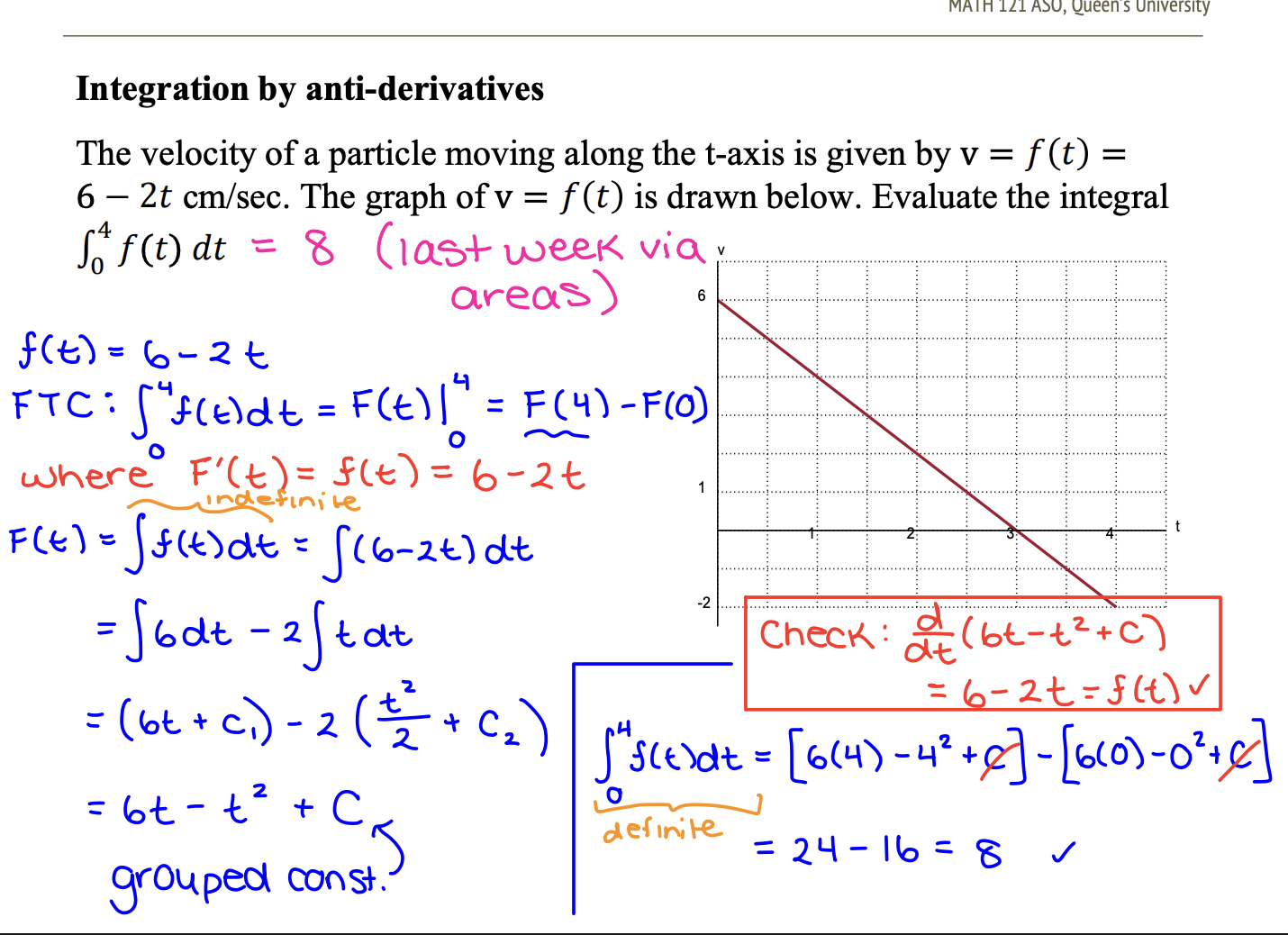
So we already saw this graph. We already computed that integral from 0 to 4 of this function.
So effectively, what we're doing here is we're just checking that What I'm telling you is fact.
We're checking that. If I tell you you can take the antiderivative and the fundamental theorem of calculus, it'll give you the same answer.
We're checking that. I am not telling you lies, okay? I promise that this will give you eight like we checked last week.
Okay? And so the way to do that is I'm going to write my little F function.
So F of T is equal to 6 minus 2t. That was given to me in the problem. Okay? And the fundamental theorem of calculus tells me something about this.
It tells me that the Definite integral from 0 to 4 of f of t dt is equal to f big f of t from 0 to 4, which I could also write as f of 4 minus f of 0.
But if I left it like that, it's actually not what the fundamental theorem of calculus is telling me.
I need to know what that big F means. What? What did. I just. I've just introduced some big F and I haven't told you anything about it.
Okay. I've just said that it has to equal big F of 4 minus big F of 0, but I don't know what that is yet.
Yeah. Is the big F the antiderivative? Exactly. So I just need to write a little thing that says that that's what I'm using this notation for.
Okay? Because if you did just write this. Wow. We probably would know what you mean. It's not technically correct. If I haven't told you what big F even is like. Now, I've just written some notation. I don't know what big F is. I need to say that F of T is such that f prime of t is equal to 6 minus 2t, which is that little F of T. So I.
This is actually what the fundamental theorem of calculus is telling me about this problem.
I need to specify what that big F is because again, I actually can't even solve this problem if I don't know what big F is supposed to be.
Okay? So if I do say what big F is, well, if it's something where if I take the derivative, I get back that little F, that means it's exactly this.
It is the antiderivative or the indefinite integral of F of T DT, which is just the indefinite integral of 6 minus 2 T DT.
Okay? And now I can use some integration rules or integration techniques.
And I'm going to separate this into two different pieces because I've got a sum of two things.
I've got the 6 minus negative or minus 2T, which is really a sum.
And so I can write this as the indefinite integral of 6dt minus 2 times the indefinite integral of TD.
Now I can take these antiderivatives separately.
So the antiderivative of a constant, I have to think of something that when I take its derivative, I get a constant.
And the one thing that should pop right into your head is the linear function, right?
Because if I remember my power rule, I bring down the power, I subtract by one, I just get a constant, okay?
When I take that derivative. But remember, if I'm talking about an antiderivative, I need a constant, okay?
Then the next one, I pull out that scalar out front, okay?
And then I take the antiderivative of T. And the way that you do this, it's a little bit of the opposite of the power rule, okay?
So you don't bring down the power subtract by one, you really do, effectively the opposite.
So you take your power and you add one, and then you have to divide by that power that you put on your new function.
So you're dividing by the original power plus one.
And so you can see how this is kind of the opposite of the power rule, where if I apply the power rule, I would get back what I want and remember, I need my constant.
But the interesting thing that's happening here is I could just rewrite this as 6t minus t squared plus c. And so when I take antiderivatives, usually what you would do is rather than writing a constant for every term in your function, just tack it on at the end.
Because if you think about that, those constants are going to be added together when you collect terms and notes.
So when you're taking antiderivatives, do all the things that involve your variable and then do not forget it.
Add your C at the end, okay? Okay. So all I did here was like group my constants, okay?
And now the check that you should do here, you should always do this to make sure that you are not proceeding with an incorrect antiderivative.
Make sure that if you take the derivative of your function, you get back what you want.
And so if I take D by DT of 6T minus T squared plus C, I get 6 minus 2T, which is exactly what I wanted.
I wanted that little F of T. Okay, does that make sense?
Is this. Okay, last step, because this is a definite integral, I am not done.
If I was just asked to compute the indefinite integral, I would be done.
But because this is a question positive, is that negative 2C?
Yeah. So the idea is those two constants aren't the same.
I wrote C1 and C2, so it's just another constant. You could write it in terms of C1 and C2. But all I mean, all I'm saying is there will be some constant added to the end.
Okay? So this wasn't asking me for an indefinite integral.
It was asking me for a definite integral. And so I need to now evaluate this antiderivative at both endpoints and take the appropriate difference.
And so what that means is I need to take 6 times 4 minus A squared plus C and I need to subtract my big F function at 0, which is 6 times 0 minus 0 squared plus C. And now you notice something very nice.
Your constants are going to cancel when you evaluate definite integrals.
So sometimes, sometimes you stop writing them. And I fear telling you to do that because then maybe you're going to forget to do it when we ask you for an antiderimitive.
So when in doubt, keep your constant there. It will never show up in your final answer for your definite integral.
It will always cancel. So a definite integral is always a number that C should always cancel.
If it doesn't, something is going on. So it's also a good check to keep the C in there to make sure that your process is going well.
Okay? And then if I evaluate this, I should get 24 minus 16, which is 8.
And so I've confirmed my original answer. So using the fundamental theorem of Kajas is another way of doing this problem.
Okay, any questions? As you can see in the next couple slides, there are a lot of practice questions that I'm not going to have the chance to get to.
I'm going to do my best to do a couple that are relevant or maybe a little bit more interesting.
But these are really good practice questions because of course I am going to put them in my notes so you will see my whole process.
Okay? Rather than just getting the final answer.
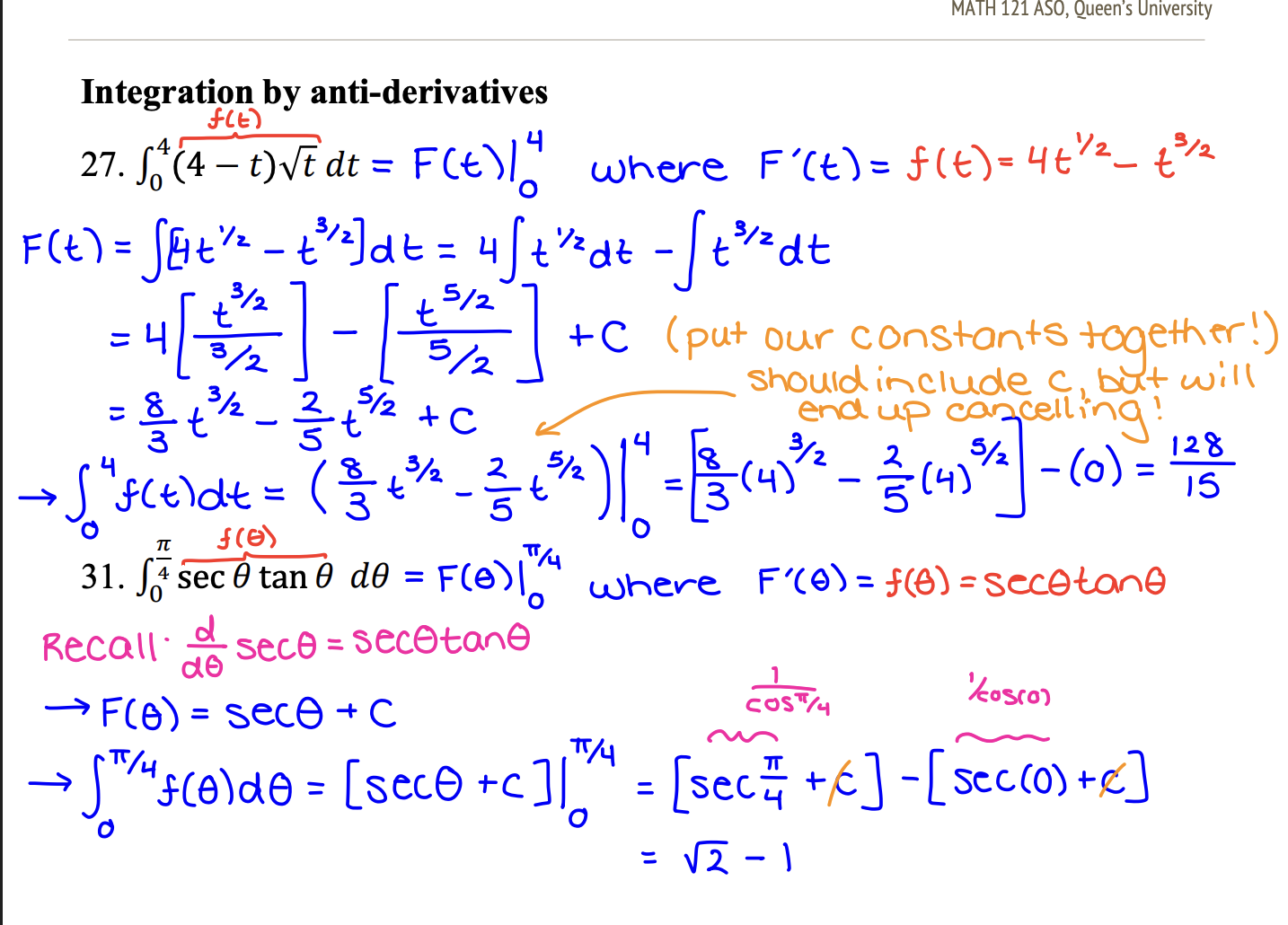
So the One thing that I will say about some of these problems is you look at them and like for this first question, those antiderivatives for those functions don't really show.
Show up in that table. They don't show up as is like that. So sometimes you're going to have to do some manipulation.
So in particular, what I like to do for these problems is I start by identifying my little F. And then I say what the fundamental theorem of calculus tells me about this integral, about this definite integral.
It tells me that that is equal to the net change of my big F from 0 to 4.
And remember, I need to include what that big F is.
Well, it's the function whose derivative is little F of T. And I'm not going to rewrite it as it is there.
I'm going to rewrite it in a way where I know how to take the antiderivatives.
So I'm going to distribute that square root of T in.
And I'm going to write my square roots as fractional powers.
So if I multiply four by the square root of T, that'll give me four times the square root of T. And I can write the square root of t as 1 over 2, the power of 1 over 2.
And so if I apply this same notion to multiplying T and the square root of T, I get T to the three halves.
Okay? And so now if I go through this whole process, I will get.
First, I want to take my antiderivative. So I want to take the indefinite integral of 4,4 T to the 1/2, minus T to the 3/2 DT.
And now I could split this up and I'll keep it in my notes the way that I've split it up.
But I could just evaluate this all at the same time in the same way that I don't usually think about when I take a derivative.
I don't usually think about the sum rule. I kind of just apply it. I'm not going to think about this as two separate indefinite integrals.
I'm just going to apply my sum rule almost implicitly.
So what I mean by that is I'm going to go term by term.
I'm just not going to write the separation of these.
So I'm going to Write this as 4. I'm taking the constant out like I know I can, and then I do the.
I don't know, I sometimes call it the reverse power rule.
You can think of it however you want. I'm going to take my power and add one. So I Get T to the three over two. And then I need to divide by that. Okay. And then I subtract, okay, I need to add 1 to this power, which gives me T to the 5 over 2.
And I need to divide by that power as well. Okay, Remember, let's see. Okay, and so if I wrote this out, I would get that this is equal to 8 over 3 times t to the 3 over 2 minus 2 over 5 times t to the 5 over 2.
And now all you need to do is say that the definite integral of 4 minus T square root of T DT.
Well, I already said that that was equal to big F of t evaluated at 4 minus big f of t evaluated at 0.
And I know that big f of t is 8 over 3t to the 3 over 2 minus 2 over 5t to the 5 over 2.
I need to evaluate that from therefore, and if I did that, if I plugged in all those numbers, I should get 128 over 15 seconds.
Okay, I'm not going to do the next problem. I know it looks a little bit daunting. Try to remember your trig derivatives. Very simple. If you remember your trig derivatives, these next two problems.
The second one is quite simple. The only thing we wanted to kind of draw your attention to here, I would say, is the difference between X to the E and E to the X.
These are two different functions. They have two different antiderivatives. For this problem here, if I identified this as my function, I told myself that this is equal to F of.
Okay, now I need to be careful about variables. Okay? Make sure you're using the right variables. So this is equal to some function, its difference between two and one, where if I take its derivative, it's going to be equal to.
And now I'm going to write this in a particular way that will make this a solvable problem, because there's not really a quotient rule for antiderivatives.
It would be really nice if there was. But this function looks like I don't know how to take the antiderivative of that.
But I'm going to write it as I'm going to split up the sum in the numerator, which I know I can.
I get that this is equal to V cubed over v to the four plus three v six over v to the four, which I can just rewrite as one over v plus three V squared.
So then my antiderivative becomes. So I take the antiderivative of 1 over v 3v squared dv if I go back to my table 1 over v has antiderivative long absolute value of v. The absolute value is quite important there.
And then I take three and I multiply it by the antiderivative of v squared, which will be v cubed over three, and then I add my constant.
So if I then do my definite integral, I promise this is the last thing I'll do.
I won't keep you any longer. If I do my definite integral of this function from 1 to 2, that means that I need to evaluate LN of the absolute value of V +V cubed, and maybe I'll write my +C as well there.
I need to evaluate that from 1 to 3. That'll be equal to if I do all the work. 7 +1