Lecture 7 - Instrumental or Operant Conditioning
Midterm Feedback
“Except for” MC questions instilled doubt, more time-consuming
Many MC questions involved similar answers, hard to differentiate
Too many written answer questions for the time constraint
Many choices of written answer prompts was really good
Maybe having a review session before the exam would be beneficial — we didn’t even get to finish the sixth chapter, yet we were examined on it
Lesson Outline
Instrumental Conditioning (IC) Background
Procedures
Influencing Factors
Consequences
Associations in Instrumental Conditioning
Instrumental Conditioning Background
Classical Conditioning vs. Instrumental Conditioning
Classical Conditioning
Stimulus + Stimulus = Conditioned Reflexive Response
Ex: Footsteps + Food = Salivation to Footsteps
Instrumental Conditioning
Voluntary Behaviour + Consequence = Increase/Decrease in Voluntary Behaviour
Ex: Biting one’s nails + Punishment = No More Nail-biting
Commonalities and Differences:
Resulting behaviour is reflexive in CC and voluntary in IC
Basic IC Procedure
In instrumental conditioning, voluntary responses are modified through the following steps:
The organism ‘reacts or behaves’
A behaviour modification technique is applied
Consequence: The reaction or behaviour either occurs more frequently or is reduced/stopped.
Note: IC can produce complex behaviours.
Definitions
Instrumental behavior: Behavior that occurs due to its previous role in producing consequences (e.g., Study hard to get an A+).
Instrumental conditioning: The procedures developed to study instrumental behavior through reinforcement and punishment. Examples of instrumental behavior:
Turning the key to start a car.
Pulling the handle on a slot machine to win.
Driving too fast leads to a speeding ticket.
Touching an electric fence results in a shock.
Background
A type of learning in which the consequences of behaviour tend to modify that behaviour in the future.
Rationale:
Behaviours that are rewarded or reinforced tend to be repeated.
Behaviors that are ignored or punished are less likely to be repeated.
Early Studies on Instrumental Conditioning
Thorndike’s Early Studies
Edward L. Thorndike (1874-1949):
The first serious theoretical analysis of instrumental conditioning
Initially, a lot of behaviours were tried out
Animal tracks outcomes of behaviours
S → R → O
In context (S), response (R) produces outcome (O)
This knowledge guides future behaviours:
Behaviours with positive outcomes increase
Behaviours with negative outcomes decrease
Thorndike’s puzzle boxes:
Cool, but there are some methodological problems:
Have to repeat trials over and over, resetting animal and device
Cutoff? What is the worst performance?
Decreases with learning
Hard to compare across animals, trials
How do you generate a prediction from latencies?
Instrumental Conditioning Procedures
Discrete-trial Procedures
Puzzle Boxes
Maze Learning
Runway Maze (aka Straight-Alley Maze)
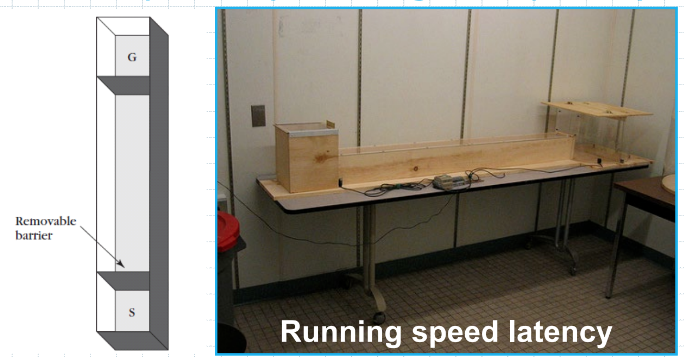
Stick rat in S-box (start box) for them to get to G-box (goal box)
Reward for rates is usually fruit loops — they love em’
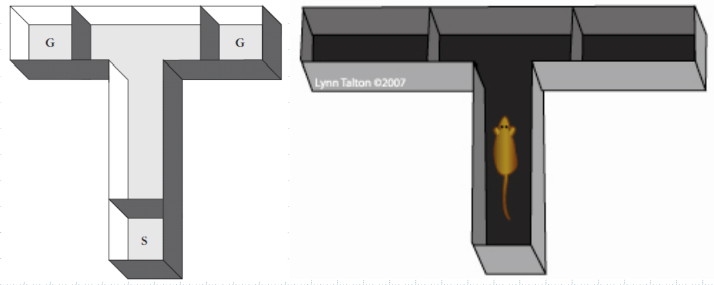
T-Maze
Used for memory studies and other aspects
One of the two ends there is a reward… when put back into the box, they demonstrate learning (e.g., make the same turn to the correct G-Box)
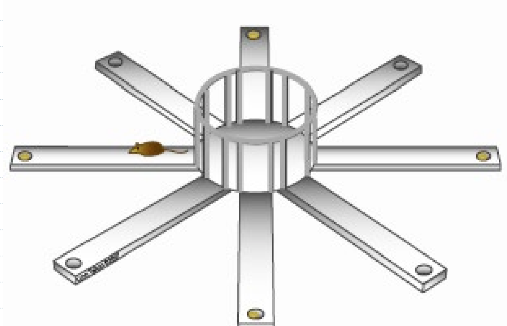
8-Arm Radial Maze
Receive different rewards at different times
Typically four feet off the ground (rats don’t like heights, but do go to ends of arms if there is a good reason for it — like a reward)
Free Operant Procedures
The operant response is defined in terms of its effect on the environment
E.g., your actions alter the environment in some way
Different types of operant responses:
1. Lever-press
Rats learning lever-pressing
2. Chain pull
3. Nose-poke
Rats poking something with nose
4. Peck
Pigeons pecking something
What is the dependent variable?
1. Response-rate
2. Total number of responses
3. Latency to respond
B.F. Skinner and the Skinner Box
Skinner was considered the leading authority of IC
Was influenced by Thorndike
Skinner invented the “Skinner Box” to test IC through shaping
Ex: One type of chamber trains rats to bar-press for rewards
The Initial Learning
The IC involves learning familiar responses in new situations or in new ways
Example: Learning where and what to run for
Rats do not need to learn HOW to run
Rats need to learn WHERE to run, WHERE to turn, and WHAT they will find at the end
Constructing new responses from familiar components
Example: To press a lever, rats hav e to combine various familiar behaviours
Raising their paws, standing on hind legs, etc.
Shaping
Reinforces any movement in the direction of the desired response
Rewards gradual successive approximations
Quicker than waiting for the response to occur and then reinforcing it
Used effectively to condition humans and many types of animals
Ex: parents and children, teachers and students, coaches and athletes
What is shaping?
It involves taking what is known by organism and modifying it in different ways — it’s not about teaching brand new behaviours, but modifying existing behaviours.
What is successive approximation?
In a lever pressing rat learning experiment,, you could wait for dumb luck for it to press lever for first time. Or you reward successive approximations to SPEED UP THE LEARNING PROCESS (for example give it rewards for simply looking in direction of lever — increased probability of facing lever — after it does that over and over again, we up the ante — we withold reward, until the rat APPRAOCHES the lever — then we see probability increase of apporach in lever direction — then eventually it gets to the lever, and nothing happens, until the next step, maybe rewarding TOUCHING the lever.
Kid spelling example — kid wants to say a word, reward it when it says letter, increases likeliness of getting the kid to actually say the word.
Shaping and Chaining
Shaping:
Shaping through successive approximation builds a complex R incrementally
Initially, the contingency is introduced for simple behaviour (R)
As the rate of R improves, the contingency is moved to a more complex version of R
Gradually, it builds a complex R animal that would never spontaneously produce
Chaining:
Chaining builds complex R sequences by linking together S→R→O (if S, then R, leads to O) conditions
Initially, train the animal to pick up an object
Next, reward it for picking it up and then throwing it
It allows a series of behaviours (as opposed to shaping, which simply elaborates ona simple response)
Shaping and chaining can be used together to train animals to complete incredibly complex behaviours. Both techniques require skill and patience from the trainer.
Keep an animal motivated and interested
Select proper training sequence
Cannot move too fast
How to Get a Rat to Lever Press
IC in the Skinner Box
Outcomes (O):
± food delivery
± shock through wires in the floor (punishment)
Behaviour (R): rate of lever pressing
Context (S): light that signals box is “on”
Note than animal is “free” in the chamber, no experimenter intervention
Free-operant learning
Also, many possible contingencies can be introduced
Positive Reinforcement: Press lever (R) → GET FOOD | Positive Punishment Press lever (R) → GET SHOCK |
Negative Reinforcement Press lever (R) → STOP SHOCK | Negative Punishment Press lever (R) → STOPS FOOD |
Structure of the IC Skinner Box Experiment
Initially, tries many things; eventually, accidentally presses the lever, produces a positive effect
Now starts hanging around the lever, accidentally presses it again
Rat has learned a contingency: if light on (S), pressing lever (R) → food (O); spends much of tis day pressing and eating
Basic Pattern of IC
Generalizing & Discrimination
Influencing Factors
Quality of the Outcome
Appetitive stimulus: ‘pleasant’ event or outcome in the context of IC
Aversive stimulus: ‘unpleasant’ event or outcome in the context of IC
Relationship Between the Instrumental Behaviour and the Outcome
Positive contingency: The instrumental response causes an outcome/stimulus to appear
Negative contingency: The instrumental response causes a stimulus to dissapear or be eliminated
Magnitude of Reinforcement
As magnitude increases:
Acquisition of a response is faster
Rate of responding is higher
Resistance to extinction is greater
Ex: people work harder for $30/hr than $10/hr
Immediacy of Reinforcement
If reinforcement is immediate, responses are conditioning more effectively
Ex: Addiction to drugs can happen quickly because the euphoric effects are felt almost instantly
As a rule, the longer the delay in reinforcement, the more slowly the response will be acquired
Ex: Eating habits are hard to change because of the long delay between better health and weight loss
Note: For rats, the association between their behaviour and the reward or punishment should be maximum one minute
Level of motivation
Higher motivation leads to faster learning
Skinner found maximum motivation occurred when rats were food deprived for 24hrs — makes the rats more interested and motivated to obtain food
Consequences
Changes in instrumental behaviour are determined by the nature of the outcome, and whether or not the outcome is presented or eliminated
Reinforcement: Where the relationship between the response (R) and the outcome (O) increases the probability of the response occurring
Punishment: Where the relationship between the response (R) and outcome (O) decreases the probability of a response occurring
Reinforcement
Anything that strengthens a response (or increases the probability that the response will occur)
Primary and Secondary Reinforcers
Primary reinforcers fulfill basic physical needs for survival
Do not depend on learning
Ex: food, water, termination of pain
Secondary reinforcers are acquired or learned by association with other reinforcers
Ex: money, praise, awards, good grades
Punishment
Anything that suppresses a response (or decreases the probability that the response will occur)
Types of Consequences and Their Procedures
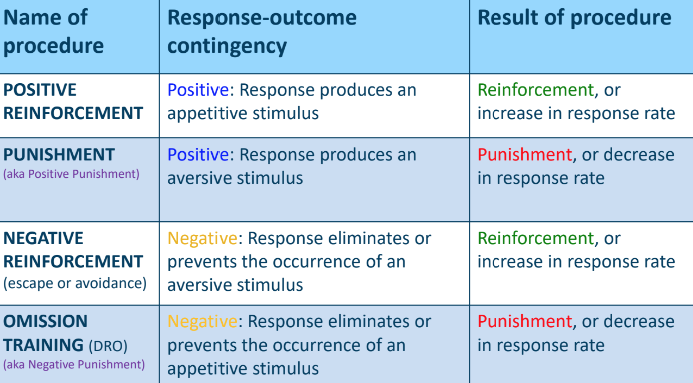
Four main scenarios outline the consequences of behaviour:
Positive Reinforcement:
Behaviour produces an appetitive stimulus
Probability of behaviour increases
Contingency is positive
Human Example: Slot machines
Experimental Procedure: Lever-pressing for food
Positive Punishment (Punishment)
Behaviour produces an aversive stimulus
Probability of behaviour decreases
Contingency is negative
Human example: ticket after speeding
Experimental example: rats not pressing lever to avoid shock
etc…
Instrumental vs. Classical Conditioning
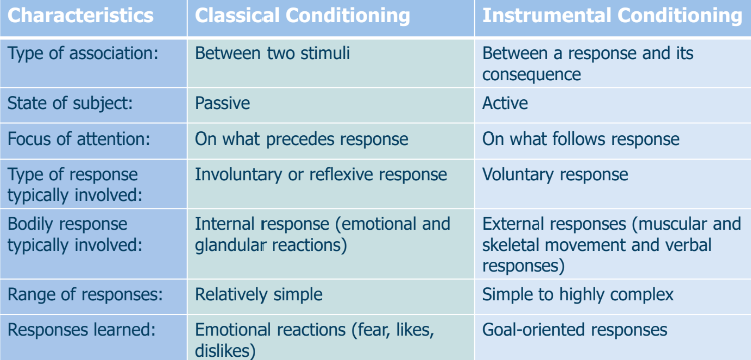
Associations in IC
Associative Structure of Instrumental Conditioning
Originated with Thorndike
Role of Pavlovian mechanisms in instrumental conditioning
Focus on individual responses and their stimulus antecedents and outcomes (molecular approach)
REMINDER: If S, Then R, Produces O (if you find yourself in a situation with particular stimuli, then a specific response will lead to a particular outcome)
Thorndike’s Law of Effect: S-R Learning
If a response in the presence of a stimulus results in a satisfying event then the S-R association is strengthened. If the response is followed by an annoying event then the S-R association is weakened.
The reinforcer (O) serves to ‘stamp in’ the S-R association
Motivation for instrumental behaviour:
Activation of the S-R association upon exposure to contextual stimuli (S), in the presence of which the response was previously reinforced
No learning about ‘O’ or ‘S-O’ or ‘R-O’
The O was not learned about; rather, it was a means of learning
THORNDIKE WAS NOT CORRECT — but he wasn’t entirely wrong either. S-R is learned about, it can be produced independently of what the O is. It’s really applied when overlearning (or habitual learning) occurs.
Back in the day Dean would smoke. He would light up in particular smoking contexts — it became habitual.
So O (outcome) MATTERS!
Reward expectancy:
Can the expectancy of a particular outcome (S-O_ modulate instrumental behaviour?
Does the expectancy of a certain outcome drive the response?
Earliest theory — Hull (1930), Spence (1956):
Two factors motivate the instrumental response (TWO PROCESS THEORY):
S-R Association
The stimulus comes to evoke the response directly
S-O Association
Response is motivated by expectancy of reward (classical conditioning occurs here — context reflexively makes organism expect a reward)
The Modern Two-Process Theory
Rescorla & Black (1967)
S-O Association (Pavlovian Learning) → Conditioned, central emotional state (positive or negative based on the reinforcer) → Response
Pavolvian-Instrumental Transfer Test
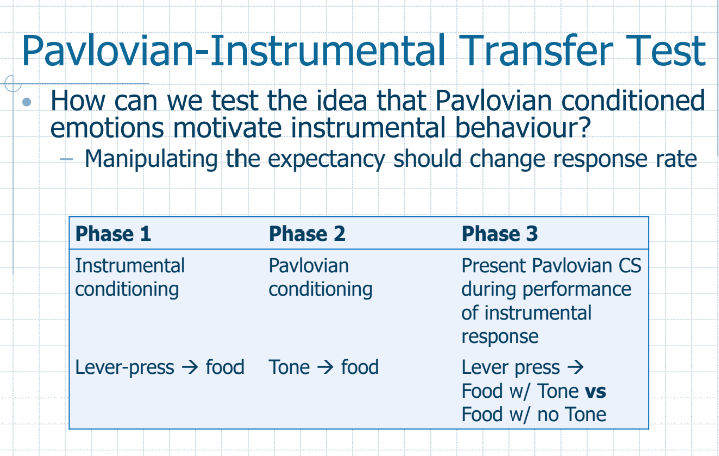
Phase 1: Lever-press → food learning (instrumental conditioning)
Phase 2: Tone → food learning (classical conditioning)
Phase 3 (Test Phase): the organism is given the opportunity to produce instrumental responding (with a lever present in the environment). Sometimes the tone will play with when the lever is pressed, sometimes it won’t. Instrumental responding increases when the CS is present vs. when it’s not.
Conclusion — CS produces a reflexive conditioned expectancy in the organism, which makes the organism work harder (press the lever harder)
PIT in Humans…
Hnadrgrip stronger when purple stimuli was present
They didn’t report
they didn’t know they were squeezing any differently when CS was present in the third phase vs when it wasnt
Conditioned Emotional State or Reward-Specific Expectancy
Does classical conditioning influence instrumental behaviour via a positive or negative emotional state (based on reinforcer valence) or do subjects acquire specific expectations of the reinforcer?
is it any reward your predicting that will increase responding, or is it a particular reward? in the transfer test, the reward was the same. could it be any work towards a reward in phase 1 and prediciton of reward in phase 2?
The Experiment:
Phase 1 — Classical Conditioning
Lever-pressing leads to chocolate reward
Chain-pulling leads to cheese reward
Phase 2 — Instrumental Conditioning
Yellow light predicts when chocolate reward is given
Red light predicts when cheese reward is given
Phase 3 — Test Phase
When lever-pressing, sometimes yellow light would be on, sometimes red light would be on, and sometimes neither would be on
When chain-pulling, sometimes yellow light would be on, sometimes red light would be on, and sometimes neither would be on
Explanation:
Lever pressing only increased when the yellow light was on (e.g., specific to the reward it was working for)
When the red light was on, it did not increase
When the expectancy of reward and working towards reward are the same, effort in instrumental responding increases
If you predict cheese, you’re not gonna work harder to get chocolate (they are not generalizing across rewards)
R-O Associations in Positive Reinforcement
The instrumental response
Stereotypy vs. behavioural variability
Relevance (belongingness and instinctive drift)
The outcome of the response
Quality and quantity
Positive and negative contrast
The relation or contingency between the response and outcome
Temporal contiguity
Contingency
The Instrumental Response
What is this R that is learned?
Initially, thought to be a rote motor program
However, if the normal motor program is blocked, the animal will use other methods to achieve the same ends
Ex: wading/swimming; pressing lever with nose
R is a “behavioural unit”
Not a single behaviour but a class of behaviours producing an effects
Some cognitive psychologists would call it a goal or intention
Stereotypy vs. Response variability
It is possible to maintain variability of responses using reinforcement
However, unless variability is explicitly reinforced, responding will become more stereotypical
Thorndike’s belongingness
Easier to train responses that ‘belong’ with the reinforcer
e.g., cannot train yawns or scratching as an escape response
Breland & Breland’s instinctive drift
Extra responses that are performed instinctively because they are related to the reinforcer
They compete with the response required by the training procedure
e.g., cannot teach raccoons to drop coins in a box
The Instrumental Reinforcer
Quantity of the reinforcer (canadian dollars vs. rupees)
Quality of the reinforcer (brussel sprouts vs. ice cream)
quantity and quality of reinforcer example
food-deprived rats changed amounts of food an dhow much insturmental responses would be dislayed to receive different quantities of different food
More acidic food does not increase instrumental output
For neutral food, you prefer medium over small, but not larger amount
For sweet food, more ouput as amount increases
RECAP:
S-O association is reward expectancy (make prediction of outcome — e.g., prediction of reward)
Example": Dean’s nephew — Kid recognized hockey arena and predicted that popcorn was coming, so he immediately started thinking ‘reward’ after being exposed to particular environment. S-O association, or reward expectancy (element of classical conditioning: reflexive association between stimulus and outcome)
Note that influence of reward expectancy is that it increases instrumental response to receive the reward — unless the reward expected and the reward gotten by instrumental response doesn’t align (see Pavlovian instrumental transfer test)
R-O association is when we learn association between making a response and the outcome it leads to… we learned this with positive reinforcement (response ledas tot he presence of something good, which goes back to fuel our response more).
Response itself is being learned
Reinforcer or outcome is being learned
The link between them is also learned
The Instrumental Reinforcer
Quantity of the reinforcer (canadian dollars vs. rupees)
Quality of the reinforcer (brussel sprouts vs. ice cream)
quantity and quality of reinforcer example
food-deprived rats changed amounts of food an dhow much insturmental responses would be dislayed to receive different quantities of different food
More acidic food does not increase instrumental output
For neutral food, you prefer medium over small, but not larger amount
For sweet food, more output as amount increases
Does prior experience with a reinforcer influence IC?
Shifts in reinforcer quality and quantity
Example: food deprived rats performed instrumental response for food
Phase 1: Groups 1 and 2 received small food reward after (2 pellets) — run same pace as groups 3 and 4
Phase 1: Groups 3 and 4 received large food reward after (22 pellets) — run same pace as groups 1 and 2
Phase 2:
Group 1 continues to receive 2 food pellets
Same pace ran in phase 2 as in phase 1 (line of best fit accounts for variability)
Group 3 continues to receive 22 food pellets
Same pace ran in phase 2 as in phase 1 (line of best fit accounts for variability)
(SL group, small-large group) Group 2 now receives 22 food pellets
Ran faster in phase 2 than in phase 1 — they are happy that they’re getting more; hell yeah I am running faster
Group 4 now receives 2 food pellets
Ran slower in phase 2 than in phase 1 — they are used to putting in effort for large food amount, so they reduce their instrumental response (it’s still a reward, but it’s a decrease in instrumental behaviour because prior experience matters — 2 is better than 0, but worse than 22)
Conclusion: prior experience DOES matter — positive contrast (experienced in group 2) and negative contrast (experienced in group 4)
In other words, you shouldn’t ONLY look at the magnitude of the reward — you should also look at prior experiences
The Response-Reinforcer Relation
Understanding the relationship between a response and its consequence is critical for efficient instrumental behaviour
First, temporal relation: The time between the response and the appearance of the reinforcement
E.G., The more the delay between the response and reinforcer, the harder the learning
EXAMPLE:
Rats lever press for food, and food pellets are delivered after different fixed delays
conclusion: Immediate reinforcement is most effective
Is it possible to overcome the delay effect? YES — Marking the target instrumental response. Where your instrumental response produces a marking that sort of reminds you that your response has been taken into account (e.g., “
Example of Marking;
Rats lever press for food, food delivered after 30-sec delay
Group 1 - no signal
Group 2 (MARKING GROUP)- 5-sec light right after lever press (the light acts as a CS, or predictive stimulus, for the reward)
Learns very quickly
Group 3 - 5-sec light right before food delivery (doesn’t learn at all — TOO MUCH OF A DELAY, REALLY AN EXAMPLE OF FLOCKING… THE LIGHT BEING A PERFECT PREDICTOR OT HE REWARD 5 SECS BEFORE ITS RECEIVED BLOCKS THEM FROM UNDERSTANDING THAT THEY CAUSED THE LIGHT IN THE FIRST PLACE)
Second, response-reinforcer contingency: The extent to which the response is necessary any sufficient for occurence of the reinforcer (causal effect)
E.G., you have to learn that you caused the reinforcer by producing the instrumental response (cause and effect)
Skinner’s superstitious behaviour — idea that we create contingencies in our mind that don’t necessarily exist. The pigeons in skinner’s experiment would be doing weird things like pecking or jumping around (imitating the thing they did the first time they received randomly-timed reward)… accidental/adventitious reinforcement.
Contiguity was all that mattered according to Skinner — they created their own contingency, and as long as the temporal contiguity is there, then reinforcement can occur
However, contrasting evidence suggests that contiguity is not the only explanation (some dude re-did skinner’s pigeon experiment):
Similar behavioural responses developed in many different pigeons
Food delivery increased strength only of terminal responses
Periodic presentation of reinforcer produces behavioural regularities based on the interval
conclusion — specific types of behaviours were reproduced that had food-getting qualities
Why are high terminal and low interim responses observed?
Periodic deliveres of food activate feeding sysems and corresponding pre-organizrd spec ies typical foraging and feeding repsonses
Just after food:
d
d
Do R-O Associations Exist?
Instrumental devaluation
Phase 1 — if you push a rod to the left, you get chocolate, and to the right, you get cheese
Phase 2 — you devalue the reinforcer of one of them (e.g., overload them with cheese)
Phase 3 — the rat will only produce the instrumental response that leads to the OTHER reinforcer (in this case, chocolate), that can only be explained by R-O associations
Colwill & Recorla (1986):
Associative Structure of Instrumental Conditioning
Hierarchical S(R-O) conditioning — about knowing WHEN the R-O association exists
S activates R (Thorndike, habitual behaviour)
S also activates R-O association
EXAMPLE: Response (not being a brat) leads to outcome (popcorn) only when exposed to a certain stimulus (the hockey arena)
Context lets you know that R-O association is now active