The tempest by Shakespeare
WHAT IS A TEMPEST?
A tempest is a violent, turbulent storm, typically with strong winds, heavy rain, thunder, and lightning. In the play, it is a magical storm conjured by Prospero to shipwreck his enemies.
WRITING AND FIRST PERFORMANCE DATE
Written: Approximately 1610 to 1611.
First Performance: Believed to have been performed on November 1, 1611, at Whitehall Palace in London for King James I and his court, as part of the festivities for the wedding of Princess Elizabeth.
First Published: In the First Folio of 1623, where it appears as the opening play.
GENRE
Romance (specifically, one of Shakespeare's late romances or tragicomedies). It blends elements of comedy, tragedy, and fantasy, with a heavy dose of magic. Unlike his earlier tragedies or pure comedies, the late romances feature themes of reconciliation, redemption, and forgiveness.
BRIEF PLOT SUMMARY
Prospero, the rightful Duke of Milan, was betrayed and usurped by his brother Antonio and set adrift at sea with his infant daughter Miranda. They landed on a remote island, where Prospero has lived for twelve years, mastering magic and controlling the island's spirit Ariel and the native Caliban. Using his magic, Prospero conjures a storm to shipwreck his enemies (Antonio, King Alonso of Naples, and their court) on the island. He separates them into groups, ensuring his daughter Miranda falls in love with Alonso's son Ferdinand. Meanwhile, Caliban plots with two drunken servants to kill Prospero, while Antonio and Alonso's brother Sebastian scheme to murder the king. In the end, Prospero brings everyone together, forgives his enemies, reveals Ferdinand and Miranda's betrothal, renounces his magic, frees Ariel, and plans to return to Milan as Duke.
MAIN CHARACTERS
Prospero: The protagonist and rightful Duke of Milan. A powerful magician who rules the island and orchestrates the shipwreck.
Miranda: Prospero's kind-hearted, innocent daughter, raised on the island. She falls in love with Ferdinand.
Ariel: A delicate spirit of the air, rescued by Prospero from a witch's curse. He serves Prospero but longs for freedom.
Caliban: A deformed, monstrous native of the island, son of the witch Sycorax. He is enslaved by Prospero and represents raw nature and colonialism.
Ferdinand: Son of King Alonso. He falls in love with Miranda and represents youthful love and nobility.
Alonso: King of Naples. He was complicit in Prospero's overthrow and mourns his son throughout the play.
Antonio: Prospero's treacherous brother who usurped his dukedom. He is an unrepentant villain.
Sebastian: Alonso's brother. He conspires with Antonio to kill Alonso.
Gonzalo: A kind nobleman who provided Prospero with supplies when he was exiled. He represents optimism and loyalty.
Trinculo and Stephano: A jester and a drunken butler from the ship. They provide comic relief and ally with Caliban to overthrow Prospero.
MAJOR THEMES
Power and Usurpation: The play examines legitimate versus illegitimate rule, authority, and the abuse of power, both political and magical.
Forgiveness and Reconciliation: Prospero's eventual choice to forgive his enemies, rather than seek revenge, is the play's emotional climax.
Colonialism and The Other: Caliban's enslavement and Prospero's control over the island reflect contemporary European attitudes toward colonized peoples and lands.
Magic and Illusion: The play questions reality versus illusion. Prospero's art controls perceptions and events, symbolizing theatre itself.
Nature versus Civilization: Caliban represents raw nature, while Prospero represents human civilization and reason, though the line between them is blurred.
Freedom and Servitude: Ariel longs for liberation, Caliban is enslaved, and Prospero himself is bound by his magic until he chooses to release it.
Love and Innocence: Miranda and Ferdinand's pure love provides a hopeful counterpoint to the treachery and ambition of the older generation.
ACT 1 SCENE 1
PG 2 – Themes: Challenging Authority
The Boatswain should take control because he is the most experienced sailor. In a storm, saving the ship is more important than social status. The passengers distract the crew, so sending them below deck helps everyone stay safe.
Two significant quotes
“Do you not hear him? You mar our labour – keep your cabins. You do assist the storm.”
The passengers are getting in the sailors’ way.
“What cares these roarers for the name of king? To cabin. Silence! Trouble us not.”
The storm does not care who is king, so the passengers should stop interfering.
PG 4 – Themes: Humans and Nature
Argument 1: Nature is humanity’s opponent and should be controlled
Storms can destroy lives and ships.
Humans should use skill and technology to survive.
The sailors work to control the ship and fight the storm.
Nature is dangerous and unpredictable.
Argument 2: Nature is humanity’s friend and should be respected
Humans cannot control nature’s power.
The storm ignores social status (king or sailor).
People should respect nature instead of trying to dominate it.
Nature reminds humans of their limits and vulnerability.
PG 4 – Characters
Boatswain
Uses commands and short, urgent language.
Shows confidence, leadership and frustration.
Gonzalo
Speaks calmly and optimistically.
Uses humour to stay hopeful despite the danger.
Sebastian & Antonio
Use insults and abusive language.
Show anger, arrogance and disrespect for the Boatswain.
Dominant emotions
Boatswain: Urgency and determination.
Gonzalo: Hope and humour.
Sebastian & Antonio: Anger and denial.
How effective is this characterisation?
It is very effective because Shakespeare quickly reveals each character’s personality through their language, making the conflict and tension clear from the start.
Gonzalo’s statement is ironic because he jokes that the Boatswain is destined to be hanged, not drowned, so even the sea cannot kill him. This is ironic because they are all about to drown in a violent storm.
It shows Gonzalo thinks the situation is hopeless because he has given up on escaping the storm and relies only on fate, believing death is almost certain for everyone else.
Based on Gonzalo’s final lines (lines 56–59):
“Now would I give a thousand furlongs of sea for an acre of barren ground… The wills above be done, but I would fain die a dry death.”
Answer (concise):
Gonzalo says he would give up all the sea for even a small piece of dry, barren land. He accepts that God’s will must be done but hopes to die on land rather than drown at sea. This exaggeration shows how desperate and hopeless he feels.
ACT 1 SCENE 2
Miranda’s lines 1–13 in Act 1 Scene 2 of The Tempest:
b) Miranda’s ‘storm’ imagery – How does it create atmosphere?
Miranda describes the storm as violent and terrifying, making the audience imagine the danger at sea.
Images such as “the sky… pour down stinking pitch” suggest the heavens are raining fire, creating a frightening, hell-like atmosphere.
She says the sea “mounting to th’welkin’s cheek”, making the waves seem enormous, as if they reach the sky.
Her description of the ship “dashed all to pieces” and the passengers’ cries creates a feeling of panic, chaos and helplessness.
The imagery makes the audience feel fear and sympathy for the people caught in the storm before they learn that no one has been harmed.
c) What does Miranda’s language tell us about her character?
Miranda’s language shows that she is:
Compassionate – she feels deep pity for the people on the ship.
Kind-hearted – she wishes to protect others from suffering.
Empathetic – she imagines the fear of the passengers as if she were experiencing it herself.
Emotional – she cries and speaks passionately about the storm.
Innocent – she is genuinely distressed and unaware that the storm was carefully controlled by Prospero.
Gentle – her concern is for saving lives rather than seeking power or revenge.
These qualities immediately present Miranda as a caring, innocent and sympathetic character, making the audience like her from the beginning.
Question 2 based on Act 1, Scene 2, lines 13–21.
2a. What do you think Prospero’s motives are?
Prospero repeats “No harm” to reassure Miranda because he knows she is upset. He wants her to trust him and believe he is acting for a good reason. However, he also wants to keep control of the situation and prepare her to hear the truth about their past.
⸻
2b. First impressions of Prospero, Miranda, and their relationship
Prospero
Powerful
Calm and confident
Protective of Miranda
Wise but controlling
Miranda
Kind
Compassionate
Innocent
Respectful of her father
Their relationship
They clearly love and care for each other.
Prospero tries to comfort and protect Miranda.
Miranda trusts and respects her father.
Prospero has authority over Miranda and controls what she knows, making their relationship loving but unequal.
How does Prospero attempt to ‘soothe’ Miranda after she was shaken by the sights & sounds of the shipwreck? (Lines 22–34)
He tells Miranda to stop crying and comfort herself:
“Wipe thou thine eyes; have comfort.”
He reassures her that nobody has been harmed in the shipwreck:
“There is no soul… betid to any creature in the vessel.”
He explains that the storm was carefully controlled by his magic:
“I have with such provision in mine art / So safely ordered…”
He emphasises that not even a single hair was harmed, showing how safe everyone is:
“Not so much perdition as a hair.”
He calms Miranda by asking her to sit down and listen, preparing her to hear the truth about their past:
“Sit down, for thou must now know farther.”
(lines 34–55):
What memory does Miranda have when she is asked if she remembers her life before the island & what is the revelation Prospero makes at the bottom of this page?
Miranda says she can remember a time before they came to the island:
“Certainly, sir, I can.”
Her memories are vague and dream-like, so she is not sure if they are real:
”’Tis far off, / And rather like a dream, than an assurance.”
She remembers having “four or five women” who looked after her, suggesting she lived an important life before the island:
“Had I not / Four or five women once, that tended me?”
Prospero confirms that her memory is correct, telling her she really did have attendants:
“Thou hadst, and more, Miranda.”
Revelation at the bottom of the page
Prospero reveals that Miranda’s father was once the Duke of Milan, a powerful ruler:
“Thy father was the Duke of Milan.”
He tells Miranda that she is the daughter of a prince of power, showing that she is of noble birth:
“A prince of power.”
PG 13 – Summarise, using appropriate quotes, the story that Prospero tells Miranda about the way in which his life changed (What happened? Who was responsible?)
Prospero tells Miranda that he was the rightful Duke of Milan.
Quote: “Thy father was the Duke of Milan.”
He became deeply interested in studying books and magic instead of ruling.
Quote: “The liberal arts, without a parallel; those being all my study.”
Because he focused on his studies, he trusted his brother Antonio to govern Milan for him.
Quote: “To my state grew stranger, being transported / And rapt in secret studies.”
Antonio was responsible for Prospero’s downfall. He became ambitious and wanted Prospero’s position.
Quote: “My brother… called Antonio.”
Quote: “To trash for o’er-topping.” (He wanted to rise above Prospero.)
Antonio gradually took control of Milan and made himself powerful.
Quote: “Set all hearts i’ th’ state / To what tune pleased his ear.”
Prospero realises he trusted Antonio too much, which allowed him to betray him.
Quote: “I, thus neglecting worldly ends…”
Page 14, based on Page 15 (Act 1 Scene 2, lines 88–120).
⸻
Language in the play – Antonio’s ambition grows
a. I neglected the business of government.
→ “I, thus neglecting worldly ends, all dedicated…”
b. I sought privacy in order to study.
→ “To closeness, and the bettering of my mind… being so retired.”
c. But what I studied was beyond the citizens’ interest or understanding.
→ “O’er-prized all popular rate.”
d. My retirement was the cause of my brother’s evil acts.
→ “In my false brother awaked an evil nature.”
e. My absolute trust in him was completely betrayed.
→ “My trust… had indeed no limit, a confidence sans bound.”
f. He abused my wealth and overtaxed my people.
→ “Not only with what my revenue yielded, but what my power might else exact.”
g. He came to believe his own lies that he was the duke.
→ “To credit his own lie – he did believe he was indeed the duke.”
h. Therefore his ambition grew.
→ “Hence his ambition growing.”
i. He wished to become the part he played – the duke.
→ “To have no screen between this part he played, and him he played it for.”
j. I was content with my books. He took this as a sign that I was unfit to govern.
→ “Me, poor man, my library was dukedom large enough… He thinks me now incapable.”
k. Eager for power, he agreed to make Milan subordinate to the king of Naples.
→ “So dry he was for sway… with King of Naples… Subject his coronet to his crown… The dukedom yet unbowed… to most ignoble stooping.”
⸻
Stagecraft – Prospero’s growing anger
Director’s Journal (5 points)
Miranda stands close to Prospero, listening patiently.
Prospero begins calmly but becomes louder and more emotional.
As he recalls Antonio’s betrayal, he paces the stage and gestures angrily.
Miranda gently interrupts: “Your tale, sir, would cure deafness,” trying to calm him.
Prospero stops, faces the audience, and speaks bitterly about Antonio’s betrayal while Miranda looks shocked and sympathetic.
⸻
“Good wombs have borne bad sons”
Five points supporting Miranda’s view (character is shaped by surroundings)
Prospero trusted Antonio too much, allowing him to gain power.
Antonio became ambitious after being given control of Milan.
Power corrupted Antonio.
Prospero’s neglect of government created the opportunity for betrayal.
Antonio allied himself with the King of Naples for greater power.
Five points contradicting Miranda’s view (character is determined by nature)
Prospero says Antonio had “an evil nature.”
Antonio willingly betrayed his own brother.
Antonio believed his own lies and stole the dukedom.
Antonio was naturally greedy and power-hungry.
Miranda admits “Good wombs have borne bad sons,” suggesting bad people can come from good families.
PG 17 - Summarise using appropriate quotes the denouement of Prospero’s story
What happened? → Prospero neglected ruling to study, allowing Antonio to gain power.
Who was responsible? → Antonio, Prospero’s brother, betrayed him and took control of Milan.
The Denouement of Prospero’s Story (Act 1, Scene 2, lines 120–150)
1. Antonio betrays Prospero
Antonio makes a deal with the King of Naples to take Prospero’s position.
In return, Naples gains control over Milan.
Quote: “The King of Naples… hearkens my brother’s suit… Should presently extirpate me and mine / Out of the dukedom, and confer fair Milan… on my brother.”
2. Prospero and Miranda are forced out of Milan
In the middle of the night, Antonio sends soldiers to remove them from power.
Quote: “A treacherous army levied, one midnight… The gates of Milan… Me, and thy crying self.”
3. Miranda feels sympathy
Miranda is upset remembering how she cried as a child.
Quote: “Alack, for pity!… it is a hint / That wrings mine eyes to’t.”
4. Why weren’t they killed?
Miranda asks why Antonio did not simply destroy them.
Quote: “Wherefore did they not / That hour destroy us?”
5. The people loved Prospero
Prospero explains that Antonio did not dare kill them because the people respected him.
Instead, he disguised his cruelty.
Quote: “They durst not… So dear the love my people bore me… With colours fairer painted their foul ends.”
6. They were abandoned at sea
Prospero and Miranda were placed in an old, broken boat and left to die.
Quote: “They hurried us aboard a barque… A rotten carcass of a butt, not rigged, / Nor tackle, sail, nor mast.”
7. Nature seems to pity them
Even the sea and wind appear to mourn their suffering.
Quote: “To cry to th’sea… To th’winds, whose pity sighing back again / Did us but loving wrong.”
8. Miranda’s concern
Miranda ends by feeling guilty that she caused Prospero more suffering.
Quote: “Alack, what trouble / Was I then to you!”
PG 19 - Summarise how prospero and Miranda survived their exile. Which character helped them? Prospero mentions both ‘Fortune’ and ‘Providence’ - research the meanings of these to Shakespeare and his audience
How Prospero and Miranda Survived Their Exile (Act 1, Scene 2, p.19)
1. Gonzalo secretly helped them
A kind nobleman, Gonzalo, made sure they had everything they needed to survive.
Quote: “By providence divine, / Some food we had, and some fresh water, that / A noble Neapolitan, Gonzalo… out of his charity… appointed / Master of this design.”
2. He gave them supplies
Gonzalo provided:
Food
Fresh water
Clothing
Linen
Other necessities
Quote: “Rich garments, linens, stuffs, and necessaries / Which since have steaded much.”
3. He saved Prospero’s books
Knowing how much Prospero valued learning, Gonzalo rescued books from his library.
Quote: “Knowing I loved my books, he furnished me / From mine own library… volumes that / I prize above my dukedom.”
4. Miranda comforts Prospero
Miranda says she is beginning to cry because she feels sad for him.
Quote: “Now I arise… and hear the last of our sea-sorrow.”
5. Prospero believes they are now better off
He says life on the island has helped him more than being a prince in Milan.
Quote: “Here in this island we arrived… Here have I, thy schoolmaster, made thee more profit / Than other princes can.”
6. Miranda notices the storm
She realises Prospero caused it.
Quote: “For still ’tis beating in my mind – your reason / For raising this sea-storm?”
7. Fortune has changed
Prospero believes events have turned in his favour and the arrival of his enemies is an opportunity.
Quote: “By accident most strange, bountiful Fortune… hath mine enemies / Brought to this shore… if now I court not… my fortunes… all else do ebb.”
Who Helped Them?
Gonzalo helped Prospero and Miranda by secretly giving them:
Food and fresh water
Clothes and supplies
Prospero’s treasured books
Key quote: “A noble Neapolitan, Gonzalo… out of his charity…”
Fortune and Providence (for Shakespeare’s audience)
Providence
Meaning: God’s care and guidance over human lives.
Shakespeare’s audience believed that “providence divine” meant God was protecting Prospero and Miranda.
Quote: “By providence divine…”
Fortune
Meaning: Luck or fate, often imagined as changing unexpectedly.
Prospero says “bountiful Fortune” has now brought his enemies to him, giving him the chance to regain what he lost.
Quote: “By accident most strange, bountiful Fortune… hath mine enemies / Brought to this shore.”
Simple comparison
Providence | Fortune |
God’s guidance and protection | Luck or fate that can change |
Saves Prospero and Miranda | Brings Prospero’s enemies to the island |
“By providence divine” | “Bountiful Fortune” |
PG 33 - what are Ariel’s songs about and how is Ferdinand reacting
Ariel’s Songs and Ferdinand’s Reaction (Act 1, Scene 2, p.33)
Song 1 – Ariel leads Ferdinand
Ariel invites Ferdinand onto the island with music.
The song is cheerful and magical, encouraging him to follow.
Quote: “Come unto these yellow sands, / And then take hands.”
The spirits add sounds like “Bow wow, bow wow” and “Cock-a-diddle-dow,” making the island seem alive and enchanted.
Ferdinand’s Reaction
Ferdinand is amazed and wonders where the music is coming from.
Quote: “Where should this music be? I’th’air, or th’earth?”
He thinks it must belong to “Some god o’th’island.”
The music calms his sadness about his father’s shipwreck.
Quote: “This music crept by me upon the waters, / Allaying both their fury and my passion.”
He follows the music wherever it leads.
Quote: “Thence I have followed it.”
Song 2 – About Ferdinand’s Father
Ariel sings that Ferdinand’s father lies at the bottom of the sea.
His body has been changed into something beautiful by the ocean.
Quote: “Full fathom five thy father lies.”
Quote: “Of his bones are coral made; / Those are pearls that were his eyes.”
The song says he has experienced a “sea-change” into “something rich and strange.”
The sea-nymphs ring a funeral bell for him.
Quote: “Sea-nymphs hourly ring his knell… ding dong bell.”
Summary
Ariel’s first song magically leads Ferdinand onto the island and calms his grief.
Ariel’s second song makes Ferdinand believe his father has died and been transformed by the sea.
Ferdinand reacts with wonder, sadness, and curiosity, following the mysterious music because he believes it is magical.
PG 35 - analyse and connect to themes
“It carries a brave form. But ’tis a spirit.”
Features: Contrast, imagery
Miranda mistakes Ferdinand for a spirit, highlighting her innocence and instant attraction.
“He’s something stained with grief.”
Features: Metaphor
Grief is described as a stain, showing Ferdinand’s sorrow has affected his appearance.
“A thing divine, for nothing natural I ever saw so noble.”
Features: Hyperbole, religious imagery
Miranda idealises Ferdinand as god-like, emphasising love at first sight and her sheltered upbringing.
“It goes on, I see.”
Features: Aside, dramatic irony
Prospero secretly realises his plan is succeeding, showing his manipulation of Miranda and Ferdinand.
“I’ll free thee within two days for this.”
Features: Foreshadowing
Prospero rewards Ariel, reinforcing his power and control over events.
“Most sure the goddess on whom these airs attend.”
Features: Religious imagery, hyperbole
Ferdinand compares Miranda to a goddess, showing his immediate admiration and idealisation.
“If you be maid, or no?”
Features: Direct question
Ferdinand asks if Miranda is unmarried, revealing his instant romantic interest.
“No wonder, sir; But certainly a maid.”
Features: Double meaning
Miranda confirms she is unmarried, reflecting her honesty, innocence, and growing affection.
“My language? Heavens!”
Features: Exclamation
Ferdinand is amazed Miranda speaks his language, giving him hope after the shipwreck.
“I am the best of them that speak this speech.”
Features: Pride, dramatic irony
Ferdinand reveals his noble status, while the audience knows Prospero is testing him despite his rank.
Prospero’s Asides – Showing His Scheme
1. He wants Miranda to notice Ferdinand
Prospero tells Miranda to look closely at Ferdinand.
Quote: “The fringed curtains of thine eye advance, / And say what thou seest yond.”
Meaning: He deliberately draws her attention to Ferdinand, beginning his plan for them to meet.
2. He realises his plan is working
After Miranda admires Ferdinand, Prospero speaks aside.
Quote: ”[Aside] It goes on, I see, / As my soul prompts it.”
Meaning: He is pleased because Miranda and Ferdinand are already attracted to each other. This reveals their meeting is part of his scheme.
3. He rewards Ariel
Prospero promises Ariel freedom.
Quote: “Spirit, fine spirit, I’ll free thee / Within two days for this.”
Meaning: Ariel has successfully carried out Prospero’s plan by bringing Ferdinand to Miranda.
Miranda and Ferdinand’s Reactions to Each Other
Miranda’s reaction
At first, she thinks Ferdinand is a spirit.
Quote: “What’s it? A spirit?”
She quickly admires his appearance.
Quote: “Lord, how it looks about!”
She believes he is more than human.
Quote: “A thing divine, for nothing natural / I ever saw so noble.”
Ferdinand’s reaction
Ferdinand believes Miranda is a goddess.
Quote: “Most sure the goddess / On whom these airs attend.”
He asks if she is a maid.
Quote: “If you be maid, or no?”
He is delighted that she speaks his language.
Quote: “My language? Heavens!”
Prospero’s Change in Mentality (Performative)
Before Ferdinand arrives
Prospero tries to stop Miranda from falling for him.
Quote: “This gallant which thou seest… but he’s something stained / With grief.”
Meaning: He pretends Ferdinand is less impressive than he really is.
What he is really thinking
His aside shows he actually wants Miranda and Ferdinand to fall in love.
Quote: “It goes on, I see, / As my soul prompts it.”
Why this is performative
Prospero acts as if he is warning Miranda, but privately celebrates that his plan is succeeding.
His public words and private thoughts are different, showing he is carefully controlling the situation.
JUMP OUT
“It goes on I see” - Prospero commenting about his success in manipulating Miranda and Ferdinand to fall in love - jump out that he is controlling everything
ACT 2 SCENE 1
Character development
Gonzalo’s idealism vs the cynicism of Antonio and Sebastian (Shakes’ emphasises the difference between them through juxtaposition and open irony)
Narrative development
plot against the king set in motion
PG 47 - examples of juxtaposition
➤ Gonzalo: “Here is everything advantageous to life.”
Sees the island as full of opportunity and resources.
Juxtaposed with:
Antonio: “True, save means to live.”
Sebastian: “Of that there’s none, or little.”
Effect: Antonio and Sebastian immediately dismiss Gonzalo’s optimism by focusing on the island’s problems.
➤ Gonzalo: “How lush and lusty the grass looks! How green!”
Describes the island as beautiful and full of life.
Juxtaposed with:
Antonio: “The ground indeed is tawny.”
Sebastian: “With an eye of green in’t.”
Effect: They mock Gonzalo’s positive view, arguing the grass is mostly brown rather than green.
➤ Gonzalo: “But the rarity of it is…”
Believes the island is unique and remarkable.
Juxtaposed with:
Sebastian: “As many vouched rarities are.”
Effect: Sebastian sarcastically suggests that “rare” things are often exaggerated or untrue.
➤ Gonzalo: “That our garments… hold notwithstanding their freshness and glosses…”
Amazed that their clothes are still fresh after the shipwreck.
Juxtaposed with:
Antonio: “If but one of his pockets could speak, would it not say he lies?”
Sebastian: “Ay, or very falsely pocket up his report.”
Effect: Gonzalo sees a miracle, while Antonio and Sebastian accuse him of lying and ridicule everything he says.
Overall effect
Gonzalo = hopeful, kind, and idealistic.
Antonio & Sebastian = sarcastic, cynical, and constantly mock Gonzalo.
Shakespeare uses this juxtaposition to highlight the contrast between optimism and cynicism, making Gonzalo appear more noble while Antonio and Sebastian seem bitter and disrespectful.
PG 49 - quick summary and key notes
Allusion to Dido - tragic.
Quick Summary
Gonzalo continues to admire how everyone’s clothes are still fresh after the shipwreck, comparing them to when they attended Claribel’s wedding in Tunis.
Adrian praises Claribel, but Gonzalo incorrectly refers to “widow Dido” and says she was in Tunis, leading Antonio and Sebastian to mock his mistake.
Antonio and Sebastian constantly interrupt Gonzalo with jokes and sarcasm, showing their disrespect and cynical personalities.
Gonzalo ignores most of their insults and continues speaking positively, showing his optimism and good nature.
Key Notes
Gonzalo’s Optimism
“Our garments are now as fresh…”
Amazed that their clothes remain clean after the storm.
Sees it as something wonderful or miraculous.
Continues speaking positively despite being interrupted and mocked.
Shows his kindness, hopefulness, and resilience.
Antonio & Sebastian’s Cynicism
Mock Gonzalo’s mistake about “widow Dido.”
“Widow? A pox o’ that!”
“What if he had said ‘widower Aeneas’ too?”
Continue making sarcastic jokes instead of contributing seriously.
Exaggerate Gonzalo’s words:
“He hath raised the wall, and houses too.”
“I think he will carry this island home in his pocket…”
Their dialogue shows they enjoy ridiculing Gonzalo for entertainment.
Language Features
Sarcasm – Antonio and Sebastian constantly mock Gonzalo instead of listening.
Hyperbole (Exaggeration) – “Carry this island home in his pocket.” Used to make Gonzalo seem ridiculous.
Irony – Gonzalo remains calm and positive while the others behave immaturely.
Themes
Idealism vs Cynicism – Gonzalo remains hopeful; Antonio and Sebastian are negative and mocking.
Appearance vs Reality – The fresh clothes seem impossible after a shipwreck, suggesting the island’s magical influence.
Mockery – Antonio and Sebastian use humour to belittle Gonzalo throughout the scene.
Why this page is important
Highlights the sharp contrast between Gonzalo’s wisdom and optimism and Antonio and Sebastian’s bitterness and cruelty.
Continues developing Antonio and Sebastian as characters who are disrespectful, sarcastic, and dismissive, preparing the audience for their later actions.
PG 51 - key notes and summary
Quick Summary
Alonso is overwhelmed with grief, believing he has lost both Ferdinand and, in a way, Claribel, who is now far away in Tunis.
Francisco tries to comfort Alonso by saying he saw Ferdinand survive the waves and believes he reached land safely.
Sebastian cruelly blames Alonso for marrying Claribel to the King of Tunis, saying it is Alonso’s own fault that Ferdinand is lost.
Gonzalo defends Alonso, telling Sebastian that although his words may be true, they are heartless and only make Alonso’s pain worse.
Key Notes
Alonso’s Grief
“Would I had never married my daughter there.”
Alonso regrets sending Claribel to marry in Tunis.
Feels he has lost both of his children.
“My son is lost.”
Shows his despair and gduilt over Ferdinand’s apparent death.
Francisco Gives Hope
“Sir, he may live.”
Offers hope that Ferdinand survived.
Describes Ferdinand:
“Beat the surges”
“Came alive to land.”
Suggests Ferdinand is strong, brave, and may still be alive.
Sebastian’s Cruelty
“You may thank yourself for this great loss.”
Blames Alonso for Ferdinand’s disappearance.
“The fault’s your own.”
Shows no sympathy and deliberately increases Alonso’s guilt.
His harsh words reveal his lack of compassion.
Gonzalo’s Kindness
“The truth you speak doth lack some gentleness.”
Tells Sebastian that even if he is telling the truth, he is being unnecessarily cruel.
“You rub the sore, when you should bring the plaster.”
Metaphor: Sebastian is making Alonso’s pain worse instead of helping to heal it.
Gonzalo believes people should comfort those who are grieving.
Language Features
Metaphor – “Rub the sore… bring the plaster.” → compares emotional pain to a physical wound.
Imagery – Francisco’s description of Ferdinand battling the waves creates hope and highlights his bravery.
Blame – Sebastian repeatedly accuses Alonso, increasing the emotional tension.
Themes
Grief and Loss – Alonso mourns what he believes is the loss of his son.
Hope vs Despair – Francisco offers hope, while Sebastian insists on guilt and despair.
Compassion vs Cruelty – Gonzalo comforts Alonso; Sebastian deliberately hurts him.
Responsibility and Guilt – Alonso blames himself, and Sebastian reinforces that guilt.
Why this page is important
Develops Alonso as a grieving, guilt-ridden father.
Shows Francisco as a voice of hope.
Highlights Sebastian’s cruelty and lack of empathy.
Reinforces Gonzalo’s role as the moral and compassionate character, contrasting sharply with Sebastian and Antonio.
PG 55 - 63
themes: challenging authority power/powerlessness Magic (Ariel)
Antonio - opportunistic and evil (see his reaction to usurping his own bro)
Act 2 scene 1 - Antonio persuades sebastian
1. Antonio manipulates Sebastian into becoming king
Uses water imagery to encourage Sebastian to seize his opportunity.
Quote: “I am standing water.” / “I’ll teach you how to flow.”
Analysis: Antonio suggests Sebastian is passive and needs to act. “Flow” symbolises ambition and taking control.
⸻
2. Antonio exploits Sebastian’s ambition
Convinces Sebastian that Ferdinand is dead, so the throne is within reach.
Quote: “Who’s the next heir of Naples?”
Analysis: Antonio plants the idea of kingship, making Sebastian think about power instead of loyalty.
⸻
3. “What’s past is prologue” – fate vs free will
Quote: “What’s past is prologue.”
Analysis: Antonio argues that past events (the shipwreck) have created the perfect opportunity for Sebastian to become king. He just needs to act.
⸻
4. Antonio has no conscience
Quote: “I feel not this deity in my bosom.”
Analysis: Antonio admits he has no guilt or moral conscience, making him a ruthless and manipulative villain.
⸻
5. Antonio uses himself as an example
Quote: “You did supplant your brother Prospero.” (Sebastian)
Analysis: Antonio successfully stole Milan from Prospero, proving that ambition and betrayal can bring power.
⸻
6. Antonio persuades Sebastian to commit murder
Quote: “Can lay to bed for ever.”
Analysis: Euphemism for killing Alonso. Antonio makes murder sound simple and acceptable.
Quote: “Draw thy sword.”
Analysis: Sebastian finally agrees, showing Antonio’s manipulation has succeeded.
⸻
7. Ariel prevents the conspiracy
Quote: “Awake, awake.”
Analysis: Ariel wakes Gonzalo before the murder can happen, protecting Alonso and carrying out Prospero’s plan.
⸻
8. Antonio and Sebastian lie
Quote: “Whilst we stood here securing your repose…”
Analysis: They pretend they drew their swords to protect Alonso from wild animals, hiding their attempted assassination.
⸻
Key Themes
Ambition – Antonio encourages Sebastian to seek power through murder.
Manipulation – Antonio twists logic to justify betrayal.
Betrayal – Mirrors Antonio’s earlier betrayal of Prospero.
Appearance vs Reality – Antonio and Sebastian pretend to be loyal while secretly plotting murder.
Conscience – Antonio’s lack of guilt contrasts with moral responsibility.
ACT 2 SCENE 2
Caliban, Colonisation & Marginalisation
Caliban is a victim of Prospero’s colonial rule.
Curses Prospero:
“All the infections that the sun sucks up… on Prospero fall.”
Shows his hatred and resentment towards his oppressor.
Prospero’s control causes physical and psychological suffering.
Spirits “fright me,” “pinch me,” and “hiss me into madness.”
Demonstrates Caliban’s constant fear and loss of freedom.
Caliban has been conditioned by oppression.
Mistakes Trinculo for one of Prospero’s spirits:
“Here comes a spirit of his, and to torment me.”
Shows how deeply colonisation has traumatised him.
Caliban would rather serve another master than be free.
Sees Stephano as a potential saviour despite him being drunk and foolish.
Reflects how colonised and marginalised people may accept another ruler because they have lost their sense of independence.
Stephano is an ironic ‘master’.
Enters “carrying a bottle and singing.”
Drunk, unintelligent, and comic, yet Caliban still chooses to follow him.
Trinculo dehumanises Caliban.
Calls him:
“A man, or a fish?”
Suggests Europeans viewed indigenous people as strange or less than human.
Caliban is exploited for profit.
Trinculo says:
“There would this monster make a man.”
Implies Caliban could be exhibited in England to earn money, reflecting the exploitation of colonised peoples.
Key Theme
Shakespeare criticises colonisation by showing how it:
Removes freedom and identity.
Causes fear and trauma.
Makes oppressed people seek another master rather than true independence.
Dehumanises and exploits indigenous peoples.
Trinculo thinks he can exploit Caliban by displaying him as a strange “monster” in England and charging people money to see him.
Trinculo first sees Caliban as a curiosity:
“What have we here? A man, or a fish?”
He believes people in England would pay to see him:
“There would this monster make a man.”
He says that while people won’t give money to help the poor, they will pay to see a “dead Indian” or strange creature.
“They will lay out ten to see a dead Indian.”
This reflects how indigenous and colonised peoples were dehumanised, treated as exotic spectacles, and exploited for profit during the Age of Exploration.
Analysis: Shakespeare criticises colonial attitudes by showing that Trinculo values Caliban not as a human being, but as an object that can earn him money.
Brief soliloquy from Caliban, which reveals dislike of Prospero’s control over him
descends into comical force with the arrival of the drunken Triculo and Stephano (shipwreck survivors)
Both consider how they can exploit Caliban; before he deems them Gods and offers his service
Themes:
Colonisation and/or exploitation
Power/powerlessness
RSC production
Caliban → pitiful → exuberant (more of a contrast) (sprites physically present)
Trinculo →costumed as a jester (with horn); interacts with audience; physical comedy (under the cloak + comedic angle)
Stephane → as per ‘the page’
Colonisation & Civilisation
Prospero’s absence
Audience judges characters without Prospero’s influence.
Stephano and Trinculo become drunk, greedy and exploitative, challenging the idea that Europeans are naturally civilised.
Shakespeare suggests civilisation depends on morality, not race, status or power.
Act 2 Prospero’s influence while absent
How Prospero influences the situation
His enslavement of Caliban causes Caliban to hate him and seek revenge.
Caliban immediately tells Stephano to kill Prospero and take control of the island.
His control of the island forces Caliban to obey him through fear.
Caliban describes Prospero’s spirits tormenting him if he disobeys, showing Prospero’s absolute power.
His magic indirectly creates the meeting.
Ariel’s storm (ordered by Prospero) shipwrecks Stephano and Trinculo, bringing them to Caliban.
His absence exposes the characters’ true nature.
Without Prospero on stage, Stephano and Trinculo reveal their greed and desire for power, while Caliban reveals his desperation for freedom.
His rule is questioned.
Caliban’s willingness to serve another master suggests Prospero’s rule has failed to earn loyalty and relies on force rather than respect.
Shakespeare’s purpose
Prospero’s influence drives the entire scene even though he is absent.
Shakespeare uses this to explore power, authority, and colonisation, asking whether Prospero is a wise ruler or simply another coloniser controlling the island.
Shakespeare’s criticism of colonisation
Europeans claimed to bring civilisation, but were often motivated by greed and conquest.
Stephano wants to own, tame and profit from Caliban (”present for any emperor”).
Caliban replaces one master with another, showing colonisation often changes rulers, not oppression.
Irony
The “civilised” Europeans behave like fools.
The “monster” is treated less humanely than the humans treat each other.
Shakespeare questions European claims of moral superiority.
Criticism of England (AO3)
“They will not give a doit to relieve a lame beggar, they will lay out ten to see a dead Indian.”
Satirises England for valuing profit and entertainment over compassion.
Reflects how indigenous people were displayed as curiosities.
Suggests English society is less civilised than it claims.
Context (AO3)
Colonisers believed natives were “savages” who needed European rule.
Colonisation often destroyed language, culture and freedom.
“You taught me language, and my profit on’t / Is, I know how to curse.”
Language symbolises cultural control, not enlightenment.
Main idea (worth remembering)
Shakespeare doesn’t simply criticise colonisation—he questions who is actually civilised. Europeans claim superiority, but their greed, exploitation and hypocrisy often make them appear less civilised than Caliban.
ACT 3 SCENE 1
Ferdinand and Miranda glaze each other
Prosperos plan is working (he observes):
Mirandas innocence/purity finds its match in Ferd’s availability Ferd’ is happy to work for Prosp’ as long as he can interact with Miranda
Ferdinand and Miranda’s love
1. Ferdinand – Love makes hard work easy
“The mistress which I serve quickens what’s dead, / And makes my labours pleasures.” (p. 79)
Ferdinand says his love for Miranda makes carrying logs feel enjoyable instead of painful.
Shows: Love gives him strength and purpose.
Prospero’s control:
Although Ferdinand thinks his feelings are natural, Prospero deliberately made him perform this labour to test whether his love is genuine.
2. Ferdinand – He refuses Miranda’s help
“I’d rather crack my sinews, break my back, / Than you should such dishonour undergo.” (p. 81)
Ferdinand insists on doing the hard work himself because he wants to protect Miranda.
Shows: Chivalry, respect, and selfless love.
Prospero’s control:
Prospero watches silently as Ferdinand proves himself worthy, treating the relationship like a test that he oversees.
3. Ferdinand – Miranda is perfect
“But you, O you, / So perfect and so peerless, are created / Of every creature’s best.” (p. 81)
Ferdinand praises Miranda as the most perfect woman he has ever seen.
Shows: Idealised, romantic love.
Prospero’s control:
Prospero has carefully orchestrated their meeting, so Ferdinand falls in love exactly as Prospero planned.
4. Miranda – She chooses Ferdinand alone
“I would not wish / Any companion in the world but you.” (p. 83)
Miranda openly admits she wants no one except Ferdinand.
Shows: Her sincere and innocent love.
Prospero’s control:
Miranda believes she is speaking freely, but Prospero has raised her in isolation and engineered this encounter, influencing her choice.
5. Ferdinand – His declaration of love
“Beyond all limit of what else i’ th’ world, / Do love, prize, honour you.” (p. 83)
Ferdinand promises that he loves, values, and honours Miranda above everything else.
Shows: Complete devotion and commitment.
Prospero’s control:
Prospero watches this declaration with satisfaction, confirming that his plan has succeeded. As he says aside:
“Fair encounter / Of two most rare affections.”
This shows he views their romance as something he has arranged and directed, almost like the playwright controlling the action on stage.
Last page of act 3 scene 1
1. Miranda’s declaration of devotion and sacrifice:
> "What I desire to give, and much less take / What I shall die to want."
Miranda expresses that her love is so essential to her existence that she would rather "die" than live without Ferdinand. This shows that her love isn't just an emotion; it is a fundamental need for survival.
2. Miranda’s forthright and innocent proposal:
> "I am your wife, if you will marry me; / If not, I’ll die your maid. To be your fellow / You may deny me, but I’ll be your servant / Whether you will or no."
This quote perfectly captures Miranda's blend of "plain and holy innocence" and fierce determination. She is willing to submit to him completely (as a servant or maid), but only on her own terms—offering him a love that is unconditional and inescapable.
3. Ferdinand’s reciprocal vow of commitment:
> "Aye, with a heart as willing / As bondage e’er of freedom."
In response to Miranda asking if he will be her husband, Ferdinand agrees with total eagerness. He likens his willingness to a prisoner's desire for freedom, emphasizing that his love for her is the ultimate liberation and that he gives himself to her without reservation.
4. The symbolic exchange of hands and hearts:
> "Here’s my hand." / "And mine, with my heart in’t;"
This is a classic and intimate gesture of betrothal. Ferdinand's response—giving his heart inside his hand—turns a simple social custom into a deeply poetic and vulnerable act of giving his entire soul to her.
ACT 3 SCENE 2
1. Stephano acts like the king of the island.
Orders Caliban around, calling him “servant monster.”
Promises to make Caliban his lieutenant, showing his inflated sense of power.
AO2/AO3: Shakespeare satirises incompetent rulers, showing how easily power and alcohol corrupt Stephano.
2. Trinculo mocks Stephano and Caliban.
Makes jokes about Caliban being a monster and Stephano’s leadership.
Provides comic relief while exposing how foolish and drunk they all are.
AO2: His sarcasm undermines Stephano’s authority and highlights the absurdity of the situation.
3. Stephano sides with Caliban against Trinculo.
Defends Caliban, calling him “my subject,” and threatens Trinculo to stop insulting him.
Caliban thanks Stephano and asks him to hear his plan to kill Prospero.
AO2/AO3: Stephano chooses loyalty over reason because Caliban treats him like a king, reflecting the theme of power and manipulation.
There are 2 main plots against Prospero in The Tempest:
1. Antonio & Sebastian’s plot (Act 2, Scene 1)
Conspirators: Antonio and Sebastian.
Plan: Kill Alonso while he sleeps.
Purpose: Sebastian becomes King of Naples, and Antonio keeps his stolen Dukedom of Milan safe.
Outcome: Ariel wakes Gonzalo, so the murder fails.
2. Caliban, Stephano & Trinculo’s plot (Act 3, Scene 2)
Conspirators: Caliban, Stephano, and Trinculo.
Plan: Kill Prospero, take his books, and let Stephano rule the island and marry Miranda.
Purpose: Caliban wants revenge and freedom; Stephano wants power.
Outcome: Ariel disrupts the plot by causing arguments, and later Prospero traps them with glittering clothes before punishing them. “Thou liest”
Why Shakespeare includes two plots
Both plots mirror each other: people driven by ambition and greed try to overthrow a ruler.
Both are prevented by Ariel, showing that Prospero’s control and magic are stronger than human ambition.
The noble plot (Antonio & Sebastian) and the comic plot (Caliban, Stephano & Trinculo) suggest that the desire for power exists in all social classes.
Act 3, Scene 2 – The Development of the Other Threat to Prospero
The comic threat
Shakespeare introduces a second threat to Prospero that is more humorous than dangerous.
Instead of powerful enemies, Prospero faces Caliban, Stephano, and Trinculo, whose drunken behaviour makes the audience laugh.
Their foolishness provides comic relief after the more serious events of the play.
Ariel aggravates the situation
Ariel secretly listens to their conversation on Prospero’s orders.
He deliberately causes arguments by pretending to speak in different voices.
Ariel makes Trinculo and Stephano think Caliban is insulting them, leading them to argue and even hit each other.
This shows Ariel’s loyalty to Prospero and how Prospero controls events without being present.
The confusion makes the conspirators look even more ridiculous and weak.
Caliban’s plot against Prospero
Caliban convinces Stephano that they should kill Prospero and take control of the island.
He explains that they must:
Kill Prospero while he is asleep.
Destroy his books first because they contain his magical power.
Let Stephano become king of the island.
Allow Stephano to marry Miranda.
Caliban believes this is his chance to gain freedom from Prospero’s rule.
Although the plan seems threatening, the drunken behaviour of Stephano and Trinculo makes it unlikely to succeed.
Key ideas
Comedy softens the danger of the rebellion.
Ariel manipulates events, showing Prospero’s power extends even when he is offstage.
Caliban’s desire for revenge reveals his hatred of Prospero and his wish to reclaim the island.
The scene develops a parallel plot that mirrors Antonio and Sebastian’s earlier conspiracy but presents it as comic rather than tragic.
ACT 3 SCENE 3
climax (height of conflict)? Or catalyst
Prospero’s magic (via Ariel) lays bare the fact they are on the island is no accident.
“You three are men of sin”
Antonio, Sebastian and Alonso draw swords
Alonso shows a measure of concern/remorse. Gonzalo seems unaffected
Guilt, or lack thereof, informs their reactions.
Act 3, Scene 3 pg 95, 97
1. Alonso’s Despair
“Even here I will put off my hope.” – Alonso gives up hope of finding Ferdinand alive.
“He is drowned.” – He believes his son is dead, showing his grief.
“Sit down, and rest.” – The nobles are exhausted, making them vulnerable.
2. Antonio and Sebastian’s Plot
“The next advantage will we take throughly.” – They continue planning to kill Alonso.
“Let it be tonight.” – Antonio urges Sebastian to act immediately.
Their ambition mirrors Antonio’s earlier betrayal of Prospero.
3. Prospero’s Control
“Prospero on the top, invisible.” – Prospero secretly watches and controls everything.
“Enter several strange shapes, bringing in a banquet.” – Ariel’s spirits create a magical feast to lure the nobles.
Prospero uses magic to manipulate rather than physically attack his enemies.
4. Colonisation
“Their manners are more gentle, kind, than of our human generation.” – Gonzalo says the islanders are kinder than Europeans.
“Some of you there present are worse than devils.” – Prospero condemns the corrupt nobles.
Shakespeare challenges the idea that Europeans are more “civilised” than native islanders.
1. The Nobles’ Exhaustion & Alonso’s Despair
Theme: Guilt, Justice
Symbolism: The maze represents Alonso’s moral journey.
“My old bones aches.” – The nobles are physically weakened, making them vulnerable.
“Even here I will put off my hope.” – Alonso loses hope and begins to feel guilt.
“He is drowned.” – Ferdinand’s supposed death is seen as punishment.
Link: Like Ferdinand’s labour in Scene 1, suffering leads to growth and change.
2. Antonio & Sebastian’s Ambition
Theme: Power, Betrayal
Symbolism: Their plot symbolises unchanging evil.
“The next advantage…” – They continue plotting murder.
“Let it be tonight.” – Antonio pushes Sebastian to act.
They show no remorse, unlike Alonso.
Link: Contrasts with Ferdinand’s loyalty and love in Scene 1.
3. Prospero’s Control
Theme: Power, Manipulation
Symbolism: Prospero’s invisibility represents hidden control.
“Prospero… invisible.” – He controls events unseen.
“Bringing in a banquet.” – Ariel obeys Prospero’s commands.
Magic allows Prospero to test his enemies.
Link: Like Scene 2, Ariel carries out Prospero’s plans.
4. Colonisation
Theme: Colonisation, Appearance vs Reality
Symbolism: The island represents the unknown New World.
“There are unicorns.” – The island seems mysterious.
“Travellers ne’er did lie.” – References explorers’ stories.
“More gentle, kind…” – Islanders are kinder than Europeans.
Link: Continues Scene 2’s criticism of European superiority.
5. The Banquet Vanishes
Theme: Illusion, Justice
Symbolism: The banquet symbolises false hope.
“The banquet vanishes.” – Prospero removes temptation.
“You are three men of sin.” – Ariel exposes their crimes.
Justice replaces comfort.
Link: Like the masque in Scene 1, magic teaches a lesson.
6. Ariel as the Harpy
Theme: Justice, Revenge
Symbolism: The harpy symbolises divine punishment.
“You are three men of sin.” – Ariel condemns them.
“Unfit to live.” – Their corruption is exposed.
“Heart’s sorrow.” – Repentance is the only escape.
Link: Shows Prospero’s revenge becoming moral rather than physical.
7. Different Reactions to Guilt
Theme: Guilt, Redemption
Symbolism: Their reactions reflect their moral character.
“I’ll seek him deeper…” – Alonso accepts guilt.
“I’ll fight…” – Sebastian rejects repentance.
“I’ll be thy second.” – Antonio remains corrupt.
Link: Highlights the difference between repentance and corruption across Act 3.
8. Prospero’s Victory
Theme: Power, Justice
Symbolism: The spirits’ performance represents theatre and illusion.
“Bravely… performed.” – Ariel succeeds.
“They now are in my power.” – Prospero has full control.
“My high charms work.” – His plan is successful.
Link: Brings together all of Prospero’s plans from Act 3.
9. Gonzalo on Guilt
Theme: Justice, Consequences
Symbolism: Poison symbolises guilt growing over time.
“Their great guilt.” – Gonzalo recognises their sin.
“Like poison…” – Guilt slowly destroys them.
“Follow them swiftly.” – He tries to save them.
Link: Reinforces Act 3’s message that actions have consequences.
SUMMARY OF ACT 3
1. Spectacle and Drama (Dramatic Ending Summary)
Act 3 ends with a spectacular display of magic, illusion and theatre. Ariel’s spirits appear as mysterious shapes, perform a dance, present a magical banquet, then Ariel transforms into a terrifying harpy and accuses the nobles of their crimes. Thunder, lightning, music and the disappearing feast create tension and fear. The scene ends with Alonso, Sebastian and Antonio running off in madness while Prospero celebrates that his plan has succeeded.
2. Different Views of the Island
Prospero
“I see this island as my kingdom, where my magic restores justice.”
Miranda
“I see this island as my home, but I long to discover the outside world.”
Caliban
“I see this island as rightfully mine, stolen by Prospero.”
Ariel
“I see this island as my prison, until Prospero grants me freedom.”
Alonso
“I see this island as a place of punishment for my sins.”
Antonio
“I see this island as an obstacle, not a place for repentance.”
Ferdinand
“I see this island as a place of love, where I found Miranda.”
Stephano
“I see this island as a kingdom I can rule.”
Trinculo
“I see this island as a strange place full of profit and monsters.”
Gonzalo
“I see this island as a place of wonder, where nature is kinder than mankind.”
3. Thematic Focus
Appearance vs Reality
Banquet appears but disappears.
Ariel disguises himself as a harpy.
The “civilised” nobles are morally worse than the island’s spirits.
Illusion & Magic
Prospero controls every event through Ariel.
Music, spirits and magic manipulate characters.
Illusions reveal truth rather than hide it.
Imprisonment & Freedom
Ariel serves Prospero hoping for freedom.
Ferdinand is imprisoned through labour.
Caliban remains trapped under Prospero’s rule.
Selfishness & Ambition
Antonio and Sebastian still seek power.
Stephano wants to become king.
Ferdinand’s selfless love contrasts with their greed.
Authority & Power
Prospero controls everyone through magic.
Ariel obeys every command.
Prospero uses power to restore justice rather than gain more power.
Theme: Change, Transformation, Power & Powerlessness (Act 3)
Alonso
“Even here I will put off my hope.” – Loses hope and begins to repent.
“Heart’s sorrow.” – Suffering leads to redemption.
AO3: Christian belief that repentance brings forgiveness.
Miranda & Ferdinand
“I am your wife.” – Miranda matures through love.
“The mistress which I serve.” – Love transforms Ferdinand into a worthy husband.
AO3: Renaissance ideal that true love brings growth and harmony.
Prospero’s Power
“Prospero… invisible.” – Controls events through magic.
“They now are in my power.” – Justice comes through wisdom, not force.
AO3: Prospero acts like a playwright directing the action.
Powerlessness
“You are three men of sin.” – Ariel strips the nobles of their power.
“Your swords are now too massy.” – Human power is useless against magic.
AO3: Divine justice is stronger than earthly authority.
Overall
Love changes Miranda and Ferdinand.
Guilt changes Alonso.
Prospero holds the power.
Antonio and Sebastian refuse to change, showing transformation requires repentance.
4. Control and Surveillance
Prospero’s Control over Ferdinand & Miranda
Tests Ferdinand by making him carry logs.
Watches their relationship before approving marriage.
Rewards Ferdinand’s honesty.
Prospero’s Control over Caliban & the Servants
Ariel spies on Caliban’s rebellion.
Uses music to lead them into traps.
Prevents their plan to kill him.
Prospero’s Control over Alonso & the Courtiers
Watches them invisibly.
Sends the magical banquet.
Ariel accuses them as the harpy.
Drives them into guilt and madness.
Prediction for Act 4
Ferdinand and Miranda will be rewarded.
Caliban’s plot will fail.
Prospero will continue testing his enemies before deciding whether to forgive them.
Overall Themes of Act 3
Power & Control
Prospero directs every storyline through Ariel and magic.
Appearance vs Reality
Illusions expose truth and reveal characters’ true nature.
Justice & Redemption
Alonso begins to repent, while Antonio and Sebastian refuse to change.
Colonisation
The islanders are shown to be more “civilised” than the European nobles.
Love vs Ambition
Ferdinand and Miranda represent loyalty and love.
Antonio, Sebastian and Stephano represent greed and betrayal.
Jacobean era concepts
Hospitality was to be extended to all ‘visitors’ → prospero mocks this
Divine right of kings and the great chain of being → description of either causes chaos
Chaos → Shakespearean audience expects chaos to be resolved
Providence → comes down to Prospero
ACT 4 SCENE 1
Prospero to Ferdinand
Rewards Ferdinand for proving his love through patience and hard work: “I have too austerely punished you… Thy compensation makes amends.”
Technique: Contrast between “punished” and “compensation” highlights that Prospero’s trials were tests of Ferdinand’s worthiness.
AO3: Reflects the expectation that a suitor must prove himself before marriage.
Gives Miranda to Ferdinand, calling her “a third of mine own life,” showing she is his greatest treasure and that he is beginning to let go of his control.
Technique: Metaphor – Miranda is presented as an extension of Prospero himself, emphasising his deep paternal love and the emotional sacrifice of giving her away.
AO3: Reflects Jacobean patriarchal values, where fathers had authority over arranging their daughters’ marriages.
Warns against premarital sex: “If thou dost break her virgin-knot…” or their marriage will be cursed with “disdain and discord.”
Technique: Violent imagery and foreshadowing create a threatening tone and stress the serious consequences of disobedience.
AO3: Reflects Jacobean Christian beliefs that chastity before marriage ensured God’s blessing.
Repeats the warning even after Ferdinand promises to obey: “Do not give dalliance too much the rein.”
Technique: Imperative (“Do not”) reinforces Prospero’s authority and protective nature.
AO3: Shows the patriarchal expectation that fathers retained control over their daughters until marriage.
Act 4, Scene 1 – The Masque
1. The Masque
Theme: Love, Marriage, Harmony
Symbolism: The masque represents Prospero’s blessing, restored order and a hopeful future.
“A contract of true love.” – Celebrates Ferdinand and Miranda’s engagement.
“Honour, riches, marriage-blessing.” – The gods bless their future together.
“Our revels now are ended.” (later in the scene) – Even beautiful illusions eventually fade.
AO3: Court masques were popular under King James I, celebrating marriage, peace and divine order.
2. Roles of the Gods
Iris – Goddess of the Rainbow
Theme: Peace, Harmony
Symbolism: The rainbow represents hope after the storm.
“A contract of true love.” – Announces the celebration.
Calls Ceres and Juno to bless the couple.
AO3: Messenger between heaven and earth, symbolising reconciliation.
Ceres – Goddess of Harvest
Theme: Fertility, Prosperity
Symbolism: Harvest represents growth and abundance.
“Earth’s increase.”
Blesses fertility and prosperity.
AO3: Fertility ensured heirs and family succession in Renaissance society.
Juno – Queen of the Gods
Theme: Marriage, Honour
Symbolism: Marriage represents unity and stability.
“Honour, riches, marriage-blessing.”
Blesses a faithful marriage.
AO3: Roman goddess of marriage, reflecting the sacred nature of marriage.
3. Imagery
Nature Imagery
“Winding brooks.” – Peace and harmony.
“Earth’s increase.” – Fertility and prosperity.
“Spring come to you.” – New beginnings.
Symbolism: Nature reflects the harmony created by love.
Harvest Imagery
“Barns and garners never empty.”
“Foison plenty.”
“Growing.”
Symbolism: Represents abundance, fertility and a successful future.
Rainbow Imagery
“Many-coloured messenger.”
“Blue bow.”
Symbolism: Hope, reconciliation and peace after conflict.
4. Characterisation
Prospero
“No tongue! All eyes!” – Directs the masque like a playwright.
“Spirits… begin.” – Controls every event.
“I had forgot that foul conspiracy.” – Remembers Caliban’s plot, ending the celebration.
Symbolism: Prospero represents both a magician and Shakespeare directing the play.
Ferdinand
“This is a most majestic vision.” – Amazed by the masque.
“Let me live here ever.” – Sees the island as paradise.
Represents gratitude, loyalty and wonder.
Miranda
Mostly silent during the masque.
Represents purity and hope.
Symbolises peace and the future.
5. Character Focus – Ferdinand (Purple Box)
Theme: Love, Appearance vs Reality, Transformation
“This is a most majestic vision.” – Ferdinand is amazed by Prospero’s magic.
“Let me live here ever.” – Love transforms the island into paradise.
“Makes this place Paradise.” – Miranda changes his view of the island.
Symbolism: The island becomes Paradise, showing love transforms suffering into happiness.
AO3: Ferdinand is Shakespeare’s ideal Renaissance gentleman—honourable, loyal and transformed by true love, contrasting Antonio and Sebastian’s ambition.
Link: Unlike Caliban, Stephano and Antonio, Ferdinand sees the island as a place of love, not power, reflecting Act 4’s shift from revenge to harmony.
6. Symbolism
The Rainbow
Hope after the storm.
Reconciliation.
Peace restored.
Harvest
Fertility.
Prosperity.
New life.
Marriage
Unity.
Restoration of order.
Future generations.
Magic
Celebration instead of revenge.
Prospero’s changing priorities.
7. Spectacle & Stagecraft
Theme: Appearance vs Reality
Music, dancing and spirits create a grand spectacle.
The gods appear in elaborate costumes.
Prospero acts as both magician and director.
AO3: The masque reflects the lavish court entertainments performed for King James I, highlighting theatre, illusion and royal power.
8. Change & Transformation
Prospero begins moving from revenge to forgiveness.
Ferdinand and Miranda prepare for marriage and adulthood.
Magic changes from punishment to celebration.
AO3: Shakespeare suggests love and forgiveness restore harmony more effectively than revenge.
9. Power & Control
“Spirits… begin.” – Prospero commands the masque.
“No tongue! All eyes!” – Controls both the characters and audience.
“Avoid; no more.” – Ends the masque instantly when he remembers Caliban’s plot.
AO3: Prospero resembles a playwright or ruler, using his authority to restore order before later giving up his magic.
Character Box: Ferdinand — shallow, deep or deluded?
“most majestic vision” → Shows Ferdinand is amazed by Prospero’s magical spectacle.
“Harmonious charmingly” → Positive, idealistic language shows he is enchanted by what he sees.
“So rare a wondered father, and a wife” → Ferdinand values having a loving father and wife, showing emotional maturity.
“Makes this place paradise” → “Paradise” suggests Ferdinand sees the island as perfect because of Miranda and his new family.
Under Prospero’s spell? → Possibly. Prospero controls the spirits and the spectacle, so Ferdinand may be influenced by Prospero’s magic.
Not simply shallow → His love for Miranda and appreciation of family show genuine emotional depth, although his view of the island is naïve and idealised.
Dramatic irony → The audience knows Prospero controls the spirits, while Ferdinand experiences the spectacle as magical and real.
Overall: Shakespeare presents Ferdinand as romantic, innocent and easily enchanted, but also emotionally sincere and capable of valuing love and family.
Character Box: Prospero’s anger — real or pretended?
Possible reasons for his anger:
Caliban’s plot threatens Prospero’s life and authority.
He is protective of Miranda and wants to ensure her future is safe.
His anger shows that he is still powerful but vulnerable.
The interruption reminds him that his enemies and problems are not completely gone.
“The minute of their plot / Is almost come” → Prospero suddenly remembers the danger, causing his mood to change sharply.
“You do look, my son, in a moved sort” → Ferdinand notices Prospero’s unusual emotional state, showing that his anger appears genuine.
“Our revels now are ended” → The sudden change from celebration to seriousness suggests Prospero’s emotions are real and difficult to control.
“I am vexed” / “my old brain is troubled” → Directly admits that he is distressed and mentally overwhelmed.
“Bear with my weakness” → Makes Prospero seem human and vulnerable, rather than an all-powerful magician.
Is the anger real? → Mostly genuine, but Prospero may also exaggerate or use his emotions to maintain control over Ferdinand and Miranda.
Overall: Shakespeare presents Prospero as powerful yet human. His anger and distress reveal that even though he controls others through magic, he cannot completely control his own emotions.
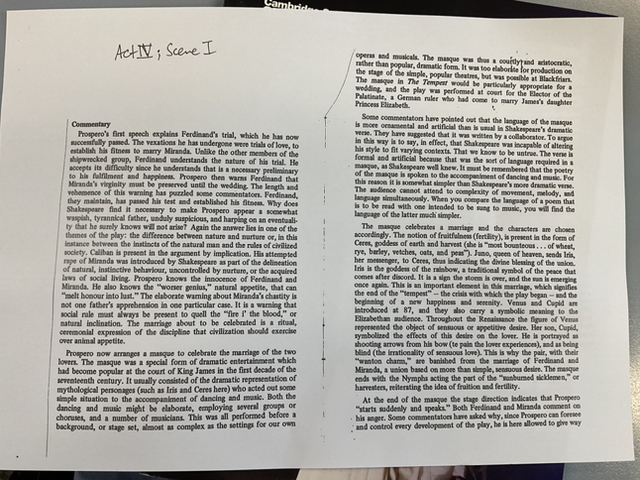
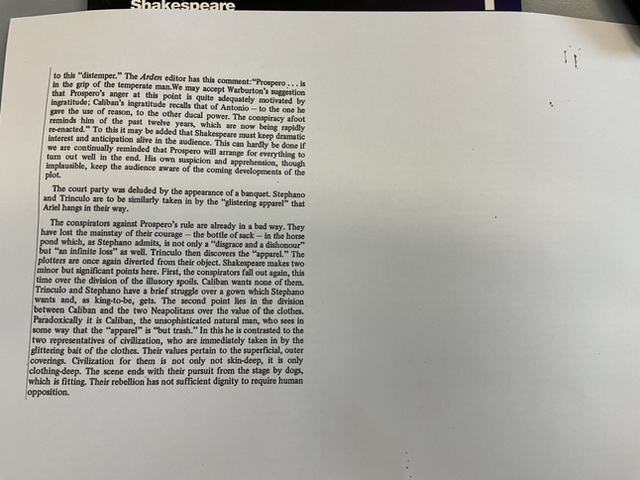
Prosperos outburst → rage against caliban (colonists’ attitude?) + Nature vs nurture
Prosp and Ariel
Drunken ‘conspirators’ enter and eventually are ran off → calibans situation has not improved, despite his new ‘master’; consider the attitudes of the three towards the clothing (civilisation vs savagery)
The Tempest – Act 4, Scene 1: Pages 116–121
📖 Page 116–117 — Ariel describes the punishment
Prospero is punishing Caliban, Stephano and Trinculo because they have plotted against him and want to take control of the island.
Ariel explains how he has tricked and frightened them, using magical illusions and disgusting images.
The descriptions of filthy creatures, smells and insects make the scene grotesque but also comic.
The conspirators are made to look ridiculous and powerless, rather than genuinely dangerous.
🧙 Prospero and Ariel
Prospero is pleased with Ariel’s work and says:
“This was well done, my bird!”
“my bird” shows Prospero’s affectionate but controlling relationship with Ariel.
Prospero tells Ariel to continue distracting the men.
🌿 Nature vs Nurture
Prospero then gives his opinion of Caliban:
“A devil, a born devil, on whose nature / Nurture can never stick.”
Prospero believes Caliban is naturally evil.
“born devil” → suggests Caliban was evil from birth.
“Nurture can never stick” → Prospero believes education and upbringing cannot change him.
This introduces the important nature vs nurture debate:
Is Caliban naturally violent?
Or has Prospero’s treatment of him helped make him rebellious?
⸻
👕 Page 118–119 — The clothes distract the conspirators
Ariel provides beautiful clothes to tempt Caliban, Stephano and Trinculo.
Stephano and Trinculo immediately become interested in the clothes.
This is ironic because they are supposed to be carrying out a serious plan to overthrow Prospero.
😂 Caliban is actually the sensible one
Caliban tries to keep them focused:
“Let it alone, thou fool. It is but trash.”
He understands that the clothes are a distraction.
However, Stephano and Trinculo are too interested in them.
💰 Greed
The clothes reveal how greedy and easily distracted Stephano and Trinculo are.
Caliban becomes frustrated:
“What do you mean / To dote thus on such luggage?”
“dote” means to become excessively interested in something.
“luggage” makes the clothes sound worthless, showing that Caliban understands they are being foolish.
👑 Stephano’s desire for power
Caliban reminds them of their actual plan:
“Do that good mischief which may make this island / Thine own forever.”
They want to remove Prospero and make the island their own.
Stephano’s ambition is also shown when he says:
“I do begin to have bloody thoughts.”
This shows that their plan is genuinely violent, even though Shakespeare presents it comically.
🎭 Appearance vs reality
The clothes appear valuable, but they are actually part of Prospero’s trap.
This connects to the theme of appearance vs reality.
The men think they are gaining possessions and power, but they are actually being controlled by Prospero.
🐶 Page 120–121 — The spirits attack
Despite Caliban’s warnings, Stephano and Trinculo continue taking the clothes.
Ariel and Prospero then send spirits disguised as dogs and hounds after them.
The men are chased away, creating a comic stage spectacle.
🎭 Why is this funny?
The three men have been planning a murder and rebellion.
Instead of becoming powerful rulers, they end up:
fighting over clothes
being chased by magical dogs
running away in fear
Shakespeare therefore makes them look stupid and incompetent.
⚡ Prospero’s power
Prospero commands Ariel and the spirits to attack them.
He says:
“I will plague them all / Even to roaring.”
“plague” suggests severe suffering.
This shows that Prospero’s magic gives him enormous power over other people.
⚖ Has power gone to Prospero’s head?
Prospero’s punishment can be seen as justified because the men planned to kill him.
However, he also seems to enjoy having complete control over them.
This makes us question whether Prospero is becoming cruel or vindictive.
The scene therefore presents power as something that can be used for justice but also abused.
🧚 Ariel’s freedom
At the end of the scene, Prospero tells Ariel:
“Shortly shall all my labours end”
“thou / Shalt have the air at freedom.”
Prospero promises that Ariel will finally be free once his work is complete.
This is important because Ariel has been serving Prospero throughout the play.
It also shows that Prospero’s plan is nearly finished.
📦 THEME BOX — Nature vs Nurture
Prospero believes Caliban is naturally evil.
“A devil, a born devil” → Caliban’s evil is presented as something he was born with.
“Nurture can never stick” → Prospero believes education cannot change Caliban.
However, the audience can question Prospero’s judgement because Prospero himself educated and controlled Caliban.
Caliban’s rebellion could therefore come from both:
Nature → his natural character.
Nurture → his experiences under Prospero’s control.
Key idea: Shakespeare makes us question whether people are born evil or shaped by their experiences.
👤 CHARACTER BOX — Prospero: Has power gone to his head?
Prospero has complete control because of his magic.
He controls Ariel and the spirits and uses them to punish his enemies.
“I will plague them all / Even to roaring.”
Shows his willingness to make his enemies suffer.
However, his punishment is understandable because Stephano, Trinculo and Caliban are plotting to kill him and take his island.
“I do begin to have bloody thoughts.”
Shows Stephano’s plan is genuinely violent.
Prospero therefore has a justifiable reason to use his power, but the cruelty of his punishment makes us question whether he is going too far.
His treatment of the conspirators shows both his authority and his potential for revenge.
By promising Ariel freedom — “Shalt have the air at freedom” — Prospero also shows that he can eventually choose to release rather than control.
⭐ Overall
Prospero = powerful, intelligent and justified, but potentially cruel.
Caliban = rebellious and possibly shaped by his treatment.
Stephano + Trinculo = greedy, foolish and easily manipulated.
Ariel = loyal servant who is finally promised freedom.
ACT 5 SCENE 1
Resolution/denouement
‘virtue’ not ‘vengeance’
Prospero is shaken by Ariel’s feeling towards those affected by his magic; breaks staff (re-humanises Prospero?)
A series of resolutions - each ‘conflict’ with characters is addressed (including Ariel)
Denouement → Prospero’s ’arranged marriage’ ends enmity with Alonso (they are family now)
Prospero asks for freedom (Shakespeare too?)
Order restored
Chaos banished
Purpose of comedy
to have a functioning society, people have to ‘get along’; if you are the cause of chaos, you need to take a hard look at yourself.
The Tempest – Act 5, Scene 1: Pages 124–126
📖 Page 124 — Prospero’s “project”
Prospero’s plan has several purposes:
Revenge → punish Alonso, Sebastian and Antonio.
Repentance → make them realise their wrongdoing.
Reform → encourage people to change.
Reconciliation → restore peace between Milan and Naples.
Freedom → eventually free Ariel and leave the island.
His “project” is therefore not simply revenge; it is about restoring order and harmony.
Most importantly, Prospero must learn to control his own anger.
🔮 Prospero: magician or scientist?
His magic is described almost like scientific experimentation/alchemy.
He carefully plans and controls nature through his magic.
His magic also transforms people, especially Prospero himself.
⸻
📖 Page 125 — Ariel changes Prospero’s mind
Alonso and the others are trapped and full of “sorrow and dismay.”
Ariel describes Alonso crying:
“His tears run down his beard like winter’s drops.”
This shows Alonso’s suffering is genuine and makes Prospero feel sympathy.
❤ Ariel’s compassion
Ariel says:
“Mine would, sir, were I human.”
Ariel means that if he were human, he would feel compassion for Alonso.
This makes Prospero realise that he should also show mercy.
⸻
⚖ Virtue vs Vengeance
Vengeance
Prospero has been deeply hurt by his enemies.
Earlier, he wanted to punish them:
“I will plague them all / Even to roaring.”
Virtue
Now Prospero decides forgiveness is greater than revenge:
“The rarer action is / In virtue than in vengeance.”
“rarer” → forgiveness is harder and therefore more admirable.
Prospero’s greatest victory is controlling his anger, not defeating his enemies.
⭐ Key idea:
Revenge is easy; forgiveness requires self-control.
⸻
🧠 Prospero’s internal conflict
“With my nobler reason, ’gainst my fury / Do I take part.”
“reason” → tells him to forgive.
“fury” → wants revenge.
Prospero chooses reason over anger.
He then tells Ariel:
“Go, release them, Ariel.”
This marks the end of his revenge.
⸻
🪄 Prospero gives up his magic
Prospero lists the incredible things his magic can do:
“bedimmed / The noontide sun”
“called forth the mutinous winds”
“given fire”
This reminds us how powerful he is.
But he decides:
“This rough magic / I here abjure.”
“abjure” = reject/give up.
He chooses to stop using magic.
Finally:
“I’ll drown my book.”
The book represents his magical knowledge and power.
Destroying it symbolises Prospero returning to ordinary human life.
⸻
🧚 Ariel and freedom
Prospero promises Ariel:
“Shalt have the air at freedom.”
Ariel has served Prospero throughout the play.
Now Prospero is finally willing to let go of his control.
This mirrors Prospero giving up his own magic.
⸻
⭐ CHARACTER BOX — Prospero
Beginning: angry, controlling and revengeful.
Act 5: compassionate, reasonable and forgiving.
He learns that true power is controlling yourself, not controlling others.
His transformation is shown through:
“I will plague them all” → revenge
“The rarer action is / In virtue than in vengeance” → forgiveness
“Go, release them, Ariel” → mercy
“This rough magic I here abjure” → giving up power
“I’ll drown my book” → complete transformation
🎯 Most important quotes
“The rarer action is / In virtue than in vengeance.” → forgiveness > revenge
“With my nobler reason, ’gainst my fury” → reason defeats anger
“Go, release them, Ariel.” → Prospero chooses mercy
“This rough magic I here abjure.” → gives up magic
“I’ll drown my book.” → rejects his magical power
“Shalt have the air at freedom.” → Ariel’s freedom
PG 133
🤝 Reconciliation & Forgiveness
“Let me embrace thee”
Physical imagery → Prospero embraces Gonzalo.
Shows forgiveness and reconciliation.
Contrasts with the betrayal and conflict earlier in the play.
Prospero is moving from revenge → forgiveness.
“most wicked sir, whom I call brother”
Juxtaposition of “wicked” and “brother”.
Highlights Antonio’s betrayal despite being family.
Shows Prospero is willing to forgive his brother.
👑 Power & Restoration
“My dukedom of thee… Thou must restore”
Possessive language → “my dukedom”.
Prospero demands the return of what Antonio stole.
Shows justice and restoration, rather than revenge.
Links to the beginning: Antonio took Milan → Prospero regains Milan.
💔 Alonso & Ferdinand
“My dear son Ferdinand”
Emotive language → “dear”.
Shows Alonso’s strong love for his son.
Links to earlier scenes where Alonso believes Ferdinand has died.
“How sharp the point of this remembrance is”
Metaphor → memory is compared to something sharp.
Shows how painful Alonso’s grief and memories are.
Links to Prospero’s own painful memories of Antonio’s betrayal.
“Irreparable is the loss”
Absolute language → Alonso believes Ferdinand can never return.
Dramatic irony: the audience knows Ferdinand is actually alive.
Creates anticipation for the father-son reunion.
“I have lost my daughter”
Parallel between Prospero and Alonso.
Alonso thinks he has lost Ferdinand; Prospero claims he has lost Miranda.
Connects them through shared grief and family love.
🔗 Important links across the play
Beginning:
Antonio betrays Prospero → Prospero wants revenge.
Middle:
Prospero separates Ferdinand and Miranda → uses his magic to control events.
Act 5:
Prospero reunites families → forgives his enemies → restores his dukedom.
⭐ Character development:
Prospero: CONTROL → REVENGE → FORGIVENESS → RECONCILIATION
🎯 Main themes
🤝 Forgiveness & reconciliation
👑 Power & restoration
❤ Family & love
💔 Loss & grief
🧠 Memory
⚖ Justice vs revenge
⭐ Overall argument
Shakespeare presents Act 5 as a movement away from revenge and towards forgiveness, using Alonso and Prospero’s experiences of family loss to bring characters back together.