IB HOTA HL I: PRE-CIVIL WAR (UNIT 3)
AVA LEUNG
IB HOTA HL 1: PRE-CIVIL WAR (UNIT 3)
Secede
Withdraw formally from membership in a federal union, an alliance, or a political or religious organization
South did this due to Abraham Lincoln winning the election and sectional issues over slavery
1st to Secede: South Carolina (Dec. 20, 1860)
Fire-eaters
Southerners would encourage secession for the union, radicals
Abolitionists
People (majority Northerners) who believed that slavery should be against the law
Cult of Domesticity
The notion that women's place was in the home
King Cotton
Expression used by Southern authors and orators before Civil War to indicate economic dominance of Southern cotton industry, and that North needed South's cotton. Coined by James Hammond
57% of total U.S. exports
Peculiar Institution
Its use in the first half of the 19th century reflected a growing division between the North and South
Manumission
A grant of legal freedom to an individual slave by their owner
German Coast Uprising
Slave revolt that occurred east of the Mississippi. 200 rebels destroyed plantation and killed men
Sovereignty
Ability of a state to govern its territory free from control of its internal affairs by other states
Second Party System
Emerged when Andrew Jackson first ran for the presidency in 1824. The period from the mid-1830's to the 1850's when Democrats and Whigs were the two main parties
Whigs
Conservatives and popular with pro-Bank people and plantation owners. They mainly came from the National Republican Party, which was once largely Federalists. Their policies included support of industry, protective tariffs, and Clay's American System. They were generally upper class in origin. Included Clay and Webster
Patronage
Giving jobs/privileges to supporters of a politician
States' Rights
Political powers held for the state governments rather than the federal government
VA and KY Resolutions
Written anonymously by Jefferson and Madison in response to the Alien and Sedition Acts, they declared that states could nullify federal laws that the states considered unconstitutional
Hartford Convention
Meeting of Federalists near the end of the War of 1812 in which the party listed its complaints against the ruling Republican Party. These actions were largely viewed as traitorous to the country and lost the Federalist much influence
New England federalist met at this convention to denounce the imperialism of republicans, asserted rights of states, and refused traction to support the war
Nullification
A state's refusal to recognize an act of Congress that it considers unconstitutional
Tariff of Abomination
1828 - Also called Tariff of 1828, it raised the tariff on imported manufactured goods. The tariff protected the North but harmed the South; South said that the tariff was economically discriminatory and unconstitutional because it violated state's rights
Sectionalism
Loyalty to one's own region of the country, rather than to the nation as a whole
Egalitarian
Promoting equal rights for all people
Hinton Helper
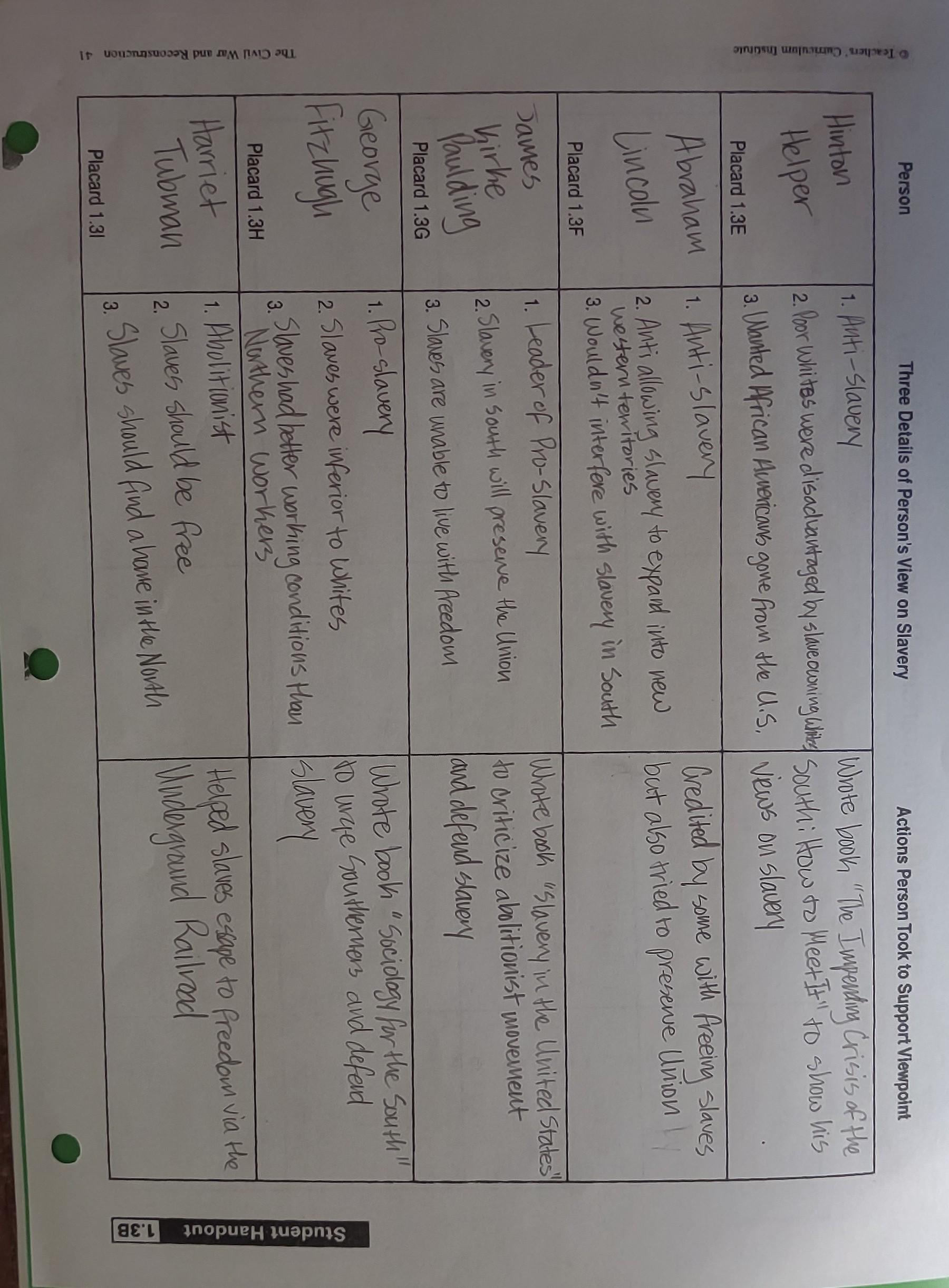
Southern critic of slavery during the 1850s who wrote a book entitled The Impending Crisis of The South. The book put forth the notion that slavery hurt the economic prospects of non-slaveholders, and was an impediment to the growth of the entire region of the South
William Lloyd Garrison
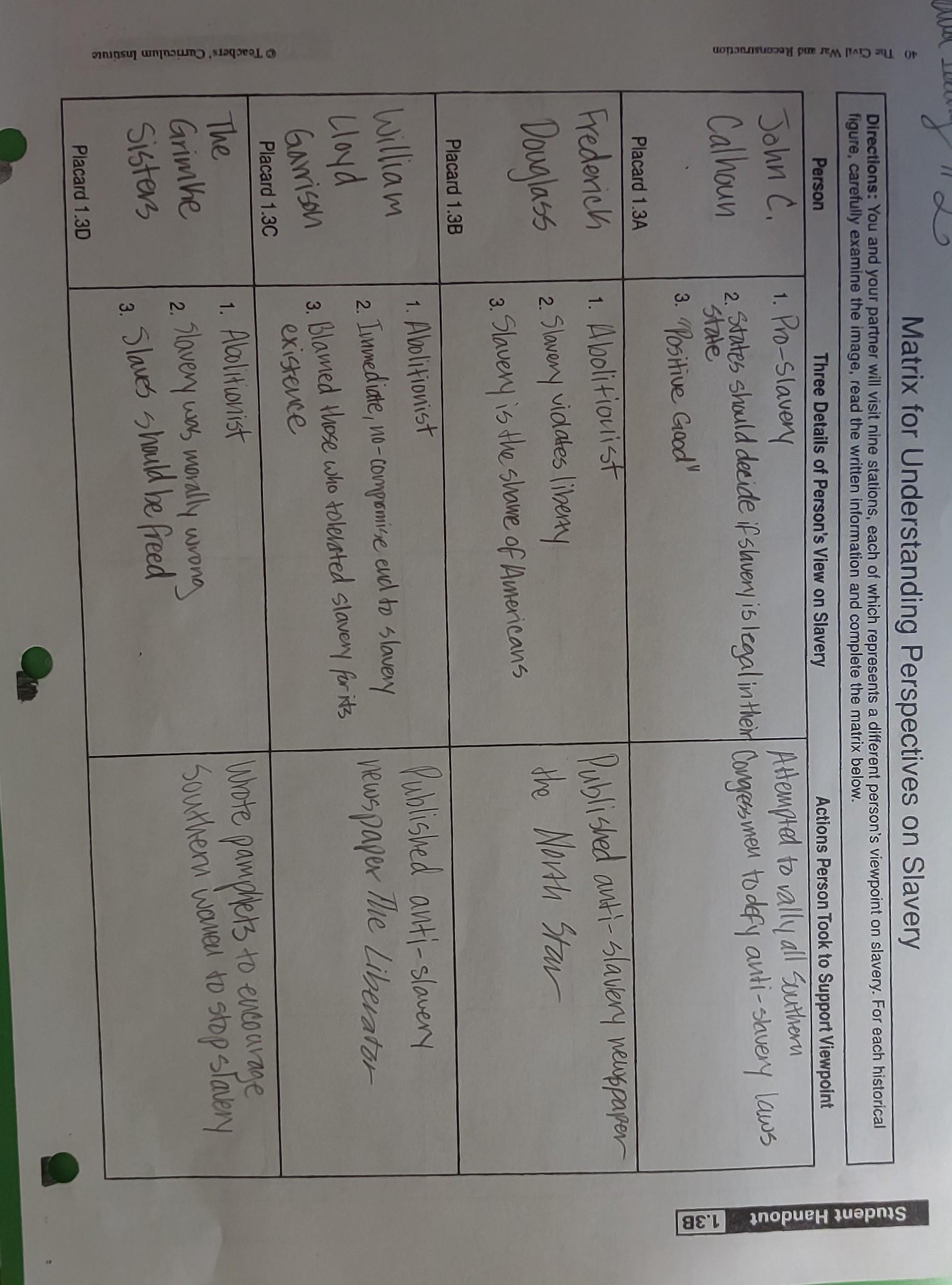
(1805-1879) Prominent American abolitionist, journalist and social reformer. Editor of radical abolitionist newspaper "The Liberator", and one of the founders of the American Anti-Slavery Society
Idealist with very little real plans
Tappan Brothers
Successful merchants in NYC; used wealth to fund antislavery activities and pamphlets
The Liberator
Anti-slavery newspaper written by William Lloyd Garrison. Drew attention to abolition, both positive and negative, causing a war of words between supporters of slavery and those opposed
Dwight Weld
American antislavery crusader in the pre-Civil War period. He left his studies in 1834 to become an agent for the American Anti-Slavery Society, recruiting and training people to work for the cause. He wrote pamphlets (largely anonymous), notably The Bible Against Slavery (1837) and Slavery As It Is (1839)
Frederick Douglass
(1817-1895) American abolitionist and writer, he escaped slavery and became a leading African American spokesman and writer. He published his biography, The Narrative of the Life of Frederick Douglass, and founded the abolitionist newspaper, the North Star
Senator James H. Hammond
(1807-1864) Representative, Governor, and Senator for South Carolina. One of the major spokesmen in favor of slavery in the years before the American Civil War
George Fitzhugh
Social theorist who published racial and slavery-based sociological theories in the antebellum era. He argued that "the Negro is but a grown up child" who needs the economic and social protections of slavery (paternalism). He went as far as to say that black slaves were in a much better situation than poor, freed blacks
Missouri Compromise
"Compromise of 1820" over the issue of slavery in Missouri. It was decided Missouri entered as a slave state and Maine entered as a free state and all states North of the 36th parallel were free states and all South were slave states
Henry clay
Manifest Destiny
Notion held by a nineteenth-century Americans that the United States was destined to rule the continent, from the Atlantic the Pacific
James K. Polk
President of the U.S, focused on manifest destiny and declared war of Mexico
Mexican-American War
(1846-1848) - President Polk declared war on Mexico over the dispute of land in Texas. At the end, American ended up with 55% of Mexico's land
Treaty of Guadalupe-Hidalgo
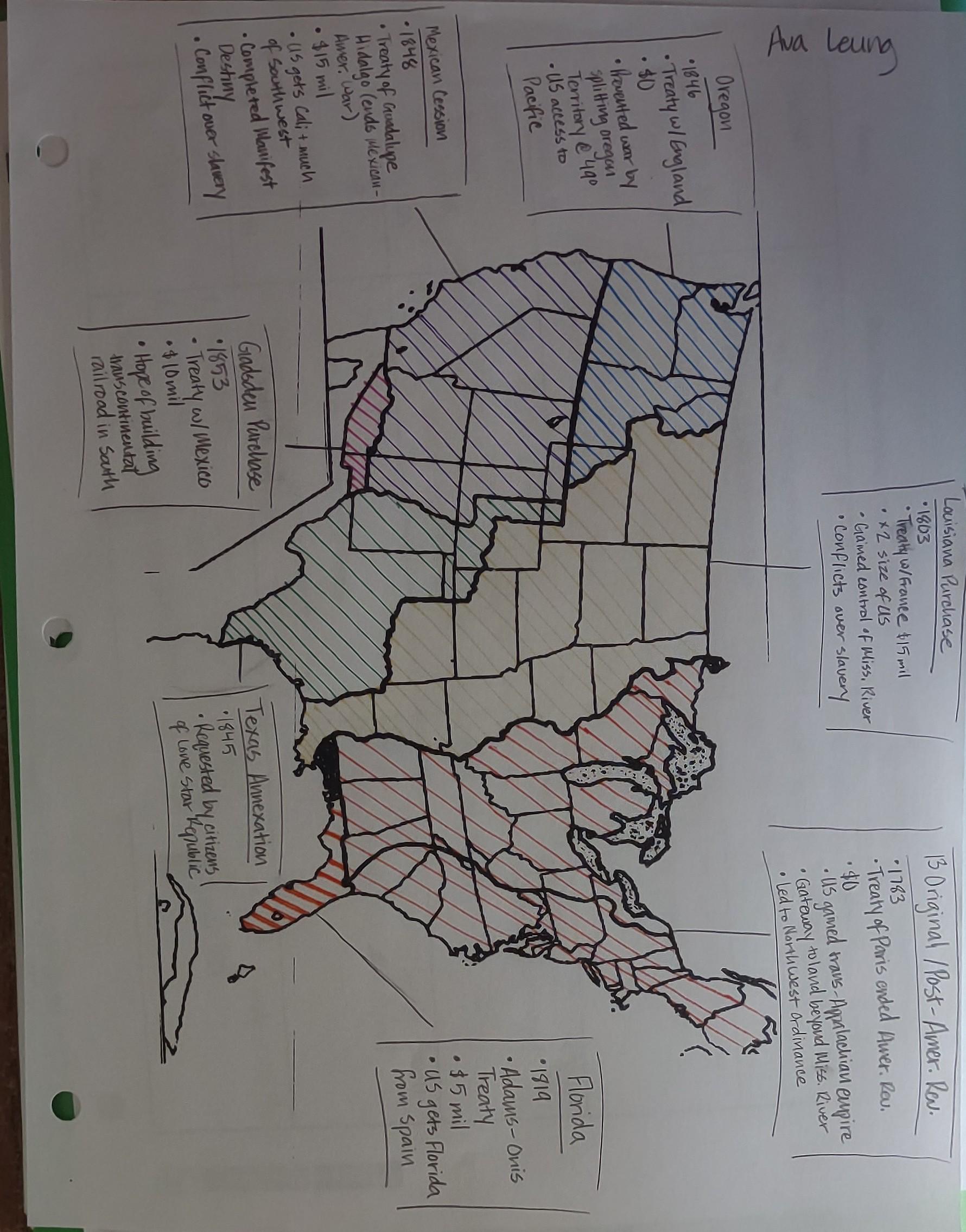
Treaty that ended the Mexican War, granting the U.S. control of Texas, New Mexico, and California in exchange for $15 million
Wilmot Proviso
1846 proposal that outlawed slavery in any territory gained from the War with Mexico
Calhoun Doctrine
Slaves are property. People are free to take property anywhere in USA. Congress has no right to enforce Missouri Compromise
Popular Sovereignty
Government in which the people rule by their own consent
Free Soil Party
Formed in 1847 - 1848, dedicated to opposing slavery in newly acquired territories such as Oregon and ceded Mexican territory
Stephen A. Douglas
Moderate senator from Illinois who ran for president against Abraham Lincoln. He introduced the Kansas-Nebraska Act in 1854 and popularized the idea of popular sovereignty. Wrote the Kansas-Nebraska Act and the Freeport Doctrine
Compromise of 1850
Henry clay
Stephen Douglas broke it up to pass through congress
(1) California admitted as free state
(2) territorial status and popular sovereignty of Utah and New Mexico
(3) resolution of Texas-New Mexico boundaries
(4) federal assumption of Texas debt
(5) slave trade abolished in DC
(6) new fugitive slave law; advocated by Henry Clay and Stephen A. Douglas
Henry Clay
Distinguished senator from Kentucky. He was a strong supporter of the American System, a war hawk for the War of 1812, Speaker of the House of Representatives, and known as "The Great Compromiser." Outlined the Compromise of 1850 with five main points. Died before it was passed however
Daniel Webster
Famous American politician and orator. He advocated renewal and opposed the financial policy of Jackson. Many of the principles of finance he spoke about were later incorporated in the Federal Reserve System. Would later push for a strong union
Fugitive Slave Act
Law that made it a crime to help runaway slaves; allowed for the arrest of escaped slaves in areas where slavery was illegal and required their return to slaveholders
Uncle Tom's Cabin
Anti-slavery novel by American author Harriet Beecher Stowe. Published in 1852, the novel had a profound effect on attitudes toward African Americans and slavery in the U.S. and is said to have "helped lay the groundwork for the Civil War"
Gadsden Purchase
Agreement w/ Mexico that gave the US parts of present-day New Mexico & Arizona in exchange for $10 million; all but completed the continental expansion envisioned by those who believed in Manifest Destiny
Allowed Southern railroad expansion to the Pacific
Ostend Manifesto
The recommendation that the U.S. offer Spain $20 million for Cuba. It was not carried through in part because the North feared Cuba would become another slave state
Kansas-Nebraska Act
1854 - Created Nebraska and Kansas as states and gave the people in those territories the right to chose to be a free or slave state through popular sovereignty
Nebraska: not climate for slavery and Kansas: climate allows slavery
Know-Nothings
American Party; anti-immigrant and anti-Catholic
Republican Party
1854 - anti-slavery Whigs and Democrats, Free Soilers and reformers from the Northwest met and formed party in order to keep slavery out of the territories
Free Soil: Non-extension of slavery
No. Industrialists: Protective tariff
Know-Nothings (Disappointment): No abridgment of rights for immigrants
Northwest: Government aid to build a Pacific railroad
West: Internal improvements at fed. expense
Farmers: Free homesteads for the public domain
Bleeding Kansas
Sequence of violent events involving abolitionists and pro-Slavery elements that took place in Kansas-Nebraska Territory. The dispute further strained the relations of the North and South
Pottawatomie Creek Massacre
In 1856, abolitionist John Brown and his sons attacked this pro-slavery farm settlement and killed five settlers
Charles Sumner
Radical Republican against the slave power who insults Andrew Butler in his speech “The Crime Against Kansas” and subsequently gets beaten by Preston Brooks
Preston Brooks
Congressman from South Carolina, notorious for brutally assaulting senator Charles Sumner on the floor of the United States Senate
John C. Frémont
American military officer, explorer, the first candidate of the Republican Party for the office of President of the United States, and the first presidential candidate of a major party to run on a platform in opposition to slavery
Mormons/Polygamy
Church founded by Joseph Smith in 1830 with headquarters in Salt Lake City, Utah, religious group that emphasized moderation, saving, hard work, and risk-taking; moved from IL to UT
Act of having more than one spouse
Dred Scott Case
Supreme Court case which ruled that slaves are not citizens but are property, affirmed that property cannot be interfered with by Congress, slaves do not become free if they travel to free territories or states, fueled abolitionist movement, hailed as victory for the south
Chief Justice Roger B. Taney delivered decision on the case
Panic of 1857
Economic downturn caused by over-speculation of western lands, railroads, gold in California, grain. Mostly affected northerners, who called for higher tariffs and free homesteads
Lecompton Constitution
Pro-slavery constitution suggested for Kansas' admission to the union (rejected)
Stephen Douglas supported it because he believed in popular sovereignty
Lincoln-Douglas Debates
Series of debates between Abraham Lincoln and Stephen Douglas over the issue of slavery
Freeport Doctrine
Idea authored by Stephen Douglas that claimed slavery could only exist when popular sovereignty supported it
John Brown
(1800-1858) Abolitionist who was hanged after leading an unsuccessful raid at Harpers Ferry, Virginia. Also involved in "Bleeding Kansas"
Raid at Harpers Ferry
Effort by abolitionist John Brown to initiate an armed slave revolt in 1859 by taking over a United States arsenal at Harpers Ferry, Virginia. Eventually surrounded and defeated by US Marines, led by Robert E. Lee. Brown was tried, found guilty of treason, and hanged
John Breckinridge
Senator from Kentucky and V.P. under James Buchanan. An unsuccessful candidate for President in 1860, nominated by the Southern faction of the split Democratic party, losing to Abraham Lincoln but receiving more electoral votes than the other major candidates. He won the South with his pro-slavery platform, but was unable to win the Border States; received almost no support in the North. Strongly for slavery and states' rights
Constitutional-Union Party
Political party formed in 1860 by a group of northerners and southerners who supported the Union, its laws, and the Constitution
Confederacy (CSA)
Alliance of 11 Southern states to form a new nation (Confederate States of America)
Fort Sumter
Federal fort in the harbor of Charleston, South Carolina; the confederate attack on the fort marked the start of the Civil War
First shots of the War
Planter Class
Elite social class formed by Southern Plantation owners
Antebellum
Pre-Civil war period name
Border States
The states between the North and the lower South
Border Ruffians
Proslavery raiders who crossed into the Kansas Territory from Missouri during the mid-19th century to help ensure the territory entered the United States as a slave state
Class Notes
Cotton Gin: Eli Whitney (inventor)
Forming families as a way for slaves to resist
1852 Prez Election:
Winner: Franklin Pierce (Democrat)
Gen. Winfield Scott (Whig)
John Parker Hale (Free Soil)
1856 Prez Election:
Winner: James Buchanan (Democrat)
John C. Frémont (Republican)
Millard Fillmore (Whig)
1860 Prez Election:
Winner: Abraham Lincoln (Republican)
John Bell (Constitutional-Union)
Stephen A. Douglas (N. Democrat)
John C. Breckinridge (S. Democrat)
Crittenden Compromise
“Last Ditch Appeal to Sanity”
Sen. John J. Crittenden (KY Know-Nothing)