The Ultimate Guide to AP United States Government and Politics (copy)
Unit 1: Foundations of American Democracy
Republicanism: supports individualism and natural rights, popular sovereignty (people give the government power), encourages civic participation
The Declaration of Independence
A formal declaration of war between America and Great Britain
Written by Thomas Jefferson
List of grievances (“crimes” King George III committed against the colonies)
Used to explain why the colonies are declaring independence
Used as a template by other nations declaring independence
The Weaknesses of the Articles of Confederation
Accomplishments:
Created federalism: the way in which federal and state/regional governments Interact and share power
Ended the Revolutionary War on favorable terms for the United States (Treaty of Paris - 1783)
Weaknesses:
1787: trade between states declined, monetary value dropped, foreign countries posed threats, social disorder throughout the country
Shays’ Rebellion
Major concern at the Constitutional Convention
Exposed issues with Articles of Confederation and showed necessity of a strong central government
Could not impose taxes (result of taxation without representation); only state governments could levy taxes
National government was in debt from the Revolutionary War had no way to pay for expenses
Could only acquire money by requesting it from states, borrowing from other governments, or selling lands in the West
No national military; could not draft soldiers
No national currency
No Supreme Court to interpret law
No executive branch to enforce laws
No control over taxes imposed between states and could not control interstate trade
Needed unanimous votes to amend the Articles
9/13 states had to approve legislation before it was passed
Could not control states
No enforcement mechanisms/requests from within federal government
Needed to be revised
Constitutional Convention created Constitution
resulted in complete rewrite of the Articles => Constitution
The Constitutional Convention
brutus 1
critiqued the draft of the Constitution
National government had too much power, an army could prevent liberty, and representatives may not truly be representative of the people
Federalist No. 10
Addresses dangers of factions + how to protect minority interest groups in a nation ruled by majority
Argues that a large republic keeps any single faction from taking control
Federalist No. 51
Argued that separation of powers would make the government efficient, dividing responsibilities and tasks
Federalist No. 70
Argued that the executive branch should only have one member: the president
energy in the exectitve and there should only bve one executive
Federalist No. 78
Addressed concerns about the power of the judicial branch
Argued that the judicial branch would have the least amount of power under the Constitution but would also have the power of judicial review
The Constitution as an Instrument of Government
Articles I-III: set up the three branches of government (in order):
Legislative branch
Executive branch
“The executive power shall be vested in a President of the United states of America”
Power to issue executive orders
Same effect as law, bypasses Congress in policy-making
Not mentioned in the Constitution
Used as part of the enforcement duties
Ex. Executive Order 9066: FDR ordered people (Japanese and German Americans) from a military zone
Executive agreements between country leaders are similar to treaties
Bypass ratification power of the Senate
Confederation: a system in which decisions are made by an external member-state legislation; decisions on daily issues are taken by special majorities, consensus, or unanimity
Powers Under Federalism
Denied powers:
Federal government:
Suspend writ of habeas corpus except during a national crisis
Pass ex post facto laws or issuance of bills of attainder
Impose export taxes
Use money from treasury without appropriations bill
Grant titles of nobility
State government:
Enter into treaties w/other countries
Declare war
Maintain an army
Print money
Pass ex post facto laws or issuance of bills of attainder
Grant titles of nobilities
Impose import or export duties
Grants:
Categorical grants: aid with strict rules from the federal government about how it is used
Used by those who favor federal power
Block grants: aid that lets the state use the money how it wants
Used by those who favor states’ rights
Federal government can still use techniques to make states follow federal law
Ex. direct orders, preemption
Advantages of federalism:
Mass participation (many can participate on many issues)
Regional autonomy (states still have some powers)
Multi-level government (local, state, federal; many politicians connected to supporters)
Innovative methods (states can experiment with policies)
Diffusion of power (no party domination)
Diversity in government
Disadvantages of federalism
Lack of consistency (differing policies creates inequality in states)
Inefficiency (overlapping/contradictory policies)
Bureaucracy (corruption/stalemate through spread-out power)
Resistance
Inequity (legislation/judicial outcomes)
Separation of Powers
President is empowered to negotiate treaties, but they cannot go into effect until approved by 2/3 of the Senate
Congress can override veto by passing a law with 2/3 majority in both houses
Unit 2: Interactions Among Branches of Government
Congress
Congressional Structure
Congress: the bicameral legislature for writing laws
Oversees bureaucracy, clarifies and codifies policy, represents citizens, build consensus
House of Representatives: a 435-member house, with members apportioned by each state’s population (designed to represent population)
Senate: a 100-member house, with 2 members per state (designed to represent states equally)
Census: a survey taken every 10 years to count population and determine the number of congressional districts each state has
Redistricting: the redrawing of district boundaries to ensure each district has an equal population done by state legislature
Gerrymandering: drawing district boundaries to give the majority party a future advantage
Does not apply for Iowa; uses an independent commission to draw district lines
Helps incumbents
Some states have such small populations that the entire state becomes a district
Each state is guaranteed one seat in the House
Congressional Elections
Congressional Districts and Representation
Voting Rights Act of 1965: encouraged states to increase minority representation in Congress
Non-legislative Tasks of Congress
Oversight: reviews federal agencies’ work (checks executive branch), investigates charges of corruption, holds hearings (experts and citizens discuss government issues and propose solutions)
Delegate Model (representational view): consider themselves delegates who mirror the views of their districts
Trustee Model (attitudinal view): some consider themselves trustees who should think about constituents’ views but use their judgement when making decisions
Electoral duties: House can elect next president if neither candidate gets 270 votes, Senate picks VP
Impeachment: House has power over impeachment; if majority votes to impeach an official, the Senate runs the impeachment trial and convicts/removes the official from office with 2/3 of Senate votes
Confirmation duties: Senate can approve both presidential appointments and federal officials
Ratification: only Senate can ratify treaties if 2/3 votes
Senate can influence international relations and foreign policy
Investigation: can be conducted by either a standing or committee and may last months while members gather evidence and witnesses
Majority lead to new legislation to address the issue, changes in programs, or officials’ removal from office
Legislative Process
Slow and complicated
Prevents decisions from being made too quickly
Facilitates compromise and communication between both sides
Bills
10,000 bills introduced every year
Some written by Congress members and staff
Others are written by executive branch and introduced by Congress members
Many are written or suggested by interest groups + lawyers
Can only be proposed by a Congress member (the sponsor of the bill)
Requires two houses to work together
Both houses must pass the same bills
Different debate and voting processes
House of Representatives:
Debates about bills are limited in House of Representatives (too many people)
Rules Committee: determines how long a bill will be debated and whether open or closed rules for amending bills are allowed
Open rules allow amendments
Closed rules forbid amendments
Republicans (majority) in 1994 promised open rules for most bills
Considered most powerful committee in House
Can kill a bill by postponing vote or make it easy for an opponent to add killer (poison-pill) amendments
Can bring bills up for immediate vote
Senate:
Does not strictly control debate, no time constraints
Filibuster: used to delay bill’s vote and tie up Senate’s work, usually by a senator making a very long speech
Can happen without speeches
Senate majority may require a traditional filibuster if needed
Cloture: the vote which is the only way to end a filibuster, requires votes of 60 members
No closed rules
Riders: amendments, do not have to be relevant to bill, allow senators to add amendments
Pork barrels: “pet project” riders created to get money to a home state
Earmark: provisions in legislation that allot money to a project (appropriation and authorization bills)
Not allowed by House
Conference committee: committee each house’s version of a bill is sent to which come from the committees of each house that wrote the bill
Attempts to negotiate compromise bill
Compromise bill returns to both houses for voting
Failure to pass a compromise bill will kill it
Sent to White House if passed for presidential approval
President:
Bill becomes law after 10 days if president does nothing regardless of signature
Bill is pocket vetoed if president doesn’t sign every bill into law and congressional session ends during 10 days
President can veto entire bill if congressional session doesn’t end in 10 days and gives reasons for vetoing
Both houses can override veto by a two-thirds vote
Houses can also make any required changes
If house of origin does nothing with veto, bill is dead
Line-item veto: given to President Clinton in 1996 by Congress, allowed the president to veto certain parts of a bill
Clinton v. City of New York(1998): the Supreme Court struck down the line-item veto as an unconstitutional power of the president
Congress has tried to give itself veto power over the president
Wrote legislation giving Congress ability to void presidential actions by a vote of the houses
INS v. Chadha(1983): Supreme Court declared legislative veto unconstitutional
Legislation by Committee
Most legislative activities by Congress are in committees
Committee members are determined by many factors
Majority party of each house holds all committee chairs
Also holds most seats on each committee (2/3 on important committees)
Oldest/most experience member of majority party is chair and senior member from minority party is ranking member
Ranking member becomes chair if minority party becomes majority party
Assignments determined by House and Senate leaders + both parties’ caucus
Try to get on committees that will help them help the constituents the most and with reelection
Investigate and debate bills that otherwise wouldn’t be considered due to time
Call interested parties and expert witnesses (often lobbyists)
Congress can subpoena witnesses
After investigations committees amend and rewrite parts of bills in meetings known as markup sessions
Often first assigned to subcommittee for consideration
Often determine how money is spent
Most die because of lack of interest
Membership of committee and subcommittee is crucial
Bills written to appeal to certain committees
Can refuse to vote a bill out
Pigeonholed: a bill stuck in a committee
Discharge petition: the way to force a bill out of committee for a floor vote
Oversee bureaucratic agencies and departments
Heads of agencies often appear before congressional committees
Can subpoena witnesses (legally requires individuals to appear or produce requested documents)
Can hear testimony from agency heads asking for money or people
House has more committees and are more specialized because each member serves on fewer committees
Types of committees:
Standing committees: permanent, specialized
Ex. House Ways and Means, Senate Judiciary, Senate Armed Services
17 in the Senate, 20 in the House
Joint committees: made up of members of both houses
Normally used for investigations or communicating with the public
Select committees: temporary committees created in each house for a special reason
Usually carry out investigations to write special bills
Ex. House Watergate Committee, Senate Select Committee on Unfair Practices
Conference committee: temporary committees made up of members from committees of both houses who wrote a bill
Try to create compromise bills, then submit to both houses
Disbanded once a compromise bill is negotiated
Congressional Leadership
The House
The leader is the speaker
Chosen by the majority party in an election
Can direct floor debate and has influence over committee assignment and the Rules Committee
Can control which bills are assigned to certain committees
Majority leader is in charge of party members, determines party policy and agenda
Minority leader is in charge of minority party members, determines party’s agenda
Majority and minority whips help their leaders keep members loyal to the agenda, coordinate members, and get support for legislation
The Senate
President of the Senate is the vice president, only official responsibility
Only votes to break a tie
President pro tempore is the temporary president when the VP is absent
Mostly honorary position
Usually given to oldest member of the majority party
Majority leader controls agenda and acts as policy initiator and power broker
Minority leader is similar, not policy initiator or agenda controller
Why Do They Vote That Way?
Pressure to influence vote from own party and opposition
President jawbones (tries to influence) and colleagues logroll (mutual help)
PACs, constituents, and interest groups donate to try to influence votes
Judgment can be affected by personal ideology and religion
Party affiliation is most important factor
Notable Legislation
Rights and Freedoms
Bipartisan Campaign Reform Act (2002): AKA McCain-Feingold Bill; banned soft money to national political parties and raised hard money limits to 2,000 dollars; SCOTUS struck down several parts of this law in Citizens United v. FEC, especially parts related to donations made by corporations
The President
The Formal Powers of the Presidency
Article II, Section 2 of the Constitution
Responsible for serving as the ceremonial head of state, handling foreign policy, and enforcing laws
Administrative head of government
Can force Congress into session, brief Congress on State of the Union, veto legislation
Must cooperate with Congress (checks and balances)
Can appoint federal judges, SCOTUS justices, ambassadors, and department secretaries that must be approved by the Senate
Negotiates treaties that must be ratified by 2/3 of the Senate
Executive agreements do not require Senate approval, agreements between country leaders
The President as Commander in Chief
Commander in chief of the armed forces
Only Congress can declare war, but president can make war
Can mobilize armed forces
Chief strategist and director of military
Relies on Congress for money
Gulf of Tonkin Resolution (1964): gave president broad powers to bring unlimited troops for unlimited time to Vietnam
War Powers Act (1973): passed in an attempt to make president get congressional approval before making war, limiting president to 10,000 troops or 60 days and 30 additional days to withdraw
The Informal Powers
Build morale
Lead legislation and build coalitions
Set legislative agenda
Important when government is divided
Chief of party
Influence on party’s agenda, issues, policy, strategy, and direction
Divided government: when the president and majorities in houses are not from the same political party
Unified government: when the house majorities and the president are from the same political party
Persuade policy and communicate to Congress and the country
Bully pulpit lets the president speak with the American people and helps them to pressure Congress
Theories about how the president chooses to use power:
Literalist doctrine: president only has the powers listed in Article II of the Constitution and should not use power that is not granted; not followed by any president 1920s
Stewardship doctrine: gives the president the ability to use power in multiple ways and arenas; free to use any power not denied to them by the Constitution; increases power of president
Unitary executive theory: gives executive branch nearly unlimited power to develop any policy that is necessary
Executive Office of the President
Helps carry out president’s administrative responsibilities
Made up of agencies involved in the White House, divided into domestic, foreign, and military areas
Chief of staff: top aid to the president; very trustworthy and known for a long time; considered extremely powerful, manages Executive Office, controls access to president (+ information received by president)
National Security Counsel (NSC): headed by national security advisor, direct access to president in situations related to the military or foreign policy; involved during national emergencies, free from congressional oversight, favored by president
Domestic Policy Counsel: helps the president create policies related to agriculture, education, energy, natural resources, drug abuse, crime, health, the economy, and welfare
Office of Management and Budget (OMB): prepares US budget and used to control/manage executive agencies; very powerful because it is able to fund cabinet departments and control the department’s effectiveness
Council of Economic Advisors: helps the president make economic policy; made of economists to advise president
US trade representative: negotiates trade and tariff agreements with help from the White House
The Cabinet
Created through custom and usage, not by the Constitution
Cabinet departments created by acts of Congress to control executive branch responsibilities
Cabinet secretaries appointed by president + approved by Senate
Able to be dismissed by president
Run departments, carry out policies
Used to deflect criticism and explain/promote policy
Fight for their own department => friction between departments
Presidents don’t usually hold full cabinet meetings
15 cabinet departments in total (latest: Department of Homeland Security, created after 9/11)
Impeachment
Gives Congress the ability to remove president for crimes
Crimes undefined by Constitution-- up to legislative branch to decide
House of Representatives impeaches president (brings charges) by majority vote
Senate holds trial with Chief Justice presiding if impeachment passes w/two-thirds vote to remove president
Political disagreement over when impeachment should be used
Every impeachment has divided Congress between parties
No president has been removed from office
House impeached Andrew Johnson for violating Tenure in Office Act, Senate fell one vote short of removing him from office
Watergate scandal caused Richard Nixon to resign before impeachment could begin
Impeachment of Bill Clinton for lying under oath was political, slim chance of Senate conviction
Donald Trump impeached for abuse and power and obstruction of Congress, but not convicted by Senate
Federal judges can only be removed by impeachment and have lifetime terms
Only 8 have ever been removed
The Judiciary and the Law
American Legal Principles
Equal justice under the law
Due process of law
Substantive due process: whether laws are fair
Bill of Rights, 14th Amendment, Constitution
Procedural due process: whether laws are applied fairly
Adversarial system
Both sides must be represented
Opposite = inquisitorial system
Presumption of innocence
Innocent until proven guilty
Types of Law
Most legal cases involve civil law or criminal law
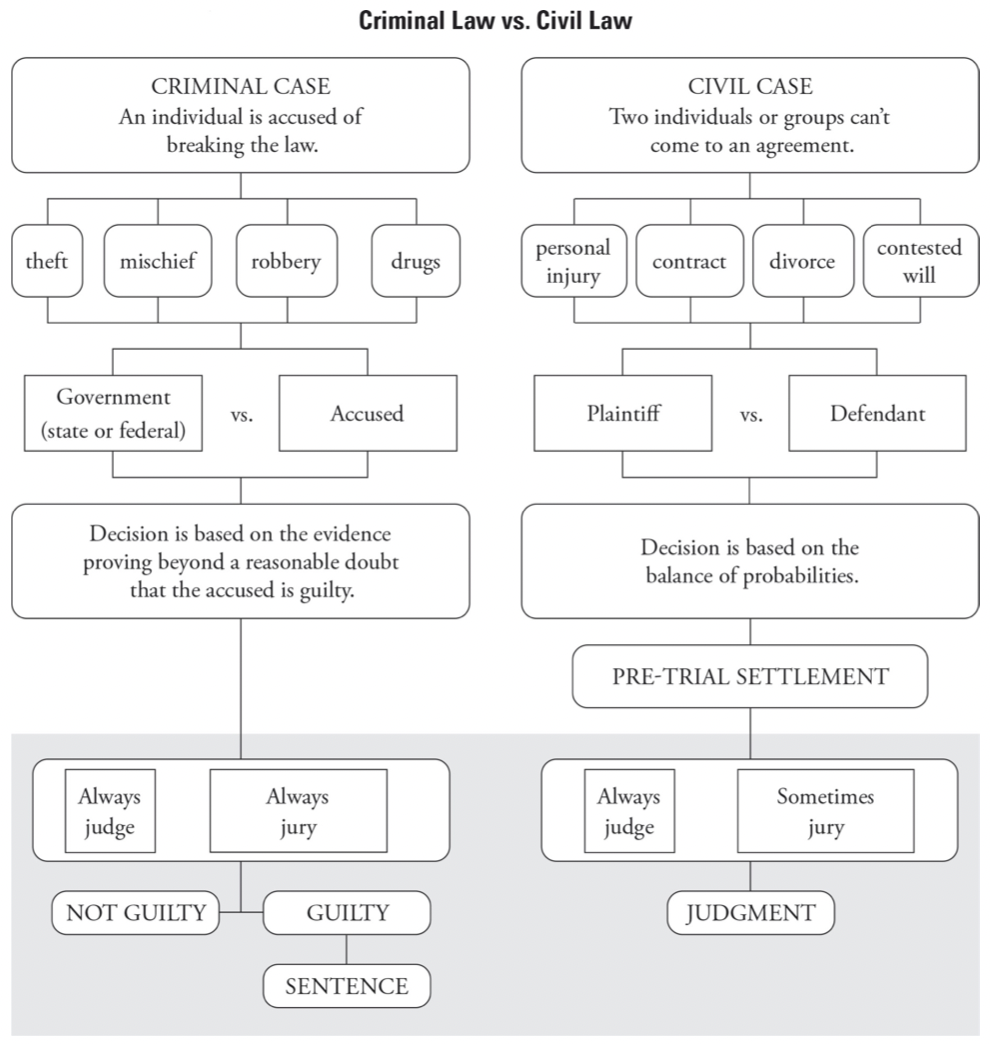
Criminal law involves crimes that harm others
Suspect arrested and to be indicted by grand jury (24-48 jurors, decide whether or not trial should begin
If accused is indicted they have the option of plea bargaining with the prosecution to agree to a less serious crime and sentence
Most cases end in plea bargains
State/US opposes accused in criminal trials
Prosecution should prove guilt beyond a reasonable doubt
Held before petit juries (12 people), decision known as verdict
Guilty verdict only returned if all 12 jurors vote to convict
Split jury = “hung jury”, results in a mistrial
Civil law solves conflicts over custody, contracts, property, or issue of liability
Government is not involved unless it is being sued
No prosecution
Plaintiff vs. defendant in civil court
Case moves forward if judge/jury thinks complaint has merit, settlement is used to avoid trial
Settlement = how much each party is willing to give up
Plaintiff only needs to show that a preponderance of evidence favors their side (~51% of evidence)
Juries can be made of as few as 5-6 members
Winning can result in payment of monetary damages or equity (loser forced to stop doing something that was annoying or harmful)
Structure and Jurisdiction
Federal courts responsible for interpreting/settling disputes from federal law
State courts responsible for interpreting/settling disputes from state law
Three levels of federal courts:
Federal District Courts: have original jurisdiction
Federal Circuit Court of Appeals: hear cases on appeal from District Courts
Supreme Court: hears appeals of cases dealing with the constitution from Circuit Courts and suits between states or cases involving foreign ministers
No jury
Collegial court - decisions made by 9 justices
Acts in appellate jurisdiction, can only decide issues of law and not facts of a case
94 Federal District Courts
Inferior to Supreme Court
Civil and criminal cases in original jurisdiction
Trial court that determines guilt/innocence is court of original jurisdiction
Heat evidence and use juries to decide verdict
dDecide liability in civil cases with monetary losses
Also have juries
Defendant can ask judge to decide a case, but a judge can refuse and force the defendant to have a jury trial
13 Circuit Courts of Appeals
Hear cases on appeal from Federal District Courts or state Supreme Court
Someone has to claim that a federal constitutional right has been violated
Decide issues of law and not fact
No juries - decisions made by panels of appointed judges
Court of last resort, Supreme Court almost never hears cases appealed from the Circuit Courts
Origins of most Supreme Court justices
The Politics of the Judiciary
All judges are appointed by the president for life
Must go through confirmation process in Senate
Impeachment is only method of removal
Appointments have become political
Some presidents have required potential appointees to fill out a questionnaire to determine political/judicial ideology
Nominees almost always of same party as president
In nomination hearings before Senate Judiciary Committee, both parties try to determine how appointees would rule in cases dealing with their issues
American Bar Association evaluates nominee’s qualifications and interest groups often show their opinions
Senators in a state where an appointee will sit have exercised senatorial courtesy - submit a list of acceptable nominees to president
Expected only when president and senators are the same party
Ideological changes in Court’s makeup has resulted in new precedents and rejection of old precedents
More precedents overturned since 1950s than in 150 years
Courts are seen as the least democratic, when they overturn an act of legislature they are overruling the people’s will
Judges who are hesitant to overturn legislature practice judicial restraint
Liberals see judges as constitutional interpreters who reflect the people’s values
Judicial activist: a judge who will readily overturn an act of legislature
Process by Which Cases Reach the Supreme Court
If 4 justices agree to review lower court’s decisions, court issues a writ of certiorari - document used to request lower court transcripts of case
The Bureaucracy
Secretary of department at head of each “pyramid”
Appointed by president, approved by Senate
Independent agencies: generally normal bureaucracies with presidential oversight
Regulatory agencies/independent regulatory commissions: more independence, act as watchdogs over federal government; Congress and president are not supposed to interfere
Iron triangle: informal alliance made of three groups: particular industry + lobbyists, congressional committee dealing with that industry, and the agency that is affected
Groups that make iron triangle work together to create and implement policy
Lobbyists representing industries promote their agendas by claiming it is in the best interest of the American people
Special interests contribute money to congressional campaigns, large donators ask for help from representatives
Alliance/issue network: a close working relationship formed when
Unit 4: American Political Ideologies and Beliefs
Characteristics of Public Opinion
Characteristics:
Saliency: the degree to which an issue is important to a certain individual/group
Intensity: how strongly people feel about a particular issue
Stability: how much dimensions of public opinion change
Measured indirectly through elections, but hard to translate
Referendum submitted to popular vote to accept/reject a legislation, measures public opinion on specific issues
Public opinion polls measure public opinion most frequently and directly
Public Opinion and the Mass Media
Unit 5: Political Participation
Political Models of Voting Behavior
Rational choice: what is in the citizen’s individual interest
Retrospective voting: whether or not a party/candidate should be reelected based on their performance
Prospective voting: the potential performance of a party/candidate
Party-line voting: voting for candidates from a single political party for all office
Media Influence on Elections
News media provides voters with daily campaign information
Report on positions but concentrate on polls
Prefer information that changes regularly and can be reported quickly (horse race aspect)
Campaign advertisements provide more controlled look at candidates
Attempt to build a positive image w/public and belittle opponents through negative advertising (especially when public knows little about a candidate)
policy making
Can have three purposes:
Solving a social problem (crime rates, unemployment, poverty)
Countering threats (terrorism, war)
Pursuing an objective (building highways, curing cancer, space exploration)
Economic Policy
Mixed economies: made of capitalist free-market systems where government and private industry play a role
Keynesian economics: the government can smooth out business cycles by influencing individuals’ income amounts and the amounts businesses can spend on goods and services
New Deal - 1930s
Fiscal Policy
Government action of raising/lowering taxes, resulting in more/less consumer spending or enacting of government spending programs
Keynesians think that government should spend money on projects during economic downturns to inject money into economy
Prosperous economy = larger tax base
Deficit spending: funds raised by borrowing, not taxation
Supply-side: believe that government should cut taxes and spending on programs to stimulate more production
Mandatory spending: required by law to fund programs such as entitlement programs, Medicare, Social Security, payment on national debt, and veterans’ pensions
Discretionary spending: not required by law, programs include research grants, education, defense, highways, and all government operations
Domestic Policy
Types of social welfare programs:
Social insurance programs: national insurance programs to which employees and employers pay taxes; public believes that benefits have been earned because they pay into them
Public assistance programs: not paid for by recipients, result of condition and government responsibility to help the needy
Social Security
Entitlement program mandated by law in which government pays benefits to all people who meet requirements
Medicare provides assistance to people >65 for healthcare; can pay more doctor’s bills for retirees who pay additional tax on social security benefit
Medicaid provides medical/health-related services for low-income individuals; funded by states and federal government and managed/run by states