Practical 1
The Adaptation of E.Coli to Growth on Different Carbon Sources
Background:
The growth of a population can be calculated by measuring the turbidity (cloudiness) of the culture at intervals in the spectrophotometer. Doubling time is determined by plotting the log of turbidity against time.
Carbon Source
Heterotrophic cell growth requires a source of organic compounds to be metabolised for:
Conversion into essential precursors of cell components
Production of energy (ATP)
Growth of Bacteria:
Lag phase - cells are alive but not dividing yet. Population stays constant but metabolic activity is high.
Exponential (log) phase - Cells divide at their maximum rate and population size increases geometrically. Each cell divides at a constant rate.
Stationary phase - growth rate = death rate because the environment can no longer support expansion e.g. nutrients become depleted, waste products accumulate, oxygen becomes limiting.
Death phase
The carbon sources where:
Glucose (a readily metabolised monosaccharide)
Glycerol (a poor substrate)
Lactose (disaccharide)
Glucose + Lactose
Glycerol + Lactose
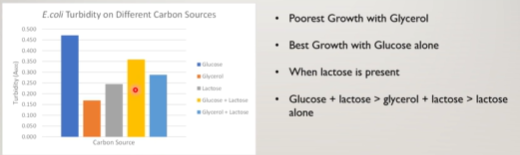
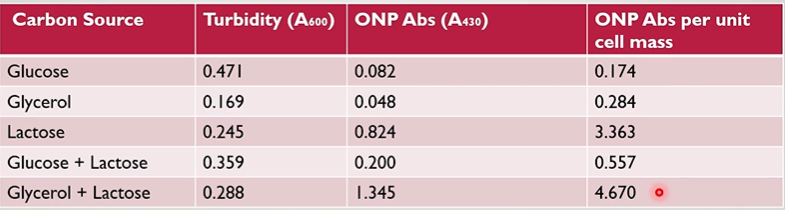
Need to calculate per unit cell mass as they may have different numbers of cells: one with more cells will have a higher enzyme activity but per cell could be lower.
Beta-galactosidase activity was highest in the presence of lactose but not when glucose is present. Why:
Production of the enzyme beta-galactosidase is tightly regulated → the lac operon.
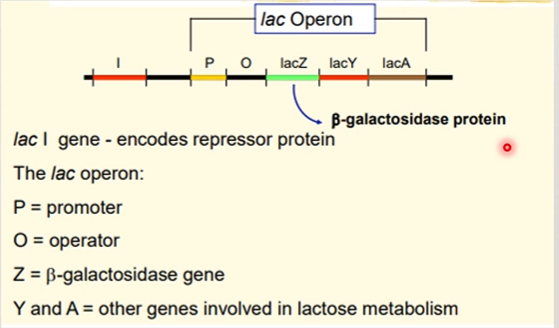
When lactose isn’t present:
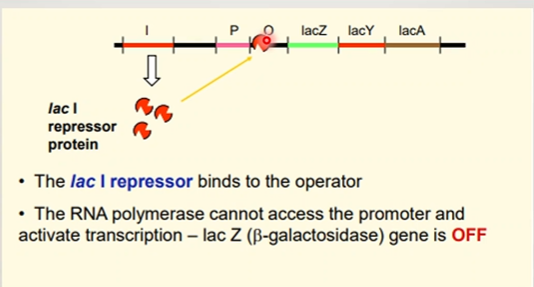
When lactose is present:
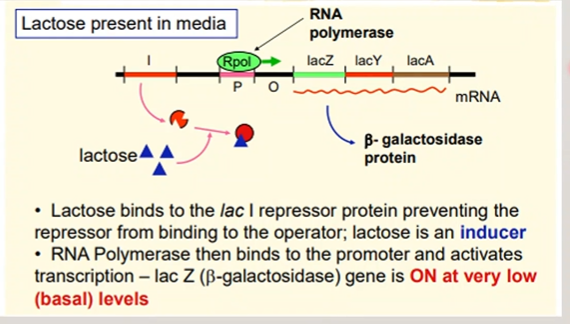
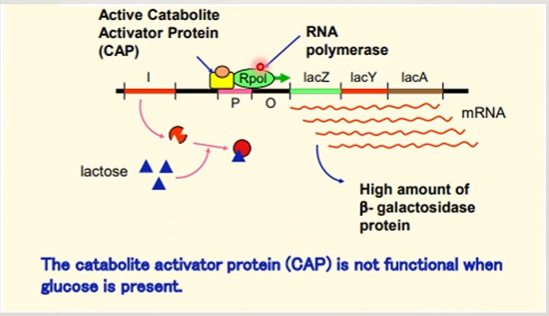
The lac operon requires an activator protien (CAP) to increase levels of beta-galactosidase in the cell.
Glucose is the preferred C-source in the cell which inhibits CAP to ensure that glucose is used up first
When glucose levels become low, CAP becomes functional and beta-galactosidase is expressed at high levels and lactose can be metabolised.
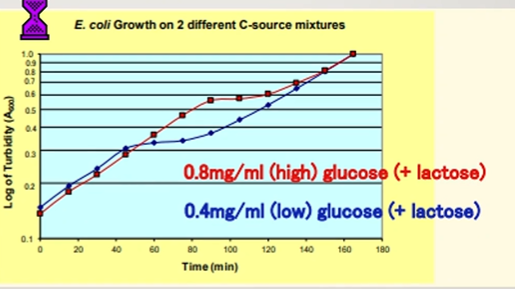
At the start is when the cells are using glucose. Growth slows until beta-galactosidase is expressed. Growth then regains exponential rate as lactose is now metabolised.