10.5 How does hard stabilization affect coastlines?
coastal residents continually modify coastal sediment erosion/deposition in attempts to improve or preserve their property. structures built to protect a coast from erosion or to prevent movement of sand along a beach = hard stabilization or armoring of the shore. hard stabilization can take many forms and often results in predictable yet unwanted outcomes.
Groins and Groin Fields
Groin: built perpendicular to a coastline, specifically designed to trap sand moving along the coast in longshore transport. constructed of many types of material, but most common = large blocks of rocky material called rip-rap. sometimes groins are even constructed of sturdy wood pilings
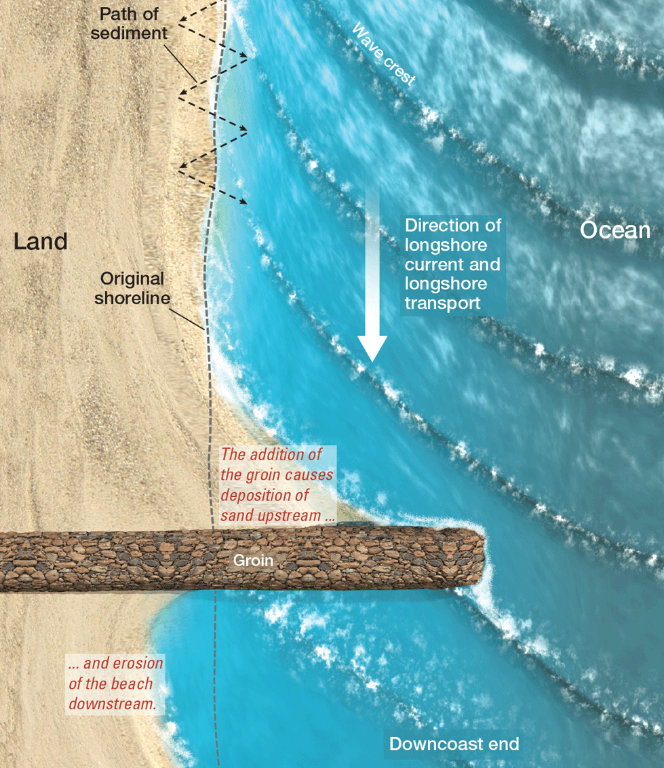
groin traps sand on its upcoast side —> erosion occurs immediately downcoast of the groin because sand that is normally found just downcoast of the groin is trapped on the groin’s upcoast side. to lessen the erosion, another groin can be constructed downcoast, which in turn creates erosion downcoast from it. more groins are needed to alleviate the beach erosion and soon a groin field is created.
does a groin or groin field actually retain more sand on the beach?
sand eventually migrates around the end of the groin so there’s no additional sand on the beach it’s just DISTRIBUTED DIFFERENTLY
with proper engineering and taking into account the regional sand transport budget and seasonal wave activity, an equilibrium may be reached that allows sufficient sand to move along the coast before excessive erosion occurs downcoast from the last groin.
some serious erosgional problems have developed in many areas bc of attempts to stabilize sand on the beach through the excessive use of groins
Jetties
jetty: similar to a groin bc it’s built perpendicular to shore and is usually constructed or rip-rap
DIFFERENCE: purpose is to protect harbor entrance from waves, and secondarily traps sand
jetties usually built in closely spaced pairs and can be quite long —> cause more pronounced upcoast deposition and downcoast erosion than groins
Breakwater
built parallel to shoreline
california’s longshore drift is predominantly southward so breakwater on western side of a harbor accumulated sand that had migrated eastward along the coast
the beach west of the harbor continued to grow until finally sand moved around breakwater and began to fill in the harbor
designed to reduce wave energy, thus creating a protected area of quite water inshore behind the breakwater
Ex. Santa Monica, CA: breakwater built to provide a boat anchorage —> bulge in the beach soon formed behind (inshore) of the breakwater, and severe erosion occurred downcoast
breakwater interfered with natural transport of sand by blocking waves that used to keep sand moving. the breakwater would soon be attached by a tombolo of sand, and further erosion downcoast might destroy coastal structures
in santa barabara and santa monica, dredging was used to compensate for erosion downcoast from the breakwater and to keep the harbor or anchorage from filling with sand. sand dredged from behind the breakwater is pumped down the coast so it can re-enter the longshore drift and replenish the eroded beach. dredging operation has stabilized the situation in santa barabara but at considerable expense. in santa monica, dredging was conducted until breakwater was largely destroyed during winter storms —> wave energy was able to move sand along the coast again —> system restored to normal conditions
**when people interfere with natural processes in the coastal region, they must provide the energy needed to replace what they have misdirected through modification of the shore environment
Seawalls
one of the most destructive types of hard stabilization, built parallel to the shore along the landward side of the berm
purpose: to armor the coastline and protect landward developments from ocean waves
once waves begin breaking against a seawall, turbulence generated by the abrupt release of wave energy quickly erodes the sediment on its seaward side, which can eventually cause it to collapse into the surf.
in many cases where seawalls have been used to protect property on barrier islands, the seaward slope of the island beach has steepened and the rate of erosion has increased, causing the destruction of the recreational beach
well-designed seawall may last for many decades but constant pounding of waves eventually takes its toll
long run: cost of repairing or replacing seawalls will be more than the property is worth, and the sea will claim more of the coast through the natural processes of erosion
Alternatives to Hard Stabilization
Construction Restrictions
restrict construction in areas prone to coastal erosion
becoming less of an option as coastal regions experience population increases and governments increase the risk of damage and injuries bc of programs like the National Flood Insurance Program (NFIP)
since beginning in 1968, NFIP has paid out billions of dollars in federal subsidies to repair or replace high-risk coastal structures —> NFIP has encouraged construction of hard stabilization
Beach Replenishment
sand added to beach to replace lost sediment
although rivers naturally suppply sand to most beaches, dams on rivers restrict sand supply that would normally arrive at beaches
used to widen beaches
involves dredging sand from offshore or coastal locations, pumping the wet slurry through a pipe, and spreading it across the beach
very expensive bc huge volumes of sand must be continually supplied to the beach
cost depends on the type and quantity of material placed on the beach, how far material needs to be transported, and how it’s to be distributed on the beach
most sand used for replenishment comes from offshore areas, but sand dredged from nearby rivers, drained dams, harbors, and lagoons is also used
Relocation
US coastal policy has recently shifted from defending coastal property in high-hazard areas to removing structures and letting nature reclaim the beach = relocation
relocation involves moving structures to safer locations as they become threatened by erosion.
RECAP
Hard stabilization includes groins, jetties, breakwaters, and seawalls, all of which alter the coastal environment and result in changes in the shape of the beach. alternative to hard stabilization include construction restrictions, beach replenishment, and relocation.
CONCEPT CHECK 10.5
(1) List the types of hard stabilization and describe what each is intended to do.
groin: designed to trap sand in longshore transport
jetty: purpose is to protect harbor entrance from waves
breakwater: designed to reduce wave energy, thus creating a protected area of quite water inshore behind the breakwater
seawall: meant to protect coastal structures that have been built close to where waves crash
(2) Overall, does a groin add any additional sand to the beach? Explain.
No, a groin doesn’t add any additional sand to the beach, it just changes the way it’s distributed, as more sand tends to pile up upcoast of the groin, and erodes downcoast, with less sand but only because the groin stops sand from going downcoast.
(3) Why do groins often multiply to form a groin field?
Groins often multiply to form a groin field because downcoast from a groin, often there is a lot of erosion and the beach kind of disappears, so a groin field is created to even it out and make sure that sand is still distributed somewhat evenly.
(4) When a breakwater was built in Santa Monica, what unexpected problem occurred? What was done to alleviate the problem (before the breakwater was destroyed by waves)?
When a breakwater was built in Santa Monica, a huge deposit of sand formed landward of the breakwater, and severe erosion occurred downcoast, making it difficult for boats to harbor which was the purpose of the breakwater in the first place. in order to fix this issue, they began dredging the sand out and bringing it downcoast to alleviate erosion.
(5) describe alternatives to hard stabilization, including potential drawbacks of each.
construction restrictions: restrict construction in areas prone to coastal erosion
drawback: becoming less of an option as coastal regions experience population increases and government increase the risk of damage and injuries bc of programs like NFIP
NFIP: encourages construction in unsafe locations it was designed to prevent
replenishment: sand is added to the beach to replace lost sediment
drawback: very expensive bc large volumes of sand must be continually supplied to the beach
cost depends on type and quantity of material place on beach, how far material must be transported, and how it is to be distributed on the beach
relocation: moving coastal structures to safer locations so hard stabilization isn’t needed
drawback: can be expensive and piss people off