Sponges, Cnidarians, Flatworms
1st animals
appeared more than 600 million years ago
evolved in the ocean
Cambrian explosion
went from a few animals to many different groups
about 30 basic shapes/body plans (now called a phylum)
scattered across the phyla, a few million species
every animal phyla except for 1 are invertebrates (animals without backbones)
insects, worms, jellyfish
Phylum 1 (simplest): sponges (phylum porifera)
sponges are considered the simplest because they lack nerves and muscles
adults are sessile (attached to the ground)
How do the adults get food if they’re stagnant?
a lot of the space on the inside is hollow, but along the edges, the cavities are lined with specialized choanocytes (collar cells)
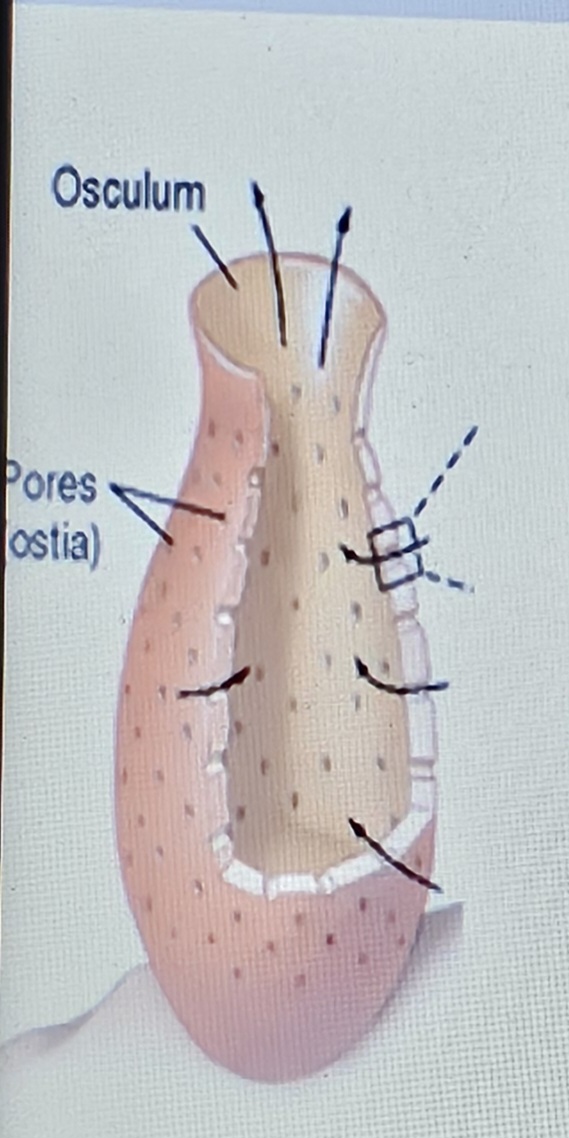
collar cells have flagella that wave back and forth to create water current that draws in water to small pores called ostia [ lining of tunnel is made up of tube like cell called porocyte?]
collar is a ring of filaments on the collar cell, and as water goes past it, it carries tiny bits of food (collar cell traps tiny food particles)
After, water exits through the oscula (large pore)
Tiny entrances outnumber the exits so much that the exits have a smaller total area
thus as water is exiting through the smaller space of the oscula, the water accelerates, flinging water further from the sponge (prevents filtering of the same water)
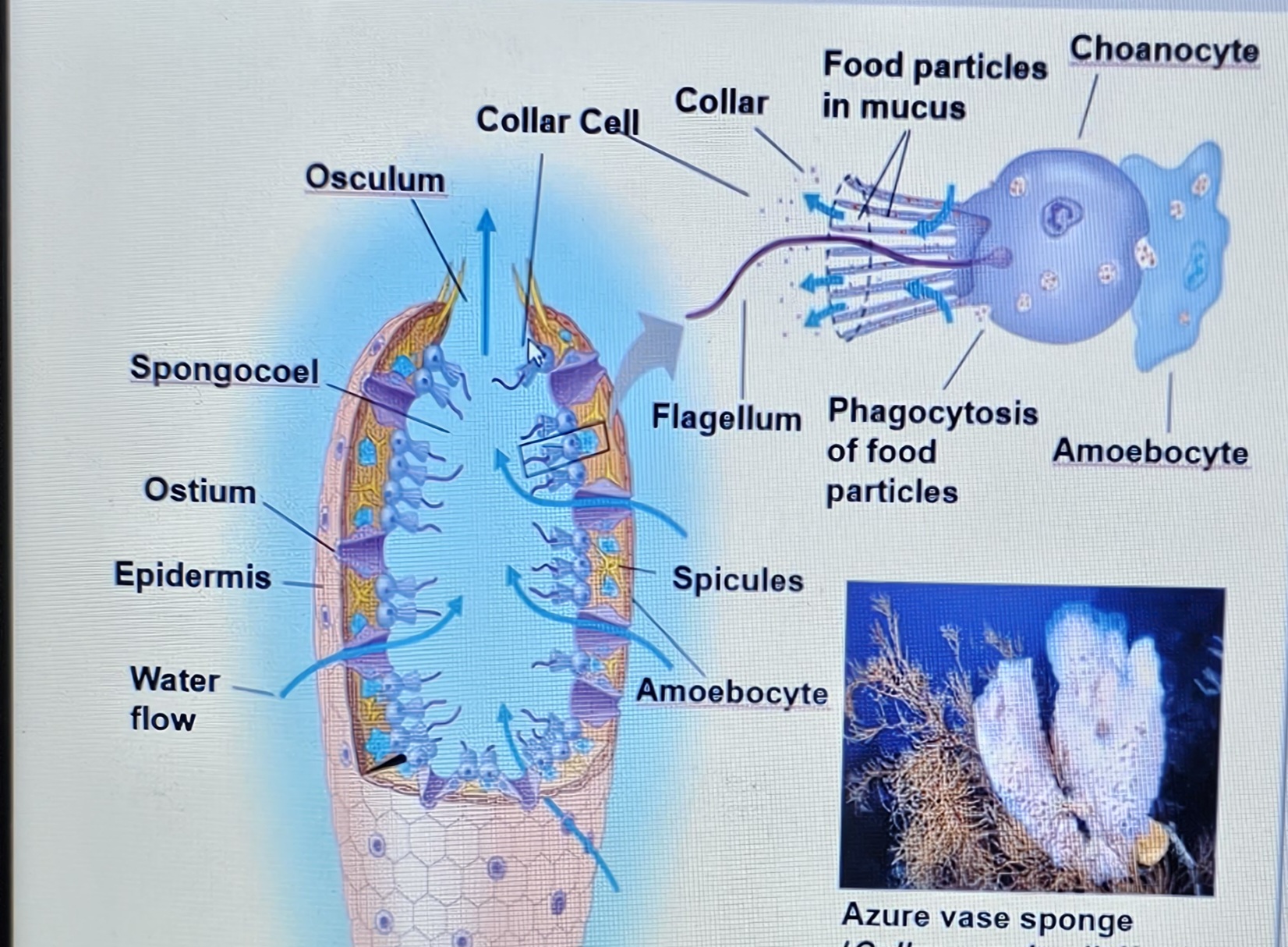
Sponges are supported by slivers of skeletal material called spicules, which are made of calcium or silica or fibers of softer spongin protein
Spicules are secreted by amoebocytes which are cells that flow freely and wander between the inner wall and the outer wall
they lay down spicules and also grab food particles from the collar cells, then they digest and transport it throughout the sponge
Unlike a bacterial colony, these aren’t just a bunch of cells stuck together. What makes it multicellular is that the cells have specialization. Each cell type has a distinctive form and function
Sponges come in multiple different colors, but only have 2 shapes - column shaped or blobs
some sponges can be used for cleaning (real sponges)
They are simple animals, but…
have incredible regeneration powers (can bounce back from being sliced)
Phylum 2: Cnidarians (3 main classes)
Anthozoa (sea anemones and corals)
Antho = flower
Zoa = animal
Scyphozoa (jellies)
Hydrozoa (hydra and portuguese man of war)
Cnidarians are one step more complex than sponges
simplest animals to have nerves and muscles
nerves that they have aren’t collected into a command center (no brain), they just sense and respond
Cnidarian nerves go out of the body in a loose network
not many complex organs (although some jellies have ocelli which are simple light receptors, simple eyespots)
Box jellies have complex eyes that are complete with a lens
Don’t look like classic animals, and part of that illusion is that they don’t move
Go through 2 stages in the course of their lives
Polyp stage - sessile cnidarian stage (attached to the ocean bottom)
Medusa stage - floating cnidarian stage
Anthozoans only have polyp stage [ most important polyps in nature are reef building corals, thin surface of coral reef is alive with polyps that secrete calcium carbonate. as that solution hardens, that’s what becomes the foundation of the reef]
topographical complexity of the calcium, which plates, branches, columns..etc… that’s what houses different animals
coral polyps can grab and eat plankton
polyps house internal dinoflagellates (zooxanthellae), make glucose and share some sugar with the coral
Many jellies have only medusa stage (they float)
Some jellies look almost like sea anemones
Some jellies have both stages, and alternate back and forth
During the floating stage, jelly releases sperm into the surroundings, and when the eggs are fertilized, they grow into a young larvae which swims around. after, the larvae settles to the bottom and grows into an attached polyp with tentacles
new buds on polyp detach and become new medusa jellies
Not all jellies do this, some just stay in the floating stage forever
Another way these animals look simple is due to their shape, they look like plants (not moving). This illusion comes from the fact that they have radial symmetry
radial symmetry is common in animals that don’t move or don’t move very much
In a polyp, the mouth is on top, while on a medusa it is on the bottom
the digestive system is very simple - called a gastrovascular cavity
Mouth is the same hole as the anus
Only the cnidarians have cnidocyte cells - contain tiny capsules called nematocyst (stinging organelles)
Mostly on tentacles
when something brushes against the tentacles, tiny threads shoot out from the capsules
if prey is small enough, thread can wrap around and inject poison
Cnidarians are diploblastic with gelatinous “mesoglea” between 2 layers
Every phylum after here is triploblastic - 3 primary germ layers in the embryo
Every phylum after here is more complex - has a brain, waste organs, reproductive organs, etc
Almost all phylum after here except 1 have a new body shape - bilateral symmetry (left and right is same)
Most animals that move around a lot are bilateral
A bilateral animal has a real head end and tail end - called cephalization
cephalic means head
to have something that can be called a head, your sensor organs and nervous system control (brain) have to be localized at one end of the animal (anterior end)
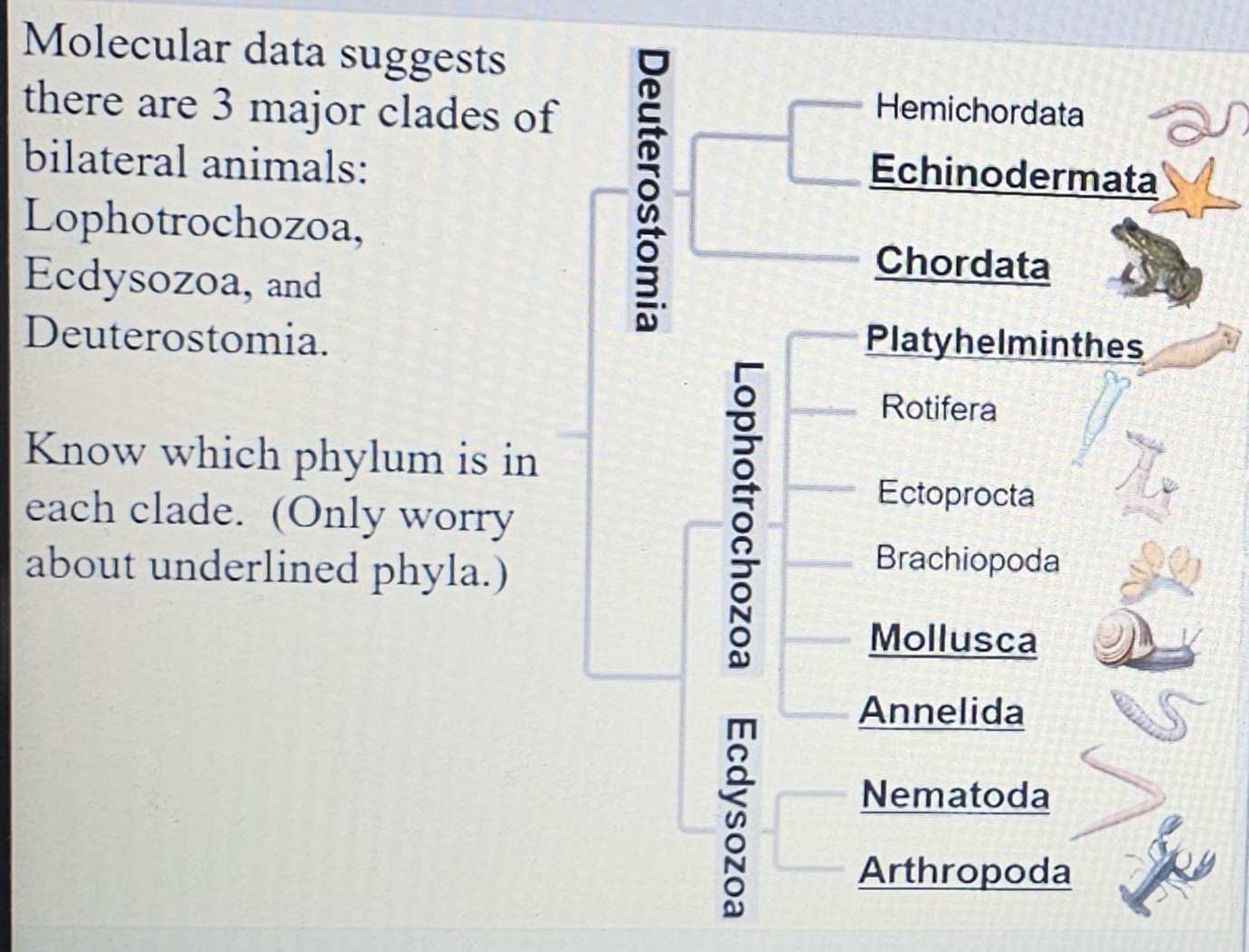
Lophotrochozoa
Phylum Platyhelminthes (flatworms)
tapeworms
flukes
turbellarians
One thing that the flatworms have in common with jellyfish and corals, is that their digestive system is still simple (only has one opening)
Flatworms have complex organs
Flatworms have ganglia (basic brains)
technically a cluster of neurons, and if there’s enough of them at the front end, then they may be called a simple brain)
First animals that can learn and modify their behavior
All organs are thickly imbedded in tissue (acoelomate - don’t have a true body cavity)
Flukes and tapeworms are parasitic
intestines are ideal due to the good amount of food that’s already digested
Flatworms have male and female organs - can fertilize itself
Tapeworm has proglottids - reproductive chambers loaded with sperm and egg
every now and then, proglottids break off - gametes travel down the intestines and are released in the feces
next thing is that the eggs are eaten by a larval flea
then flea hops on another dog when its an adult
they attach on via hooks and suckers
One blood fluke cases schistosomiasis
Turbellarians are free living predators
ex: planaria
mouth is ventral (bottom side) on the end of a tube called pharynx
have a GVC